HSP_TelegraphDecoding_RemoteLearningActivity
Document _ 1863 Princeton Telegraph Offices
1869 lecture on the transatlantic cable
IMG_0113
IMG_0112
IMG_0111
Omnigraph Code Practice Machine
https://www.prc68.com/I/Omnigraph.shtml
Who put telegraph lines on poles?
Correspondence, 1874-02-01 – 1874-05-26 _ ArchivesSpace Public Interface
ezra0034_17
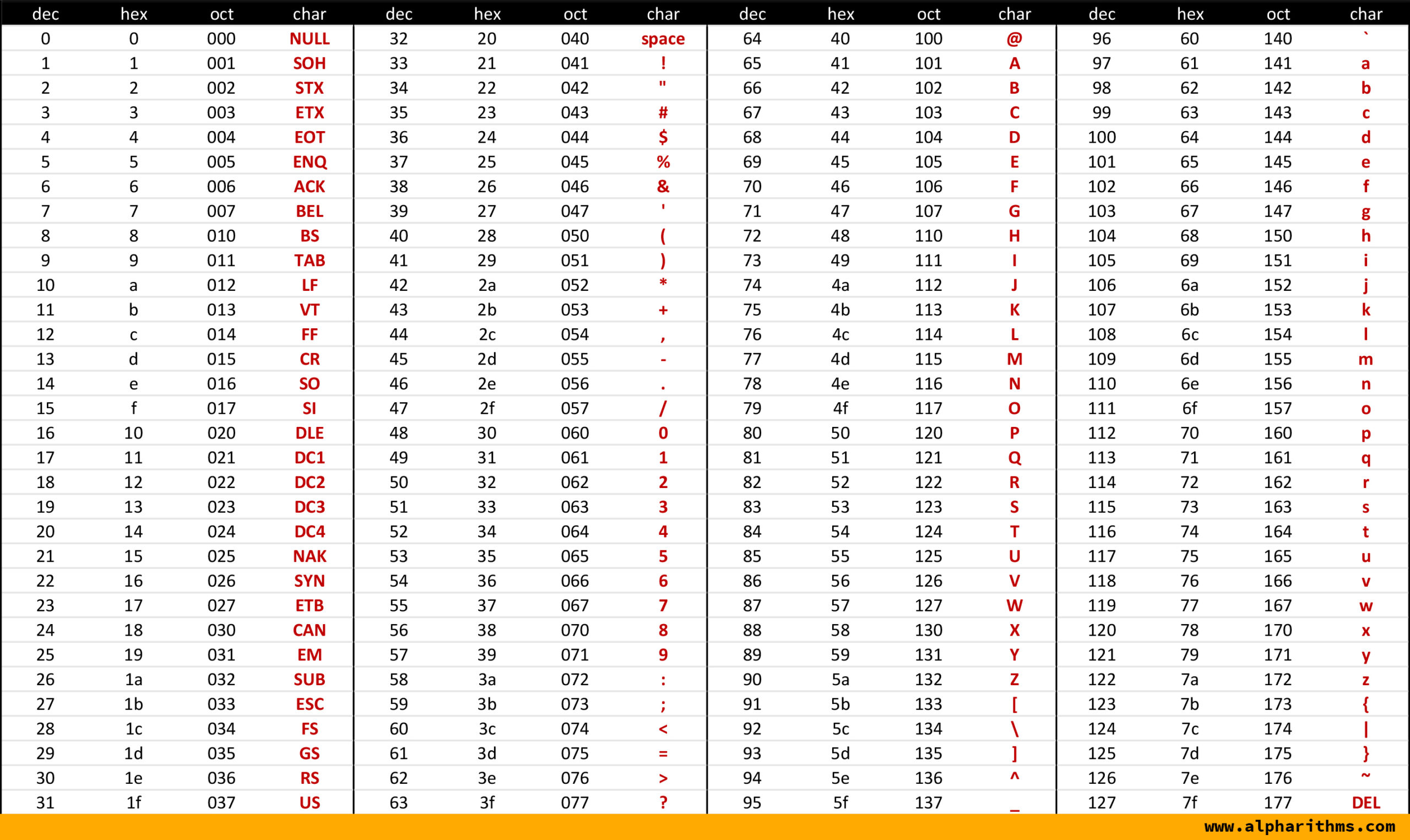
Modern text documents use ASCII code (American Standard Code for Information Interchange).
ASCII code is a modern version of Morse Code.
A modern text file (with extension .txt) uses ASCII coding to store each character in a document. The ASCII coding is similar to Morse Code.
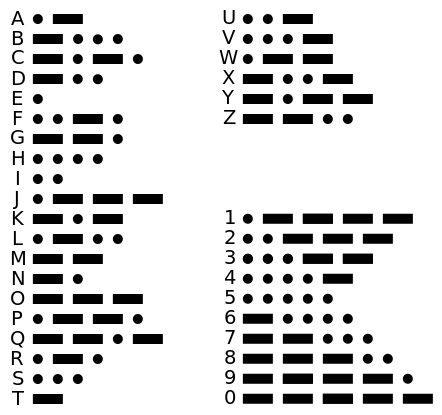
In Morse code a character is made up of ‘dits’ or ‘dahs’. A ‘dit’ has a time duration of one unit of time. A ‘dah’ has a time duration of three units of time. The time spacing between the ‘dits’ and the ‘dahs’ making up a character is one unit of time. The letter Q is ‘dah’, ‘dah’, ‘dit’, ‘dah’. The ‘dit’ and the ‘dah’ is equivalent to a one or a zero in a binary code. The time spacing between a sequential characters is three units of time and the time spacing between words is seven units of time.
In ASCII code a character is made up of ones and zeros in a group. The group is a combination of eight ones and zeros known as a byte. The individual one or zero is known as a bit. Bit is a name coined by Prof. John Tukey of Princeton and is short for ‘binary digit’. The letter Q in ASCII code is 01010001 (HEX format, 51 – HEX format is made up of 2 four-bit groups – a 5 in a four-bit group is 0101 and a one in a four-bit group is 0001). The letter q in ASCII code (that is lower case Q) is 01110001 (HEX format, 71). When an ASCII text file is being sent along a wire (for example on an ETHERNET cable), each bit lasts for a set unit of time. Like Morse Code, there is a waiting time of before the next character is sent.
ASCII code is a descendent of the original Morse code. It is in common use in modern times to store and transmit information.
A table of ASCII 8-bit code is below. Below that is Morse code. In Morse code a letter might be made up of one, two, three, or four ‘dits’ and ‘dahs’. Numbers are made up fo five ‘dits’ and ‘dahs’. In ASCII code, letters, numbers, and control characters are all made up of 8 ones and zeros.
The Movement of Western Union At Princeton
The original telegraph company operating out of Princeton was the Magnetic Telegraph Company. The company was then acquired by the American Telegraph Company. Then, the American Telegraph Company merged into Western Union. So, it is probable that the office that was home to the Magnetic Telegraph Company probably was also the office of the American Telegraph Company.
D_s_American_and_European_Railway_and_St go to page 167
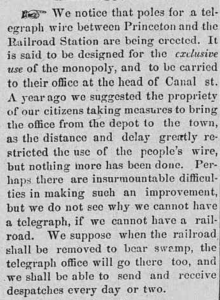
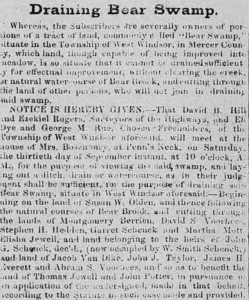
This is further reinforced by a newspaper written in 1860 complaining about how far the telegraph office was from Princeton, being at the head of Canal St instead of a place more convenient for Princeton residents. The head of Canal St is fairly close to Princeton basin. So, the telegraph office was still probably located at Princeton basin even after the Magnetic Telegraph Company was acquired by the American Telegraph Company in 1859. It mentions Bear Swamp, probably a sarcastic remark about how the people who run the telegraph office should move there in order to further inconvenience the people of Princeton. Bear Swamp is in Mercer County, probably close to Bear Brook which is several miles away from Princeton.
 princetonstandard_18601003_0003
 princetonpress_18540929_0003
https://www.loc.gov/collections/samuel-morse-papers/articles-and-essays/timeline/1840-1872/
According to a local article written in 1863, the American Telegraph Office was located in the Camden & Amboy office. It also recognized that there was a second, independent telegraph company operating in Princeton which was not very popular. The article complained that the American office charged high fees for delivering messages and that the independent office didn’t advertise itself so nobody really knew about it.
Document _ 1863 Princeton Telegraph Offices
This Independent telegraph office was probably apart of the Independent Telegraph Company which was merged into the Western Union alongside the American Telegraph Company. This means that after 1866, there was only 1 telegraph office in Princeton. So, here onwards any mention of a telegraph office would be to the Western Union office.
A brief mention in The Princetonian mentioned that the telegraph office that was in Dr. Baker’s store was to be moved to Stelle and Smith’s book store. So, sometime between the years 1866 and 1872 the Western Union office was at Dr. Baker’s store and then moved to Stella and Smith’s book store which it resided up until 1873. Dr Baker’s store is described as opposite the college. That would mean that the store was likely located on Nassau St.
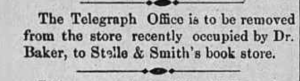 weasaaaaprincetonian_18720309_0003
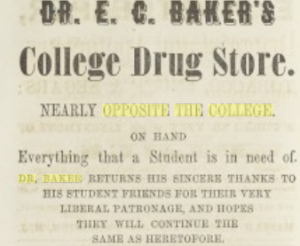 NassauLit_18641001_0072
The Press building was located on Witherspoon St so the Western Union office was located somewhere around 70 Witherspoon St. This was the Western Union office between the years 1873 and 1876 when it was again moved.
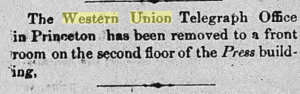
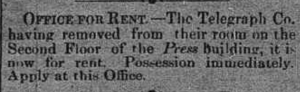 princetonpress_18761014_0003 (1)
In 1881 there is a mention of a Western Union office located on or near Railroad Ave. This Indicates that at some time before 1881 the Western Union office again shifted locations.
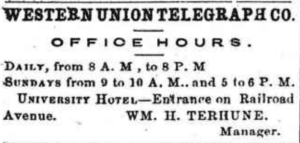 princetonpress_18810403_0003 (1)
Again, the office was listed as to be removed from where it was and moved to a building next to the post office and back into the press building. This was in 1886.
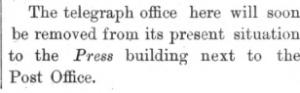 Princetonian_1886-10-18_v11_n41_0001 (1)
The office then moved to Lower Pyne or 104 Nassau St. The construction of this building was commissioned by Moses Taylor Pyne.
https://sirismm.si.edu/EADpdfs/NMAH.AC.0205.pdf – page 20
Princeton_university_directory_(IA_princetonunivers00np)
The Equipment of Telegraph Offices in Princeton
When the first telegraph office was established in Princeton in the year 1846, the standard equipment that was issued was primarily the Morse Register which used an electromagnet to press a stylus onto a tape of paper which would record the message.
magnte0001artass page 13 – 15
That was the standard from 1846 to 1859. The standard never changed so registers were still used up until 1859 when the Magnetic Telegraph Company was acquired by the American Telegraph Company. The American Telegraph Company commonly used sounders rather than registers.
Telegraph – Engineering and Technology History Wiki
In the early 1870’s the Western Union formally adopted the patents of Joseph Stearn for his duplex telegraph. Then, in 1874 they started employing Edison’s quadruplex system.
G.M. Phelps
The Operators of the Telegraph Offices in Princeton
From 1865 to 1876, a telegraph operator in Princeton was a man named Joel Wright. He had a wife, a child and was said to be a descendant of English nobility.
In the year 1874 a man named George Lanahan was named as the night telegraph operator in Princeton. Also, he was a witness in a murder case in Princeton when a man was found dead near the tracks of a railroad. George was working in an office at the railroad because telegraph wires usually run alongside railroads.
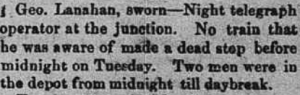 princetonpress_18740321_0002
In 1875 a telegraph operator was promoted to an office in Philadelphia. He was the operator for Princeton for 2 years so from 1873 to 1875 he was the operator. He was named Mr J D Parvin. It states that his successor was Mr Shinn.
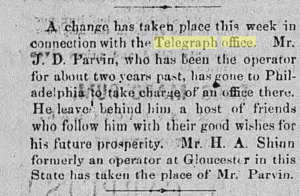 princetonpress_18751211_0003
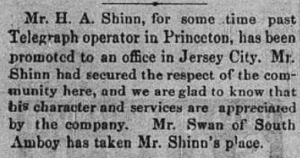
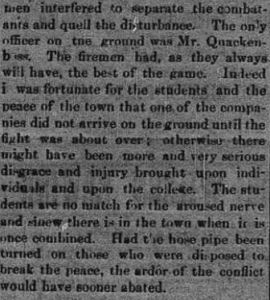
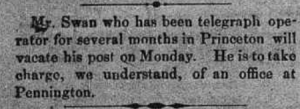
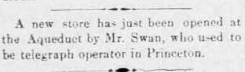
In 1876, a man named Mr Shinn had been promoted from telegraph operator in Princeton to one in Jersey City. He is said to have been replaced by Mr Swan. Mr Swan is mentioned in a story about a fire that happened behind his home. The fire consumed an old barn and some fencing but what was interesting was that while the firefighters were putting out the fire, many Princeton students came and started taunting the firefighters and messing with their equipment. A brawl then ensued while the fire was being put out with the newspaper saying how fencing was torn apart and used as improvised clubs during the fight. Ultimately however, the firefighters won. Then, a couple months after this incident, Mr Swan decided to leave his post at Princeton for one at Pennington. Finally, Mr Swan came back to Princeton opened a store by the aquaduct in 1878.
 princetonpress_18760506_0003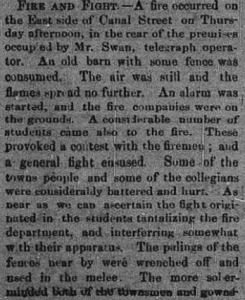
 princetonpress_18761014_0003
 princetonpress_18761230_0003
 princetonpress_18780720_0003
In 1881 the manager for the Western Union office was a man named William H Terhune. He was married and had 4 sons. He died in 1915.
https://www.familysearch.org/ark:/61903/1:1:FZMF-9JR?lang=en
Cyrus Field
He was the founder of the American Telegraph Company, a company dedicated to laying the first transatlantic telegraph cable.
The company he made was eventually consolidated into the Western Union in 1866, right when the first stable cross continent underwater cable was laid.
With his large fortune, he made many terrible Wall Street bets that left him bankrupt. He was elected a month before his death as an honorary member of the American Institute of Electrical Engineers, the precursor to the IEEE.