Henry Clay Cameron’s (class of 1847) Notes on Joseph Henry’s lecture about famous telegraphs, including Steinheil’s
Lecture 61th
Electro-Magnetic Telegraph
March 29th
1 The great velocity of electricity early suggested the idea of its employment for the purp. of transmitting intelligence, and during the progress of the whole century the construction of a magnetic telegraph has been the great end of many inventive minds. But as has been beforehand, an invention is never made until in the first place Science is fully ripe for it, and in the second until the wants of man require it. A great distinction exists between an invention and a discovery. e.g. Franklin discovered the action of points and subsequently invented the lightning rod. Watts was both a discoverer and an inventor.
An invention is the application of a scientific principle to some useful purpose. Hence the merit of the discoverer exceeds that of the inventor, yet the latter is more held up for public admiration. When a great mind has discovered some principle in science men of inferior mind apply the principle and gain the applause. The inventor usually reaps no pecuniary benefit: some other steps upon his shoulders &c. e.g. Prof. Morse.
Our land is full of inventors, but there are few who devote their attention to philosophy with a view of discovering the great principles of natural science. Franklin suggested that, if the head waters of the Susquehanna and the Ohio, were united by a wire, a stream of electricity might be sent down the Mississippi & up to the Susquehanna. But we know now that the earth is such a good conductor that this is impossible. It would take a short cut &c. An attempt was made in Germany, to construct a Galvanic Telegraph, by placing a wire upon posts, and insulating it by glass bottles, and breaking the connection at one end. One end was in the ground, the other connected with the machine. By a certain regulation in regard to the sparks at the break, the alphabet was formed &c. Common electricity possesses great repulsive power, hence it is driven down the posts when moist &c. The moist atmosphere also dissipates it.
When galvanism was discovered and to be less easily conducted off, recourse was had to it, and a telegraph was constructed, in which the decomposition of water was used as a signal, the number of bubbles denoted the letters &c. Dr. Cox of Philadelphia exhibited this before his class, but it was never reduced to practice. A year or two after Oersted’s experiments, in 1822, Ampere in a paper presented to the French academy suggested the construction of a telegraph by means of the deflections of galvanism.
His plan was to have several galvanometers affected by galvanism, at the farther station. According as the needles were deflected singly or together they represented different letters &c.
- Experiments were made on this hypothesis in 1826 by Barlow, and he found that employing a single battery, the power diminished so rapidly with the distance, that an essential difference was observable even in the space of a mile. He thence concluded that the telegraph was impossible. These experiments cooled the ardour of the pursuit for a time.
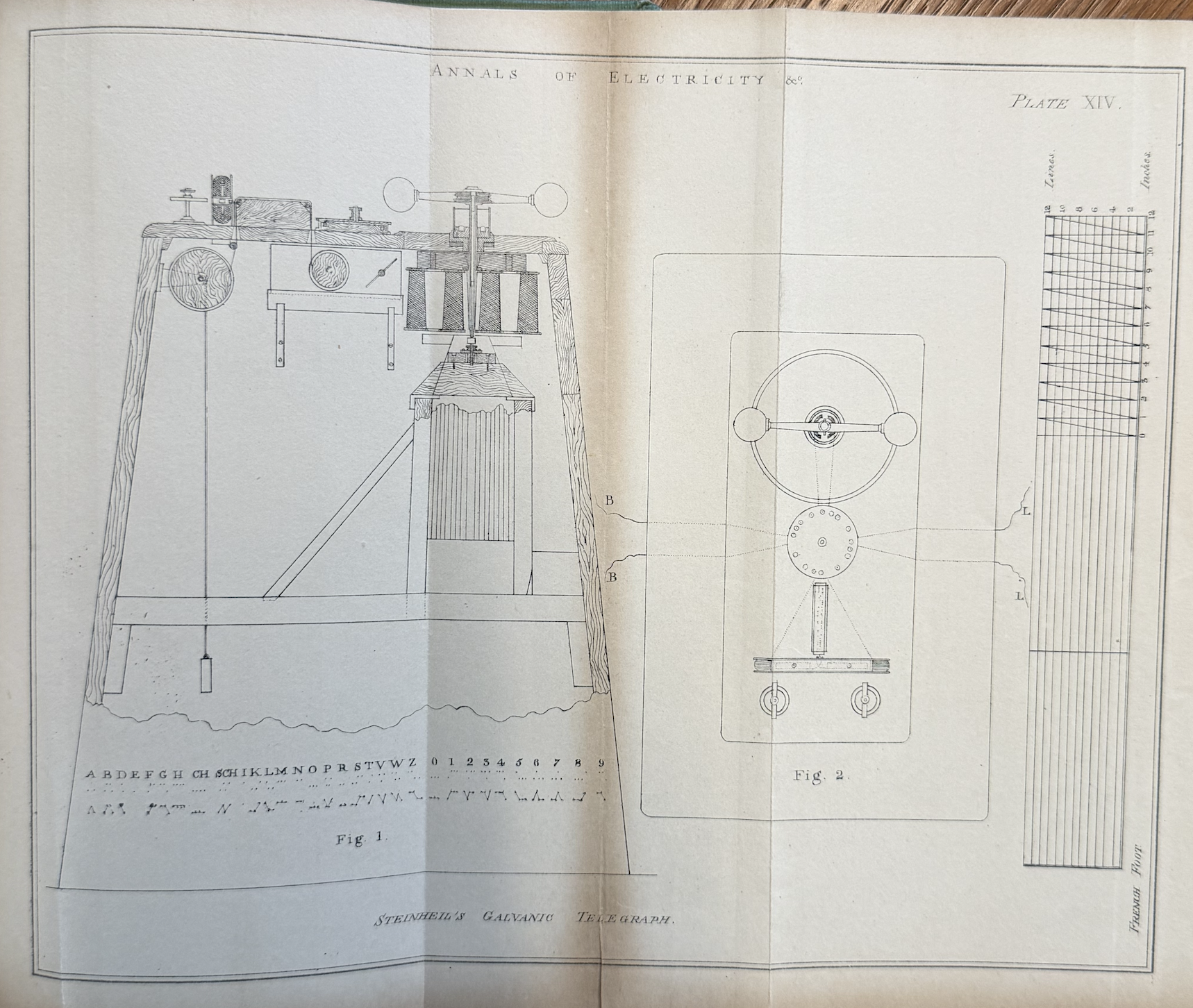
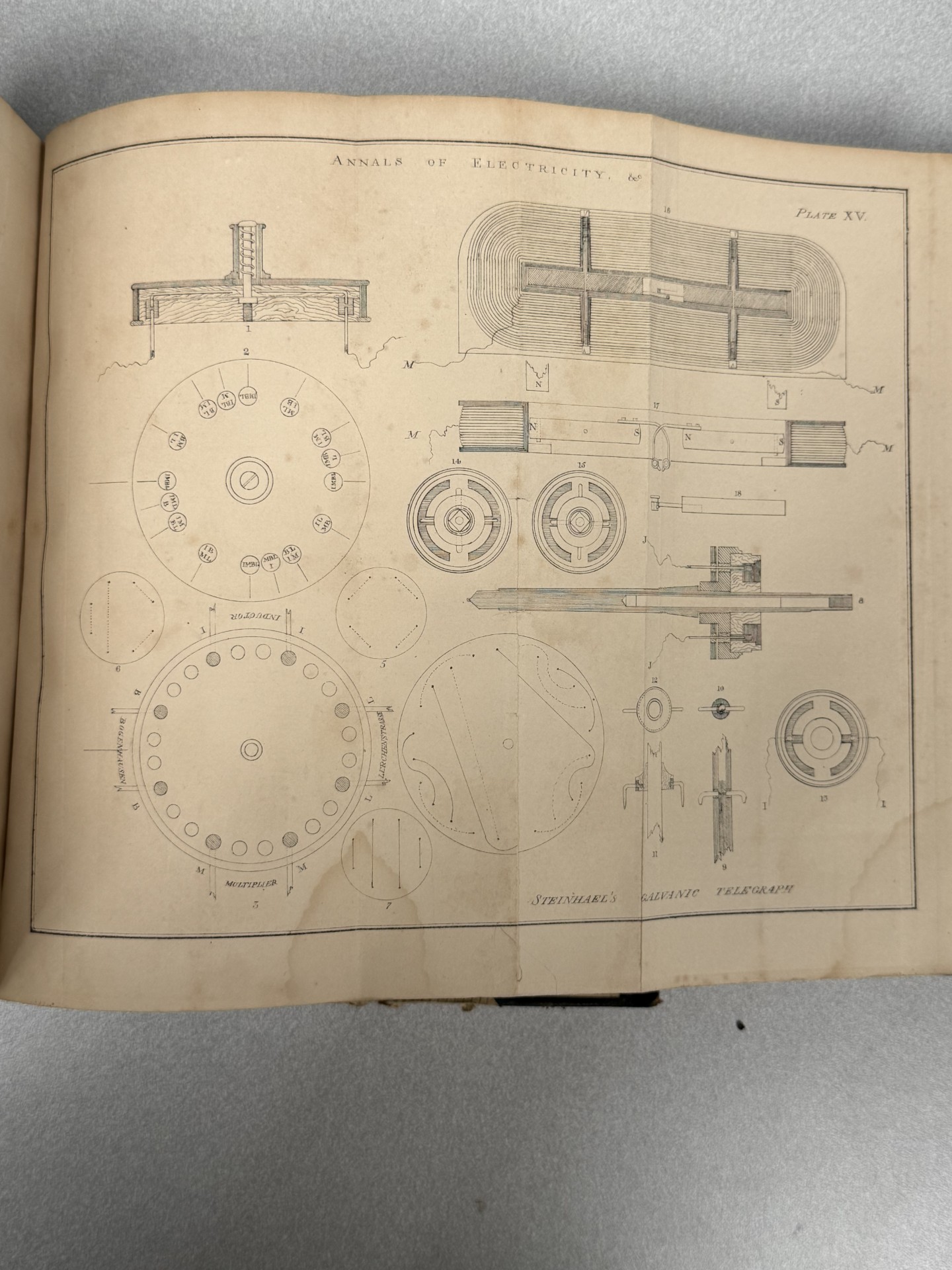
- The next experiments upon the subject, were made by myself in 1830 in Albany and from them I inferred the practicability of a telegraph, and have been in the habit of informing my classes so &c. (1) I found that by using a compound battery, power could be sent to any distance, almost without sensible diminution. (2) A horse shoe was magnetized at the distance of one fifth of a mile. (3) To produce the maximum effect, the magnet must be surrounded by one long wire. My paper was published in Silliman’s Journal, and afterwards republished in England. It gave rise to new experiments, and the result has been the discovery of Wheatstone in England, Steinheil in Germany, and Morse in America of practical and useful machines. In Steinheil two galvanometers are used, each needle armed with a pointer at right angles to its length. As the currents pass around them in different directions, only one will mark the paper rolling before it, until the current be suddenly changed. He has a sound bell for interpreting in the dark. Wheatstone has obtained several patents, one is like Ampere’s suggestion. Four needles are employed, and the directions in which they point, combined, form letters. He now uses at each end a wheel, marked with the alphabet. This revolves behind a disc with a hole in it, and stops when the required letter comes opposite this &c. Morse’s is the simplest. He has an inverted horse shoe, and a piece of soft iron attached to a spring above. The horse-shoe is rendered magnetic by the current through the wire around it; the soft iron is drawn down, and a pointer near the end of the spring marks the paper as it is drawn off from a roller underneath &c. Dots and lines formed by continuing the wire in the battery constitute the alphabet. An improvement of Wheatstone and adopted by Morse is the relay battery. By means of a spring, which the battery at the end moves between the poles of a horse shoe, the circuit of this relay battery does the work; only a small quantity of electricity is thus employed to move the spring to & fro of an inch &c. House of N.Y. has invented a printing telegraph. The letters are on the periphery of a wheel moved by electricity and stop, when the right letter comes round, and makes the impression upon the paper &c.