1060 ft of 17-gauge silk-insulated wire
5.06 ohms per thousand feet – > 5.3636 ohms of resistance in the wire around his classroom.
scientific papers of joseph henry vol 1
The experiments relevant start on page 37, and he begins to describe the electromagnetic telegraph on page 41.
Describes the effect of varying distances of wire on the deflection of a galvanometer, noting that the tangent function of the ratio of deflections was roughly equivalent to the ratio of the square root of the distances.
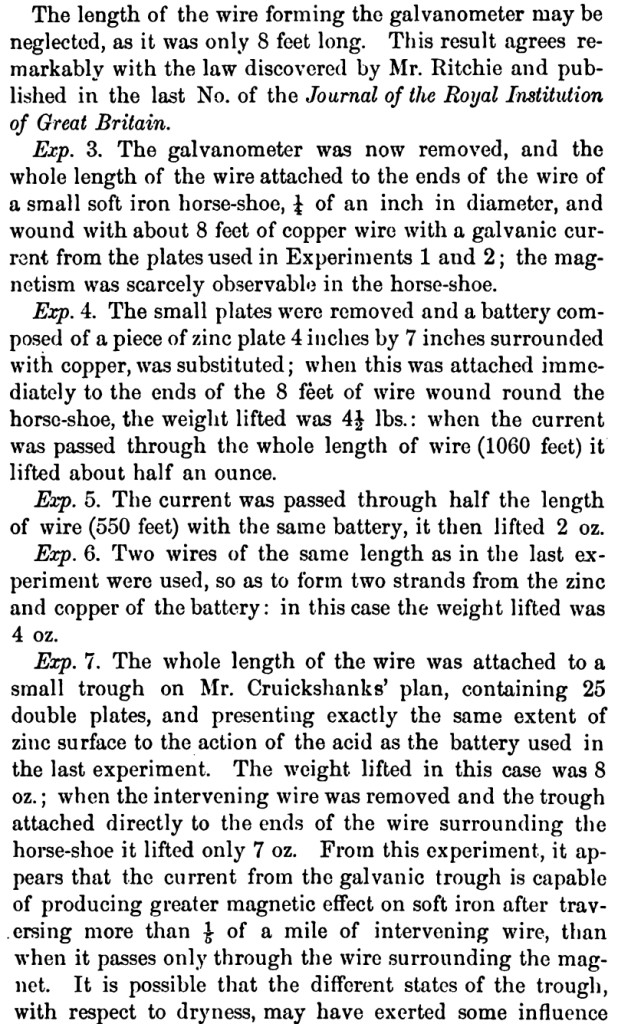
It seems that experiments 3 and 4 were performed with a single galvanic cell battery using 2″x2″ plates of copper and zinc. But experiments 5 and 6 were done with a 4×7 inch zinc plate surrounded by copper. Finally, experiment 7 was done with a Cruikshank’s trough “containing 25 double plates, and presenting exactly the same extent of zinc surface to the action of the acid as the battery used in the last experiment“.
Over the experiments, it was noted that the mass magnetism was affected by the length of the wire and the strength of the battery.
Summarized effect on mass lifted throughout experiments:
- Experiment 3 – Scarce magnetism (not specified whether this was the case with both lengths of just 1)
- Experiment 4 – When wired directly, it lifted 4.5 pounds (72 ounces). When through the 1060 ft wire, only half an ounce
- Experiment 5 – When wired through 530 ft, it lifted 2 ounces.
- Experiment 6 – When connected with 2 positive wires and 2 negative wires of 530 ft each, the magnet lifted 4 ounces
- Experiment 7 – Implied 1060 ft, 8 ounces. But interestingly, when wired directly, only 7 ounces were lifted. Joseph Henry attributes this to an error due to “dryness” in the trough.