Pasta Baking and World-Making: A Common Chef in Exarcheia

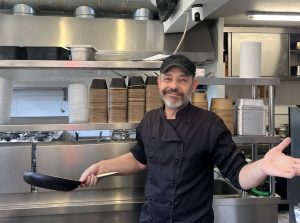
A Picture of Thedore Xytakis, Pasta Box Owner in Exarcheia Square. June 18, 2026. 

In Exarcheia Square, a neighbourhood in the heart of Athens, a black sheet hangs from a fence. Gently waving in the breeze, it distorts bold white letters indicating solidarity with the hunger strikers of Prosfygikait. Beneath it sits a singular black motorbike, tarnished with the scars of years on Athens’ roads. Opposite this, a red, white, and black takeaway kitchen is squeezed between a bar and a pizza shop, where Theodore Xytakis tosses pasta through a burst of flame.

For 32 years, Xytakis has been a chef, honing his craft under a succession of different bosses for decades. From Italian Tavernas in Greece, to a Michelin Star Restaurant in London, to Chicago and Paris and through every Greek Island, he is now running his own take-away, having opened two and a half years ago.

Xytakis’ face was obstructed by a pan ablaze with fire when I asked him what he knew about Exarcheia. He extinguished the flames to reveal a delicious tangle of tagliatale, then pointed to the fence: “[The locals] don’t want the metro station,” he told me. Before the site of construction took over, there were trees, occasional festivals, markets, and socials in the square. Now, there are regular protests against the metro, and a steady flow of Greek police to limit riot activity. The graffiti messages around this area consist of the Anarchist symbol — a circled capital “A,” “Don’t go here,” and numerous “No Exarcheia Metro Square” banners.

After moving around the kitchen like a time-lapsed cartoon, Xytakis finally sat down by the counter to talk to me. He scratched his head through his black chef’s hat before patting down his black uniform, brushing away the remnants of cheese, flour and vegetable peelings.

When Xyatkis was 15, he was old enough to take the bus. He would travel from Zografou, his childhood neighborhood, to Exarcheia and hang out in the square with his friends. It was on Stournara Street in Exarcheia that Xytakis and his friends were first introduced to computers. Being the only place they knew that sold computer accessories, it excused them to keep going back. For Xytakis’ Exarcheia was alive.

“Now the spark has gone,” he said. Only the flicker of his gas stove remains.

The Exarcheia Xytakis remembers, of trees, markets, computer shops and teenagers lingering in the square, has endured financial collapse, refugee arrivals, police crackdowns, and now the construction of a metro station.

Exarcheia is riddled with memories following the 2015 refugee crisis. It is a place where refugees and migrants can find solace in buildings in the neighborhood — similar to how Xytakis found solace in the Exarcheia square. There are some active squats, but most have since closed down, one of them has randomised graffiti with a colourful mural painted by the refugees.

But one story above this, heavy stacks of concrete barricade the windows — preventing entry and the doorways follow a similar fate. That was a harsh way to do it, some might say.

“The refugees, they are pieces of a chess board,” said Xytakis when referring to how the government handles these crises.

Recent actions in the Exarcheia neighbourhood have shown Xytakis that it is not the refugees that people want rid of, it is the tourists. Xytakis proclaims that he has seen teenagers — quite unlike his younger self — attacking tourists. Xytakis recalls an instance from a couple of weeks ago, where a family of tourists walking towards their AirBnB with luggage in hand, were attacked by masked teenagers. He pointed to the direction of the inactive squat mentioned above, and informed me of a graffiti piece that confirms this hate. It reads:

“Welcome Tourists, to the cemetery of Europe.”

But why would teenagers be causing this trouble?

“They claim they are anarchists, but they don’t know jack shit. They just want to come here and make a fuss,” Xytakis explained.

People from all backgrounds have passed through Exarcheia: localers, foreigners, refugees and – Xytakis. He has come, gone, and found his way back again.

In 2005 before both crises, Xytakis wanted to build upon his culinary skills and was recruited by a Greek man in America who offered him a student visa to study at a university in Chicago in exchange for working as a chef at his restaurant.

Before continuing, Xytakis raised his eyebrows at me and firmly slapped the rag in his hand down on the countertop to profess, “Do not trust the Greek owner outside of Greece, they’re all scumbags.”

He paused for a moment to take an online order. I looked around the shop, the theme colours: black, white, red coupled with his fast-paced energy reminded me of a race track. Above the stoves were three large metal tubes looping and intertwining like slides at a water park. He traversed underneath them and lit the stove, I strained to hear him over the sizzling.

After living in the Greek-American’s “crappy” basement and freely running around Chicago for two years, he was stopped by some policeman who asked to see his ID. Proudly, he handed over his passport.

However, Xytakis had been fooled into thinking he had a student visa, “I found out that I was illegal because the boss didn’t even enlist me in the university.”

Placing down the pan to raise his arms high and wide he added, “I went back to my boss. All hell broke loose, and I left.” Xytakis had been given one week to leave the country.

How unfair, I uttered. “Life is unfair Honey,” he shrugged.

His university endeavours didn’t end there. After a brief stay in his home country, Greece, he obtained a visa to the United Kingdom, and achieved a masters in molecular culinary at York University. It was here that Xytakis met his wife, Maria. Being half-English half-Greek, she had also travelled from Greece for education, and got a degree in English Literature.

“She’s been through a lot, that’s why I love her,” he said.

Xytakis stayed with Maria, who was his partner at the time, and worked as a chef in York on what he described as an average salary. Then they went down South and Maria supported him in moving to Teddington, London to become a Michelin Star chef at Hotel du Vin. Though this was a big raise, income didn’t overcome the outcome when living in this expensive area, and they were forced to move back to Greece in 2011.

After explaining this, Xytakis gestured towards the lonely motorbike beneath the black banner, “I’ve had that bike longer than my wife,” he laughed.

At one point, a delivery man parked his e-bike next to Xytakis’, and entered the shop to pick up the online order Xytakis had processed ten minutes earlier. The delivery man from e-foods appeared to panic and hastily ruffled through his pockets to find the QR-code for the order. Upon failing, he began visually shaking.

“Calm down my friend, you’re doing a good job,” Xytakis said to him. The delivery man appeared to inhale, then exhale as he showed the order number to Xytakis.

Once the man had driven off, I asked Xytakis why the delivery man seemed so nervous. “Honey, look,” he said, “I’ve been in England. I’ve been to Chicago. I’ve been to Paris, and I know how it is to be outside of your waters. He’s alone at work. He doesn’t know the language. Most of the owners are yelling at him. They don’t respect him, but I do because I’ve been him,” said Xytakis.

“My life motto is to put yourself in his position, that’s why I can appreciate a hard working man,” he added.

Xytakis speaks three languages and can swear in 17. He has seen multitudes, cooked for thousands, and I found him in Exarcheia. Why?

“We don’t need to earn millions, all we need is an earnest living to feed our family, and then go home and watch television,” he said. He has settled in the neighbourhood of Saint Demetrius, four kilometres from where he’d grown up, and he appears absolutely content.

“Look,” he said, “I’m just a common chef.”
 

Greece’s Luxury Restaurants Combatting Climate Change

In 2018, a crisis broke out on Crete, Greece’s largest and most-traveled-to island: blue crab dominated fishermen’s worn-out, yellow nets. Since then, several other invasive species have infested the waters and reduced the trove of the fishermen’s usual catch. 

George Egglezakis, the owner of Despina Tavern, an upscale eatery in Elounda Bay, watched his two-generation fisherman father struggle. The typical sea bream and grouper had now been replaced with blue crab and lionfish, the latter of which can be toxic to humans. No restaurant wanted to buy these never-before-seen aliens.   

Instead of seeing these invasions as a weakness, Egglezakis turned them into a strength. By adding blue crab and lionfish to the menu of Despina Tavern as appetizers, Egglezakis found a solution to make high-end dinners a planet-saving experience. 

Global warming and humanity’s increase in carbon dioxide emissions are having a profound effect on the oceans, causing these invasive species to migrate to new locations. The temperature of the Mediterranean Sea has warmed to the same level as the Red Sea, drawing blue crab and lionfish through the Suez Canal. 

These invasive species have begun dominating the seas surrounding Elounda Bay, eliminating competition and reproducing at record rates. While some invasive species, like rabbit fish, are fully toxic, blue crab and lionfish are edible with precautions taken. By getting rid of these non-native species in the sea through cheffing them up, Egglezakis and his cooking crew are doing their small part to prevent a complete Mediterranean takeover. 

“Anyone who loves the sea sees how much it has changed in the last 10 years,” Egglezakis said. As an ocean lover and son of a fisherman himself, Egglezakis feels both excited and confident about his contribution to combating climate change. 

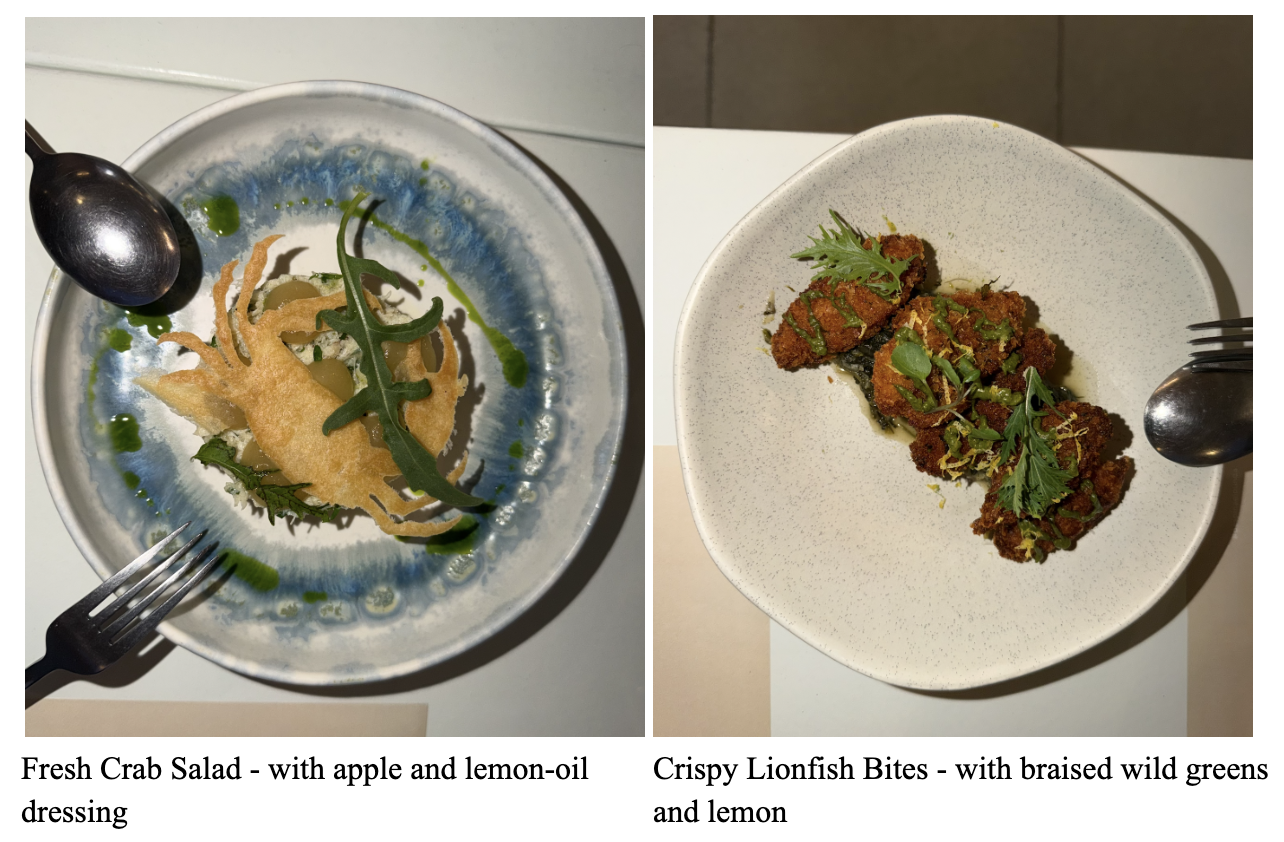
Egglezakis and his chefs have turned the blue crab and lionfish into a Fresh Crab Salad and Crispy Lionfish Bites. These items have become some of the most popular eats on the menu. Originally worried about what customers would think about these unheard-of mouthfuls, Egglesakis asked chefs to try several recipes before finalizing an updated menu. 

Chef Dimitri Skyralos is just one of the esteemed cooks who sought to create the best versions of the dishes possible. Today, Skyralos completes special cleanings with scissors to cut off lionfish spikes and steams blue crab in a special oven that shocks them at 100 degrees every day to prepare the two animals for consumption and satisfy taste buds.    

The shredded blue crab mixed with apple and lemon-oil dressing, priced at 16 euros, is simple yet refreshing. While this sea creature lends itself to a minimally sour salad, the lionfish, with its tender, savory flavor, is better suited when fried into a nugget shape. With braised wild greens and lemon, this 15-euro dish features the perfect amount of crunch, accompanied by just enough chew. 

Looking out at the pink and purple hues of the mountain horizon, coupled with the crystal sea beneath, makes for the perfect ambience, catering to both tourists and locals. Ordering delectable appetizers while knowing that they help preserve this view is nothing but fulfilling. 

It is easy to get distracted by the chic interior, welcoming staff, and tasty eats, and become unaware of this sustainable excitement. As the hospitality of the sea changes, that of Despina Tavern never does. 

On Gavdos, a Physicist Searches for Meaning Beyond Equations

The papers are impossible to miss.

Neatly stacked on the couch inside Alla Yavtushenko’s home are the notes she studies each afternoon as she prepares for the Greek citizenship exam. Abstract paintings fill the walls alongside a detailed cityscape of a Russian town. The paintings and the house are both products of the same group. The house, on Gavdos, the southernmost island of Europe, was built by its members, including Andrej, a nuclear physicist who volunteered to help clean up the Chernobyl nuclear disaster after the reactor exploded.

His experience —learning to understand the body rather than fear it — Yavtushenko says, became significant for the group’s approach to health and recovery. It is why they chose to move here to Gavdos. “He understood everything, how dangerous it is,” Yavtushenko said. But volunteering was “his deep decision.”

The group’s work extends beyond health practices. Here on Gavdos, the conversation drifts from physics to Pythagoras, from the Chernobyl disaster to immortality. It is an unusual path, but for Yavtushenko, every subject points toward the same question: how should people live?

She has spent much of her life trying to answer it.

Born in Kharkiv in what was then the Soviet Union, Yavtushenko said she began asking questions about the nature of the world as a child. When physics and mathematics appeared in school, she believed they might hold the answers.

“I wanted to understand this world,” she said. “How it was created.”

She studied physics at university before joining the Monocrystal Science Research Institute, where she spent seven years researching superconducting materials alongside a new generation of young scientists. But after work, conversations rarely stayed inside the laboratory.

“We started to speak about questions that were interesting to us,” she said. “What is matter? Where is the border between matter and something invisible?”

Those discussions eventually led her to a lecture given by members of a philosophical group.

“It happened exactly in one lesson,” she recalls.

What followed changed the course of her life.

“We were involved in one philosophical reasoning about arithmetic of Pythagoras, and at one step of reasoning we understood what is necessary to change our life, our place, where we stay,” she said. 

The arithmetic of Pythagoras Yavtushenko mentioned, is a reference to Pythagorean philosophy, an ancient Greek tradition that treats numbers and mathematical relationships as the basis for understanding the world.

Acting on that conclusion meant leaving their former lives behind. Leaving, however, was not an easy decision.

“I left my country, my job, my family for this reason,” she said. “It was difficult.”

She moved first to Russia, where she spent eight years living with the group before its members began searching for somewhere new to put their philosophy into practice. They were drawn to the idea of an island. “It’s one example of wholeness,” she said, smiling.

For two years, members of the group travelled through Greece searching for the right place. They dismissed place after place before someone mentioned another island farther south.

That island was Gavdos.

“It is important if the island needs you,” Yavtushenko said.

When the first members arrived in 1998, they began building houses. Yavtushenko joined them in 2003.

Outside, the philosophy she describes has become tangible.

She walks through vegetable gardens carved from Gavdos’ poor soil after decades of work. She points to a rainwater collection basin, explaining how difficult it is to find water on the island. Nearby stands a triangular structure she and her husband built as part of the group’s search for alternative energy.

“Our basic position of our philosophy is wholeness,” she said. “We knew that it’s necessary to build not only a house, but a source of energy.” “We tried to find a source of water. A garden, of course,” she said.

Their days also follow a rhythm. Coffee and discussion in the morning. Physical work until the midday heat. Tea and more discussion in the evening.

“We have to keep thinking through our philosophy,” she said.

When asked about immortality, Yavtushenko does not describe it as a miracle or a promise. Instead, she speaks of evolution. Plants, animals, and humans each represent different stages of life, she explains. Humanity’s next step depends not on technology but on consciousness.

“Immortality is not a given thing,” she said. “We just have to change our way of life, way of thinking.”

To her, immortality is inseparable from responsibility.

“If we produce some waste,” she said, “it will stay with us forever.”

The community’s philosophy has also left its mark on Gavdos itself.

Their most recognizable creation is the giant chair overlooking Tripiti, now one of the island’s most photographed landmarks.

The mayor of Gavdos, Lilian Stefanaki, laughs when she remembers seeing it for the first time.

“The first time I saw it I thought it was so ugly,” she said. 

Today, she said, visitors make the walk specifically to photograph the chair at Europe’s southernmost point. “Everybody likes it.”

For local business owner Joy Lampaki, who runs the island Taverna Kiki Coffee and More, the group’s contribution reaches beyond tourism.

“These people are awesome,” she said, describing them as members of the community who have helped residents with practical jobs around the island and have always welcomed people into their home. 

The chair has become so closely tied to Gavdos that locals rarely give directions to Tripiti anymore.

“We ourselves say, ‘Go to the chair,’ not go to ‘Tripiti,'” Lampaki said.

Back inside Yavtushenko’s home, the citizenship papers remain waiting on the couch.

Nearly twenty three years after arriving on Gavdos, the physicist who left Ukraine in search of knowledge is preparing for another transition. “I get to study about geography, more about history, and about the political structure of Greece. It’s knowledge, you know, it’s interesting. It’s necessary to have.” 

Sunglasses and Statues

Beguiling is the first word that comes to mind about Athens. Not only because I read it every time I opened Robert Beaton’s Greece: Biography of a Modern Nation, but because it accurately captures how Athens appears. Charming and attractive yet deceptive and mysterious, that is how I felt after just minutes of walking through the city.

What is all this graffiti for? Why did I struggle so profusely walking with my suitcase on the sidewalk from the metro to my apartment? Is it always 30-35 degrees Celcius? Who are the tourists, and who are the locals? Do they hate us being here? Every street opens an opportunity for more questions – and there are so many.

On my first morning in Athens, I decided to go for a run around the perimeter of the Panathenaic stadium. Being elevated, I was provided with a marvelous view of the city and saw a distant viewpoint with a white church. Below the church was an avalanche of concrete, tightly packed and difficult to discern one corner from the next. It looked claustrophobic, quite like the elevators in our apartment building about the size of a single cubicle. Recently, I talked to a Greek saleswoman who works at Plaka’s Agora Workshop. Located near the Parthenons’ Acropolis, it is a souvenir shop that sells sunhats, keyrings and small statue replicas of Greek Gods. I found Alexander at the back of the shop counting coins, signing cheques, and wrapping customer purchases. Alexander, who has worked at the shop for two years, compared Athens to “a kiddie pool.” “We have 50 people inside the kiddie pool. You know what I mean?” I knew exactly what she meant.

Alexander has worked since the age of fifteen, starting work with her dad.Back then, she was paid 30 Euros every four to five hours. With the ability to speak six languages — Portuguese and French Creole, Spanish, Italian, German, English and of course Greek — she dreams for more from life. I was extremely impressed by her multilingualism. While listening to some German tourists in her shop, she realised that she understood it but had never practiced German before. “Last month, I don’t know how it happened. I understand German. I don’t know how. I just do,” she told me. I asked her what she wanted to do with this gift. “I would love to be either a tour guide. Or, uh… how you say, translator?” Exactly like that I told her, “Yes, then I’d like to be a translator,” she said.

I stood by for a moment while tourists came into the shop to buy a statue replica of an offering that would have been given to the Greek Goddess Athena. “Sir, where are you from?” she asked, “North Africa,” he smiled in response, “Oh, you sure, you look Mexican or something?” she pried, “Not yet. Not yet.” he grinned, “What? What do you mean not yet?” she said. The group fell into laughter, you couldn’t not smile.

She’d spent years working in a shop selling fake copies of the real things that lie just up the street. I asked her if she’d ever seen them, “Only once,” she said, “I don’t have time, I work all the time.”

After this conversation, I made my way to the Acropolis museum that possessed the real things. I felt lucky that after merely a few days, I was fortunate enough to see the artifacts that Alexander, who has lived and worked here her entire life, has only had one opportunity.

I thought about Athens’ over-populated streets while standing atop Lycabettus, the hill that appears to be at the centrepoint of Athens. Looking towards the direction of the ocean, I saw the antiquity of the Acropolis which stood high and proud against an ocean of modernity. Limited only by the sea and surrounding mountains: Penteli, Ymittos Parnitha – Athens’ apartments, and buildings stretch farther than the naked eye. If not for these limitations, I was told passingly by someone that the city would keep on going – continuing to be built upon.

This tight-knit arrangement means that everything is walkable, reducing our excuse to get an uber, or a bus to traverse a distance that is otherwise thirty to forty minutes of walking – like the walk from Pagrati, where I am living, to Exarcheia, across the city. From barely meeting 6,000 steps at home, I am now doing 20,000 or 30,000 steps a day. This is unnoticeable because at any moment I could stumble upon some ancient ruins, or two boys banging boxes as drums in Victoria Square, or a masterpiece of graffiti art, like the portrait of an elderly man squinting through his wrinkles at the word Hope, on a wall in Exarcheia. Although this is what I’m experiencing, I’m almost certain locals are: motorbiking or scootering everywhere, even up steep gradients that make me breathless to climb. All while I am dodging cars that are parked like hot wheels toys in a chain that hangs from the steepest hills, I am even more impressed by the strength of their handbrakes.

I am frequently compelled to take out my phone and capture a picture. The pictures haven’t yet done justice to the views. One of these moments happened on the roof of the National Museum of Contemporary Art. The sun was gently grazing the horizontal surface that connects sky to ground, creating a watercolor palette from obsidian to crimson. The piles of concrete were morphing into silhouettes, only one remained visible, facing me. On it, a block-lettered bright-yellow graffiti message, “You are my favorite notification,” reminding all those art-seekers that someone is excited by the appearance of their name. Of all the graffiti in Athens, this was the most optimistic, non-political one I’ve seen. Others tend to express political frustrations, “From the river to the sea, Palestine will be free,” “Free Gaza, Smash Zionism,” and “Tourists get out.”

In the touristy neighbourhood of Plaka, and just two minutes down the road from Alexander, Gregory Tsourouflis sits in a small cuboid-shaped stall. He’s been selling souvenirs for sixteen years. After buying a pair of sunglasses from him, I became intrigued by his confined set-up. I walked round the back of his stall and stood by the open door to talk to him. He was handed one 50 Euro note for a bottle of water to which he would give 49 Euros in change. “Most tourists don’t know the currency, or which is which,” he said as he passively handed the receipt to a woman with a red bag slung across her shoulder which was thinly covered by a tight black tank top.

Tsourouflis works all the time. At 4:30pm that day, he would exit the stall and hand over the shift to a younger girl. From there, he would go to his next job, installing air conditioning in homes across the city. “People,” he said, looking away briefly to sell a fridge magnet, then returning his gaze, “they think Greeks are lazy, we like the sun, we spend a long time drinking coffee, but we are not lazy.” I leaned in closer so I could hear him over the traffic. Anyone who notices the Greek will know that they work hard. I thought Tsourouflis’s job looked monotonous and wondered if he ever socialised with the other stall-owners along the street. “We talk. We’re not close,” he said while shrugging. I was surprised, they have so much in common: tourists, long-labourious work days and being Greek.

Later that day, I walked past his stall again, he looked at me and told me he liked my sunglasses.

I laughed.


In the Air

The weekend was windy, by Athenian standards, and the flags flew proudly in the squares and rippled by the embassies and the shirts hung from the gridwalled thoroughfares of Monastiraki fluttered too. The sun, for once, was welcome. In the Fokianos Sports Park, over by the Panatheletic Stadium, Stavros B. was working on his shot. From the three-point line he raised his elbow to his chin and rose an inch or two into the air and snapped his forearm forward like a tongue. Silence, for a moment, and then a muted clank. “Opa!” I tossed him the rebound. “It was wind,” he said, glaring at his disobliging ball. I’d told him I was from New York, the chain-linked holy land of pickup basketball, and the slight embellishment (I mean, I go to New York) was worth the respect of this wiry, sharp-nosed athlete. “Windy day,” I said. And so it was.

Deeper in the park, by the benches and the marble busts of Swiss-Greek bankers (“Ioannis G. Enyard: Benefactor of Greece”), a leaf-green bird flew overhead. A brief consultation with my birding app of choice pegged this fellow as a Monk Parakeet, a noisy and endearingly chubby species of parrot that was originally native to South America. They arrived in Athens in the 1990s, courtesy of the exotic pet trade, and the city’s pine trees and power poles are now festooned with their large, communal nests. The birds are beautiful enough that some Athenian transplants have, upon encountering them for the first time, phoned the Ornithological Society. Unfortunately, they’re also considered an invasive species. In 2018, Greek authorities removed scores of parakeet nests from the National Garden. The effort turned out to be mostly symbolic. Eight years later, the Monks remain, chirping from on high.

These parakeets, of course, make up but a sliver of the Athenian soundscape, which is dominated by the wheezing growls of the city’s buses, the buzzing of its motorbikes, the multilingual hubbub of the doorway to the West. In the air on a recent Saturday was one voice in particular: that of Hussein Haji Dafat, an Iranian refugee who fled to Greece in 2015. He was standing out in front of the Panatheletic Stadium between two large speakers, and reading a list of names into a shotgun microphone. He held an iPhone in his left hand, and a ten-foot flagpole in his right — this was the Pahlavi flag, used in Iran before the Islamic Republic took power in 1979. For half an hour, Dafat read the names of victims of the Supreme Leader’s regime. “In January 8th and 9th” of this year, he told me, “more than 40,000 people were killed” (only 4,000 of these killings have been verified by international NGOs). From 9am to 9pm, Dafat and a handful of his Iranian compatriots worked in shifts to read their list. “As an Iranian,” Dafat told me, “we have one choice, and our choice is king Reza Pahlavi.” Despite the zeal of Dafat and his Athenian compatriots, domestic support for Pahlavi, the exiled, 65-year-old son of the former Shah (and a staunch advocate for a secular Iran), is muted, at best. Other choices may well have to be considered. 

Dafat wore a henly and a bucket hat. His eyes were large and brown. His gums were raw, and his lower incisors were streaked with blood, as if the names he’d read had caught and snarled on his teeth. He considers himself lucky to have immigrated back in the 2010s — today, many Iranian asylum cases are “frozen,” he said, “because of the situation in Iran… I don’t know what’s coming, because I don’t know the rules.” Even so, Dafat will lend his support to baldly xenophobic actors, so long as they are working against the Islamic Republic. “We trust Trump,” he declared, “and Netanyahu.” His eyes rose briefly — very briefly — to the sky. “We have hope.” During our conversation, dozens of people, tourists and locals alike, passed through the plaza behind us. Not one of them stopped at the protest. 

Due West, however — past the marble columns of the Hellenic Parliament, past the cafes where jowled septuagenarians blow cigarette smoke up toward the gathering clouds — Syntagma Square was thronged. Here you could find not a rally but a celebration: Athens Pride, 2026. Merch tents and Heineken-branded umbrellas swayed lazily in the wind. A band was playing, loudly, on an elevated stage. I declined, to my eventual regret, an invitation to join a free pilates session from a woman wearing what was truly an astounding quantity of rainbow face paint. I was there for a reason: I had come to see SNAP, Athens’ only explicitly queer comedy club. Upon meeting the exuberant bunch, who were filming some kind of informational video in the center of the square, I was referred to their spokesman of choice: a lively and mustachioed comic who introduced himself as Yannis. 

Yannis joined SNAP in 2022, the year it was founded. The nice thing about the group, he tells me, is that, “linguistically speaking,” his jokes can be “a little bit gayer.” SNAP’s audience is self-selecting. Greece, Yannis says, “is deeply homophobic. And this current government loves old-fashioned things, they love their… old customs.” While same-sex marriage was legalized in 2024 (Greece became the first Orthodox Christian-majority country to do so), its parliament recently re-instated a ban on plasma donation for men who have sex with other men. In response, LGBTQ+ communities have resurfaced some of their old customs, too. Yannis told me about “Kaliarda,” a slangy dialect that queer Athenians have used since the 1940s. “That’s a factor now,” he said. It was present in the park, though — like the small opposition rally that had formed by the Syntagma metro station — it was drowned out by the noise.

This is how it is in Athens. Things are in the air, but they come from both directions — from high and low, from sea and sky. I was reminded of the country’s myths: the Gods feud upon their mountaintop, descend to the earth to make mayhem, and find there mortals trying charmingly, appallingly, almost always hopelessly, to meet their deities halfway. The holy places of Athens are built upon its hilltops, which jut from the dense and low-slung city like monumental fingertips. Up there, it’s windier still.

At the headquarters for the Melissa Network of Migrant Women in Greece, I met a Ukrainian refugee by the name of Halyna Zhohan. She wanted me to find her sons, who both go by “Alex,” and who live (apparently) in Michigan. I do not know why she thought I was the man for the job. Before I left, she gave me one of her watercolor paintings, with her name scrawled on the back. It was a simple image, well-painted but childish in form — the sun rising over the ocean, a seabird soaring through the cloudless space. She told me that she’d painted “hope.” She’d put it where the wind-roughed ocean met the open air.

A New Jerseyan in Athens

On my sixth morning in Athens, a Saturday, I woke and dressed in synthetic clothing, preparing to roar with strangers more closely descended from chimeras than I at my gym’s cross training class.

That night, I would go to the theater with my classmates – this I knew, but as for the hours in between, only time would tell.

According to my mental calendar, I had now lived in this city for one point five years (meaning I say things like “my gym”) – but in reality, it had been a mere six days.

On Monday, the first of these days, I landed at 7:30am, and did what any Central New Jerseyan would do upon arriving to the Mediterranean: I went to the beach. 


Beach:

My chosen patch of sand at Zen Beach Club, was, unfortunately, right in the crossfire of two children playing volleyball, a pastime that was certainly new to them, judging by their aim, which resembled that of two people with vertigo. Coming up short on the “zen” end, at least there was a beach. 


In the bathroom, where I’d gone to check on my sunburn, I heard an unlikely voice, the words, “Hello beautiful girl!” Grossly fried and terrifically underslept, it was an unconvincing lie, but I appreciated the stranger’s charity. 


By the time I knew where Nora was from – Bali – and how many kids she had – one daughter, still in Indonesia – I thought it fitting to shake her hand, but when I reached out to do so, I discovered such pleasantries rendered difficult by a yellow rubber glove, one which swallowed her tiny arm whole. I found her ungloved left hand and shook it awkwardly, deeming this better than conceding the impossibility of physical contact.


If I had to guess – though I am famously useless at this game – I would put Nora somewhere between an old thirty and a young forty. She had been in Athens three years, sending home remittances. There were many Indonesians in Athens, who, like her, had secured seasonal work through an Indonesian agency which took a big cut from them, but Nora was not here to be social. She was here to work, and then get back home to her life. After she’d used all the English she knew, I bid Nora farewell, and she went to clean the next toilet.


Pagrati:

Chelsea Hotel, the cafe of which I am already a devotee, unfolds onto Pagrati’s sidewalk in an eclectic mix of metal chairs and colorful woven cushions. Populating them are skinny old men eating nuts one at a time, as if consuming each one requires immense effort. They wear brown leather shoes. Several days in a row, I’ve seen a British woman on her own, sporting a tuft of white hair swept to one side so as to resemble a cockatoo. She is an English teacher, which I know because a posse of her tweeny students, dressed in crop tops and tapered joggers, are also regulars, and I overhear them chatting about upcoming exams and summer vacations. The teacher’s presence does nothing to scare away the tweens’ rigorous vaping practice.


One day I asked Fiona, the foxy waitress with the full lips and ambitious blowout, what time the cafe closes. First she said 3am, and then she thought some more, and said “Eh, we don’t really close.” On Google Maps, the hours are, indeed, listed as 24/day. Fiona tells me that young people particularly like it here – the cafe, the neighborhood – and that there are many old people living here too, who appreciate having the young around, and the young, too, are happier for the presence of the old.


The Gym:

Alter Life seemed like the most appropriate choice of gym, as it was the only result of my Google search not presenting itself as a single buff bald man with some dumbbells and a yoga ball, welcoming you to come exercise on the top floor of his souvlaki shop.

Alter Life is populated by many buff bald men, not just the one. There are men with hair, too, and with it they’ve done bold things, like shaving a lightning bolt in one case. Alter Life could very well be in New Jersey, though the people here are fitter, and the women, instead of doing micro movements on a mat (pilates), squat beneath some amount of weight identifiable to me as that of a small car.


Exarchia:

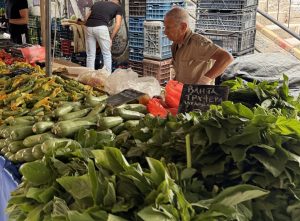
There is something inherently apolitical about a European farmers market. In the States, they’ve been co-opted by Bo-Bos (bourgeois bohemians) as places to take naturally-birthed children for cruelty-free kombucha and grass-fed bone broth marshmallows. In Europe, farmers markets are just happy places to buy zucchini from other people’s grandpas.


The farmers market felt like the most normal thing about Exarchia, the only few hours of the week where one might honestly mistake their surroundings for Provence. And then, a pierced passer-outer handed me my first flyer, decrying the war in Gaza.


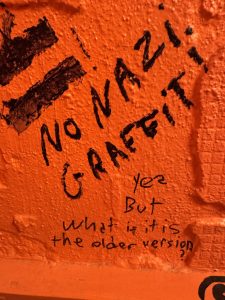
In the bathroom of the trendy cafe I went to next, someone had written “NO NAZI GRAFFITI,” to which a response arrived: “Yea, but what if it’s the old version?” Another wrote: “Fuck Israelis.” Then “Israelis” got crossed out, replaced with “Netanyahu.” Below it, rewritten, was “Israelis.”
Back out in front of the cafe, hot young people sunned themselves. One read Camus’ The Stranger, and several ate the sugar free, gluten free, vegan banana bread, advertised by the cafe as “not baked, designed.” The confluence of politics and trend perplexes me here, as always.


My last stop in Exarchia was Mrs. Dalloway’s, a “concept store,” selling “gifts,” the worker explained. I spotted a mug that said “The World Needs More Women Like You,” a tote that read “My Baggage,” and a vase, sold for 59 euros, covered all over with the word “FUCK.”


The name of the literally blue-haired woman manning the shop was Athanasia, meaning “immortality,” and when I asked her how Exarchia has changed, I hoped she would deliver a spiteful answer about how shops like the one that employs her have found ways to profit off of politics in the tragic kitschification of anarchism. Instead, she said that Exarchia is “a relatively affordable neighborhood with handmade products and high quality food.”


Kolonaki:

In Kolonaki, the poshest neighborhood in town, I found emaciated middle-aged women in ass-hugging bellbottom jeans smoking cigarettes next to their fat Massimo Dutti-clad husbands downing croissants. I heard a lot of Hebrew. The flyer the students gave me in Exarchia read, “We take action so that Exarchia remains an unfriendly place for IDF soldiers and their supporters.” So they came to Kolonaki instead? Down the street, in Zara, I contemplated a bifurcated city.

Pride: 

There is only one thing to do upon hearing Shakira’s voice, and that is, to follow it. In the central Syntagma Square, I got lost in a sea of rainbow flags, drag queens, and Eastern European uncles sporting tracksuits and crimson haired wives. Suddenly, the city seemed wholly united. Plunked down on some garbage covered grass, sandwiched between an uncle and a queen, I broke open a Magnum bar that had been handed to me – and everyone else at Pride – for free.


Theater: 

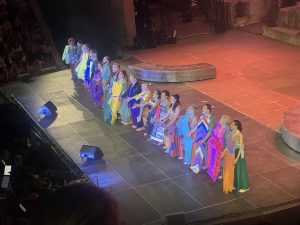
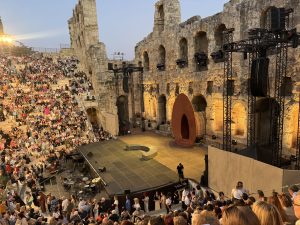
The evening’s production of Lysistrata took place at the 5,000-seat Odeon of Herodes Atticus amphitheater, built entirely of stone before AD 161. On the stage’s center stood a gaping vagina, out of which a cast of performers emerged, pelvic thrusting, in a storm of sequins and tulle.

More soon!


Not So Far Away From Home

After 16 hours of melatonin-induced sleeping, researching European socioeconomics, and doom-scrolling on my flight from Los Angeles to Athens, I pondered how this new country I was eager to visit would compare to the others I had traveled to. I spent the beginning of my summer exploring Southern California, appreciating the region I left before starting a new life at college in New Jersey. I went sightseeing, venturing from Venice to Malibu to traverse the variety of beaches, trying every new restaurant and matcha shop that had opened up while I was at Princeton. Nevertheless, my excitement could not be contained as I was restless to soon purchase the gyros and freddo espressos mentioned all over my TikTok feed and by every individual I told about my upcoming summer in Greece. 

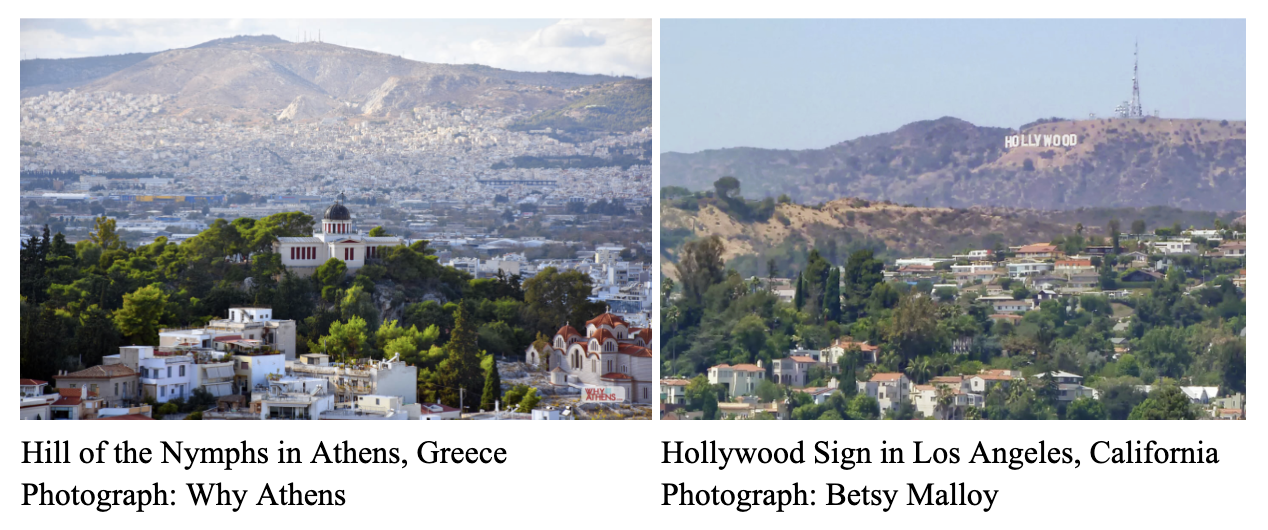
Preparing for my trip, I anticipated a place full of new sights and unique geography, understanding that the country is a climate crisis hotspot with rising temperatures and droughts striking its vibrant cities. Bright blue water, white buildings, and millions of cats filled my imagination when thinking about what my new home for five weeks would look like. However, when I stepped off the plane at Athens International Airport and looked out the jetway windows, it seemed as if I had never left Los Angeles. The dry, dark green, and brown hills on the other side of the glass resembled the same ones that are home to the Hollywood sign—I realized my experience in Athens might not feel as foreign as I once thought. 

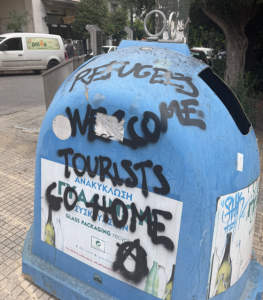
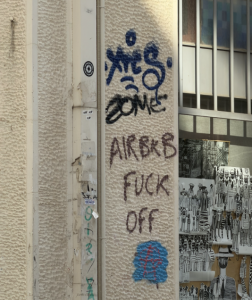
Not only is the topography the same in both Los Angeles and Athens—both have a Mediterranean landscape of mountainous ecosystems and terrain—but the political climate was strikingly similar in both cities. Rising home prices, immigration controversies, and divisive politicians were the topics of conversations among locals I overheard everywhere in Athens; these were issues I heard about every day in my hometown. In Greece’s urban heart, not only did I hear about these political problems from our classroom visitors and local citizens when eavesdropping, I read about public uproar everywhere—not just on the news, but on the walls of this historic city. Everywhere I went, graffiti-covered walls, dumpsters, and everything in sight, both ranting and raising awareness about issues on the minds of citizens of Athens. Athenians expressed their complaints through graffiti: “REFUGEES WELCOME, TOURISTS GO HOME,” I read, sprayed on the front of a blue recycling bin. Initially confused, I wondered why the taxi driver who took me to my apartment from the airport praised Athens’ hospitality and kindness towards foreigners. Nevertheless, after hearing from Al Jazeera journalist and Substack writer John Psaropoulos, I grasped why Athenians have a mixed opinion of vacationers. It has to do with the aftermath of the economic crisis that began in 2008. As Psaropoulos explained, “too late, too little, unproductive reforms” created economic turmoil 18 years ago, affecting the city to this day. After the minimum wage was cut from €751 to €586 in 2012 in hopes of boosting the country’s economy, Athenians were outraged, and occasional riots raged throughout the city. Tourists only exacerbated this challenge for those in Greece. Trying to bounce back from economic distress seemed impossible, and the popular house-renting company, Airbnb, ended up becoming a big help for people trying to keep their homes and avoid defaulting on their mortgages because tourists could rent them out. Nonetheless, an increase in tourism with Airbnb’s assistance meant an increase in housing prices. Airbnb’s connection to this rise in home prices leads to intense distaste not just for the website, but for the tourists who use it to visit Athens. This dislike became clearer to me as I glanced at the walls when walking towards a coffee shop near our apartment to get a freddo latte: “AIRBNB FUCK OFF,” it read. While initially taken aback by the colorful spray paint that coated the walls around every sidewalk throughout the city, I grew a newfound appreciation not necessarily for its look (as I am a minimalist when it comes to design), but for its contribution to productive discourse and enhancing community feeling. From my perspective, the graffiti only strengthens the social justice, democratic, and civic equity approach to the city that Athenians sought since 600 BC. 
As the strong culture around social justice is one of my favorite aspects of Los Angeles, whether this means protesting for the world to see or just talking to peers about community inequalities, I perceived the appeal of Athens immediately. Evita Anagnostou, a 21-year-old employee at Häagen-Dazs at the Flisvos Marina south of central Athens, explained to me why locals love the culture of Athens so much. 

“It’s perfect for family, for drinks, for friends, to walk around,” Anagnostou said about the city. Born in Athens in 2005, she started exploring the streets at just 12 years old. 

“It’s also really cheap. It’s affordable. There’s no difficulty buying expensive things. Like, a drink is around seven or 10 euros,” Anagnostou said, comparing Athens to Paris. That was another first impression I got from the city: food, clothes, coffee, and activities cost much less than they do in America. Anagnostou told me she, too, appreciated the graffiti. 

“I would say that it’s a kind of art,” Anagnostou said. It also raises awareness about injustices. “We write a word or a name, and we see it, and we recall the murderer,” Anagnostou added, referring to murals memorializing a 2008 incident in which a police officer killed a 15-year-old in a skirmish in downtown Athens. Whether Athenians are raising awareness about police brutality or attempting to fix the tourism industry, citizens like Anagnostou truly value improving their city.  

“We’re trying to find a way to make Athens a nice place for everyone. We’re trying really hard,” Anagnostou said. 

But not all tourists feel that way. Some told me they felt less welcome than usual in the city.  

Tom, a middle-aged vacationer in his late thirties who asked not to use his last name, was in a group of three friends visiting Athens from Glasgow, although originally from Australia. 

“The heat, the food, and the people” are why Tom loves Athens so much, bringing him back for the third time in his life. Yet, when asked about whether he felt welcomed as a tourist, he sighed and replied, “No, not as much by locals this time.”

Nevertheless, he was not bothered by this. Tom agreed with Anagnostou’s opinions about graffiti, acknowledging it as an art form. 

“It gives us a sense of place and an understanding of what people really think about the world,” Tom said. He was very familiar with the spray paint all over the city and respected it. This was part of why he felt that “the culture and the people” kept bringing him back to Athens. I understood that greatly. 

From a vintage store owner listing all the places I needed to visit, to the local coffee shop already knowing my order, to my neighbor in my apartment building asking about my life in America for thirty minutes, there is no doubt in my mind that the people of Athens are some of the friendliest in the world. While I might be a 16-hour plane ride from Los Angeles, I don’t feel far away from home in Athens.  

A Window Onto Athens

On my first full day in Athens, I ended up in a random cafe, with my phone dead, two friends absorbed in work, and a quite friendly ginger-haired man. With nothing else on me except my wallet, my only immediate source of entertainment was the massive window before me, where I sat watching, in a manner I can only liken to an elderly couple sitting on their porch on a summer afternoon, the people of Athens go by. Instead of going back to the apartment, which would have been the reasonable thing to do, I sat there for 40 minutes, in my elderly bliss. Looking through this window was better than any reality TV show — why? Because it was real.  

Funnily enough, that had not been my first encounter with a large window that day. After we went for a run that morning, my friend and I went to Shake n Bake cafe, owned by the very friendly Dionysous, and sat outside their large window drinking our lattes and chatting. There was a very real sense of human relationship, which I believe is often lost in the hustle and bustle of the American cities I’m used to. Dionysous and his workers could see us through the window, enjoying our coffee, and would flash us occasional smiles until we left. If this had been New York, the barista would have forgotten about me the moment I left the cash register. 

Additionally, there had been seating both on the inside and outside of the window ledge, meaning that my elbow was brushing with that of the person sitting inside. Talk about feeling human connection. 

Eventually, when I interviewed Dionysous about his shop, he told me his favorite part of the store was the window. 

At the cafe where my phone was dead, named Katsika Pagrati, I meditated on how these urban parts of Athens, which contradicted the tourist parts of the city I had seen in the fall when I visited on another Princeton trip, differed from the cities I knew in the States. The first thing that came to mind were these windows, and how they always remain open, acting as a bridge between the street and the business. It appeared to me that there was little trepidation in Greece about keeping a hard line between the streets of the city and the inside of these institutions, and every business felt more inviting. I began to think about the essence of this difference and what it says about American society that we tend to keep our doors and windows constantly closed, whether you’re in the town of Princeton or in the summer in Philadelphia. 

Through Katsika’s window, I also contemplated how much shorter the buildings were in Athens, making the entire city feel more open and alive, rather than in New York or Los Angeles, where the skyscrapers make you feel caged and separated from the world around. Perhaps the American skyscrapers are reaching too far up, like Icarus. 

Two American tourists I met, Julie and David from Texas, who were boarding a Mediterranean cruise in a few days, spoke exactly to these points, saying that the city to them has been very welcoming, and they have recognized how open and spacious the city feels — different from what they have experienced in U.S. cities. Julie described Athens as a walking city. 

“I look at [Athens] as an adventure,” she said. “Walk until you find something.” 

At the window in Katsika, I thought hard about how the spaces we occupy define us, and what it means to enter a new space. Being from the United States — the land where we were always told to lock the doors and close the windows; where we sat in buildings that were entirely cut off from the streets; and where the most exposure to Greece that I had gotten was it being the land where ancient gods were believed to have roamed and Sophie and Donna sang about men in Mamma Mia! — I was surprised by how open and friendly everyone seemed. Each line of graffiti, each low-level apartment, and each open window became a part of the new image of Athens I was forming. 

In her book The Re in Refuge, Adrianne Kalfopoulou, an Athens-based poet, writes that “the reality of refugees reminds us that what is built can come undone, and in the undoing, the interfaces of the devastated and possible are also sites for beginnings.” 

My new perception of the city was exactly that — a space come undone by the experiences I was now having outside of tourism and one that was being rebuilt in a greater social awareness.

Space, as purported by Kalfopoulou, is malleable, able to be bended at the will and eye of the beholder. Dually, it is a powerful concept, able to control how someone engages with a culture, energized by the worlds someone comes from. A part of me, over the past couple of days, had now become obsessed with understanding how the American hubris can destroy the true beauty of foreign spaces, which lay in the miniscule details of the city. 

Now, I feel a small sense of guilt. When I returned to the U.S. after the fall trip, I told everyone how Athens, and the country as a whole, was this mystical place absent from social problems, where everything was cheap and the streets were pristine rows of stucco-topped houses. I had not seen any of the graffiti calling for tourists to get out or bashing Israel, because I had never been in those spaces.

Still, even as tourists, we can sometimes create our own bridges with the local community, opening our own windows of connection that help break down the barriers between us. 

As I was walking through Plaka, which now seemed jarring after my time over the past week living in a non-tourist section of the city, I stopped and spoke with a teenager named Paulina, who worked at a very small cafe near the Acropolis Museum. Paulina was 19, and had just begun working at the cafe three days prior. She shared that she enjoys speaking with Americans. 

“It’s interesting, because you get to see another mentality, and it’s interesting to hear their own stories,” Paulina told me. “A woman came yesterday, and she was telling me that she came with her husband, and they were saving for five years to come to Greece, so that’s — how to say, I don’t know — fantastic.”  

Paulina, whose mom runs a bar near Plaka, also said she didn’t expect the work to be as physically hard, but she was getting used to it. At the end of the interview, she asked to exchange Instagrams, and when we had ended the recording, she expressed how happy she was that we came by. 

For Manos Otsi, a homemade candle-maker from the island of Patmos, who sells his candles online and at markets in Athens, the city is “shitty,” which is why he hasn’t lived in it for ten years, preferring to live on the outskirts. 

“I am from an island with a lot of tourists,” Manos said. “So I like tourists.” 

So why does all of this matter to me? Because I feel more satisfied with understanding Athens through meeting the everyday people who live here, in the backdrop of what Kalfopoulou has called the ruins of modernity. 

This space that was typically characterized by the old and crumbling ruins of antiquity has been replaced with those ruins of modernity: a space of shared liminal boundaries, through open windows, doors, and cafes where the boundaries between city, street, and building are blurred — a space where each person carries a legacy of Greece’s intertwining modern crises. I have now understood Greece as a space in the present, not the past.

In Athens, Sport Offers a Window Into Modern Greek Life

The rhythmic sound of soccer balls bouncing against grass echoes across the Athens National Centre, I. Fokianos. Teenagers wait on the sidelines for their turn to play while others battle through another game under the afternoon sun. Jerseys are everywhere. One player wears the name Messi across his back. Another proudly sports a Ronaldo jersey. Nearby, a teenager proudly wears the colors of the Greek national team, while others represent NBA star Giannis Antetokounmpo on the basketball court nearby. 

A full 22 years after Athens hosted the 2004 Olympic Games, sport continues to shape daily life in the city. 

The courts rarely stay empty. As one game finishes, another begins almost immediately. 

This is not the Athens that I expected to find. 

Athens is a city often defined by its past. For millions of tourists each year, it is known as the birthplace of democracy, a destination filled with ancient artifacts and monuments, a picturesque city with stunning views. Long before they arrive, many already have a clear image of what Athens is supposed to be. 

Yet beyond the Acropolis, another Athens exists. It is found in the neighborhood basketball courts, overcrowded restaurants, soccer stadiums, and the public spaces where residents gather every day. While these aspects of the city rarely appear on travel itineraries, they play a significant role in shaping contemporary Athenian life. 

Conversations with residents revealed a city that is not only preserving its history but actively creating a new future. Through discussions about sport, community, identity, culture, and everyday life, a different picture of Athens begins to emerge. 

For artist Liapakis Yanis, for example, sport remains an important part of that everyday culture. A supporter of Panathinaikos F.C., he describes soccer matches as experiences unlike anything else in Greek society. 

“It is fun to watch it because you never in your life watch a game where fans are as crazy,” he said from his small studio in Plaka, where I met him on a warm afternoon. When discussing the atmosphere surrounding major matches, Yanis struggled to find a comparison. “It will be like a war.” 

His comments reflect the intensity that soccer can generate in Greece. Matches are not simply sporting events but social occasions that bring together communities, families, and generations of supporters. Rivalries often last a lifetime, creating emotional connections that extend beyond the pitch. 

Yet football is only one part of Athens’ sporting culture. Despite supporting one of Greece’s largest football clubs, Yanis believes basketball is often more accessible to young people growing up in the city. “Football is not an easy sport to start in school because it takes space to build football fields,” he explained. “It is easier to just play basketball.” 

A walk through Athens supports that observation. Public basketball courts are scattered throughout the city, providing spaces where children and teenagers can play without the need for organized facilities. They serve not only as places for sport but also as community gathering points where neighborhood identities are reinforced. 

The popularity of these spaces demonstrates something important about Athens itself. Despite being one of Europe’s most populated cities, much of its social life remains highly local. Neighborhoods retain distinctive identities, and public spaces continue to play a role in bringing people together. In Plaka, tourists fill the narrow streets, while in Exarchia it’s more residents and migrants. This sense of community extends beyond sport. 

When discussing life in Athens, Yanis repeatedly returned to the importance of social interaction. Whether attending football matches or meeting friends, much of the city’s culture revolves around shared experiences. “When we go to bars, people go to have fun,” he said. 

The city remains social. Cafes spill onto narrow streets, gatherings linger into the night, and public life feels visible in a way that differs from many other major European cities. 

At the same time, discussions about sport also revealed broader social issues. Sitting in a cafe in Pangrati, Angelina, a teacher and biologist who plays basketball recreationally, explained that opportunities are not distributed equally across all sports. While she enjoys playing basketball, she believes soccer remains less popular among women because of a lack of investment. “There isn’t as much investment and money being put into women’s sports,” she said. 

Like many aspects of society, sport reflects broader inequalities while also providing opportunities for change. Angelina, nonetheless, loves to play basketball with her friends. “I am going right after this,” she said as she was preparing to leave the cafe. 

Questions of identity also emerged elsewhere throughout the city. In the historic district of Plaka, among the souvenir shops and narrow streets frequented by tourists, one business offers a particularly modern interpretation of Greek heritage. A. Sports specializes in customized jerseys and sporting souvenirs, allowing customers to personalize jerseys with Ancient Greek lettering and references. When asking the owner what jersey he likes best, his reply, “AEK, that’s my team,” came instantly. “The jerseys are popular among tourists and locals,” he said. 

Daily, visitors arrive searching for souvenirs of the ancient world, yet they encounter products that blend history with contemporary culture. Ancient Greece remains an important aspect of the city’s identity, but it is constantly reimagined through new forms of expression. The result is a city that continues to redefine what it is. 

During my first journey into Athens, a football jersey caught my attention through the window of a taxi. The design appeared different from most modern kits. The sleek, modern, and carefully considered design immediately drew my attention. Later, I discovered it belonged to Athens Kallithea F.C. 

At first, the moment seemed insignificant. Yet after spending time speaking with Athenians, the shirt began to feel representative of something larger. 

Yanis admitted that he personally does not care much about football jerseys or their appearance. However, he noted that many Greeks and foreign visitors purchase sporting merchandise. Angelina, meanwhile, said she appreciates a well-designed jersey. Their differing perspectives reveal how sport can function in multiple ways, not only as competition, but as entertainment, culture, and community. 

Athens Kallithea FC has attracted international attention precisely because of its emphasis on identity and design. Yet what makes the club interesting is not simply the appearance of its jerseys. Through its branding and community-focused ambitions, it reflects many of the themes that surfaced throughout conversations with residents. 

Like contemporary Athens itself, the club attempts to balance tradition with innovation. It draws upon local identity while presenting itself in a distinctly modern way. More importantly, it recognizes the importance of community and place in shaping how people experience the city. 

What began as a passing observation ultimately became an entry point into understanding a city that cannot be reduced to its history. Although Athens’ historical significance will always attract visitors worldwide, the city is equally defined by the people living among those famous artifacts. The teenagers playing basketball after school, the soccer fans filling stadiums on weekends, and the friends gathering in bars, all continue to shape Athens every day. 

Athens, City of Contrasts

“Intimate and toxic,” Valentini Anagnostopoulou, our course assistant, who is a journalist and resident of the city, described her relationship with Athens.  A city of historic preservation and present-day destruction, hospitality alongside animosity towards tourism; a city where locals see beauty while feeling anger, refugees smile while struggling; Athens is a city of contradictions. 

The ruins of antiquity precariously preserved stand out beside ruins of modernity, buildings covered in graffiti and torn down to create anew. The pinnacle of Athens, the Acropolis, is delicately protected. The Parthenon is being repaired so carefully that construction is still in progress after 50 years for a structure that took 15 to build in antiquity. Athenians are fighting for ancient artifacts housed in the British Museum, after being taken from the city in the early 19th century in a legally dubious move, to be returned. In cleaning statues that naturally grey through time, conservators use lasers to remove grime, careful to ensure even the oils from hands are not contacting any deeply meaningful historic artifact. 

That shining hill can be seen from a former squat in the Exarchia neighborhood. There, a squat that once housed hundreds of refugees, now remains unused following a police closure of the building in 2020, with doors incapacitated by cement. Promises of turning the building into a music hall, which residents were told at the time of its closure, have yet to be fulfilled six years later. On the side of the building, an inspirational message has been covered up by graffiti, all that remains of the initial mural is the word “Hope” written in black against a pink background. It led me to wonder what the message under the graffiti said. 

In Athens, tourists are a problem, but also a major contributor to the economy. The industry drives up the cost of living for local residents and crowds the city, but supports businesses that are heavily reliant on tourism. Graffiti artists along the streets have written obscenities, like “Fuck AirBnB.” A bright yellow sign that I have seen in many neighborhoods reads, “Tourists, hipsters, digital nomads, investors, zionists go home,” “Don’t expect from us to play the role of welcoming local.” 

Seeing these messages, I expected to be treated with less care by some. Instead, I have experienced nothing but hospitality and kindness. I met Tota, a woman from Crete who had traveled with her husband and two daughters to Athens, while waiting for the Lysistrata opera performance to start at the Odeon of Herodes Atticus theater. Sitting next to me in that ancient structure at the foot of the Acropolis, Tota told me she thought the ruins housed in Greece are a part of the history of the world that must be shared with all who seek it. While she recognizes the real problems caused by tourism, she believes changes should happen at the policy level. Tourists should be welcomed to Athens amid the crowding they cause, she said. I also spoke to Vicky Palliou, who works at a bakery in Pangrati called Shake n Bake. She was more than eager to share the story behind the pastries we bought: they were handmade by her everyday using a traditional Greek recipe but with her own contemporary twist. As I bit into the airy pistachio treat, I tasted her added flourish in the filling. Beside the register, there were multicolored sticky notes with messages written in all different languages from happy customers, with phrases like “thank you from Texas.” 

Walking through the touristy Plaka area at the base of the Acropolis, I entered a small, empty art shop. Canvases covered the walls with realistic depictions of the shades of blue in ocean waves and the alleyways between white buildings. The man at the counter, Liapakis Yanis, said they were all his original works. He had been living in the city his whole life and painting ever since he was young. 

Yet, while he paints the beauty of Athens every day, he couldn’t answer when I asked why he loved the city. He said he hated the city, and wished he had instead been born in a suburb or on an island of Greece. Younger people enjoyed the city more, he told me, but it lost its sparkle through time. Through our conversation, it seemed he had become disillusioned with Athens over time, caught in a reality that didn’t match up to his dreams. 

At a workshop for female refugees held in Exarchia, a dozen women gathered around a table and shared memories of childhood toys. Many were from Ukraine, others from Morocco and Syria, undoubtedly all with personal hardships that brought them to this country. They read stories around the table, and one woman even shared how her house was burned down, taking with it the objects she treasured as a young girl.  

In her blue and green top and brown hair back in a bun, one woman stood out to me, smiling through the whole workshop. While hearing others share, she was preoccupied, playing with a barbie doll. I spoke with her after everyone had finished sharing, her cheerfulness contagious. It didn’t matter that she could not speak my language nor I hers. She mimed to me the deliciousness of her bowl of strawberries as she had poured sugar, intended for the tea, on top, and motioned for me to have a bowl of my own.  

Acceptance and openness in Athens is felt by some, but maybe not all. Immigration policies are tightening in line with the rest of Europe and the US, and online, the far right is targeting refugee groups. One popular influencer named Afroditi Latinopoulou, a young woman who is a member of the European parliament, regularly posts produced videos of herself talking into the camera, blaming the nation of Islam for problems in Greece. 

In contrast to this digital landscape, my impression of Greece has been one of warmth and welcoming. I talked to Sara Marcus, a professor at Notre Dame who was visiting Athens with her husband and daughter, on the rooftop of the National Museum of Contemporary Art for an exhibition opening. Her initial impression of the city was one of openness, how she felt there was so little judgment and prejudice towards different types of people. A few days later, a woman working at a tourist shop even felt comfortable enough with me, upon first meeting, to share that she and her husband used the “Sex in Ancient Greece” cards deck depicting different sex positions that she sold at the counter. 

The city and the people of Athens leave me with far more questions than answers. How does the government decide how much of their budget to allocate towards preservation of antiquity versus renewal of the present? How do Athenians working in hospitality balance their treatment towards tourists with financial struggles? In my first week experiencing the city I have only been able to see some of the most visible layers of the onion. Peeling further down will come with time and conversations.