After 16 hours of melatonin-induced sleeping, researching European socioeconomics, and doom-scrolling on my flight from Los Angeles to Athens, I pondered how this new country I was eager to visit would compare to the others I had traveled to. I spent the beginning of my summer exploring Southern California, appreciating the region I left before starting a new life at college in New Jersey. I went sightseeing, venturing from Venice to Malibu to traverse the variety of beaches, trying every new restaurant and matcha shop that had opened up while I was at Princeton. Nevertheless, my excitement could not be contained as I was restless to soon purchase the gyros and freddo espressos mentioned all over my TikTok feed and by every individual I told about my upcoming summer in Greece.
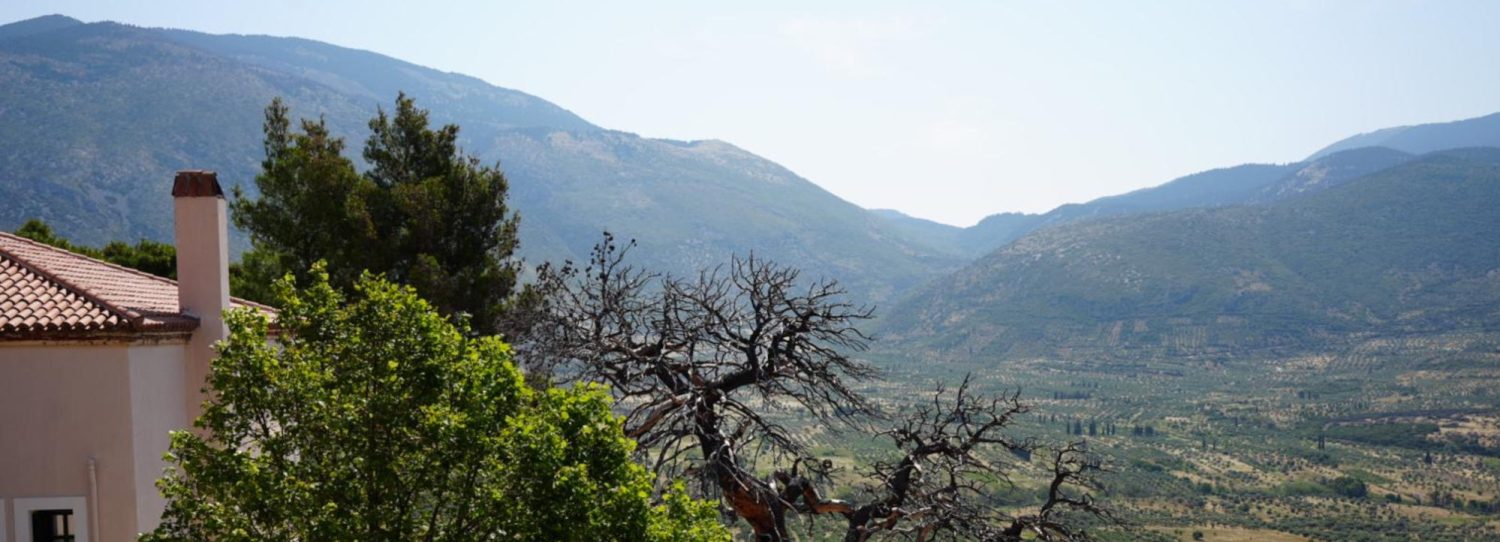
Preparing for my trip, I anticipated a place full of new sights and unique geography, understanding that the country is a climate crisis hotspot with rising temperatures and droughts striking its vibrant cities. Bright blue water, white buildings, and millions of cats filled my imagination when thinking about what my new home for five weeks would look like. However, when I stepped off the plane at Athens International Airport and looked out the jetway windows, it seemed as if I had never left Los Angeles. The dry, dark green, and brown hills on the other side of the glass resembled the same ones that are home to the Hollywood sign—I realized my experience in Athens might not feel as foreign as I once thought.
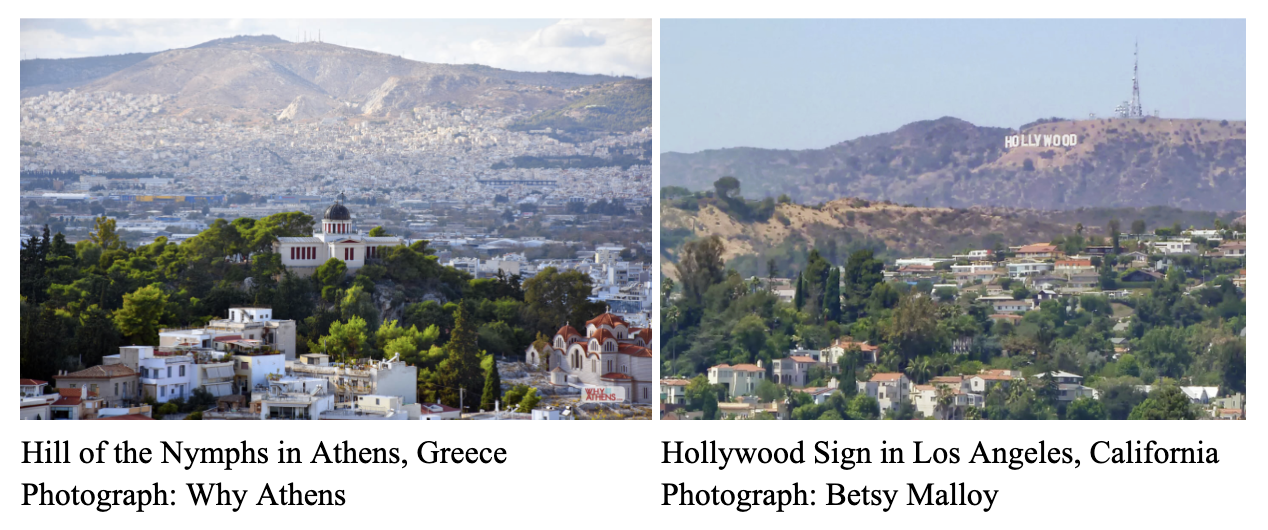
Not only is the topography the same in both Los Angeles and Athens—both have a Mediterranean landscape of mountainous ecosystems and terrain—but the political climate was strikingly similar in both cities. Rising home prices, immigration controversies, and divisive politicians were the topics of conversations among locals I overheard everywhere in Athens; these were issues I heard about every day in my hometown. In Greece’s urban heart, not only did I hear about these political problems from our classroom visitors and local citizens when eavesdropping, I read about public uproar everywhere—not just on the news, but on the walls of this historic city. Everywhere I went, graffiti-covered walls, dumpsters, and everything in sight, both ranting and raising awareness about issues on the minds of citizens of Athens. Athenians expressed their complaints through graffiti: “REFUGEES WELCOME, TOURISTS GO HOME,” I read, sprayed on the front 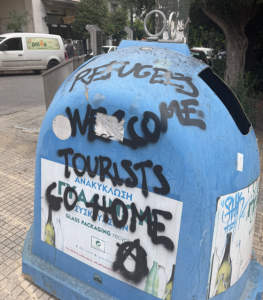 of a blue recycling bin. Initially confused, I wondered why the taxi driver who took me to my apartment from the airport praised Athens’ hospitality and kindness towards foreigners. Nevertheless, after hearing from Al Jazeera journalist and Substack writer John Psaropoulos, I grasped why Athenians have a mixed opinion of vacationers. It has to do with the aftermath of the economic crisis that began in 2008. As Psaropoulos explained, “too late, too little, unproductive reforms” created economic turmoil 18 years ago, affecting the city to this day. After the minimum wage was cut from €751 to €586 in 2012 in hopes of boosting the country’s economy, Athenians were outraged, and occasional riots raged throughout the city. Tourists only exacerbated this challenge for those in Greece. Trying to bounce back from economic distress seemed impossible, and the popular house-renting company, Airbnb, ended up becoming a big help for people trying to keep their homes and avoid defaulting on their mortgages because tourists could rent them out. Nonetheless, an increase in tourism with Airbnb’s assistance meant an increase in housing prices. Airbnb’s connection to this rise in home prices leads to intense distaste not just for the website, but for the tourists who use it to visit
 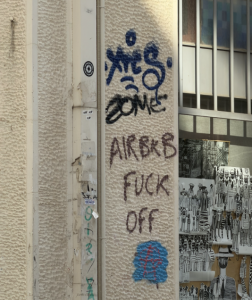 Athens. This dislike became clearer to me as I glanced at the walls when walking towards a coffee shop near our apartment to get a freddo latte: “AIRBNB FUCK OFF,” it read. While initially taken aback by the colorful spray paint that coated the walls around every sidewalk throughout the city, I grew a newfound appreciation not necessarily for its look (as I am a minimalist when it comes to design), but for its contribution to productive discourse and enhancing community feeling. From my perspective, the graffiti only strengthens the social justice, democratic, and civic equity approach to the city that Athenians sought since 600 BC.
As the strong culture around social justice is one of my favorite aspects of Los Angeles, whether this means protesting for the world to see or just talking to peers about community inequalities, I perceived the appeal of Athens immediately. Evita Anagnostou, a 21-year-old employee at Häagen-Dazs at the Flisvos Marina south of central Athens, explained to me why locals love the culture of Athens so much.
“It’s perfect for family, for drinks, for friends, to walk around,” Anagnostou said about the city. Born in Athens in 2005, she started exploring the streets at just 12 years old.
“It’s also really cheap. It’s affordable. There’s no difficulty buying expensive things. Like, a drink is around seven or 10 euros,” Anagnostou said, comparing Athens to Paris. That was another first impression I got from the city: food, clothes, coffee, and activities cost much less than they do in America. Anagnostou told me she, too, appreciated the graffiti.
“I would say that it’s a kind of art,” Anagnostou said. It also raises awareness about injustices. “We write a word or a name, and we see it, and we recall the murderer,” Anagnostou added, referring to murals memorializing a 2008 incident in which a police officer killed a 15-year-old in a skirmish in downtown Athens. Whether Athenians are raising awareness about police brutality or attempting to fix the tourism industry, citizens like Anagnostou truly value improving their city.
“We’re trying to find a way to make Athens a nice place for everyone. We’re trying really hard,” Anagnostou said.
But not all tourists feel that way. Some told me they felt less welcome than usual in the city.
Tom, a middle-aged vacationer in his late thirties who asked not to use his last name, was in a group of three friends visiting Athens from Glasgow, although originally from Australia.
“The heat, the food, and the people” are why Tom loves Athens so much, bringing him back for the third time in his life. Yet, when asked about whether he felt welcomed as a tourist, he sighed and replied, “No, not as much by locals this time.”
Nevertheless, he was not bothered by this. Tom agreed with Anagnostou’s opinions about graffiti, acknowledging it as an art form.
“It gives us a sense of place and an understanding of what people really think about the world,” Tom said. He was very familiar with the spray paint all over the city and respected it. This was part of why he felt that “the culture and the people” kept bringing him back to Athens. I understood that greatly.
From a vintage store owner listing all the places I needed to visit, to the local coffee shop already knowing my order, to my neighbor in my apartment building asking about my life in America for thirty minutes, there is no doubt in my mind that the people of Athens are some of the friendliest in the world. While I might be a 16-hour plane ride from Los Angeles, I don’t feel far away from home in Athens.