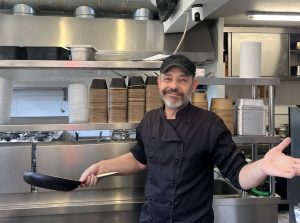
A Picture of Thedore Xytakis, Pasta Box Owner in Exarcheia Square. June 18, 2026.
In Exarcheia Square, a neighbourhood in the heart of Athens, a black sheet hangs from a fence. Gently waving in the breeze, it distorts bold white letters indicating solidarity with the hunger strikers of Prosfygikait. Beneath it sits a singular black motorbike, tarnished with the scars of years on Athens’ roads. Opposite this, a red, white, and black takeaway kitchen is squeezed between a bar and a pizza shop, where Theodore Xytakis tosses pasta through a burst of flame.
For 32 years, Xytakis has been a chef, honing his craft under a succession of different bosses for decades. From Italian Tavernas in Greece, to a Michelin Star Restaurant in London, to Chicago and Paris and through every Greek Island, he is now running his own take-away, having opened two and a half years ago.
Xytakis’ face was obstructed by a pan ablaze with fire when I asked him what he knew about Exarcheia. He extinguished the flames to reveal a delicious tangle of tagliatale, then pointed to the fence: “[The locals] don’t want the metro station,” he told me. Before the site of construction took over, there were trees, occasional festivals, markets, and socials in the square. Now, there are regular protests against the metro, and a steady flow of Greek police to limit riot activity. The graffiti messages around this area consist of the Anarchist symbol — a circled capital “A,” “Don’t go here,” and numerous “No Exarcheia Metro Square” banners.
After moving around the kitchen like a time-lapsed cartoon, Xytakis finally sat down by the counter to talk to me. He scratched his head through his black chef’s hat before patting down his black uniform, brushing away the remnants of cheese, flour and vegetable peelings.
When Xyatkis was 15, he was old enough to take the bus. He would travel from Zografou, his childhood neighborhood, to Exarcheia and hang out in the square with his friends. It was on Stournara Street in Exarcheia that Xytakis and his friends were first introduced to computers. Being the only place they knew that sold computer accessories, it excused them to keep going back. For Xytakis’ Exarcheia was alive.
“Now the spark has gone,” he said. Only the flicker of his gas stove remains.
The Exarcheia Xytakis remembers, of trees, markets, computer shops and teenagers lingering in the square, has endured financial collapse, refugee arrivals, police crackdowns, and now the construction of a metro station.
Exarcheia is riddled with memories following the 2015 refugee crisis. It is a place where refugees and migrants can find solace in buildings in the neighborhood — similar to how Xytakis found solace in the Exarcheia square. There are some active squats, but most have since closed down, one of them has randomised graffiti with a colourful mural painted by the refugees.
But one story above this, heavy stacks of concrete barricade the windows — preventing entry and the doorways follow a similar fate. That was a harsh way to do it, some might say.
“The refugees, they are pieces of a chess board,” said Xytakis when referring to how the government handles these crises.
Recent actions in the Exarcheia neighbourhood have shown Xytakis that it is not the refugees that people want rid of, it is the tourists. Xytakis proclaims that he has seen teenagers — quite unlike his younger self — attacking tourists. Xytakis recalls an instance from a couple of weeks ago, where a family of tourists walking towards their AirBnB with luggage in hand, were attacked by masked teenagers. He pointed to the direction of the inactive squat mentioned above, and informed me of a graffiti piece that confirms this hate. It reads:
“Welcome Tourists, to the cemetery of Europe.”
But why would teenagers be causing this trouble?
“They claim they are anarchists, but they don’t know jack shit. They just want to come here and make a fuss,” Xytakis explained.
People from all backgrounds have passed through Exarcheia: localers, foreigners, refugees and – Xytakis. He has come, gone, and found his way back again.
In 2005 before both crises, Xytakis wanted to build upon his culinary skills and was recruited by a Greek man in America who offered him a student visa to study at a university in Chicago in exchange for working as a chef at his restaurant.
Before continuing, Xytakis raised his eyebrows at me and firmly slapped the rag in his hand down on the countertop to profess, “Do not trust the Greek owner outside of Greece, they’re all scumbags.”
He paused for a moment to take an online order. I looked around the shop, the theme colours: black, white, red coupled with his fast-paced energy reminded me of a race track. Above the stoves were three large metal tubes looping and intertwining like slides at a water park. He traversed underneath them and lit the stove, I strained to hear him over the sizzling.
After living in the Greek-American’s “crappy” basement and freely running around Chicago for two years, he was stopped by some policeman who asked to see his ID. Proudly, he handed over his passport.
However, Xytakis had been fooled into thinking he had a student visa, “I found out that I was illegal because the boss didn’t even enlist me in the university.”
Placing down the pan to raise his arms high and wide he added, “I went back to my boss. All hell broke loose, and I left.” Xytakis had been given one week to leave the country.
How unfair, I uttered. “Life is unfair Honey,” he shrugged.
His university endeavours didn’t end there. After a brief stay in his home country, Greece, he obtained a visa to the United Kingdom, and achieved a masters in molecular culinary at York University. It was here that Xytakis met his wife, Maria. Being half-English half-Greek, she had also travelled from Greece for education, and got a degree in English Literature.
“She’s been through a lot, that’s why I love her,” he said.
Xytakis stayed with Maria, who was his partner at the time, and worked as a chef in York on what he described as an average salary. Then they went down South and Maria supported him in moving to Teddington, London to become a Michelin Star chef at Hotel du Vin. Though this was a big raise, income didn’t overcome the outcome when living in this expensive area, and they were forced to move back to Greece in 2011.
After explaining this, Xytakis gestured towards the lonely motorbike beneath the black banner, “I’ve had that bike longer than my wife,” he laughed.
At one point, a delivery man parked his e-bike next to Xytakis’, and entered the shop to pick up the online order Xytakis had processed ten minutes earlier. The delivery man from e-foods appeared to panic and hastily ruffled through his pockets to find the QR-code for the order. Upon failing, he began visually shaking.
“Calm down my friend, you’re doing a good job,” Xytakis said to him. The delivery man appeared to inhale, then exhale as he showed the order number to Xytakis.
Once the man had driven off, I asked Xytakis why the delivery man seemed so nervous. “Honey, look,” he said, “I’ve been in England. I’ve been to Chicago. I’ve been to Paris, and I know how it is to be outside of your waters. He’s alone at work. He doesn’t know the language. Most of the owners are yelling at him. They don’t respect him, but I do because I’ve been him,” said Xytakis.
“My life motto is to put yourself in his position, that’s why I can appreciate a hard working man,” he added.
Xytakis speaks three languages and can swear in 17. He has seen multitudes, cooked for thousands, and I found him in Exarcheia. Why?
“We don’t need to earn millions, all we need is an earnest living to feed our family, and then go home and watch television,” he said. He has settled in the neighbourhood of Saint Demetrius, four kilometres from where he’d grown up, and he appears absolutely content.
“Look,” he said, “I’m just a common chef.”
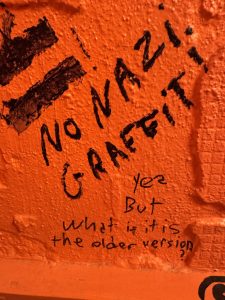 next, someone had written “NO NAZI GRAFFITI,” to which a response arrived: “Yea, but what if it’s the old version?” Another wrote: “Fuck Israelis.” Then “Israelis” got crossed out, replaced with “Netanyahu.” Below it, rewritten, was “Israelis.”