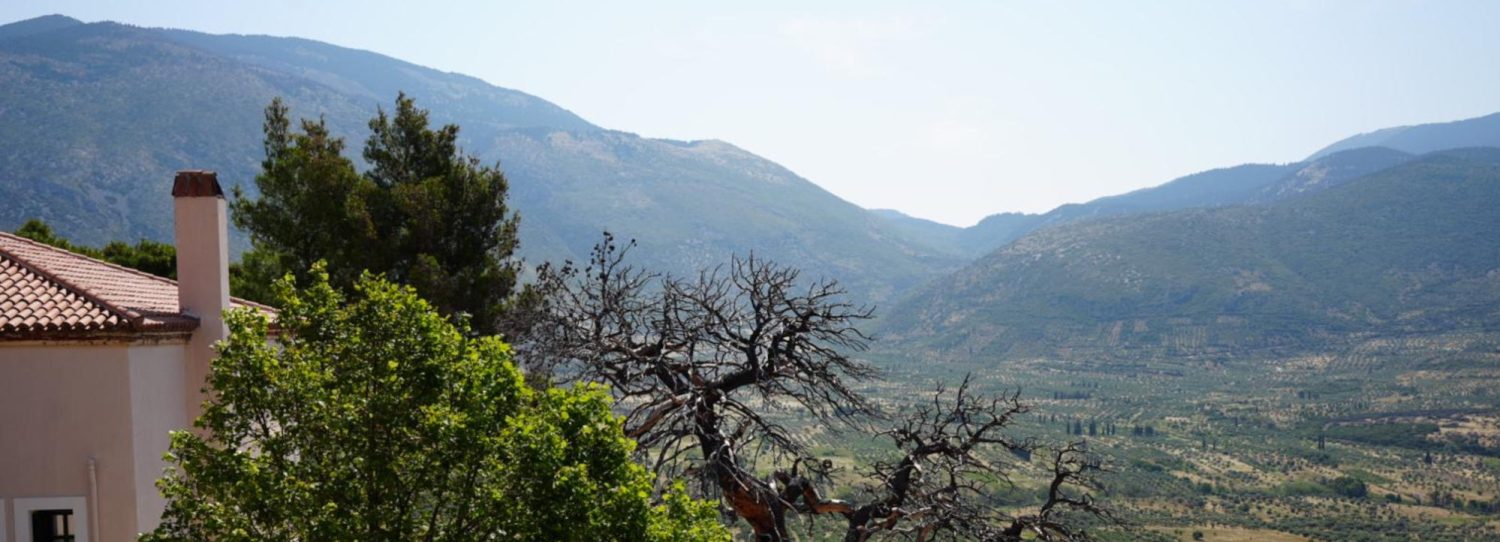
Beguiling is the first word that comes to mind about Athens. Not only because I read it every time I opened Robert Beaton’s Greece: Biography of a Modern Nation, but because it accurately captures how Athens appears. Charming and attractive yet deceptive and mysterious, that is how I felt after just minutes of walking through the city.
What is all this graffiti for? Why did I struggle so profusely walking with my suitcase on the sidewalk from the metro to my apartment? Is it always 30-35 degrees Celcius? Who are the tourists, and who are the locals? Do they hate us being here? Every street opens an opportunity for more questions – and there are so many.
On my first morning in Athens, I decided to go for a run around the perimeter of the Panathenaic stadium. Being elevated, I was provided with a marvelous view of the city and saw a distant viewpoint with a white church. Below the church was an avalanche of concrete, tightly packed and difficult to discern one corner from the next. It looked claustrophobic, quite like the elevators in our apartment building about the size of a single cubicle. Recently, I talked to a Greek saleswoman who works at Plaka’s Agora Workshop. Located near the Parthenons’ Acropolis, it is a souvenir shop that sells sunhats, keyrings and small statue replicas of Greek Gods. I found Alexander at the back of the shop counting coins, signing cheques, and wrapping customer purchases. Alexander, who has worked at the shop for two years, compared Athens to “a kiddie pool.” “We have 50 people inside the kiddie pool. You know what I mean?” I knew exactly what she meant.
Alexander has worked since the age of fifteen, starting work with her dad.Back then, she was paid 30 Euros every four to five hours. With the ability to speak six languages — Portuguese and French Creole, Spanish, Italian, German, English and of course Greek — she dreams for more from life. I was extremely impressed by her multilingualism. While listening to some German tourists in her shop, she realised that she understood it but had never practiced German before. “Last month, I don’t know how it happened. I understand German. I don’t know how. I just do,” she told me. I asked her what she wanted to do with this gift. “I would love to be either a tour guide. Or, uh… how you say, translator?” Exactly like that I told her, “Yes, then I’d like to be a translator,” she said.
I stood by for a moment while tourists came into the shop to buy a statue replica of an offering that would have been given to the Greek Goddess Athena. “Sir, where are you from?” she asked, “North Africa,” he smiled in response, “Oh, you sure, you look Mexican or something?” she pried, “Not yet. Not yet.” he grinned, “What? What do you mean not yet?” she said. The group fell into laughter, you couldn’t not smile.
She’d spent years working in a shop selling fake copies of the real things that lie just up the street. I asked her if she’d ever seen them, “Only once,” she said, “I don’t have time, I work all the time.”
After this conversation, I made my way to the Acropolis museum that possessed the real things. I felt lucky that after merely a few days, I was fortunate enough to see the artifacts that Alexander, who has lived and worked here her entire life, has only had one opportunity.
I thought about Athens’ over-populated streets while standing atop Lycabettus, the hill that appears to be at the centrepoint of Athens. Looking towards the direction of the ocean, I saw the antiquity of the Acropolis which stood high and proud against an ocean of modernity. Limited only by the sea and surrounding mountains: Penteli, Ymittos Parnitha – Athens’ apartments, and buildings stretch farther than the naked eye. If not for these limitations, I was told passingly by someone that the city would keep on going – continuing to be built upon.
This tight-knit arrangement means that everything is walkable, reducing our excuse to get an uber, or a bus to traverse a distance that is otherwise thirty to forty minutes of walking – like the walk from Pagrati, where I am living, to Exarcheia, across the city. From barely meeting 6,000 steps at home, I am now doing 20,000 or 30,000 steps a day. This is unnoticeable because at any moment I could stumble upon some ancient ruins, or two boys banging boxes as drums in Victoria Square, or a masterpiece of graffiti art, like the portrait of an elderly man squinting through his wrinkles at the word Hope, on a wall in Exarcheia. Although this is what I’m experiencing, I’m almost certain locals are: motorbiking or scootering everywhere, even up steep gradients that make me breathless to climb. All while I am dodging cars that are parked like hot wheels toys in a chain that hangs from the steepest hills, I am even more impressed by the strength of their handbrakes.
I am frequently compelled to take out my phone and capture a picture. The pictures haven’t yet done justice to the views. One of these moments happened on the roof of the National Museum of Contemporary Art. The sun was gently grazing the horizontal surface that connects sky to ground, creating a watercolor palette from obsidian to crimson. The piles of concrete were morphing into silhouettes, only one remained visible, facing me. On it, a block-lettered bright-yellow graffiti message, “You are my favorite notification,” reminding all those art-seekers that someone is excited by the appearance of their name. Of all the graffiti in Athens, this was the most optimistic, non-political one I’ve seen. Others tend to express political frustrations, “From the river to the sea, Palestine will be free,” “Free Gaza, Smash Zionism,” and “Tourists get out.”
In the touristy neighbourhood of Plaka, and just two minutes down the road from Alexander, Gregory Tsourouflis sits in a small cuboid-shaped stall. He’s been selling souvenirs for sixteen years. After buying a pair of sunglasses from him, I became intrigued by his confined set-up. I walked round the back of his stall and stood by the open door to talk to him. He was handed one 50 Euro note for a bottle of water to which he would give 49 Euros in change. “Most tourists don’t know the currency, or which is which,” he said as he passively handed the receipt to a woman with a red bag slung across her shoulder which was thinly covered by a tight black tank top.
Tsourouflis works all the time. At 4:30pm that day, he would exit the stall and hand over the shift to a younger girl. From there, he would go to his next job, installing air conditioning in homes across the city. “People,” he said, looking away briefly to sell a fridge magnet, then returning his gaze, “they think Greeks are lazy, we like the sun, we spend a long time drinking coffee, but we are not lazy.” I leaned in closer so I could hear him over the traffic. Anyone who notices the Greek will know that they work hard. I thought Tsourouflis’s job looked monotonous and wondered if he ever socialised with the other stall-owners along the street. “We talk. We’re not close,” he said while shrugging. I was surprised, they have so much in common: tourists, long-labourious work days and being Greek.
Later that day, I walked past his stall again, he looked at me and told me he liked my sunglasses.
I laughed.
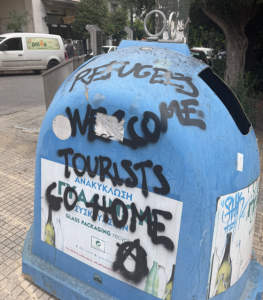 of a blue recycling bin. Initially confused, I wondered why the taxi driver who took me to my apartment from the airport praised Athens’ hospitality and kindness towards foreigners. Nevertheless, after hearing from Al Jazeera journalist and Substack writer John Psaropoulos, I grasped why Athenians have a mixed opinion of vacationers. It has to do with the aftermath of the economic crisis that began in 2008. As Psaropoulos explained, “too late, too little, unproductive reforms” created economic turmoil 18 years ago, affecting the city to this day. After the minimum wage was cut from €751 to €586 in 2012 in hopes of boosting the country’s economy, Athenians were outraged, and occasional riots raged throughout the city. Tourists only exacerbated this challenge for those in Greece. Trying to bounce back from economic distress seemed impossible, and the popular house-renting company, Airbnb, ended up becoming a big help for people trying to keep their homes and avoid defaulting on their mortgages because tourists could rent them out. Nonetheless, an increase in tourism with Airbnb’s assistance meant an increase in housing prices. Airbnb’s connection to this rise in home prices leads to intense distaste not just for the website, but for the tourists who use it to visit
 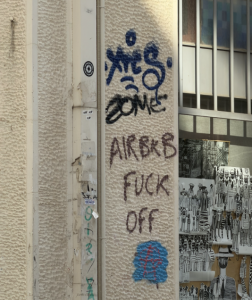 Athens. This dislike became clearer to me as I glanced at the walls when walking towards a coffee shop near our apartment to get a freddo latte: “AIRBNB FUCK OFF,” it read. While initially taken aback by the colorful spray paint that coated the walls around every sidewalk throughout the city, I grew a newfound appreciation not necessarily for its look (as I am a minimalist when it comes to design), but for its contribution to productive discourse and enhancing community feeling. From my perspective, the graffiti only strengthens the social justice, democratic, and civic equity approach to the city that Athenians sought since 600 BC.