On my sixth morning in Athens, a Saturday, I woke and dressed in synthetic clothing, preparing to roar with strangers more closely descended from chimeras than I at my gym’s cross training class.
That night, I would go to the theater with my classmates – this I knew, but as for the hours in between, only time would tell.
According to my mental calendar, I had now lived in this city for one point five years (meaning I say things like “my gym”) – but in reality, it had been a mere six days.
On Monday, the first of these days, I landed at 7:30am, and did what any Central New Jerseyan would do upon arriving to the Mediterranean: I went to the beach.
Beach:
My chosen patch of sand at Zen Beach Club, was, unfortunately, right in the crossfire of two children playing volleyball, a pastime that was certainly new to them, judging by their aim, which resembled that of two people with vertigo. Coming up short on the “zen” end, at least there was a beach.
In the bathroom, where I’d gone to check on my sunburn, I heard an unlikely voice, the words, “Hello beautiful girl!” Grossly fried and terrifically underslept, it was an unconvincing lie, but I appreciated the stranger’s charity.
By the time I knew where Nora was from – Bali – and how many kids she had – one daughter, still in Indonesia – I thought it fitting to shake her hand, but when I reached out to do so, I discovered such pleasantries rendered difficult by a yellow rubber glove, one which swallowed her tiny arm whole. I found her ungloved left hand and shook it awkwardly, deeming this better than conceding the impossibility of physical contact.
If I had to guess – though I am famously useless at this game – I would put Nora somewhere between an old thirty and a young forty. She had been in Athens three years, sending home remittances. There were many Indonesians in Athens, who, like her, had secured seasonal work through an Indonesian agency which took a big cut from them, but Nora was not here to be social. She was here to work, and then get back home to her life. After she’d used all the English she knew, I bid Nora farewell, and she went to clean the next toilet.
Pagrati:
Chelsea Hotel, the cafe of which I am already a devotee, unfolds onto Pagrati’s sidewalk in an eclectic mix of metal chairs and colorful woven cushions. Populating them are skinny old men eating nuts one at a time, as if consuming each one requires immense effort. They wear brown leather shoes. Several days in a row, I’ve seen a British woman on her own, sporting a tuft of white hair swept to one side so as to resemble a cockatoo. She is an English teacher, which I know because a posse of her tweeny students, dressed in crop tops and tapered joggers, are also regulars, and I overhear them chatting about upcoming exams and summer vacations. The teacher’s presence does nothing to scare away the tweens’ rigorous vaping practice.
One day I asked Fiona, the foxy waitress with the full lips and ambitious blowout, what time the cafe closes. First she said 3am, and then she thought some more, and said “Eh, we don’t really close.” On Google Maps, the hours are, indeed, listed as 24/day. Fiona tells me that young people particularly like it here – the cafe, the neighborhood – and that there are many old people living here too, who appreciate having the young around, and the young, too, are happier for the presence of the old.
The Gym:
Alter Life seemed like the most appropriate choice of gym, as it was the only result of my Google search not presenting itself as a single buff bald man with some dumbbells and a yoga ball, welcoming you to come exercise on the top floor of his souvlaki shop.
Alter Life is populated by many buff bald men, not just the one. There are men with hair, too, and with it they’ve done bold things, like shaving a lightning bolt in one case. Alter Life could very well be in New Jersey, though the people here are fitter, and the women, instead of doing micro movements on a mat (pilates), squat beneath some amount of weight identifiable to me as that of a small car.
Exarchia:
There is something inherently apolitical about a European farmers market. In the States, they’ve been co-opted by Bo-Bos (bourgeois bohemians) as places to take naturally-birthed children for cruelty-free kombucha and grass-fed bone broth marshmallows. 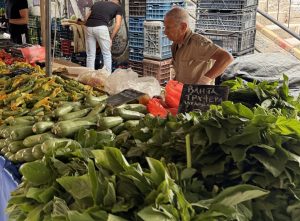 In Europe, farmers markets are just happy places to buy zucchini from other people’s grandpas.
The farmers market felt like the most normal thing about Exarchia, the only few hours of the week where one might honestly mistake their surroundings for Provence. And then, a pierced passer-outer handed me my first flyer, decrying the war in Gaza.
In the bathroom of the trendy cafe I went to 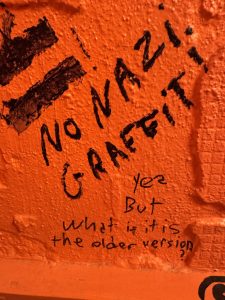 next, someone had written “NO NAZI GRAFFITI,” to which a response arrived: “Yea, but what if it’s the old version?” Another wrote: “Fuck Israelis.” Then “Israelis” got crossed out, replaced with “Netanyahu.” Below it, rewritten, was “Israelis.”
Back out in front of the cafe, hot young people sunned themselves. One read Camus’ The Stranger, and several ate the sugar free, gluten free, vegan banana bread, advertised by the cafe as “not baked, designed.” The confluence of politics and trend perplexes me here, as always.
My last stop in Exarchia was Mrs. Dalloway’s, a “concept store,” selling “gifts,” the worker explained. I spotted a mug that said “The World Needs More Women Like You,” a tote that read “My Baggage,” and a vase, sold for 59 euros, covered all over with the word “FUCK.”
The name of the literally blue-haired woman manning the shop was Athanasia, meaning “immortality,” and when I asked her how Exarchia has changed, I hoped she would deliver a spiteful answer about how shops like the one that employs her have found ways to profit off of politics in the tragic kitschification of anarchism. Instead, she said that Exarchia is “a relatively affordable neighborhood with handmade products and high quality food.”
Kolonaki:
In Kolonaki, the poshest neighborhood in town, I found emaciated middle-aged women in ass-hugging bellbottom jeans smoking cigarettes next to their fat Massimo Dutti-clad husbands downing croissants. I heard a lot of Hebrew. The flyer the students gave me in Exarchia read, “We take action so that Exarchia remains an unfriendly place for IDF soldiers and their supporters.” So they came to Kolonaki instead? Down the street, in Zara, I contemplated a bifurcated city.
Pride:
There is only one thing to do upon hearing Shakira’s voice, and that is, to follow it. In the central Syntagma Square, I got lost in a sea of rainbow flags, drag queens, and Eastern European uncles sporting tracksuits and crimson haired wives. Suddenly, the city seemed wholly united. Plunked down on some garbage covered grass, sandwiched between an uncle and a queen, I broke open a Magnum bar that had been handed to me – and everyone else at Pride – for free.
Theater:
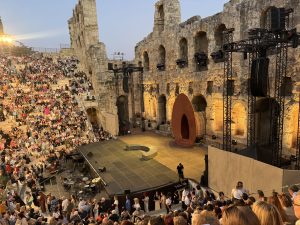
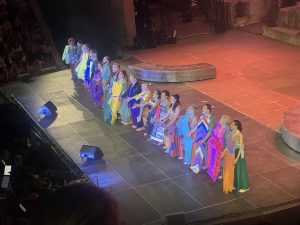
The evening’s production of Lysistrata took place at the 5,000-seat Odeon of Herodes Atticus amphitheater, built entirely of stone before AD 161. On the stage’s center stood a gaping vagina, out of which a cast of performers emerged, pelvic thrusting, in a storm of sequins and tulle.
More soon!