Author: Carina Fucich (Page 1 of 2)

Mentions of AfD in Nuremberg

Trash Can Musings

October 18, 2026 / Carina Fucich

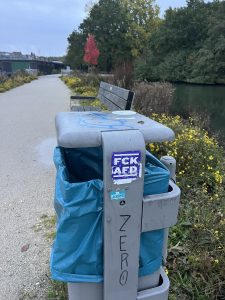
Since reading about the rise of Germany’s far-right political party, the AfD, I have been looking forward to observing how it is perceived in the country. Within our short time in Nuremberg, I stumbled across only one mention of the party – a purple sticker reading “FCK AFD.” 

The sticker was on a grey trash can on the edge of a path that cut through Wohrder Lake. I saw the sticker out of the corner of my eye. I wandered on for a few strides before processing what the sticker was and tracked back to take a picture of the message. The fact that the sticker was written in English caused me to reflect on the perception of English use in Germany.


I have not yet encountered anyone who doesn’t speak English in Germany. Granted, we have spent most of our time in touristy places, which may give me a skewed perception of the use of English here. However, the exhibit text in the Nuremberg Trials museum was in German only. Translation of physical exhibits takes up space and can affect visuals that are so important to museum experiences, but I cannot see any obvious drawbacks to providing a translation option in digital displays. 


This absence of translations was very interesting as the Nuremberg Trials themselves were translated into multiple languages in 1945 and remain of great interest internationally. Even more notable, there was a paper sign taped to the top of one of the digital displays that said “Out of Order” in English, with the German translation below. The choice to provide the English translation to “out of order” on a physical sign, but not provide an option for translation of the digital display seemed very counterintuitive. Additionally, at the Albrecht Dürer house museum, our other stop in the city, provided English translations throughout the exhibits. This lack of English translation seems to be unique to the Nuremberg Trials museum. 


When looking into the AfD’s stance on the use of English in Germany, I observed that they would like to limit or eliminate English classes in schools in hopes of preserving the German language. Thus, the choice to write the anti-AfD sticker in English rather than German seems to reflect a contradiction in language use that I would like to learn more about through the course of this trip.


The purple color also stuck out to me. When I researched “FCK AFD” stickers, they seem to come in either rainbow or black and red. The black and red stickers are characteristic German colors, as they appear on the German flag, and the rainbow colors seem to have a correlation to the LGBTQ movement, which the AfD opposes. However, purple seems like a rather random choice of color. I looked for images of purple “FCK AFD” stickers, but none appeared. This deviation is interesting to me, as political messaging in the US typically all follows a uniform font and color scheme, such as the characteristic bright red MAGA hats. I will be on the lookout to see if this deviation in political branding is typical in Germany.


Under the “FCK AFD” sticker, there is a blue sticker made of a similar material. After some digging, I identified it as a logo for the manufacturer of the garbage can. This indicates that the bottom sticker was placed on the can earlier. However, the AFD sticker is more worn, with its edges peeling off and a slash through the middle. Could this indicate that some person on their morning routine saw the sticker and tried to peel it off? Apparently, they didn’t bother to return and remove it completely.  

Upon reading about the rise of the AfD, I have been looking forward to observing how the party is perceived in Germany. Within our short time in Nuremberg, I only stumbled across one mention of the party – a purple sticker reading “FCK AFD.” 


The sticker lay on a grey trash can on the edge of a path that interestingly enough cut through the Wohrder See lake. I saw the sticker out of the corner of my eye, and kept wandering on for a few strides before processing what the sticker was, and tracking back to take a picture of the message. The fact that the sticker was written in English caused me to reflect on the perception of English use in Germany.


I have not yet encountered anyone who doesn’t speak English in Germany so far. Granted, we have spent most of our time in mostly touristy places, which likely gives me a skewed perception of the use of English in the country. However, the writing in the Nuremberg Trials museum was in German only, including an interactive digital exhibit towards the back of the museum. Translation of physical exhibits takes up space and can affect visuals that are so important to museum experiences, but I cannot see any obvious drawbacks to providing a translation option in digital displays. 


This absence of translations was very interesting to me, as the Nuremberg trials themselves were translated into various languages, and the trials are inherently of great interest internationally. What’s even more notable is the fact that there was a paper sign taped to the top of one of the digital displays that said “Out of Order” in English, with the German translation for out of order. The choice to provide the English translation to “out of order” on a physical sign, but not provide an option for translation of the digital display seemed very counterintuitive to me. Additionally, the Albrecht Dürer house museum we went to provided English translations throughout the exhibits, so this lack of English translation seems to be unique to the Nuremberg trials museum. 


When looking into the AfD’s stance on the use of English in the country, I saw that they would like to limit or eliminate English classes in schools in hopes of preserving the German language. Thus, the choice to write the anti-AfD sticker in English rather than German seems to demonstrate this nuance in language use, which I would like to learn more about through the course of this trip.


The color of the sticker also stuck out to me, as when I looked up “FCK AFD” stickers, they seemed to be uniformly colored in either black and red, or in rainbow. The black and red stickers are characteristic German colors, as they appear on the German flag, and the rainbow colors seem to have a correlation to the LGBTQ movement, which the AfD opposes. However, purple seems like a rather random change of color. I looked for images of purple “FCK AFD” stickers, but none appeared. This deviation is interesting to me, as political messaging in the US typically all follows a uniform font and color, such as the characteristic bright red MAGA hats. I will be on the lookout to see if this deviation in political branding is typical in Germany.


Lastly, I was drawn towards the condition of the sticker on the garbage can. Under the “FCK AFD” sticker, there is a blue sticker, which with some digging I identified as a sticker advertising the manufacturer of the garbage can. This indicates that that bottom sticker was on the can from when it was placed there originally, and seems to be made of a similar material as the AFD sticker. However, the AFD sticker is more worn, with its edges peeling off, and a slash that goes through the middle of the sticker. Could this indicate that some people on their morning walks and runs see the sticker and try to peel it off, but don’t bother to return to completely cover it up or rip it off? Regardless, this sticker was a very interesting insight into AfD perception in Germany, and has set me up to observe AfD rhetoric in Berlin. I am particularly interested in observing the difference in how the AfD is perceived and discussed in these two cities. 
Blog week 6

For the past week, I’ve been watching Green Boarder as I walk to class, brush my teeth, and stretch after runs. This has caused a stark juxtaposition between my life, and the life of the refugees trying to cross the Belarus/Poland border. Although probably not what the film makers intended, watching this film in many 15 minute chunks over the span of a week made the film all the more impactful. Just when I am stressing about midterms, or psets, I would turn on the film to watch a bit more and immediately be reminded of how privileged I am to be stressed about school work. Additionally, the very deep imagery in the film was really impactful to me as I became immersed in the film while also walking around our sheltered campus. 


On the topic of juxtaposition, I really liked the various stark contrasts that the film presented. First, the contrast between the normal lives of the Polish people in the story, and the suffering of the refugees trying to cross the border. Second, the juxtaposition between the Ukrainian border and the Belarus border. The way that the film presents these contrasts makes them impossible to ignore.


I also found the level of attention that the film gave to the lives of children crossing the border to be interesting. Of course, children are beacons of innocence, and helplessness, so focusing on the children makes the film much more heart wrenching. Especially with the death of Nur, these scenes that focus on the experience of children at the borders left a strong impact on me. However, I would have liked the film to also focus on the past of the adults more. The adults have the added strain of having to leave everything behind them, and also be burdened with the decision to leave their home, and guide their children through this experience while coping with it themselves. I understand that this film could only be so long, but I would have liked to also see more into the past of the adults and what went into their decision to leave their home countries behind. 


Lastly, the way that the film played with sound was very impactful to me as well. The long periods of silence, combined with the constant sound of babies crying gave more suspense and feeling into the film. The film didn’t use music to fill any of the gaps in dialogue or other sound, but instead left us in silence. I really liked this choice because it left the viewers with no cloak to hide behind in times of discomfort or strong grief and fear, helping portray the feelings of those who are crossing the border. Additionally, the song that the boys created at the end of the film helped humanify the refugees again, giving them their joy back instead of only portraying them as “crying or dying.”  This contrast again added to the film, reminding me that at the end of the day, these refugees still find ways to entertain themselves and make light of the situation, something so human that every viewer can relate to.

It’s a “small island thing”

The small Mediterranean island country of Malta has seen an astonishing shift in ethnic groups over the past 20 years, evoking strong opinions on race and immigration. “We are a racist country, there is no shifting around that,” said Andrew Azzopardi, professor of Migration Studies at The University of Malta.


In 2005, merely 1% of the country’s population were immigrants from non-EU countries. Now, a quarter of the country’s population are non-EU nationals. “Two weeks ago, I was sitting in a cafe, and an Indian family came into the shop. A Maltese man refused to move his chair so they wouldn’t be able to sit,” said Azzopardi. “Some Maltese people say that Indians smell like spices and are dirty.” 


To understand this shift and social attitudes towards immigrants in Malta, journalist Matthew Vella, who has previously reported on immigration in Malta, gave insight about the country’s past. He explained how its demographic changed from being a “mainly white, conservative, Catholic society that had been relatively shielded from external events,” to a country that now is home to so many immigrants. 


Asylum seekers from Africa 


Through an email response, Vella explained that immigration into Malta in large numbers began in 2004, when asylum seekers from sub-Saharan Africa began arriving in Malta via boat. This group was first held in detention centers before working as unskilled laborers. “Immigration via boat was visible on the news, and people would panic when they saw videos of boats arriving,” said Azzopardi.  


As explained by Vella, this panic quickly led to racism, which was fueled by the media landscape in Malta. “The situation was made worse by the government’s constant narrative that painted the arrival of a maximum of 2,000 asylum seekers a year as a ‘crisis,’” said Vella, explaining how this “false narrative” quickly spread through the country. To add even more fuel to the fire, “far-right movements also started in Malta due to the influx of asylum seekers,” he said. 


However, Godfrey Baldacchino, professor of sociology at the University of Malta emphasizes through an email response that although far right groups exist in Malta, they have not gained any significant traction in elections. 


Legislatively, Malta has recently adopted more restrictive policies on refugees through the EU Pact on Migration asylum, but has not taken action towards setting up protections for refugee human rights. In response to this, Baldacchino said, “Perhaps the Maltese Government is taking this political stance in order to ‘protect’ itself from the absence of any burden-sharing and solidarity at European level. Should 1,000 illegal migrants arrive at our shores today, what happens?” 


Economic migrants from Asia


From 2010-2015, there was a period of economic growth in Malta, due to the country’s efforts to “boost investment, pursue structural reforms and ensure responsible fiscal policies,” according to Malta Enterprise.


Vella explained that this growth attracted migrants from both inside and outside of the EU. There was “a new working class of Asian workers – bus drivers from Pakistan, nannies and care workers from the Philippines, and very soon many more Asian workers taking up service and carer jobs (healthcare, catering, logistics, manufacturing, etc).”


Azzopardi explained that compared to the refugees who spend many months in detention centers upon arrival, this group of migrants are much more visible to the general public in daily life. “It is a strange relationship as our comforts are highly dependent on these people, but we look down on them, and they are overworked and underpaid,” he said. 


“The Maltese treat such workers as walking dollars rather than members of society,” said Vella, who explained that many of these immigrants during this period “started taking up much-needed jobs that the Maltese were not taking on.” Although more integrated into the daily lives of Maltese people, “there was little to no reaction [to this wave of immigrants], but a passive acceptance of economic ‘rationality,’” he said. 


Baldacchino also acknowledges this so-called ‘economic rationality’ of immigrants, but states that “no strong anti-immigration sentiment exists in Malta, probably because practically all immigrants are working and subsidizing our pensions.” 


What influences the treatment of immigrants in Malta?


On the other hand, Azzopardi says that the treatment of immigrants is getting worse over time and gives several examples of ‘anti-immigration sentiment’. “There is a messy detention policy, the government chucks people out like ICE,” he said. “Immigrants are renting out mattresses, living in stables, and being killed in drive-by shootings. Not enough people are speaking out and using their voices.”


In 2019, two off duty soldiers killed an immigrant from the Ivory Coast. “Cisse was shot on the night of 6th April 2019 while walking back to the Ħal Far Open Centre after watching a football match in Birżebbuġa,” reported Lovin Malta. The trial for this case is scheduled for October 19th 2026, seven years after the shooting. 


When explaining why immigrants and racial minorities are ‘othered’ in Malta, Vella said, “people question the impact of a growing population on our healthcare system (which is tax-funded and universally free at point of service), on our traffic (increased use of private cars), and on our public transport system (today mainly used by low-income foreign workers.” 


However, Baldacchino views this strain that the immigrant population is adding onto infrastructure through a different lens. “No hard feelings really, but the donkey is loaded with a heavy baggage, and the straw keeps piling up – will the donkey’s back break?” he asked. “Water supply interruptions, power outages, traffic jams, overloaded public transport…”


To explain racism and anti-immigration attitudes in Malta, Azzopardi points towards what he calls “a strange nostalgia.”. He says that many Maltese people have an attachment to their strong Catholic identity, although many people are turning away from the religion. “People are worried that immigrants will take away their religion, but many of these immigrants are very devoted Catholics from the Phillipines,” he said, while pointing out that many Maltese people now only get married in churches because they are ‘fancy.’


Azzopardi also uses the term ‘strange nostalgia,’ to describe Malta’s attachment to language, which stems from Malta’s time as a British colony. Since immigrants do not come into the country speaking Maltese, “people feel like their identity is being chewed away,” he said. “I don’t think so. I can’t understand the obsession that identity is tied to language and religion. Identity is tied to togetherness and unity. If I am talking with you and speak in English, why should I be bothered that you don’t speak Maltese?” 


On the topic of language and identity, Vella states that immigrants generally have a lack of buy-in to learning Maltese. “My view is that the number one obstacle to integration here is, apart from the rentier mindset that treats foreign workers who lack agency as walking dollars, is a lack of buy-in to Maltese society via its language,” he said. 


Lastly, both Vella and Azzopardi point out Malta’s island geography in relation to this resistance to change. “Malta is an island state seemingly far away from anything else and has been colonized by other countries throughout history, which causes this feeling of insecurity,” Azzopardi said. 


“Today I feel inclined to concede that the racism that is prevailing amongst Maltese has a particular psychological pattern – a small society, locked into a small rock, vigilant about external pressures that can affect the serenity of a relatively peaceful, crime-free society, pressures,” said Vella. 

Refugee deaf culture in Berlin

Ever since learning about deaf culture in Noah Buchholz’s class, a survey of American Sign Language, I have been interested in learning even more about deaf culture. From that class, I have learned that the strength of the deaf community is a force to be reckoned with. The concept of developing such a tight knit community among discrimination, hate, and othering is very empowering to me. The deaf community is also unique in that deaf culture is rarely shared within the nuclear family. Only 5-10% of deaf children have deaf parents, meaning deaf children are a part of this strong community that their parents and siblings are likely not a part of. Additionally, although deaf culture is different in different regions, deaf people across borders can still immediately connect over shared experiences such as trouble communicating with the hearing community, discrimination, misunderstanding, etc. The only other group I can think of with similar attributes is the LGBTQ community, where LGBTQ kids are often the only members of their family who are queer and develop queer culture. 


There is an association in Berlin called Deaf Refugees Berlin, which I would like to do a feature piece on. I have already been in contact with someone who works at the company, who is waiting to hear back from her supervisor for permission to proceed and begin answering some of my questions. I also reached out to my ASL professor to see if he has any contacts with the deaf community in Berlin. He referred me to another Princeton professor who does have contacts in Berlin, but hasn’t been responsive to any of my emails.


There have been previous reporting on Ukrainian deaf refugees, as in 2022, the German government told deaf refugees from Ukraine that they need to relocate out of Berlin, away from each other, and away from supporting sign language interpreters. They were originally told to relocate because at the time, the government had a program to relocate refugees to other cities to avoid overcrowding Berlin. However, Berlin is a hub for deaf culture, with deaf schools, deaf sports programs for kids, etc, which a lot of other cities in Germany do not have. The German government eventually let the deaf people stay in Berlin. 


InfoMigrants also created a short video (2 minutes), in 2024 highlighting Abbas Bazzi, who volunteers to teach refugees German Sign Language in Dresden Germany. They titled the short video, Double Language Barrier, and focused on the community that the lessons fostered, as well as explaining how the group helps form community. 


The biggest issue will be the communication barrier since I do not know German or ASL, but I have been communicating with the community through written German so far, which can be a work-around to that issue. However, I hope to report on the experiences of deaf refugees in Berlin, and shed light on the very unique space that Deaf Refugees Berlin holds. This can help reveal insight on the lives of a refugee group that is underrepresented in the media.

Reading blog week 5

I found these readings very helpful with further contextualizing the political climate in Germany, as well as evaluating how different types of journalism help portray events differently. For example, the InfoMigrants article presented the information with a more objective angle than the other articles. The writers in this piece were more clear and to the point, formatting the AfD’s policies in bullet points. They didn’t touch as much on the jarring implications that these laws would have, but rather just presented the AfD policies in a digestible way.

However, the other articles have more of an analytic nature to them, adding inputs regarding the implications of the rise of the AfD, specifically calling out the alarming correlations between the AfD and Nazis. I enjoyed the structure and writing style of The Economist’s story, particularly the lede. The details about the past booming industrial town first left me confused as to how this town related to the AfD. However, once the author made the connection, explaining how towns like these have more support for far right politics, it really gave me a better sense of the nuance of the situation. This lede and style of writing was a perfect way for the author to answer the question that many people have about the rise of the AfD – who would vote for such a party?

The answer to this question is what I find the most unsettling out of the situation. This article makes it clear that the AfD is really capitalizing on the worries and frustrations of people, and using this fear to rise to power, as well as using immigrants and refugees as a scapegoat to a plethora of issues in the country. This reality was unsettling to me because with the rise of AI and other technologies, we live in such a rapidly changing world, meaning this uncertainty and shift towards far right policies can happen anywhere at any time.

I also couldn’t help reading this article through a comparative lens of politics in Malta. I had the opportunity to speak with a journalist who emphasized that in Malta, the blaming of immigrants for problems that they are not associated with has caused racism in the country to run rampant. These parallels are a bit disheartening, as it seems as if it is unavoidably human nature to choose a group to blame for one’s own problems disproportionately. We can also see this in history, particularly with the Nazis scapegoating the Jewish community at the dawn of WWII. The parallels between the two situations are stomach churning to say the least.

Additionally, these articles were evidently effective in their objective – letting more people know about the AfD. I of course knew about the AfD before reading these articles from exposure in this class, and some outside conversations. However, I did not fully understand the gravity of the situation, or how alarming it really is until reading this collection of articles. This really underscores the importance of journalism, even with the rise of social media, as these articles convey this information in a captivating and nuanced way that an Instagram post simply cannot achieve.

Malta’s lack of response to the International Monitoring Mechanism reflects anti-immigration views

On September 16th, Malta’s Ombudsman published a press release which highlights that Malta has not included the Department of Ombudsman in discussions/development of the Independent Monitoring Mechanism (IMM), reflecting broader trends of anti-immigration attitudes in Malta. The IMM is part of the EU Pact on Migration and Asylum which was implemented last June to address concerns surrounding immigration and asylum. The IMM was included in this pact as a safeguard for the newly robust screening system for asylum seekers, and is to be independently developed by each country in the EU. 


Malta is a small EU country in the Mediterranean located south of Sicily, which has seen a rise in immigration over the past decade, with immigrants now occupying 31% of the country’s population. Most of these immigrants come from India, Nepal, and the Philippines. The Times of Malta reports that due to these growing numbers of immigrants, and the small geographic size of the country, Malta is the most densely populated country in the European Union, putting strain on the country’s infrastructure and economy. 


As explained by Katie Cordina, a nursing student at the University of Malta, immigrants are often looked down on and disrespected in Malta. Cordina is currently writing her thesis on the experiences of immigrant nurses at Mater Dei Hospital, Malta’s main hospital. When asked about the general view of immigrants in Malta, she explained, “Recently an immigrant choked a Maltese person, which broke headlines and everyone was complaining about the trouble that immigrants cause in the country.” 


Cordina clarifies that she does not hear many discussions about immigration policy in Malta within her University or hospital networks. However, she notes that she does notice more disrespect towards immigrants as there is a rise in laws restricting immigrants and refugees into the country. International Migrations professor Christopher Blair helps explain the link between legislative policies, and public opinion regarding immigration. “Some countries try to use policies to shape attitudes, and sometimes policies follow from attitudes,” he said.  


Princeton Professor Andrew Moravcsik, head of the Liechtenstein Institute on Self-Determination explained through an email response that there is nuance to Malta’s lack of action towards the IMM. Professor Moravsik explains that the lack of action may be a delay.  “The literature on EU compliance suggests that enormous cross-national differences exist in average speed of implementation driven by more or less efficient national bureaucracies,” he said. 


But this is not the only possibility, “A still more interesting possibility is that the countries (right now the four: Belgium, Italy, Malta, Hungary, for which this seems plausible) are engaged in willful non-compliance due to some internal conflict or particular political or economic cost to special interests of compliance accruing to that country, or specific opposition,” he said. 


Professor Blair explains that EU policy often provides an overarching framework, but leaves space for countries to delegate specific laws as demonstrated by the IMM. “Within the broad scope of EU rules, countries certainly implement different levels of policy liberality,” he said. In Malta’s case, the lack of the IMM reflects a trend of low liberality, as The European Council on Refugees and Exiles warns that the new EU Pact on Migration and Asylum will further prevent asylum seekers from receiving legal help in Malta. 


Despite these social and legislative trends towards immigrants and asylum seekers in Malta, human rights groups such as the Aditus foundation, Jesuit Refugee Service, and Malta Refugee Council continue to advocate for refugee and immigrant rights in Malta. “Us immigrants stick together,” said Cordina. 


Sources:

Aditus Foundation. Country Report: Malta; Update on 2025. European Council on Refugees and Exiles, June 2026. AIDA Country Report on Malta

European Commission. 2024 EMN-ESTAT Country Factsheet: Malta. European Migration Network and Eurostat, 2024. 2024 EMN-ESTAT Malta Country Factsheet

“The 31% of Malta’s Population Made Up of Foreigners, as Country Received over 32,000 Immigrants in 2025.” The Malta Independent, 9 July 2026. The Malta Independent article

“Malta Remains EU’s Most Densely Populated Country, Eurostat Finds.” Times of Malta, 2026. Times of Malta article

Week 4 reflection

Azmat Khan’s NYT series did an exceptional job juxtaposing the lived experience of civilians with the apathy and lack of attention shown by the US military and the claims that officials made to the public. I especially appreciated being able to read both of her pieces in the series because it caused me to think about how writing in two different styles can change what the readers take away from the article. For example, in “Airstrikes Allowed America to wage war with minimal risk to its troops,” Khan includes information about her methodology of conducting interviews. Specifically, she notes that she didn’t contact anyone before arriving to limit awareness that she is coming, and thus bias. This was interesting to me because I had never considered awareness of forthcoming interviews to be considered the root of bias. She explains that “evidence could be doctored; stories could be aligned.” I found this to be a great way to bring more credibility to Khan and her witnesses because it demonstrates that she is considering the possibility that the witnesses may try to deceive her. However, she of course also demonstrates great empathy towards the civilians. Thus, this style of writing allowed her to include accounts of her methodology, which allows space for strengthening her credibility.


This piece also helps strengthen Khan’s credibility by explaining more context behind her experience in the field, and decisions she had to make as well as the reasoning behind these decisions. I appreciated how that style of journalism helped humanify the writer, which I believe makes her message able to reach more people, especially those who are a bit more closed minded to these types of messages. I also find the headline of this article to be worth discussion. This headline seems almost geared towards people who have a positive outlook on America’s involvement in the war, and who would believe that America is a hero in this situation. This makes me think that the article was written in this way to try to get to Americans who would not normally start reading articles that claim wrong doings by the American army in hopes of penetrating the polarizing nature of politics in America. 


 “In Hidden Pentagon Records reveal Patterns of Failure in Deadly Airstrikes,” however, Khan takes more of an impersonal writing style. She includes more context behind the US military’s procedures and thought processes, while showing the stark contrast between their apathy and the lived experience of the civilians. Thus, I thought reading these two very different articles that were written by the same person, about the same events was very interesting, and I will take this into account when planning for my Berlin article. 


In the Holy boarders vs EU boarders article, I was specifically drawn to this quote: “the heightened scrutiny on places of worship giving sanctuary to refugees reflects hardening attitudes towards immigrants in general.” As I wrote my news piece on Malta, I was particularly interested in how attitudes towards refugees intersects with attitudes towards immigrants in general, since I was speaking with a student in Malta who has witnessed blanket disrespect towards all immigrants. Thus, it was interesting to see this correlation between scrutiny against refugees reflecting scrutiny against all immigrants. 

Reflection blog, week 3

I found the readings this week very helpful in contextualizing the experiences of Ukrainians during this time of war. I was again drawn towards viewing these readings through a lens of mental health in times of trauma, as each source shed light on the ways people are coping with these intense times.


The source that stood out to me the most during this week was the video Faith Under Siege due to the intense visuals that were included. Through the interviews with individuals who endured torturous conditions, I was able to get a full grasp of the gravity of the hardships that the Ukrainians are forced to endure. This immediately caused me to consider how people possibly overcome these types of tragedies from a mental health perspective. The video then reveals that the community is able to keep on keeping on due to their strong unity in faith. This strong faith is also what helps the Americans connect with the Ukrainians, even though they have no connection to Ukraine, and come from areas where their daily reality centers around work and family life instead of survival. 


While it seems as if religion really helps believers get through times like these, this concept made me question how the communities that are not highlighted in this video deal with these hardships. Does the fact that some people use religion as more of a crutch in these times of war further exclude people who are not religious? One topic that I may focus my final paper on is the experience of LGBTQ asylum seekers in Berlin. Thus, this documentary made me wonder what the experience is for people who are othered by the church, such as LGBTQ people if they cannot access this type of relentless community. However, the documentary was shown through the lens of the religious community, making me wonder if the extent to this religious unity is tinted through the storytelling and message of the documentary.  


Another two texts that really stood out to me were the “why isn’t dad home” article, and the article on the bunker museum in Berlin. This is because these two texts are focused around featuring media intended to help people interpret the war. The NYT article explicitly mentions mental health in relation to children during wartime, as the books are cited as grounds for kids to be able to access, process, and vocalize their emotions. Reading about these books really helped me put myself into the shoes of the children who have to endure these hardships. Next, the bunker museum in Berlin is designed to help people empathize with the conditions in Ukraine. This unconventional means of spreading information was very interesting to me. As one of my other possible topics for the final project is looking at the Maltese enclave in Berlin, I am interested to look into the visitation data in this museum, and if it affects people’s willingness to be empathetic towards all types of immigrants and asylum seekers. 


I also found it interesting how through the ‘Union Hub’ article, and the Ukrainian museum bunker article, it seems as if both social and political efforts are being disproportionately skewed towards Ukrainian asylum seekers, in comparison to other asylum seekers such as Syrian refugees. If decide to focus on the Maltese enclave in Berlin, I would have to think carefully about the angle of my article, because it seems as if Berlin is more sympathetic and welcoming towards European immigrants than immigrants from other backgrounds. 


Reading blog 9/15

By: Carina Fucich 


This week’s readings really gave me a varied view into both the experience of people dealing with the Syrian revolution, and the conflicts in Ukraine. I really appreciated how this weeks’ readings showed us perspectives through novels, articles, podcasts, and memoirs because I admittedly did not know much about these two revolutions previously. I thought that the articles showing how Syrians are being financially incentivized to leave Germany combined with the perspectives of Syrian doctors in Germany to be very interesting. When this is coupled with the memoirs of the experiences of these people during the revolution, I felt like I got a view into the tumultuous emotional pathways of Syrians who ended up in Germany. 


 Although I enjoyed all of the readings, I found the defiance reading to be the most interesting and eye opening. The imagery and details shown through the reading helped me really get into the head of the main character and get a glimpse into what it is like to live in Turkey during the revolution. Additionally, I thought discussions of mental health were very interesting. For example, when the main character showed up to work after sleeping in, it was an American who referred her to a mental health specialist. The main character then explains how she had never heard of anyone who sought mental health, and she immediately took offence to the suggestion, although she was evidently struggling with her mental health. Why was the person to suggest to her to seek mental health specifically identified as an American? Is the author biased in claiming that Americans are more forward with destigmatizing mental health? I am also interested in learning more about that American character and how they are portrayed. 


Additionally, I enjoyed reading about the main characters’ interactions with social media. I of course know the great impacts of social media and how prevalent it is in global conflicts currently. However, reading about how people reacted to the main character’s social media post was very eye opening. The global impacts and visibility to issues that social media no doubt offers is definitely shown here, but the passionate and angry comments were also shown to hurt the main character’s mental health even more. Is there a way that we can adjust how people interact with social media so that these stories can still be shared, while protecting the mental health of the users? By showing both the impacts in visibility from posting on social media, as well as the detriment to the main characters’ mental health, the author opens an interesting discussion surrounding social media. When arguing for the benefits of social media in conflicts like these, are we inherently overlooking the mental health of these individuals, and in doing so shortening them to insignificance?

Leibert Cannot Be Put into a Box

Leila Leibert embraces juxtaposition: Community college to the Ivy League, San Francisco to Hong Kong, mathematics to art history. This juxtaposition has allowed Leibert to view the world through a more holistic lens. “She is a maverick. She likes to try everything and go for everything,” said Manuel San Millan, Leibert’s boyfriend. Not only does Leibert try everything, but San Millan explains that Leibert puts her all into everything that she tries, making her a truly special person to be around. 

Leibert spent her first year out of high school at a community college near her hometown in San Francisco, California. It was there that she first embraced her varied interests and genuine desire to learn. “I had taken 120 units, which is almost four years worth of courses in a year and a half. So I was taking a lot of courses in many disciplines like art history, architecture and math,”  she explained. 

In community college, Leibert was immersed into a non-traditional college environment. “A lot of the students there came from all backgrounds, and all ages, so in a lot of my classes I was surrounded by adults and even people who were working full time or returning back to college to pursue their studies.” Despite these varied backgrounds, and having classmates who were only in college part time, Leibert fully immersed herself into her studies. She explained how she has never been a stickler for grades, and instead was always focused on taking classes she was interested in, and building relationships with professors.  

No one from Leibert’s community college has ever transferred to an Ivy League, and no one from Leibert’s high school’s graduating class went to an Ivy League. It was only through Leibert’s involvement in research that she was introduced to the opportunities available to apply to and attend an Ivy League. Evidently, Leibert was an anomaly and a trail blazer. 

However, being the first to do something is never without its struggles. Leibert had to grapple with how her old classmates and friends would perceive her move to an Ivy League. “I told no one I was applying, so I just kind of left and disappeared, because people already have preconceived notions about going to a school like Princeton.” Leibert was also worried about how her life would be at Princeton, and what it would be like to make new friends in a school where transferring is rare. “When I got in, I didn’t even pick up the phone call. I was a bit apprehensive about whether or not it was a mistake.” 

Although Leibert describes her first year at Princeton as “pretty rough,” she was able to hit her stride during her second year at Princeton and find great success. Leibert was able to leverage the strengths that she embodied in her academic curiosity while studying at a community college to find success at Princeton. Although her major, ORFE, is known to be a tough one, she really enjoys it because “you don’t need to specialize or feel confined to one specific field of study. ORFE is for generalists who love quantitative challenges,” she described. 

Just as would be expected from someone with such diverse interests and backgrounds, you cannot put Leibert in a box. She has since lived in Hong Kong, Wyoming, and Los Angeles, pursuing research related to ORFE and beyond. “Leila is very difficult to describe in words, there is a certain energy about her – very warm and positive, and everyone feels very heard when talking to her,” said Leibert’s friend from Princeton, Isabelle Tseng. Tseng also explains that Leibert has the extra enrichment of being on another college campus and is very open minded.

Although it wasn’t easy for Lubert to take the jump into attending an Ivy League, she was able to leave her mark on the people she left behind in California, as well as inspire those that she met at Princeton. There is a portrait of Leibert hanging proudly in her community college, displaying her name, major, and education at Princeton. “Whatever she does, she cares about it very deeply. Anything from horses to sailing, or interior design, she loves to talk about it and immerse herself in it,” San Millan said. “She is the whole package,” said Tseng. “Talking to her is like a warm ray of sunshine.”

By: Carina Fucich

« Older posts

The McGraw Center for Teaching and Learning
328 Frist Campus Center, Princeton University, Princeton, NJ 08544
PH: 609-258-2575 | FX: 609-258-1433
mcgrawdll@princeton.edu

A unit of the Office of the Dean of the College

© Copyright 2026 The Trustees of Princeton University

Accessiblity | Privacy notice