Pardon My Ribaldry

The room was far from quiet. The cacophony of drilling and hammering woke me in a daze. “What the fuck?” I exclaimed, still half-asleep, while my classmate sharing the adjacent bed snored just as loudly as the construction, though I was careful not to wake him while dressing myself in yesterday’s unwashed clothes. I am truly cursed by my own ingratitude, and cursed still further by the awareness of it—my complimentary hotel breakfast, on my complimentary class trip, courtesy of my complimentary tuition. I should welcome whatever inconvenience hotel maintenance sees fit to subject me to.

Like the cold eggs, or the displayed carcinogenic deli meats held at the same temperature. I ate them, of course, and when finished, set my plate aside, signaling to the waitstaff that it was ready for retrieval, while drinking my machine-dispensed “Café Latte,” whatever that means. I don’t speak German; however, Vanessa, the German translator hired by the university to mitigate the language barrier, speaks fluently.

Vanessa sat across from me at breakfast.

She is a kind woman. Contemplative and well-mannered, yet I sense it unwise to cross her.

Estar joined Vanessa and me soon after.

“Stary,” as she prefers to be addressed, is a faculty member at the university. Despite speaking with her for several hours on the first night of our trip, I failed to ask enough questions to know much about her. For the majority of that evening, I spoke at her. Perhaps that should not be considered a conversation since I wanted her to think highly of me, or, at the very least, not think too little of me—a theme consistent throughout my life, and evident in my relationship with Deborah, whose approval I desperately seek.

Professor Deborah Amos, or “Deb” as she permitted us to call her, is a short-haired, short-statured, long-time international journalist framed by her uncommonly striking glasses, one of many fashion commonalities we share, as we humorously discovered on the first day of our trip when we both arrived dressed in Canadian tuxedos.

Our final itinerary outlined the relevant tours our class was scheduled to participate in, along with the specific day each student was assigned a “Writer/Editor” role, yet neglected our unfashionable failure to coordinate outfits.

Every morning, each student is tasked with editing a blog post submitted the previous night by one of their peers. Tonight was my night, this was my morning, and, assisted by Vanessa, Stary, and Deb, who followed shortly behind Stary to the breakfast table, I edited the works of my three fellow classmates.

The carefully chosen words my peer produced, only comprehensible under the influence of the Café Latte, were subject to our criticism for over an hour, while I thought to myself, “Wow, this is good,” as I read his post. “I want to be like this. I want to write good too.” I want my linguistic gifts to be recognized and praised for their hyperspecificity, audacious yet cautionary, uncontested in my competition for greatness, with an unyielding aim for appreciation, revered by classmates whom I senior, awed by those who senior me, and produced effortlessly.

But this would require effort on my part, demonstrating what separates uninspired writing from the kind produced only through vulnerability. Perhaps my vulnerability, still undecided about whether to be continued, wary of the sharp knife of criticism, and sheltered behind sardonic wordplay, will extend beyond this blog post. Perhaps I should welcome whatever inconvenience this course sees fit to subject me to.

Perhaps I am trying too fucking hard in this effort, while not one joke I’ve written thus far has landed to the audience for whom they are written.

Or perhaps I should pardon my ribaldry.
“Not a Vacation”

We all know the phrases “time flies when you’re having  fun” or “work doesn’t seem like work if you enjoy it.” So when Professor Amos said “this is not a vacation” when speaking of our time in Berlin and subtly reminding us of the goal to report and collect information for our sources, I was almost scared. Scared I was not doing enough, did not have enough interviews lined up, etc. However after conducting my first interview this morning, and throughout our eventful day, I am reflecting that our work can be fun.

My first full day in Berlin began on foot. Our spontaneous tour of the neighborhood (Mitte?) led us through the side streets toward Hackescher Markt. Between the cafés and graffiti-covered courtyards, I kept noticing small brass plaques set into the sidewalk. These are Stolpersteine, or “stumbling stones,” each engraved with the name of a person deported or killed by the Nazis, placed in front of their last chosen home. Several were clustered outside a single doorway on one block. It struck me that in Berlin, remembrance isn’t confined to museums; it is literally underfoot, something you trip over on the way to get coffee. I am a history nerd, so that idea stayed with me as we headed to Bayer’s pharmaceutical campus for lunch.

Over a surprisingly elegant spread, Thore, the company’s historian and archivist, walked us through Bayer’s history, from aspirin to its place in today’s global market. When he reached the Nazi era, though, his account grew noticeably vague. He acknowledged that Bayer was folded into IG Farben, the chemical conglomerate that collaborated with the regime, but the details stayed abstract. What he did not dwell on is that IG Farben was among the largest corporate donors to the Nazi party, or that Degesch, a firm IG Farben subsidiary albeit through many other subsidiaries, produced the gas used in the gas chambers at the Auschwitz concentration camp. The web of subsidiaries made it easy to keep Bayer at arm’s length from the worst of it, but I kept waiting for a direct and short: this is our history, we messed up, it was not that long ago but here is what we’ve done in those years to attempt to regain the trust of the public and those we’ve hurt, and, this is our business strategy now to ensure the strongest ethical standards today. But after seeing those stumbling stones that morning, the contrast felt sharp: the city names individual victims on its sidewalks, while the company’s own archivist seemed most comfortable speaking in terms of corporate structure.

I don’t think Thore was hiding anything outright. But I left wondering whether a company can truly reckon with its past when the person telling that history is also on its payroll.

The walk back to the train was bitterly cold, the kind of damp October wind that cuts straight through a jacket (and I thought I was prepared). Back near our hotel, I thawed out over coffee and a delectable vegan lemon couture with Marisa and Frances before we wandered the boutiques along Alte Schönhauser Straße. “Shopping” is generous; mostly we tried on coats we had no business buying. Still, the difference in quality from the fast fashion I’m used to back home was obvious. The wool was thicker, the seams cleaner, and everything seemed made to last more than a season, which perhaps explains the price tags.

Dinner was the highlight of the day. We took the S-Bahn, Berlin’s above-ground commuter rail, to a neighborhood in West Berlin, where we ate at a small Palestinian restaurant. The walls were covered in photos of activists and personal trinkets, my favorite the dinnerware with colorful patterns hung above Devonne’s head.  Our server, the owner’s son, was the kind of person who makes a whole table feel like regulars. He kept bringing dishes, encouraging us to save space for the seemingly infinite courses that still remained, and told us a bit about how his family started and now maintains the restaurant and the original recipes that came from his Grandma (or aunt?). Between plates of hummus, musakhan, and lemonade, he made it clear that this place was as much a community gathering spot as a business.

I look forward to speaking with him again. After a day spent thinking about how Berlin remembers the people it lost, it felt meaningful to end it with someone actively shaping the city’s present.

A Company Cop-Out

How does a corporation which aided and abetted the Nazi atrocities properly atone? Is a legitimate reckoning with past wrongs even possible if the company’s goals must be narrowly tailored to maximizing profit?

I’m letting my inner cynic write this post.

Today, we visited Bayer, a pharmaceutical company known for inventing aspirin and commercializing the hormonal IUD. It is one of the largest pharmaceutical companies in the world. And it had a hand in the extermination of at least a million Jewry.

The Bayer archivist, a nice man named Thore, led us through a seminar on the evolution of memory culture at the company. The presentation sought to track the company’s transformation from marketing a “defensive narrative” to assuming “historical responsibility” for its participation in the Nazi atrocities. But the lecture felt remarkably evasive.

Most disturbing was the lecture’s silence on the specifics of Brayer’s contributions to the Nazi project. There were mentions of slavery and of a Brayer-sponsored labor camp adjacent to Auschwitz. Beyond that, the company’s shoddy past was broadly whitewashed. Notably, Brayer was responsible for the distribution of Zyklon B, the pesticide used to gas over a million Jews at death camps. There was no acknowledgment of this fact until it was raised by a member of our group during the Q&A. Moreover, only through independent research (read: a Wikipedia skim) did I discover that Brayer conducted medical experiments on inmates at Auschwitz. In one case, the company transported 150 women from Auschwitz to its own facility in order to test a new anaesthetic. An employee wrote to Rudolf Hoss, the death camp’s commandant: “The transport of 150 women arrived in good condition. However we were unable to obtain conclusive results because they died during the experiments.” I learned of this crime online, rather than from the company historian.

It seems that Brayer’s little history project, ostensibly devoted to remembrance, is suffering from amnesia.  

Beyond suppressing the most egregious aspects of the collaboration, our lecturer also parroted Nazi legal defense strategies when describing the actions of the company. He argued that Bayer executives perhaps “did not know” that Zyklon B was being instrumentalized at a death camp. And because of “complicated decision structures” at the company and its subsidiaries, assigning blame for the Nazi collaboration was challenging. The company seems more interested in maintaining a facade of innocence rather than engaging in real self-assessment.  

Part of me wonders if any performance of guilt would have been satisfying. At a corporation where profit is the only prize, accountability will always seem like PR. We know there are ulterior motives. Indeed, it was not until the company faced public backlash – an economic threat from its customers – that they began to catalogue their crimes. 

It may be said, then, that the structure of the corporation inherently limits the authenticity of its soul-searching. Regardless, Bayer made a sorry attempt. Ignoring the least comfortable (and most fatal) aspects of its Holocaust-era activity is certainly not accountability. It’s a cop-out for cash.  

Sanitized Past, Sanitized Present?

As someone who is fascinated by Holocaust remembrance and Palestinian liberation movements, I was particularly curious to see how Berlin would reckon with and commemorate its genocidal past, and how current debates over Israel-Palestine politics would unfurl in Europe’s largest refugee hub. We’ve only been in Berlin for a day; I recognize that the city harbors a plethora of opinions. But today, I discovered a paradoxical unwillingness to engage with the anti-Semitism of the past coinciding with an institutionalized tendency to dismiss the pro-Palestinian sentiment of the present as anti-Semitism.

This morning, I interviewed two student activists from the Technical University of Berlin who have been bravely collecting evidence that their university has helped fund MedWater, a water distribution system that restricts Palestinian access to water in the occupied West Bank. H. was small and gentle, ensconced in a red-and-black keffiyah that seemed to swallow him. He hugged me when we split off — he had to lead a workshop teaching high schoolers in South Berlin how to make good trouble. M. was broad-shouldered and more brusque; H. frequently interjected to explain that it was the injustice of water apartheid and not my questions that prompted his indignation. I asked them if any professors had been supportive of their campaign to expose the university’s entanglement with a project that violates international law, and they said that even though 90% of their student body supported their divestment demands, faculty were reluctant to speak out publicly due to fear of being maligned as anti-Semites. The activists told me that no German journalists will publish the story of TU’s sponsorship of MedWater, presumably for the same reasons. I was shocked.

This atmosphere of self-censorship is probably overcompensation for Germany’s violently anti-Semitic history. But it struck me as contradictory that given its perpetration of the worst genocide in history, Germany would be so quick to stifle criticism of a present-day genocide. I had hoped that, at the very least, fear of the “anti-Semitism” label would prompt German institutions to substantively contend with their former Nazi ties. So I was incredibly disappointed by the presentation we attended this morning at Bayer Pharmaceuticals.

Bayer was a founding member of I.G. Farben, a chemical and pharmaceutical conglomerate that served as the largest corporate donor to Adolf Hitler’s election campaign. I.G. Farben tested newly developed drugs on prisoners at Auschwitz and Dachau, injecting healthy inmates with diseases like typhus and causing many deaths. Bayer also had a controlling interest in the company that distributed the poisonous gas that the Nazis used in their death camps. All of this, however, was absent from or glossed over in Bayer’s presentation about the corporation’s Nazi involvement. 

At Bayer, we ate salmon and lavishly decorated chocolate mousse; servers in white uniforms cleared our plates. Our bespectacled guide, who had the bland affability of a high school science teacher, smiled while he narrated the story of elite Germans’ complicity in the most monstrous regime in history. He told us that Bayer initiated a “History Project” in 2022 to disseminate information about the Nazi history of the company. (It only took almost eighty years.) But a quick Google search revealed that the history we received was highly sanitized. The presentation felt less like an effort to demonstrate genuine remorse for the past and more like a public relations campaign designed to assure skeptical Americans of the company’s present-day ethical commitments. I was disturbed. 

I know that America’s free speech liberalism breeds disinformation and hate speech, and Germany’s more restrictive speech laws have effectively combatted extremism. But I wonder if they haven’t also circumscribed the terms of civic debate, rendering frank, open discussion of both Nazism and Palestine taboo. Today, I felt that Berlin’s facade of cosmopolitanism and Holocaust memory belies an aversion to difficult conversations that allows injustice to proliferate in the present. 

We Just Got Here

Though we’ve been in Germany for just two days, something that genuinely surprised me is how Germans follow U.S. politics. Granted, the sample size has been quite biased, but hearing about how people in Germany watch the developments in the U.S. reminded me of the enormous foreign influence that U.S. politicians can wield. Though, I suppose it makes sense that Germans would pay such close attention to politicians like Trump when Germany’s far-right party, the AfD, is so closely taking notes from the American right.  

In many other ways, too, Germans are far more well-versed to interact with Americans than the other way around: every German I’ve met so far understands English to some degree, even if they profess otherwise. 

Yet for all the ways that Germany is accessible (and perhaps even familiar), there are also some things that feel quite distinct from the U.S. As we toured the Nuremberg museum today — replete with descriptions of the ways major Nazis were put on trial in 1945 — I thought of Susan Neiman’s Learning from the Germans. Neiman argues that while Germany as a country has had a reckoning with its past crimes, particularly in World War II, the U.S. has not had a similar reckoning with its own racist past. I found it especially interesting that our tour guide, Maik, described his work as public history — reckoning with the past is not just a job for historians in the archives, but it’s also a project for the wider public. I’m looking forward to learning how companies like Bayer also think about the role they played in war crimes and crimes against humanity. I wonder, too, to what extent this obligation can be found in German education, and whether that is something that will change in the coming years, especially in regions where the AfD is gaining power, as education is a power delegated to the states.

Another surprising thing about Germany: the closing of many stores on Sundays. As we walked to the subway station to visit the site of the Nuremberg Trials, the commercial streets were mostly quiet. 

Also surprising was learning from Michael, a union representative and organizer who joined us for dinner, that the right to strike is constitutional (except for civil servants). Another thing which is quite different from what we’re familiar with in the United States is that unions in Germany are not dependent on citizenship. Yet despite the strength of the unions, some economic issues in Germany, like significant wealth inequality, are very reminiscent of the U.S.  

Some less surprising things: the late-night culture, the number of smokers in Berlin, the bureaucracy, and the rain. I had several close calls with puddles on the Berlin sidewalks as I walked to and from The Festival of Lights, of which we luckily were able to catch the last day. Of course, this is but one of many events in Berlin; even when it’s cold and dark, the people here find reasons to gather on the streets.

Mentions of AfD in Nuremberg

Trash Can Musings

October 18, 2026 / Carina Fucich

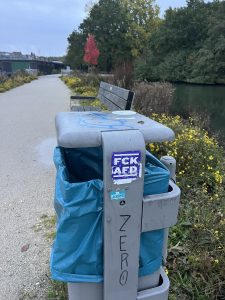
Since reading about the rise of Germany’s far-right political party, the AfD, I have been looking forward to observing how it is perceived in the country. Within our short time in Nuremberg, I stumbled across only one mention of the party – a purple sticker reading “FCK AFD.” 

The sticker was on a grey trash can on the edge of a path that cut through Wohrder Lake. I saw the sticker out of the corner of my eye. I wandered on for a few strides before processing what the sticker was and tracked back to take a picture of the message. The fact that the sticker was written in English caused me to reflect on the perception of English use in Germany.


I have not yet encountered anyone who doesn’t speak English in Germany. Granted, we have spent most of our time in touristy places, which may give me a skewed perception of the use of English here. However, the exhibit text in the Nuremberg Trials museum was in German only. Translation of physical exhibits takes up space and can affect visuals that are so important to museum experiences, but I cannot see any obvious drawbacks to providing a translation option in digital displays. 


This absence of translations was very interesting as the Nuremberg Trials themselves were translated into multiple languages in 1945 and remain of great interest internationally. Even more notable, there was a paper sign taped to the top of one of the digital displays that said “Out of Order” in English, with the German translation below. The choice to provide the English translation to “out of order” on a physical sign, but not provide an option for translation of the digital display seemed very counterintuitive. Additionally, at the Albrecht Dürer house museum, our other stop in the city, provided English translations throughout the exhibits. This lack of English translation seems to be unique to the Nuremberg Trials museum. 


When looking into the AfD’s stance on the use of English in Germany, I observed that they would like to limit or eliminate English classes in schools in hopes of preserving the German language. Thus, the choice to write the anti-AfD sticker in English rather than German seems to reflect a contradiction in language use that I would like to learn more about through the course of this trip.


The purple color also stuck out to me. When I researched “FCK AFD” stickers, they seem to come in either rainbow or black and red. The black and red stickers are characteristic German colors, as they appear on the German flag, and the rainbow colors seem to have a correlation to the LGBTQ movement, which the AfD opposes. However, purple seems like a rather random choice of color. I looked for images of purple “FCK AFD” stickers, but none appeared. This deviation is interesting to me, as political messaging in the US typically all follows a uniform font and color scheme, such as the characteristic bright red MAGA hats. I will be on the lookout to see if this deviation in political branding is typical in Germany.


Under the “FCK AFD” sticker, there is a blue sticker made of a similar material. After some digging, I identified it as a logo for the manufacturer of the garbage can. This indicates that the bottom sticker was placed on the can earlier. However, the AFD sticker is more worn, with its edges peeling off and a slash through the middle. Could this indicate that some person on their morning routine saw the sticker and tried to peel it off? Apparently, they didn’t bother to return and remove it completely.  

Upon reading about the rise of the AfD, I have been looking forward to observing how the party is perceived in Germany. Within our short time in Nuremberg, I only stumbled across one mention of the party – a purple sticker reading “FCK AFD.” 


The sticker lay on a grey trash can on the edge of a path that interestingly enough cut through the Wohrder See lake. I saw the sticker out of the corner of my eye, and kept wandering on for a few strides before processing what the sticker was, and tracking back to take a picture of the message. The fact that the sticker was written in English caused me to reflect on the perception of English use in Germany.


I have not yet encountered anyone who doesn’t speak English in Germany so far. Granted, we have spent most of our time in mostly touristy places, which likely gives me a skewed perception of the use of English in the country. However, the writing in the Nuremberg Trials museum was in German only, including an interactive digital exhibit towards the back of the museum. Translation of physical exhibits takes up space and can affect visuals that are so important to museum experiences, but I cannot see any obvious drawbacks to providing a translation option in digital displays. 


This absence of translations was very interesting to me, as the Nuremberg trials themselves were translated into various languages, and the trials are inherently of great interest internationally. What’s even more notable is the fact that there was a paper sign taped to the top of one of the digital displays that said “Out of Order” in English, with the German translation for out of order. The choice to provide the English translation to “out of order” on a physical sign, but not provide an option for translation of the digital display seemed very counterintuitive to me. Additionally, the Albrecht Dürer house museum we went to provided English translations throughout the exhibits, so this lack of English translation seems to be unique to the Nuremberg trials museum. 


When looking into the AfD’s stance on the use of English in the country, I saw that they would like to limit or eliminate English classes in schools in hopes of preserving the German language. Thus, the choice to write the anti-AfD sticker in English rather than German seems to demonstrate this nuance in language use, which I would like to learn more about through the course of this trip.


The color of the sticker also stuck out to me, as when I looked up “FCK AFD” stickers, they seemed to be uniformly colored in either black and red, or in rainbow. The black and red stickers are characteristic German colors, as they appear on the German flag, and the rainbow colors seem to have a correlation to the LGBTQ movement, which the AfD opposes. However, purple seems like a rather random change of color. I looked for images of purple “FCK AFD” stickers, but none appeared. This deviation is interesting to me, as political messaging in the US typically all follows a uniform font and color, such as the characteristic bright red MAGA hats. I will be on the lookout to see if this deviation in political branding is typical in Germany.


Lastly, I was drawn towards the condition of the sticker on the garbage can. Under the “FCK AFD” sticker, there is a blue sticker, which with some digging I identified as a sticker advertising the manufacturer of the garbage can. This indicates that that bottom sticker was on the can from when it was placed there originally, and seems to be made of a similar material as the AFD sticker. However, the AFD sticker is more worn, with its edges peeling off, and a slash that goes through the middle of the sticker. Could this indicate that some people on their morning walks and runs see the sticker and try to peel it off, but don’t bother to return to completely cover it up or rip it off? Regardless, this sticker was a very interesting insight into AfD perception in Germany, and has set me up to observe AfD rhetoric in Berlin. I am particularly interested in observing the difference in how the AfD is perceived and discussed in these two cities. 

Week 6 Analytical News Story

Eala’s rise draws a new Filipino audience to tennis

By Xavier Latimer

Filipinos who had never followed tennis are now buying tickets, streaming matches and signing their children up for lessons, a shift in the Philippines and across its diaspora that has followed almost entirely from the rise of 21-year-old Alexandra “Alex” Eala.

Before the Mubadala DC Open in August, nearly all of the tournament’s ticket requests were about Eala, its chairman, Mark Ein, said at the trophy ceremony, according to CNN. A one-set exhibition she played before the U.S. Open passed one million views on the tournament’s YouTube channel in less than a day, Tennis365 reported. In the Philippines, Decathlon told AFP that its sales of beginner racquets had risen 66 percent over the past year.

Eala was ranked 49th when she played the Australian Open in January and is now No. 18, the highest ranking ever held by a Filipino or Southeast Asian player. In July she beat defending champion Iga Swiatek on the way to the fourth round of Wimbledon, and in August she beat Jessica Pegula in the DC Open final to become the first Filipino to win a singles title on the WTA Tour. She reached the third round of the U.S. Open and won a bronze medal at the Asian Games in Japan on Oct. 1, an event she chose over the WTA’s China Open, a mandatory tournament, at the risk of a $10,000 fine.

At Home

Tennis has long been treated as a sport for the wealthy in the Philippines, where basketball and boxing draw most of the attention. The Philippine Tennis Association estimates there are fewer than 1,000 tennis courts in a country of about 116 million people, and AFP reported in August that parents were crowding their preschoolers onto the few that exist. The association’s executive director, Tonette Mendoza, told Front Office Sports that Eala’s results have made it easier to ask the government for money to build and refurbish tennis facilities.

Counting how many Filipinos watch at home is harder. WTA matches air in the Philippines on pay channels such as Premier Sports 2 through Cignal, and Spin.ph reported in March that informal Facebook livestreams, in which fans film a TV with a phone and collect small donations through the mobile wallet GCash, had multiplied around Eala’s matches to fill the gap. Much of her home audience never appears in official ratings. A clearer count may come Dec. 8, when she plays an exhibition at the 55,000-seat Philippine Arena. A full house would break the attendance record for a tennis match.

Abroad

More than 11 million Filipinos live overseas, and about 4.6 million people in the United States identify as Filipino, according to Pew Research Center’s analysis of Census Bureau data.

At the U.S. Open in September, thousands of Filipino fans filled Louis Armstrong Stadium for Eala’s first two matches, and the Associated Press reported that every seat at her practice court was taken hours before her opener, many by fans who did not have tickets to the evening session.

Jackie Chan, 46, who owns a hair salon in Queens, went to Eala’s second- and third-round matches with her parents, who moved to New York from Davao City around 1965 and had never followed tennis.

“It was amazing seeing how many Filipinos showed up,” Chan said. “You could feel the support throughout the stadium, and it made the match feel like more than just a tennis match.”

Eala lost in the third round to American Iva Jovic. “Seeing a Filipino player make it that far meant a lot to us,” Chan said. “My family will definitely keep following her.”

For some younger Filipino Americans, following Eala has become a way into the community as much as the sport. Nicolas Wright, 20, a sprinter at the University of Connecticut, started watching her at watch parties hosted by the Filipino student club on campus.

“I’m only half Filipino, but being involved with the Filipino club at UConn has helped me connect with that side of myself,” Wright said. His family now watches her together during big tournaments. “It’s something that gives us another reason to connect with our Filipino side.”

In Stockton, California, Eala’s following reaches back to one of the oldest Filipino American communities in the country. From the 1920s through the 1960s, the city’s Little Manila neighborhood held the largest Filipino population outside the Philippines, until most of it was torn down to build the Crosstown Freeway. Rhonda Ureta-Villalos, a fourth-generation Filipina American who has chaired the board of the preservation nonprofit Little Manila Rising since 2015, said her father, who was born in the Philippines, hears from relatives there that they have been watching more tennis because of Eala.

“Historically, I wouldn’t say tennis has occupied the same place in our community that basketball and some other sports have,” Ureta-Villalos said, pointing to the cost of equipment, courts and lessons.

“Our community has always had talent, ambition, and determination,” she said. “Seeing someone like Alex succeed helps make that visible to a much wider audience.”

What Comes Next?

Whether these new fans are following tennis or following Eala is still an open question, and her results have slipped since New York. She lost in Singapore to Tatiana Prozorova, ranked 180th, and in the Asian Games semifinals to China’s Wang Xiyu, ranked 85th, a loss that also cost her the automatic spot at the 2028 Los Angeles Olympics that came with a gold medal. This week she lost her opening match at the Wuhan Open.

The tennis association is betting that the children now filling courts will keep playing either way. Mendoza said it is working with World Tennis to certify more coaches and is trying to bring tennis into the country’s public schools.

Blog 10.13

I’ve been waiting for someone to call out Nigel Farage for being, quite frankly, an idiot. Since studying in the US, I have had a much better grasp of American politics than of my own country’s (British politics). I actually learned more about Reform UK through social media, which pairs perfectly with Ayala Panievsky’s chapter on how social media and journalism are a perfect way for populist parties to launch their popularity. However, the reels that came up on my feed were anti-reform, parody videos where people acted out what people who voted for reform are like. Every single one of them blatantly mocked a potential lack of education. I found this chapter incredibly interesting after the interview I conducted with the German Professor Barbara Nagel for my analysis piece. She talked about how populist parties thrive on creating irrational arguments because it’s so much more fun and so much easier. You can quite literally bend anything, in fact, to work in your favour, and because the argument is basic and simplistic, uneducated people should follow. When Panievsky brought up Emily Maitlis’ interview, this directly reminded me of what Professor Nagel had told me. Dr Gorka had so much fun destroying the BBC on live television, even if he didn’t believe what he was saying himself.

Additionally, I actually had no idea that Farage had been on I’m a Celebrity Get Me Out of Here, and to gain traction for all the wrong reasons. It’s such an unserious show; it’s meant to be for celebrity actors, comedians or television personalities, so the fact that Farage, a politician, was on there is laughable. I actually remember when Boris Johnson’s father, Stanley Johnson, I believe, went on the show; he was made a laughingstock, and then a few years later, we were stuck with “Bojo” leading us through the pandemic.

Another part of the reading which I found myself underlining was the AfD being declared by the German domestic intelligence agency as right-wing extremist and an anti-constitutional organisation “which has Nazi roots,” (81) and that the DJV “suggested that media outlets should use clear warning labels in all their articles about the AfD, similar to health risk warnings on cigarette packets.” (81) This reminded me of the times when Trump was banned from social media for posting heinous things, and how he is a convicted felon, and how is he also the president of the United States. Panievsky reflects a similar sentiment in her interview with the journalist, who asks, “How can this person be our prime minister?” (87) when referring to Netanyahu. But she ends up being just as bad as everybody else by reposting his replies. So it is a constant cycle that is being fed, like CBS claimed to have raked in the money when Trump voiced his heinous views on their platform. Then she goes on to talk about journalists who take a centre view, so they are not anti-MAGA in the public view. But surely that undermines everything they stand for in the industry? Integrity is so important; they can’t let that go just because they think their views might slip. Again, Panievsky later talks about strategic bias and how “journalists knowingly slant the news to favour one candidate, party or political camp regardless of their personal beliefs” (102). It’s the “regardless of their personal beliefs” that stumps me. Why do they choose to do that?

Panievsky really gets us thinking about certain aspects of journalism, politics, and mainstream media in a way I wouldn’t without prompting. I wonder what journalists thought of this book, since she blatantly calls them out for their lack of integrity in the field.

« Older posts

The McGraw Center for Teaching and Learning
328 Frist Campus Center, Princeton University, Princeton, NJ 08544
PH: 609-258-2575 | FX: 609-258-1433
mcgrawdll@princeton.edu

A unit of the Office of the Dean of the College

© Copyright 2026 The Trustees of Princeton University

Accessiblity | Privacy notice