Month: June 2025 (Page 3 of 4)

Social mobility through music?

One particular notion that has stuck with me since the visit to the Bach Archive was learning about the opportunities afforded to the choristers who sang in the Thomanerchor.

I was particularly surprised that the choristers in the first choir received sizable compensation for their work, because the attitudes surrounding paying musicians what they are worth in the modern era is highly contentious. This is to say that musicians are often paid in ‘exposure’ or are paid disproportionately to the time and dedication it takes to master their instrument or voice craft. Further, this point was particularly salient to me as I grew up singing in children’s choirs where my parents paid for me to be in the choir and receive musical instruction and training. As such, the fact that the choristers were paid handsomely enough to be able to afford university tuition upon completion of high school was incredibly surprising as it indeed serves as a means for upward social mobility through music. And whilst this does exist to some extent in the 21st century where becoming a successful musician may indeed enable upward social mobility, the age at which this happens is not usually under 18 and would not fund further education. Further, the process by which this monetary musical success is ascertained is certainly not institutionalized as it was in Bach’s day.

I also think that whilst monetary compensation was only offered to those in the first choir, the other boys were receiving free musical training, which was evidently quite comprehensive if it was training the choristers to be able to sing complex pieces composed by Bach with a rather short turnaround of a single day of rehearsals/practices. I also have personal opinions about the value of being able to sing and understand music and how it just generally enriches your life and I can imagine this must be true if you are living in a society in which art and music is incredibly important.

However, I think that the larger and more salient takeaway that I garnered from learning about this was the importance that music held in Leipzig and broader German society at the time. Indeed music is still important in Germany given the long term monetary grants avaliable to support conservation of the arts and of the strong German tradition in the arts.

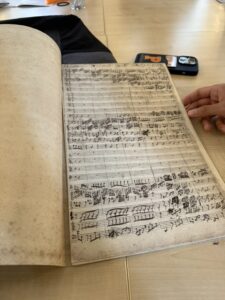
Bach's ManuscriptBach Archive

German Architecture and Gothic undertones

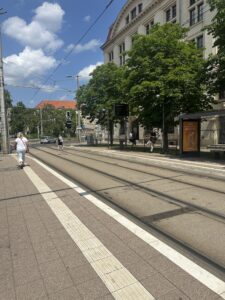
As a newly declared structural engineering major, I promised myself that I would truly explore German architecture and infrastructure in Leipzig. It doesn’t take an engineering student to see the incredible efficiency of the tram system. I was blown away by the fact that the tram tracks are above ground, and on the same streets that cars traverse. This might just be the inefficiency of Atlanta public transit, but I was absolutely amazed. The frequency and cleanliness of the tram system is something I will definitely be sad to leave.

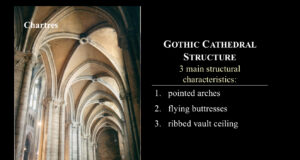
More on German architecture: Upon first arriving in Leipzig, one of the first activities we did was a tour. The “English-Speaking” (A1) group got to go inside of both Nikolai and Thomas Kirches. While inside Thomaskirche, Tendekai and I shared our thoughts. We exchanged a moment where both of us started spewing knowledge about either German architecture (in my case), or visually interpreting the organ pipe sizes (I was quite amazed about how much he knew on the subject entirely). The contrast in both of our thoughts was hilarious, but also showed how many differing parts and perspectives can come from one work. This past semester I had the opportunity to take a Civil Engineering class called “Bridges”, but we also studied tons of European vaults, buildings, domes, etc. One lecture from that class that I thought of immediately was Lecture 12: “The Gothic Cathedral and the Skyscraper”. The Goth festival (amazing to see while exploring this weekend) being this weekend aside, the insights from that lecture allowed me to see some architecture inside of Thomaskirche in a new light.

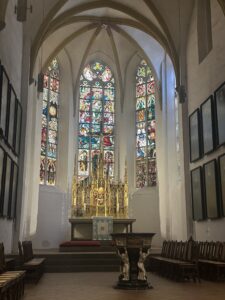
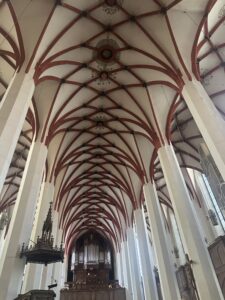
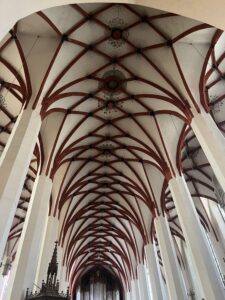
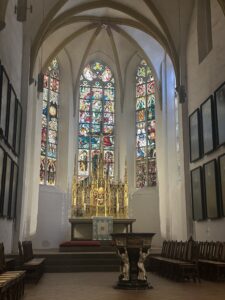
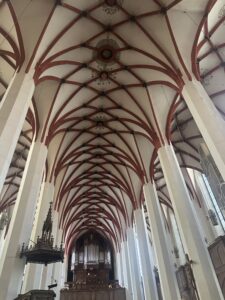
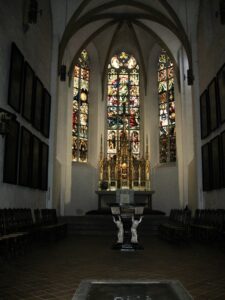
To me, the ceiling of Thomaskirche was enthralling. To make it brief, it featured numerous pointed arches(very visible in the stained glass picture), flying buttresses(those white pillars you can see in the picture), and a ribbed-vault ceiling that features diagonal braces for a more stylistic approach. Long story short: if you ever see me looking up at the ceiling randomly, these terms are bouncing around in my head. I find it so fun to discover more about German architecture while exploring the city, and I can’t wait to explore more musically and historically important buildings while also keeping my eyes peeled for architectural insights!

P.S. Am I saying there are undiscovered links between Gothfest and Bachfest in Leipzig….? That will remain to be seen….

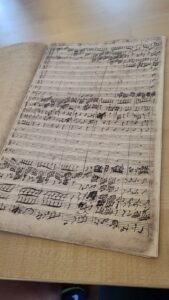
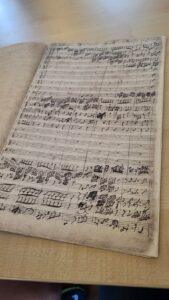
Bach's Manuscript

I think everyone could tell how blown away I was after our seminar with Professor Wollny—I really enjoyed it. One thing that made my heart burst was realizing that I had actually played BWV 33 “Allein zu dir, Herr Jesu Christ” on continuo (bass) with Vito on baroque viola and the Early Music Princeton choir. I was truly amazed. But what really caught me off guard was learning that Bach originally wrote it in G minor, not A minor like it’s commonly performed today. Seeing the copies with all of his edits, scribbles, and crossed-out endings made me realize just how hands-on and experimental Bach was. It makes me wonder what the piece would have sounded like if he had kept some of those first ideas.

After finishing the first week of readings, and especially hearing Professor Wollny talk about Bach’s personality, I started to rethink the image I had of him. I used to think of Bach as really serious and almost untouchable. But now I see him as someone who could be funny, playful, and even a little rebellious. That came through both in his music and his life. Marshall explains in Young Man Bach, Bach had a temper, stood up to his bosses, and even once got into a sword fight with a student. He was also an orphan by age 10, which might have made him guarded and fiercely independent. It’s like he was constantly pushing against limits.

I’m not sure if the Bach that’s presented in Leipzig today—through statues, concerts, and museums—is always the full picture. Heller writes in Music in the Baroque, Bach’s image has been shaped over time by nationalism and tradition. We get the “great master” version of Bach, but not always the everyday, cheeky guy who made jokes in his Coffee Cantata or experimented with different keys. It’s easy to market the genius, but harder to show the full, messy, human side. I’m glad this seminar is helping us explore all of that, it makes me love his music even more.

I left so inspired that I decided to sight read the chorale from Bach du Großer Schmerzensmann on the bass. Doing this, I hope I can continue to adjust to this massive five string and help improve my intonation.

EE9ED5D7-BA55-4A62-A988-864777BA4784

at the Archive – Performance practice

I’ve spent a lot of time studying Bach, but I learned so much at our session with Professor Wollny yesterday.  Those little account books that he showed us were really remarkable.    Princeton manages dozens and dozens of endowed funds that make many things possible for us — including this trip—but here we see how it worked in the sixteenth and the seventeenth century!  Imagine having motets sung in your name for hundreds of years!  I was also very excited about Peter Wollny’s project concerning performance practice in Bach.  It is exciting to know that there is still so much we can learn — and to remember that performance traditions are never static — there’s one “authentic” to play Bach.   Changes in dynamics, articulations, scoring — all of these things make a differences, and I’m sure he was sensitive to the abilities of his players, the spaces in which he was performing, and that his notions about what made a good performance changed, much as ours do.


I hope you will take some time to listen to multiple recordings of the pieces that we are studying — and see the kinds of performance choices that different groups are making.  I will add as many as I an to the class playlist!   If you find some interesting performances or have comments about some of thee ones we’ve posted, feel free to respond to this post!


Kirchen!

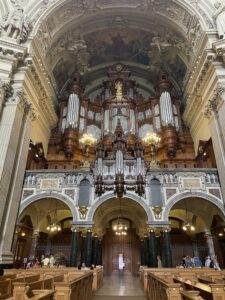
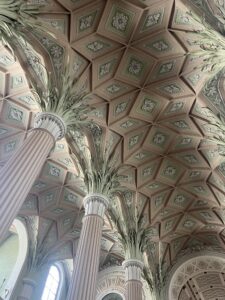
This is a photo taken of the ceilings of the Nikolaikirche and Thomaskirche during our walking tour yesterday.  Both were very grand although the Nikolaikirche even more so. It even had balconies with their own pews! Can’t wait to see concerts in both.

« Older posts Newer posts »

The McGraw Center for Teaching and Learning
328 Frist Campus Center, Princeton University, Princeton, NJ 08544
PH: 609-258-2575 | FX: 609-258-1433
mcgrawdll@princeton.edu

A unit of the Office of the Dean of the College

© Copyright 2026 The Trustees of Princeton University

Accessiblity | Privacy notice