Month: June 2025 (Page 1 of 4)

Thoughts on the Coffee Cantata Concert

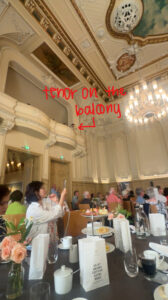
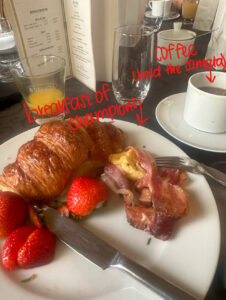
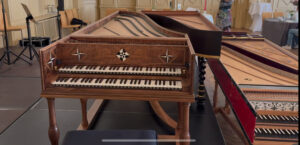
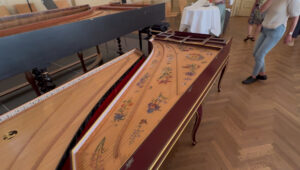
Friday, June 13th (ooh ominous), I had the chance to attend what ended up being one of my favorite experiences so far in Leipzig. The rather unassuming street entrance just off Richard-Wagner-Platz led up several flights of stairs to an ornate Baroque-style hall. Over a rich coffee-breakfast, early music students from the Hochschule für Musik und Theater in Leipzig performed a spirited, genuine, and very well-prepared concert. There were assorted vocalists, string players, and wind players, and four beautifully decorated harpsichords, each with two manuals, much to my delight as a harpsichord owner and (aspiring) harpsichordist myself. The first part of the program was filled with various ensembles ranging from accompanied soloists to full chamber orchestra, including, at one point, all four harpsichords playing at once! Especially notable was the trumpet player who performed virtuosically on a natural (i.e. valve-less) instrument, no less. I cannot fathom the precision required to leap about and perform ornaments and trills on such closely placed partials. My ears are not accustomed to the 4th being tuned that high the 6th being tuned that low, so the instrument has a slightly unusual sound to me, but I very much enjoyed it.

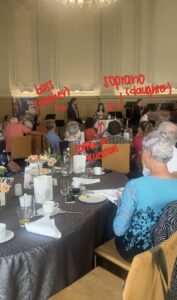
The main attraction, however, was J.S. Bach’s Schweigt stille, plaudert nicht BWV 211, known as the Coffee Cantata. A tenor narrated from a balcony overlooking the hall while a soprano and bass acted out the humorous story of a father’s attempts to separate his daughter from her one true love: coffee. All of the performers were fantastic, but to me, the soprano stood out. Her voice was light and agile, but also effortlessly filled the hall and her dynamic control was also fully on display in impressively executed messa di voce. Overall, the students proved to be quite skilled technicians but also imbued the music with a fresh vitality. I felt a sense of transparency and authenticity, that kept me engaged through the whole program. I often have this experience when listening to ensembles of young musicians, where the music somehow feels much more alive to me than it otherwise would.

This experience was also made more memorable by the kind woman sitting next to me who was keen to practice her English and insisted on providing me translations of the musicians’ remarks. All in all, it was just about the best way I could imagine spending my breakfast.
Malcom’s Musings – Konzert 1 – Concerto Nr.20 Kantaten zum Sonntag Jubilate.

On Friday, June 13, 2025, at 8 PM, I had the unique opportunity to experience a performance of Bach’s cantatas, notably one titled “Nr. 20 Kantaten zum Sonntag Jubilate.”

From the very beginning, the atmosphere felt theatrical, brought to life by the soprano’s singing alongside the first instrumental soloist. The initial chorale was captivating; after an energetic opening, there was a noticeable slowdown, allowing me to savor moments of caesura. It was during these reflective pauses that I truly began to appreciate the power of sound—so soothing and relaxing that my mind hovered just beneath the threshold of peaceful sleep. I yearned to understand the language of the music, and though my comprehension was limited, I was eager to learn. I envisioned a day when I could fully embrace the depth of Bach’s work.


As the performance continued, I perceived the serene beginning as a subtle river, flowing gently with waves of melody rather than explosive crescendos. When the singers joined for the first chorale, the emotional intensity surged, igniting a fire deep within my heart. The sound swept above my diaphragm, filling the space with sweetness and calm, lingering in the air like an unspoken presence. The soloists created an atmosphere that allowed me the freedom to process my thoughts, evoking a sense of ease amid their performance. 

It was remarkable to observe one of theviolinists skillfully reading their music while effortlessly gracing us with smiles. The connection between academic study and musical performance became increasingly unclouded, and I found myself reflecting on how dedicated scholarship can deepen our understanding of such a rich heritage. 


The applause following each movement was infectious. The energy in the room transformed with every pause, urging spontaneous cheers of encouragement as the violinist took brief moments of respite. The rhythmic backdrop of the orchestra flowed seamlessly, inviting us on a journey that felt endless, full of discoveries and realizations. Even the most irritable spirits could be comforted by the mesmerizing “bum bau bum” section.

I marveled at how musicians resisted the temptation to relax despite the soothing quality of the music. Each section held its softness yet remained controlled, allowing me to discern the nuances of major and minor harmonies. Observing one of the singers, who walked in place as laughter echoed softly among the audience, I contemplated the production’s effort to connect modern listeners with those who experienced Bach’s music in the 18th century, especially during those cold winter mornings when survival was the priority.


My thoughts drifted to the question of whether they ever considered how the conditions of the past—temperature, seating arrangements, historical context—might have influenced the experience of the music. Yet, here we were, viewing it all through a contemporary lens that could never fully capture the past. It was heartening to realize that scholarship sought to bridge this gap, emphasizing the importance of appreciating the music within its original context.

As I continued typing my thoughts, I couldn’t help but be impressed by the unwavering stamina of the vocal soloist. Even amidst my focused observation, the grand pauses that erupted throughout the performance drew me in. For the first time, I noticed how one blows the flute from the side, not the end; it struck me that there were over 1,500 musical instruments in the world. This orchestral mosaic was a testament to the classification that my high school teacher, Mr. Nyathi, had encouraged us to comprehend. Seeing the brass, woodwind, string, and percussion instruments come together was a beautiful realization, far beyond simply earning a good grade in a niche subject.

The transitions between instrumental and vocal soloists added layers to the overall experience. Amazingly, when I thought the performance might draw to a calm conclusion, the music would swell again, leaving me in awe of the heavenly artistry unfolding before me.

That night, my roommates explained to me that groups of performers go in the order “solo, duet, trio, quartet.” I then discovered “quintet, sextet,” and even more! Having been able to draw back on everything we’d learned in the first music seminar with Dr. Heller made me realize that I was truly learning, even if I barely knew how to read sheet music or analyze the performance as my professor did in class.

As a sports enthusiast and chess commentator, I’ve always appreciated how field-specific terms capture the core of the activity performed. My perspective is that once you know those, you not only describe how you feel or see, but how you believe it comes alive, which is another whole realm where captivating discussions also spring from. However, as Gabrielle said to me the next day, “You have to start somewhere.” I agreed.

Belated Thoughts on the Cello Suites

Before taking this course, I was not super familiar with the music of J.S. Bach, and in fact the only piece of his I had ever played was a portion of his third cello suite arranged for viola. As a result I did have some idea of what to expect going in, but seeing these pieces performed live has completely changed my perspective on them.

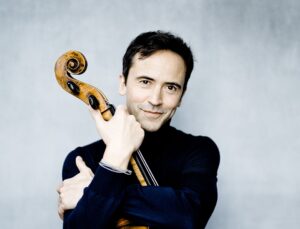
On Tuesday, June 17th, we went to the Thomaskirche to see the suites performed by Jean-Guihen Queyras, who I thought overall did an excellent job. One of the first things that struck me about the performance was something we had discussed in class, which was how the suites are all collections of dance movements. Though, as we talked about, they would be near impossible to actually dance to, it was very clear how their composition and performance were informed by these different dances. The complexity and liberties taken with tempo throughout the suites make it clear that they are meant as performance pieces and would not likely be danced to. This is particularly evident in the later suites which are more technically challenging and would be extremely difficult for a dancer to follow. However, the way Queyras performed the suites still seemed to keep in mind the spirit of the dances.  I especially noticed this in the Allemande from the third suite in C major, as the lightness with which Queyras played this movement definitely allowed the listener to feel a pulse reminiscent of dancing. I also noticed this in the Minuets from the first two suites, his light and clean playing combined with a slight emphasis on beat one created a feeling of lifting up which is characteristic of minuets and makes the dance elements very clear.

On further reflection, I tried to imagine what a different interpretation of the suites would sound like without this characteristic lightness and a more “virtuosic” and heavy tone, and I do not think it would work as well. Not only was Queyras’ performance leaning into the dance elements of the suites, but the way they were composed seems to make this approach necessary. Trying to take too many liberties and make the pieces fit a style where the soloist is clearly the main focus would only make them sound unnatural, and instead a balance must be struck between interpreting them originally while not straying too far from the uniform and light nature of dance pieces. I think Queyras overall did a great job of finding this balance, especially in the first three suites.

Another interesting aspect of this performance is the repeats which occur in almost every movement of every suite. These again contribute to portraying the pieces’ origins in dance, as the repeats make them more uniform and, well, repetitive, which would be important for people to latch onto and dane to a piece. In Queyras’ performance he did not take all of the repeats, which is understandable as this would have made the performance longer than is practical for the audience or for Queyras himself. It also does not take much away from the performance, as he took enough of the repeats to still convey the sense of dance. However, I do feel that some of his choices of which repeats to take were rather random and there were times where he took repeats which I did not expect him to take and vice versa. I feel like a more consistent approach to which repeats to take would have made the performance a little more cohesive and natural, but this is not a huge issue and I still enjoyed the performance quite a bit.

Final Reflection

The final days of the Princeton in Leipzig program were some of the most chaotic I’ve experienced in a long time. Between slipping and twisting my knee, speaking broken German with paramedics, hydroplaning in an Uber, scrambling for a last-minute ICE train after my flight was cancelled, and then sprinting through the airport only to find the gate closed four minutes early due to an extended security screening—I’m not entirely sure how I made it home in one piece. These are not the memories I plan to hold onto, but they do underscore how unpredictable and disorienting travel (and life) can be, especially at the end of something so meaningful.

Looking back on the final recital, however, I’m filled with gratitude. I performed three pieces: the Allemande from Bach’s Third Suite, transcribed in G Major for double bass; a trio in C Major with Maurice on cello and Vito on viola; and The Art of the Fugue No. 5, alongside Charlotte on violin, Vito on viola, and Maurice again on cello. Each ensemble offered something distinct, but the trio in particular surprised me with how naturally the instruments blended. There was a warm, grounded texture to the sound that felt effortless and deeply rewarding to be part of.

The Allemande was, without question, the most personally challenging. Not because of the notes on the page — although Bach leaves no room for hesitation — but because solo playing still brings a kind of internal resistance I’m learning to overcome. Ensemble work comes more naturally to me; there’s safety and energy in collaboration. Playing alone is a different conversation. In preparation, I did everything I could to stay grounded: hydration, breathing exercises, walking, and even a slightly excessive number of bananas. I also tried pushups as a way to flush the nerves, but strangely it was effective.

The performance as a whole was deeply fulfilling. I particularly appreciated hearing the gamba sonata performed by James on bassoon. It inspired me to explore the piece myself, especially given the bass’s lineage in the viol family. It’s a reminder of how fluid and adaptable early music is — and how much more there is to explore.
The recital venue offered beautiful acoustics, which required restraint. I’m not often in spaces of that size, and learning how to let the sound breathe rather than over-project was a valuable lesson in itself. Performing Jesu, Joy of Man’s Desiring to close the evening was a perfect conclusion — a piece I’ve long loved, and one that felt amazing.

Our group came together the following evening for a celebratory dinner — a chance to unwind, reflect, and connect beyond the rehearsal room. We shared stories, laughed about our rehearsal blunders, and exchanged photos. It’s rare to feel so connected to a group in such a short amount of time, but this experience brought us together in a truly meaningful way. I leave with not just stronger musicianship, but with friendships I genuinely value.
This program has reaffirmed many things for me. That Bach’s music is inexhaustible in its beauty and challenge. I am grateful to the Princeton German Department, the music faculty, and every musician and mentor I encountered in Leipzig. And I hope to be back soon!

Kaffeehaus Kultur

If you know me, you know I love coffee. However! I am not addicted to caffeine. How can this be? I grew up drinking coffee since I was 6 years old (maybe when I was 6 it was mostly milk, but it was still my job to brew the coffee every morning). My mom began drinking coffee when she was 5. While this may not be normal for most American families, my mom’s side of the family is Colombian, and there’s much less stigma related to coffee there. Plus, it’s typical to add cinnamon! This practice did not turn into a caffeine addiction because due to having ADHD, I actually experience the opposite effect from coffee — it makes me sleepy and calms me down. So, if I don’t drink coffee in the mornings I don’t really feel a difference at all because after all, it’s always been more of a social and cultural activity for me.

Okay! That was a lot, But that background brings me here, to Germany, where I have quickly fallen in love with the culture of “Kaffee and Kuchen” on Sundays. I like the idea of one day each week being a Ruhetag, and as someone who’s not very religious, I appreciate how it’s done in Germany. Businesses except for cafes and ice cream places are closed, and the expectation is that you’ll sit (preferably outside) with friends and family and exchange gossip or “Kaffeeklatsch.” Clearly from having read about and listened to Bach’s coffee cantata, coffee and coffeehouses have held important social roles for quite a while. In fact, how long coffeehouses have been around is fairly fascinating to me (and maybe this is just an amazement of how much older many buildings in Europe are than in the US), but Cafe Riquet (where our one on one German sessions are being primarily held) was founded in 1745 — a year before Princeton was founded! When I decided to first check it out on my own, I felt a bit like a fish out of water after realizing that I was the only person with a laptop out, working. To be fair, this was on the holiday we had off, but I still haven’t seen too many people working in coffeeshops when I walk around town (which is quite often). While working in a coffee shop is definitely my happy place, it’s caused me to wonder how the same exact spaces are treated in different geographic locations. I wonder what it must feel like to go to a US coffeeshop on a Sunday (or any day) and see almost everyone with their headphones in, bent over their computers. It does stress how we as Americans can be quite individualistic and perhaps more antisocial than other regions where rest time is more built into the weekly schedule.

Wondering where these traditions all began, I decided to read a bit more about German Kaffee und Kuchen. I began by reading an article from the Goethe Institute called “The Culture of Coffee.” It starts with an interesting account from a student named David who grew up in Germany and left to attend the University of Minnesota for college. He remarks that in contrast to to-go cups in the US, many german coffee places serve you your drink on a porcelain cup which means you’d have to take your time and finish your drink before you leave the coffee house, forcing you to slow down. He also remarks that coffee is treated as more of a stimulant in the US (students would drink it to perform better in class, feeling a dependency on caffeine) whereas coffee in Germany was drank more for enjoyment or as a social activity.

Next, the interviewer speaks with a local expert in Berlin: Jochen Hintze, the owner and founder of JOcaffè Rösterei und Maschinen, which is a shop roastery. He notes that his favorite aspect (aside from the coffee and a good Kenyan roast) is the way that people who live in the same neighborhood get to know each other through the coffee shop. In my experience, I have almost never met someone new at a coffee shop and stayed in touch. Places like Small World and Sakrid function more for maintaining pre-existing relationships or running into friends which has its own positive aspects, but I find it interesting that meeting new people seems to be more associated with coffee shops in Germany.

Next, Hitze begins explaining that another term for Kaffee und Kuchen is ‘Konditoren gehen’ because the tradition used to be centered on visiting a cake shop called ‘Konditorei,’ getting a slice of cake, and having a cup of coffee. He also talks about the shift in coffee culture from the mid-80s to the arrival of Starbucks in Germany. Surprisingly, he describes it as a positive shift in bringing back coffee culture as it encouraged people to leave their houses to get a cup of coffee.

Upon return to the US, I will definitely continue enjoying Ruhetag on Sundays and inviting my friends out to Kaffee und Kuchen perhaps at Small World, perhaps somewhere else.

https://www.goethe.de/prj/tbp/en/bpa/cul.html

A night at the Gewandhaus

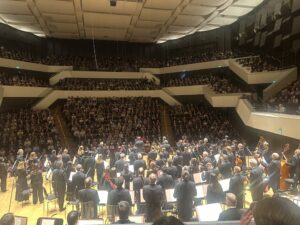
This week, I attended a concert at the Gewandhaus Leipzig: an impressive building and performance space that felt just as important to the experience as the music itself. The hall is designed in a way that draws you in: the stage is central, and the audience surrounds it from every side. Our seats were directly in front of the conductor, and we were close enough to read the musicians’ sheet music. That kind of proximity made it easy to feel connected to what was happening on stage, which almost felt like being a part of the music-making process.
The program featured three works:

Johann Sebastian Bach – Concerto for Three Pianos and Orchestra in D minor, BWV 1063

Arthur Honegger – Symphony No. 2 for Strings and Trumpet, H. 153

Johannes Brahms – Symphony No. 4 in E minor, Op. 98

Bach’s concerto opened the evening with an unusual and exciting setup: three grand pianos in a triangular formation. After the performance, one of the pianos was lowered from the stage through what I could only describe as a trap door, which made for a theatrical (and unexpected) moment. Beyond the visuals, the pianists themselves were deeply expressive. It can be hard to physically convey emotion through a seated instrument like the piano, but all three performers found a way to make their interpretations visible through body language and phrasing. It was very engaging and fun to watch.
The Honegger piece stood out for me as the most striking part of the program. The string writing was rich and layered, with a tension that slowly built throughout the piece. From the beginning I felt captivated, like there was something I was waiting for, but I did not want it to end. I didn’t know much about Honegger before this performance, but now I want to learn more. This work was absolutely beautiful.
The final piece, Brahms’ Fourth Symphony, was powerful and beautifully performed. The brass section played with warmth, and the entire orchestra felt very unified. It’s crazy to think that a band and orchestra, two very different sounds, can come together into such a harmonious body. It’s easy to hear why this work is so well-known—its balance of complexity and emotion is something I’ve come to appreciate more the deeper I get into performance and analysis.
Overall, this concert reminded me how much more I notice in live performances now than I used to. Being a musician and leaning more into my ear for music when attending a performance has changed the way I listen. There’s more awareness of detail, effort, and nuance. Watching professionals perform at such a high level was both inspiring and motivating, and it’s definitely a night I’ll remember.

Bach Mass in B Minor

Sunday, June 22nd — I finally heard Bach’s Mass in B Minor live, and I don’t think I’ll ever be the same.

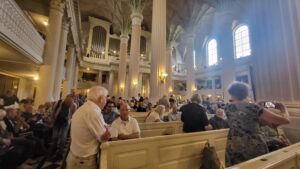
I should start by saying I wasn’t emotionally prepared. I knew it was going to be breathtaking — it’s Bach — but I didn’t expect to be sitting there, score open on my iPad, feeling dizzy because the sound was coming from behind me. I had no idea the ensemble would be positioned that way, and trying to follow along while the music surrounded me in reverse stereo was… disorienting at first. But once I settled in, I was locked in. The acoustics were incredible, (I feel that 415 carries better than 440 or 442 and I don’t know why, it just resonates more) — every line rang out with this resonant clarity, and the voices cut through the space in a way that made it feel like the soloists were right beside me. I couldn’t believe how powerful and immediate the vocal projection was in such a huge space.

But what really moved me was the Sanctus.

I was teary-eyed. That movement already holds a strange place in my heart. The first time I ever heard the Sanctus was a few months ago, during the announcement of the new Pope on television. (For the record, I’m not Catholic — I just knew the chances of witnessing a papal election again in my lifetime were slim, especially since the current pope is relatively young. But I’m getting off topic.)

They (the Vatican ensemble) played the Sanctus during that moment — this overwhelming, cosmic-sounding chorus erupting as the new Pope stepped out onto the balcony. Even without context, that music hit something in me. And hearing it again now, live, with that same transcendent force — in a church, no less — was honestly too much. I was holding back tears while pretending to casually scroll through IMSLP so that Lucien or the older lady next to me wouldn’t see.

It was holy in a way that goes beyond religion. It felt like the heavens cracking open for a second. Bach somehow found the sound of awe itself and wrote it down.

That moment alone would’ve been worth the entire concert. But the truth is, the whole Mass was full of moments like that where time slowed, and where music spoke louder than language, where I remembered exactly why I love baroque music and Bach.


Re: Bach Suites

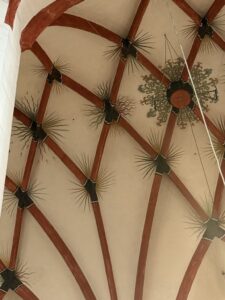
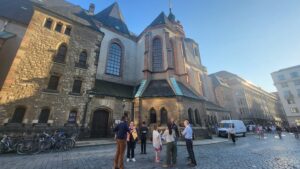
Tuesday, June 17th — This concert of all six of Bach’s cello suites took place in the Thomaskirche, and this was my first time seeing the interior. I found it to be much more rustic and plain than the beautiful and fancy-looking Nikolaikirche. The patterns on the ceiling of the church were very unsettling to me (see below) and I much prefer the aesthetic of the Nikolaikirche.

Moving on to the performance, though Jean-Guihen Queyras is a cellist whom I have never heard of before, his performance was compelling and beautiful.

It was a night full of surprises — First of all, I expected to enjoy the latter three suites much more, however that was not the case. I think that he played the first three suites much better than he did the latter three — not only were they more technically accurate, but also the phrasing was more convincing for me.

A few musical choices that I want to highlight:

In the D minor (2nd) suite Menuet I, Queyras chose to pizzicato the first half, the first time he played it. The second time through he played it normally (arco). This is (at least for me) completely unheard of and I must say, I was not the biggest fan. Now, I will say that because of the nature of the concert (the continuous performance of the suites and the amazing resonance of the church),  in some ways it worked and at the very least, definitely added a great deal of contrast.

Also in the D minor (2nd) suite but this time the Sarabande, I heard some strange notes near the end of the movement, the second time through. At first I thought it might be possible that he just played the wrong notes, but after discussing with Ruth, I realize now that it was a melodic choice — again, not necessarily one that I agree with, but definitely interesting.

Lastly, I was more than anything curious about Queyras’s choices regarding repeats. He took some and not others — there was no detectable pattern and seemingly no clear reason why he took some and not others. For reference, when performing the suites, it is standard and acceptable to play all the repeats, none of the repeats, or sometimes just the first or just the second repeat. However, in the case of last night’s concert, for some movements, Queyras took both repeats, some he took none, and others he took one of the two. If I had gotten to talk to him after (which I could of, but I was hungry :\ ) I definitely would have asked him about his choices. It is even a possibility that he simply decided on the spot if he would take a given repeat based on how he felt, how tired his hands were, or even if he felt like he wanted another chance at a section of the music.

This was a performance full of interesting and unexpected choices. Overall, I enjoyed the concert and learned from it — though in some cases I learned what I do not like.


The Concert Experience!

Having the opportunity to scrutinize, analyze, and appreciate the musical and textual choices made by Bach before each concert has enhanced my experience as an audience member astronomically: I have come away with a much better understanding of how to be an engaged listener and an enhanced appreciation for musical interpretation.


Moments that were of particular note to me in the Canata concert were the way in which the words“Weinen, Klagen, Sorgen, Zagen” extended into each other for a little longer than Bach wrote in his score, perhaps to prolong the sense of grief evoked in the listener. I was surprised at the choices made with the words “Angst and Not” – initially more tentative, but, when repeated, more aggressive. I was impressed, later in the same Cantata, at how the singer was able to make the wavering “ei” melisma in “alle Pein”sound so much like great suffering, a feature that can only be realized during live performance. I also enjoyed the duets I could hear between the picollo and the soprano during BWV103, which was more playful than I had expected given the theme of pain and suffering that pervaded the three Cantatas (although, notably, this aria was about healing!).


I was a little surprised by the more dramatic interpretation given of the St. John Passion. For instance, the bass singing the part of Jesus was more expressive than I expected, using his hands and facial expressions to enhance his performance. The tenor who sang the aria following Jesus’ condemnation to death was incredible, although again more dramatic than I expected him to be – I in fact appreciated this break from the more sombre, less expressive mood of the piece. It was also interesting to notice the movements for which the soloists would come out front as opposed to staying with the rest of the chorus (which I thought was possibly linked to Professor Heller’s proposition on the role of time in the St. John Passion, although this was not always the case – at one point, the singer voicing Jesus came out to the front). I was also interested to notice that the theme from the initial soprano aria kept returning in the chorus’ line — perhaps Bach was trying to blur the boundary between what it means to be a good believer versus how easy it was to fall into the trap of condemning Jesus to death.


Finally, it is so cool to be able to attend these performances in the places Bach might have come up with many of his ideas!! It felt particularly awesome that I had been in Weimar the very same day as I attended the “Art of Dying” cantatas alongside Ruth and Vito — BWV161 was initially written and performed there!!


In all, having had the opportunity to go over the music before the concert greatly enhanced my listening experience, and I am looking forward to putting this skill to use in my future concert-going endeavours.

Coffees and Cantatas

If you told me a few months ago that one of my favorite mornings in Leipzig would involve opera-style improvisation, free croissants, and a dive into 18th-century caffeine politics….I probably would’ve believed you, honestly. But I definitely wouldn’t have imagined it would all come together as beautifully as it did at the (numerous) Cantatas performance this Saturday. Specifically, the performance of Bach’s Coffee Cantata (BWV 211) was one of those rare events where every element, music, space, staging, and even the breakfast, came together in a way that made the whole thing feel both special and surprisingly current.

The program featured Bach’s Schweigt stille, plaudert nicht (or Coffee Cantata for those uninterested in authenticity) is basically a mini comic opera, complete with a dramatic father-daughter standoff over….coffee. It was performed with wit, energy, and a creative sense of staging that made the music feel incredibly alive. The tenor(Fridolin Wissemann), who served as the narrator, delivered his part from a balcony ledge a story above and off to the side, while the soprano (Yumi Tatsumiya, playing the daughter) and bass (Lucas Reis, the father) performed at ground level in front of us. That spatial dynamic made the piece feel like it was unfolding in real time. I sat there with a cup of coffee in hand, watching this hilarious drama unfold (I even watched Vito fearfully say “nein” when the father asked him to marry his daughter. Guess he wasn’t interested in letting his potential wife drink coffee three times a day).

And speaking of the potential wife, she was brilliant. Yumi’s voice was clear and expressive, but what really stood out was her presence. Her acting was both playful and grounded, completely in sync with the tone of the piece. Afterward, I had a chance to speak with her and was amazed to hear that much of the acting was improvised. It’s one thing to perform Bach well; it’s another to bring humor, spontaneity, and emotionality to a centuries-old piece with such confidence and timing.

Even though I’m not much of a coffee drinker myself, I found the cantata’s subject unexpectedly interesting. Written at a time when coffee culture in Europe was still developing, and when women in particular were mostly discouraged from drinking it, the story becomes more than just a musical joke. The daughter’s love for coffee became a stand-in for something bigger: autonomy, desire, and resistance. It wasn’t just about caffeine, it was about access and control wrapped in clever writing and expressive music. This made watching this piece (as a woman in 2025 casually sipping coffee) feel both funny and empowering. On top of that, watching it performed by young musicians who brought their own interpretations to the roles made that dynamic feel even more layered.
There’s something delightful about starting the day with a performance like this: lighthearted, beautifully sung, and historically rich. It reminded me just how much personality and humor there is in Bach’s secular music, something that can often get overlooked next to his larger sacred works.
If this performance is any indication, Leipzig mornings are best spent with live music, coffee, and a bit of theatrical flair.

Screenshot

« Older posts

The McGraw Center for Teaching and Learning
328 Frist Campus Center, Princeton University, Princeton, NJ 08544
PH: 609-258-2575 | FX: 609-258-1433
mcgrawdll@princeton.edu

A unit of the Office of the Dean of the College

© Copyright 2026 The Trustees of Princeton University

Accessiblity | Privacy notice