Month: June 2025 (Page 2 of 4)

I Played a 356-Year-Old Bass That Bach Literally Saw and Heard!!!!!

This past Saturday was one of the most meaningful days of my time in Leipzig so far. With Princeton, I had the opportunity to attend a performance of three Bach cantatas at St. Nikolai Church — the same church where Bach once served as music director. Even more surreal was the fact that the concert was conducted by Sir John Eliot Gardiner, someone I’ve admired deeply as a baroque conductor for years. Hearing his interpretation of Bach’s music in that historical setting was truly unforgettable.

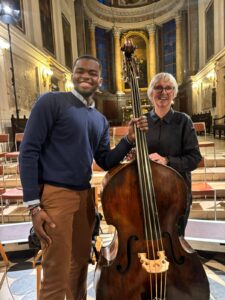
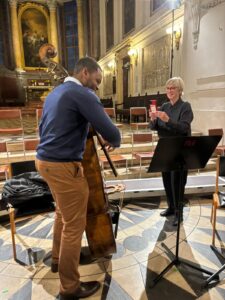
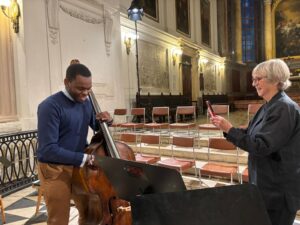
After the concert, I had a conversation with the bassist from the orchestra, and what followed was something I never imagined would happen: she handed me her instrument and invited me to play it. It was an incredibly generous gesture — and one that meant the world to me.

What I didn’t realize at first was just how special that bass was. She told me it was 356 years old — even older than the average Stradivarius — and had been used to perform Bach’s cantatas and orchestral suites during his lifetime, when he was music director at St. Nikolai. It’s very likely that Bach not only saw this bass, but also heard it in the very works he composed. I was completely stunned.

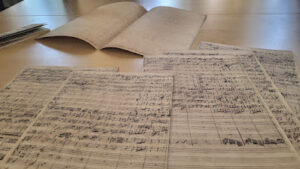
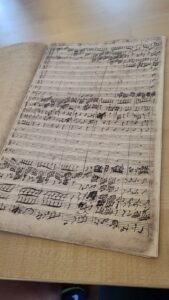
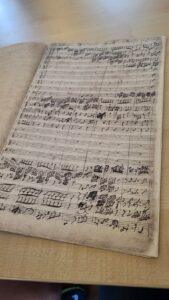
At Princeton, I’m not even allowed to touch the original manuscript of BWV 33 — and yet here I was, unsupervised, holding and playing an instrument that once existed in Bach’s sound world. It was a moment that reminded me why I chose to study this music in the first place.

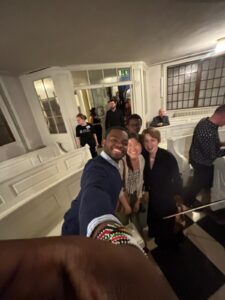
Later, I met Jenna, a violinist in the ensemble who also happens to be from the U.S., and coincidentally from the South, like me. Talking with her about life as a professional baroque musician was incredibly inspiring. She reminded me that pursuing a life in music — especially early music — is not only possible, but full of joy, curiosity, and community.

To end the evening, I had a slice of cake and an impromptu grammar lesson from Professor Rankin. His explanation of several German language points helped clarify things I had been struggling with all week. Learning German has not been easy, but I’m so grateful to have support from the Princeton German Department while I’m here — it makes all the difference.

I left the day feeling energized and thankful. So much so, in fact, that I decided to arrange a short excerpt from the third movement of Brandenburg Concerto No. 6 — just as a small way of reflecting on the joy I felt.


copy_A2A668A7-FAB1-436E-9C32-EF74A9AB1739

Bach & Biography

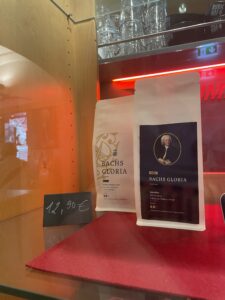
Upon my arrival in Leipzig, I noticed the ‘great man’ everywhere – from the street names, like Karl Liebknecht Straße and Bernhard Göring Straße, to the statues of figures like Leibniz, Bach, and Mendelssohn that towered over me as I walked past. It seemed to me that Bach was being used as a marketing tool: a ‘great man’ who was being used to attract tourists (for an example, see the Bach fest banner at the Hauptbahnhof). Until fairly recently, biography writing similarly struck me as a ‘great man’ venture (as discussed by Marshall, p.12). Despite the fact that I have taken several literature, history, and music classes, where I have been taught that interpretation is quite possibly the furthest thing from what can be described as ‘static,’ I could not fully grasp the idea that biographies evolve. But reading Heller’s “Postlude and Prelude: Bach and the Baroque” and particularly Marshall’s “Young Man Bach: Toward a Twenty-First Century Bach Biography” changed my mind. Both articles brought to the surface considerations that have formerly been left out of Bach studies – Marshall encouraging a psychological interpretation of Bach’s troubled childhood (which perhaps went a little too far) and Heller emphasizing the way in which humour wove its way into Bach’s life and music. The latter was further illuminated by our visit to the Bach archive during which Peter Wollny told us a fascinating anecdote about the letter of recommendation penned by Bach’s daughter! I was particularly fascinated by Heller’s attention to the coffee cantata. I have since listened to several recordings that have shifted my interpretation of humor in music, much in the same way as I have recently come to notice moments of humor in texts I formerly perceived as serious. Biography, I have realized, is not static: in the same way as we continue to interpret and re-interpret music, our understanding of the lives of the ‘greats’ evolves and adapts in different contexts. Walking around Leipzig and considering the way in which Bach is marketed over the past week, I have had time to pay attention to Bach’s shifting legacy. He is no longer imagined as a stern, overpowering figure – at the Bach Archive shop, bags of coffee are being sold with the Bach brand (see below). The very theme of the Bach festival – ‘Transformation’ – gets to the heart of this observation, lending itself to a renewed and evolving understanding of Bach’s life and works. One concert that embodies this is the Queerpassion – I would have loved to have gone to see it, but it unfortunately would likely have overlapped with our concert tonight. It seems fair to say that Bach no longer lives in my imagination as the stern, serious figure who once captured my attention. I look forward to continuing my exploration of biography as I begin reading the book Quartet by Leah Broad, which tells the stories of four overlooked female composers from the nineteenth and twentieth centuries. It is exciting to think that formerly overlooked historical figures are beginning to receive the attention they really deserve – I look forward to learning more about the women including Bach’s wives and daughters, and Christiana Mariana von Ziegler who played important and yet underappreciated roles in his life!

Leipziger Lerche

Next on my Leipzig dessert quest is the Leipziger Lerche. This pastry was originally filled with lark – that is, until the saxonian King banned hunting songbirds in 1876! Now, it’s baked with almonds, nuts, and a cherry. Unfortunately, although it has a fascinating history, I wasn’t a huge fan of the pastry itself.

[see: https://en.wikipedia.org/wiki/Leipziger_Lerche]

(Side note: I would highly recommend Quarkkeulchen, a Saxonian speciality, which I tried at Barthel’s Hof – delicious!)


Agrippina

Going to see Handel’s Agrippina last Friday was such a fun experience! This was only the second opera I have ever seen, the first being the Magic Flute, so it was quite a contrast from what I was expecting. As I’m sure the others who saw the opera will agree, it was a very interesting (and entertaining, I might add) interpretation. At the very start, the scene opens to reveal the setting of a Las Vegas casino. For an opera composed in the early 1700s, before Las Vegas existed, that was certainly quite unexpected. I was also expecting the scene to change, but it stayed on that setting for the entire opera.

Having read the synopsis beforehand and now having seen the opera itself, I wish I could go back and watch it again! I feel the first time around I spent a lot of the time trying to understand the plot (which was difficult, as the opera was in Italian with German subtitles, and unfortunately my German knowledge is not yet at the level of being able to read that quickly), but if I were to have another opportunity to see it, I would love to do more research on Handel’s original intentions when composing the opera and think about what might have inspired the directors of the production to put on this interpretation of it. It makes me think, how much of this comes from Handel himself? What does this show about who he was as a composer, and a person?

This opera is unusually NOT dark with the lack of any character deaths, but it still has a curiously light-hearted tone to it. There is a lot of anger and heartbreak and betrayal in the story, which would lead one to expect the viewer to feel more negative emotions when watching. However, the casino setting and the excessive and potentially unrealistic use of drugs and other not… kid-friendly scenes, I suppose, add a sense of comedy that does not match the usual emotions conveyed in similar stories. Going back to the questions I asked earlier, about what this opera reveals about Handel, we can also view the massive love triangle (or hexagon?) as adding a large comedic effect to the story. Perhaps the director of this specific performance saw the humor in this unrealistic situation and chose to add more elements in the story that would further exemplify the humor.

Having seen the Magic Flute last year and now Agrippina, it makes me want to go see more operas, and explore the different personality traits of various composers revealed by their works. I am also intrigued by something I hadn’t thought much about before, which is how the opera can change just based off the directors’ interpretations. In the future, I’d like to see different performances of the same opera, to compare the level of difference in various performances of the opera, and I want to consider what that reveals about what the composer intended to be portrayed in every performance.

This Weekend & More ~

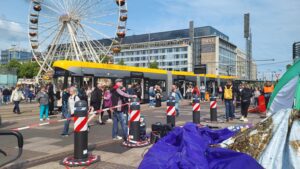
So far I have been loving Leipzig–I came in with few expectations and have been really impressed by the city.  My two favorite things: the city center and public transportation. The city center is quite beautiful and so gloriously car-free! There is so much to look at when walking around–cute bakeries, clothing shops, nice restaurants–and because of the goth festival that occurred this weekend, there have been a lot of food/drink carts, and there’s been live music playing.  I also love how there is little pattern and uniformity to the city center–there are often little alleys that lead to other shops. In terms of public transportation, I am so jealous! I wish that Chicago, or more broadly America, had public transportation that was this convenient. I especially like the street cars (Straßenbahnen).

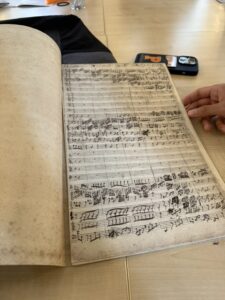
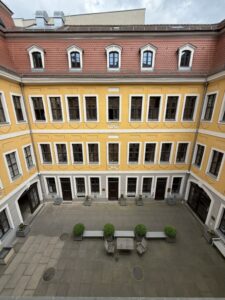
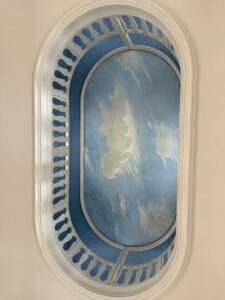
The Bach Archive was such a cool experience. Herr Wollny did an excellent job of giving us the context of each artifact that he showed us. I thought it was fascinating that when he showed us the journals of Bach, the signature displayed on the pages was originally Bach’s, but changed from Bach’s to someone else’s at a certain date, since he had someone else interact with clients as he became more well-known. The building that we were in, especially the rising hole in the ceiling that gave way to a tiny performance space, was very cool and really indicated the wealth that the owners had at the time. Seeing the manuscripts and the crossed out music notes was really neat as well. Everything we have learned about Bach so far has indeed changed my perception of Bach. I will try to approach Bach slightly differently when playing it henceforward.

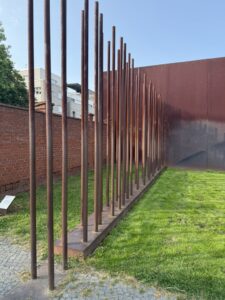
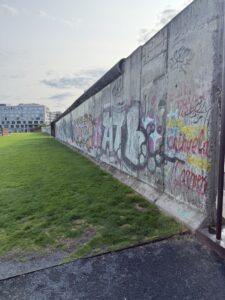
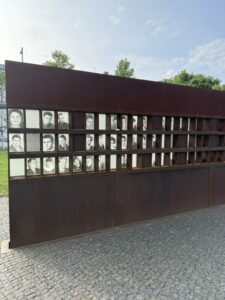
Over the weekend I also went to Berlin (for a pretty short time). I arrived late Saturday afternoon and went to see the Berlin wall briefly. I had seen a piece of it in Chicago before–there’s a small segment of the wall in Lincoln Square—but this was obviously a very different experience. A lot of what I assume used to be the wall has been reduced to a line of rusted metal rods (shown below). At the monument there was also a structure that contained the portraits and names of individuals who died at the Berlin Wall or in connection with the East German border regime. I left Berlin the next day in the early afternoon, so I did not see that much of Berlin, but from what I experienced, I think that I actually enjoy Leipzig more. It is a newer, cleaner city–Berlin was somewhat dirty, messy, and chaotic, though I was happy to see it again after so many years. One very cool thing happened to me as I arrived at the Berlin Central Station to return to Leipzig: I saw this famous cellist whom I recognized from Instagram. Her name is Anastasia Kobekina and she was carrying her cello and walking with her boyfriend. I really wanted to talk to her, so as I mustered up the courage to go up to her, I followed them around and eventually into a Pret a Manger. This story is really anticlimactic because I ended up being too scared to talk to her. I am really mad at myself though because seriously what is the worst that could have happened?! Anyway, that was my weekend. I look forward to the rest of our time in Leipzig together; there is still so very much to do and see!

The Cantatas [Part 1]


I’ve been reflecting a bit on the impact of endowments and how they allowed for two performances every [interval] from 1753 to 1928, only interrupted by hyperinflation. The influence of that endowment on music over the years is truly staggering; it transformed so much and left a lasting legacy that astounded me.

On a related note, when I consider the financial aspects, I can’t help but think about the social mobility it provided to some of the boys in the choir. It opened up opportunities for them in significant ways.

In his cantata BWV12, I found it fascinating to observe where he made edits. He composed without a pencil, so it’s interesting to notice where he had ideas written down before setting them to music.

It was intriguing to see that Bach didn’t issue strict dictates; instead, he offered directives to the university students in his inner circle who were involved in poetry. He would ask them to take one specific Lutheran hymn with eight stanzas and rearrange it. They were to keep the first and last stanzas intact while reworking the others into four or five movements. I find this collaborative approach quite intriguing!

Pique Damnnn

On Saturday night, a group of us went and saw Tchaikovsky’s Pique Dame (The Queen of Spades) at Oper Leipzig. The opera house itself was very grand, with four separate coat checks on the entry floor! The outside of the building was light gold or buttery yellow, and the inside was warm-feeling with various shades of beige and gold intermixed.

I’m someone who likes to go into shows somewhat blind. With opera, I tend to only read the synopsis and maybe listen to a few of the main songs before seeing the work because usually a bit more context is necessary for foreign-language pieces (especially since this was my first Russian opera). Funnily enough, because of having read the Met’s synopsis, I almost felt more confused during the opera since the director made so many choices that differed from the original version. The Queen of Spades is based on a story by Alexander Pushkin, which follows a man named Hermann (an engineer in the Imperial Russian army) who watches the other officers gamble every night but never gambles himself. When Count Tomsky relays a story of his grandmother, the Countess, Hermann learns of her gambling success and how she used the secret of the three winning cards. He becomes obsessed with learning her secret. This comes into conflict with his love for Lisa, a woman he initially does not know the name of but whom he has fallen in love with, since she is the Countess’ granddaughter and engaged to Prince Yeletsky. The opera ends in tragedy as Hermann’s dual obsessions with his love for Lisa and the secret of the cards result in the death of the Countess, a broken engagement between Lisa and Prince Yeletsky, Lisa’s death by drowning, and eventually his own. Having been tricked by the ghost of the countess, who tells him his three lucky cards are the 3, 7, and ace, he bets ridiculous sums of money on them only to find that the final card is not the ace at all, but the queen of spades. Having lost everything in pursuit of this fortune, he shoots himself, believing that the queen of spades is an amalgamation of the Countess herself, taking her revenge.

Throughout Oper Leipzig’s production, there were several notable variations that threw me off, given my preexisting knowledge of the plot. Some changes I liked or was at least intrigued by, while others contrasted too sharply with the libretto. Other directorial choices I felt were over the top, simply done for shock value. I have many thoughts about this production, and now I will pretend to be a weathered opera critic, unabashedly sure of her opinions. 

Beginning with the set, I enjoyed most of the set design and usage of space. The curtain rose to reveal a rocky, graveyard-esque terrain that I heard several others describe as appearing like the surface of the moon. For a darker opera, it set the tone well, and throughout the show was well-utilized to portray all types of spaces (different bedrooms, a gambling house, the streets of St. Petersburg, etc.) 30 or so minutes into the opera, it was revealed that the stage could rise, revealing a fully-furnished room underneath the ground. I did not like how the set was used in Act II – frankly, I really didn’t like much about Act II in general. It began with a scrim (a gauzy fabric draped over the main area of the stage) where an image of the underground set was projected. Partway into the Act, during one of the arias, the stage rose again and the room underneath was shown. Now, projected onto the scrim were the actions of Hermann sneaking into the Countess’ room. This effect was cool at first, but it went on for almost the entire act and the illusion was shattered as the physical actors weren’t in time with their holographs. It also wasn’t clear what purpose this doubling of the scene served at all. My favorite use of the set was in Act III, where the aboveground layer was converted into a gambling house and a square rim of lights was set above the scene. I felt like Act III was the strongest act in terms of set usage – there just wasn’t as much going on which was a relief since many choices were so left field, they became distracting and took away from the music.

In terms of costuming, I didn’t love how either Hermann or Lisa was portrayed. Hermann often looked ragged with a stained shirt and wild hair, and his unappealing portrayal through the show made me very unsure of how to consider the love story between him and Lisa – despite being the main tenor role his character was very unsympathetic. I understand that Hermann is considered half-hero and half-antihero, and I would have understood a production fully leaning into the antihero angle, but an antihero is still not a villain, and I felt like it wasn’t made clear enough how we as the audience were supposed to feel about Hermann who was almost fully portrayed as a villainous character throughout. Especially in contrast to Prince Yeletsky who sings of his love of Lisa and his hope to be more than just a husband to her, Hermann seemed especially revolting as he repeatedly ignores Lisa’s please to leave her room, threatening to kill himself. Lisa herself was very nicely clothed in a fur robe when she’s first introduced but then for the entire rest of the show is in this strange jeans and gauze slip combination that looked neither elegant nor practical. Funnily enough, the only time Hermann is dressed nicely is in Act III when he enters the casino wearing a tuxedo with his hair slicked back. Yet, this image is immediately juxtaposed by the libretto where the other men sing of how ill and ragged Hermann looks. It could have been an interesting decision to make the only time Hermann looks put together as what is supposed to be his most repulsive moment and have the audience wonder what else it was about his demeanor that looked so sick (perhaps he looks sick with obsession – a fair assumption to make since it is written into the score that the men are supposedly frightened of his mad, confident demeanor while he gambles), BUT given the sheer number of directorial choices that felt half-baked, I didn’t feel like this was done with well thought out intentions. 

I realize I have written so much and still have a lot to say, so maybe I will add a part 2 later!

Immer eine Kritikerin,

Gabrielle

Leipzig’s Trams

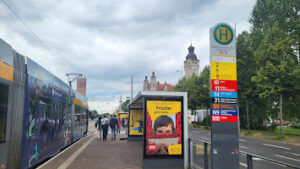
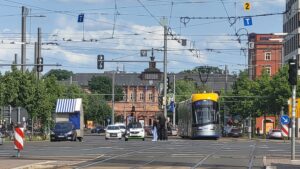
The tram system is impressive. It’s efficient and clean, smoothly operating alongside buses, trucks, and cars on the roads. I initially wondered why a city would invest in both buses and trams, considering they often run on the same streets. However, I realized that each mode of transport likely serves different purposes and meets unique needs that the government intends to address.

Experiencing this level of Mini Metro in real life has been nothing short of amazing. I appreciate how the digital boards at the stations and inside the trams are precise—something many other countries could learn from. It has been so straightforward to navigate that I didn’t need my phone until yesterday to determine which station I should get off at.


Additionally, the feature that allows tram doors to open at specific stations with a button click shows how considerate the system is of people’s time.


Overall, I love how easy it is to get around the city. I’m pleasantly surprised by how quickly I’ve become familiar with the tram routes. In less than a week, I’ve learned to navigate from Brittestraße, past the Hauptbahnhof, Nordplatz (where we learn), and Reudnitz (where I stay).

Over the weekend, I was able to see not one but two different operas, Handel’s Agrippina and Tchaikovsky’s Pique Dame. As someone who had never seen an opera before, it was a very interesting and fun experience! One thing that I was especially surprised and intrigued by was how much freedom directors seem to have when choosing the staging and setting of their production. In both productions, many of the decisions made for the staging were beyond what the original writers could ever have imagined, including using props or ideas which did not even exist when they were alive.

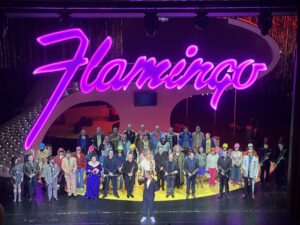
I want to now focus on one of the operas, Agrippina, and how I felt the staging worked well in conveying the setting and atmosphere of the different scenes. Agrippina follows the ancient Roman story of Agrippina’s schemes to install her son, Nero, as the emperor. This production, however, was set in a Las Vegas casino called Caesar’s Palace. Something that jumped out to me immediately was the fact that the set did not change throughout the opera, nothing about the scene was added or removed, and the only motion of the stage itself was its ability to rotate. However, the setting did not feel too static because the set had several different areas which were connected, but could be made to feel separate when necessary. These were a main lobby area with a long couch, a gambling/bar area with several tables, and an upstairs section with a large staircase leading up to it. These separate areas, I felt, were used quite effectively to convey the moods of the different scenes. The upstairs area, for example, was at times used as an overlook for large and busy scenes where a character needed to address a crowd of people below in the main area. However, by turning the set, the wide stairs blocked the audience’s view of other areas and allowed the stairs and upstairs area to be used as a more intimate setting for Agrippina’s secret dealings. A similar effect could be achieved with the other areas as the set was wide but not long, so rotating it could make certain areas feel smaller or larger depending on what was necessary for a certain scene. This was also combined with good use of lighting, such as changing the color of the large billboard sign to make the main area feel darker or otherwise different for scenes with a more isolated mood which made use of the couch. Overall I felt this was quite an interesting introduction to the world of opera, and it definitely opened my eyes to how much freedom and creativity is possible now, even through such an old art form.

Wo sehen sich Komponist:innen?

IMG_1183

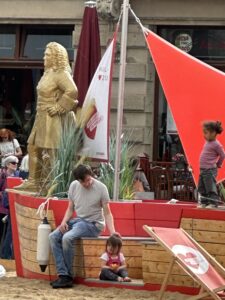
Some images of the Handel Festival in Halle: notably, a statue of Handel as the figurehead on a children’s pirate ship and the child who unintentionally happened to be in the same pose.

The particular location of Halle as the site for this Handel Festival prompted me to think about why or how it comes to be that we attribute certain places to composers. Many large music festivals, such as the Bachfest Leipzig, Beethovenfest Bonn, and the Salzburg Festival, which emphasizes the work of Mozart, are held in cities where these composers spent a significant portion of their lives. In contrast, the Handelfest being in Halle seems out of place. Handel merely spent his adolescence here compared to the more formative years of his life spent in Italy and Hamburg, and the vast majority of his life spent in London, the site of another Handel Festival. Being the birthplace of Handel, I find that Halle does hold some significance regarding the composer, but it’s more of a postmortem significance implemented by historians and fans.

This point addresses the idea of wanting ownership, mentioned in class and the Agrippina preview session. We, in the present, look at people from the past and choose where we identify them. It becomes a question of who gets to hold the responsibility of having built the figure rather than where the figure identifies themself. For Handel, it is a debate concerning nationalistic pride regarding the composer as a champion from Germany or as the world-renowned British Subject that he was.

This idea of postmortem identity building then brings us back to Bach, particularly the location of Leipzig for the Bachfest. Bach spent a significant portion of his career in Leipzig, but it is also important to note what the composer actually thought about the city. It’s difficult to know definitively what Bach felt about Leipzig with so little writing. However, I found his relationship with the city to be somewhat questionable, given his failed attempt at applying for the Kapellmeister position in Dresden and his general attitude towards his role in Leipzig, discussed during our visit to the Bach Archiv. Overall, I find it valuable to distinguish the conceptions of historians from the contemporary sentiments of those being studied. We can so easily get caught up in popular opinion that we fail to notice the more nuanced relationships historical figures have with the places we associate them with.

« Older posts Newer posts »

The McGraw Center for Teaching and Learning
328 Frist Campus Center, Princeton University, Princeton, NJ 08544
PH: 609-258-2575 | FX: 609-258-1433
mcgrawdll@princeton.edu

A unit of the Office of the Dean of the College

© Copyright 2026 The Trustees of Princeton University

Accessiblity | Privacy notice