Abstract
Inspired by Gan’s diagrammatic approaches to analyzing multispecies relation, I thought it would be an interesting endeavor to use a similar visual approach in deconstructing relations and processes underlying Indigenous filmmaking that are otherwise invisible. In particular, these networks are explored on three layers. The production of the film itself requires a network of various interacting subjects in order for it to function. This includes, filmmakers, producers, actors or subjects, distributors, etc. The distribution and consumption of the film also leads to the emergence of a global network, consisting of other indigenous communities and alliances, film festivals, academic scholarship, and audiences around the world consuming the film. The film itself, whether fictional or non-fictional, acts as a central node between several communities and groups, and facilitates several types of processes and interactions, such as cultural mediation. The ultimate goal is to highlight that, indigenous filmmaking is all of these invisible relations that constitute it.
Introduction
This project aims to explore the symbiotic relationship between filmmaking, the Indigenous community, and beyond, through the subtle underlying networks and relations that emerges from the filmmaking medium and processes. What is visible to the audience is the final cut of the film, edited and packaged together into a unified final product. However, the relations that constitute the film itself are largely not visible to the unassuming audience. In this essay, I will deconstruct the relations underlying Indigenous cinema, and create a diagrammatic representation that utilizes graphs, diagrams, and data visualizations. More importantly, I will argue for the purpose and value of making these relations visible through Escobar’s and frameworks of relationality in addition to Turner, Ginsburg, and Himpele’s support toward indigenous filmmaking.
Networks and relations underlying different processes
Throughout this essay, the major part of visualization of networks is inspired by mathematical graphs, consisting of nodes of discrete data points and arrows or relations between them. Weighted, directed arrows may be used to indicate the different kinds of relations between people, the weighting can be represented with the size or thickness of arrows, and the direction is indicated with arrowheads. In addition to these graphs, methods described in Gan’s paper may also be used and combined in order to create more complex representations of these relations.
Part 1: Production of the film
The production of indigenous media exemplifies how filmmaking requires a complex network of interacting subjects and organizations to function effectively. This network extends far beyond just the filmmakers themselves, encompassing a wide range of actors and institutions. This is illustrated in Himpele’s interview with Jesús Tapia and Marcelina Cárdenas.
As filmmakers and video center operators, Tapia and Cardenas do not view themselves as individual authors and creators, rather as “social communicators” and coordinators who facilitate a collective process (Himpele, p.357). It is evident that the indigenous communities themselves play a crucial role, not just as subjects but as active participants, which constitutes the “integral”, community-based process of filmmaking. As Cárdenas explains, “We have another manner of directing. We cannot demand that our ‘brothers and sisters’ follow a script. We give them ideas, they give us some input, and we incorporate these ideas” (Himpele, p.358).
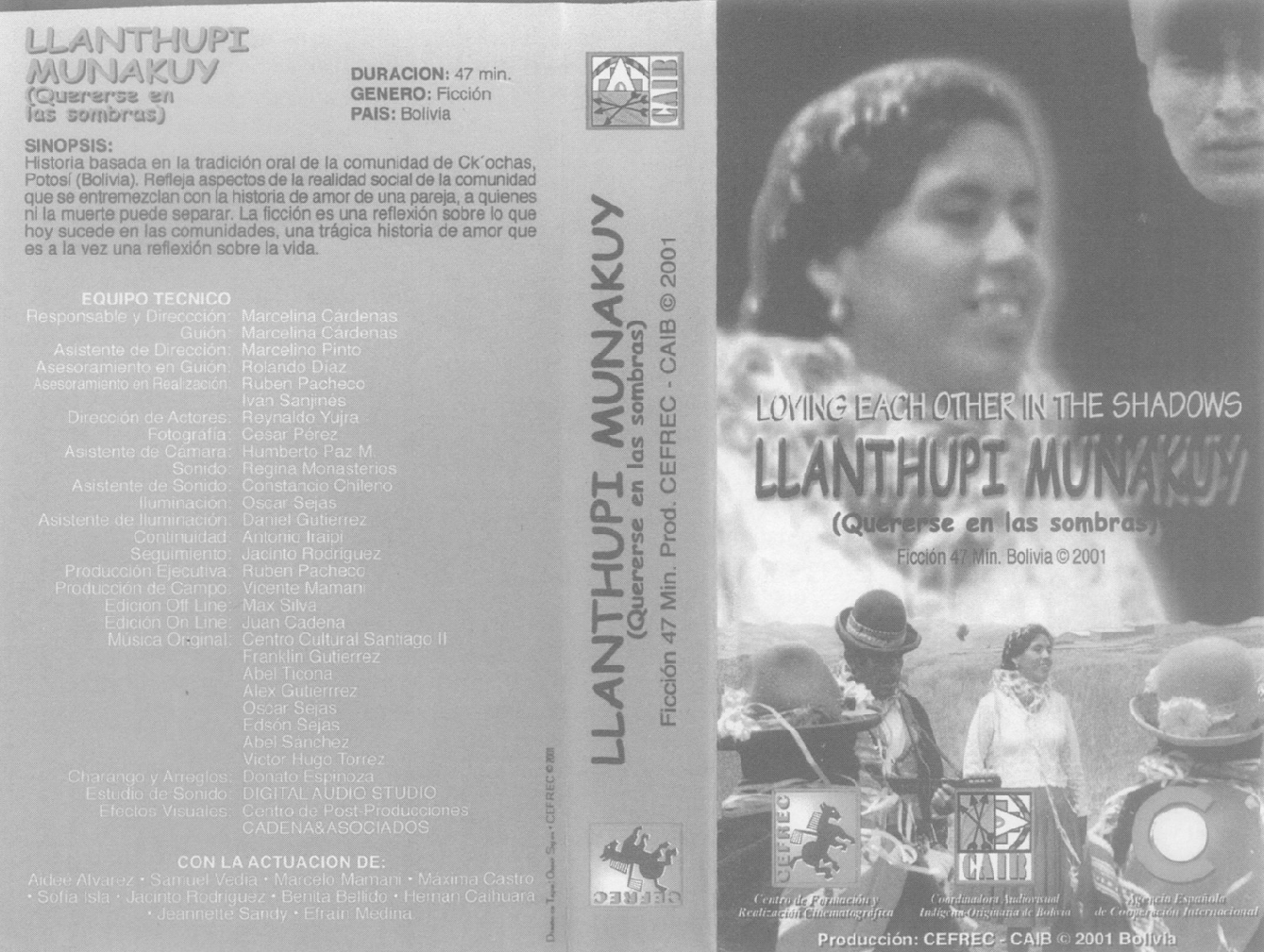
Fig 1. Videocassette packaging of “Loving Each Other in the Shadows”. Obtained from (Himpele, p.358)
The packaging of “Loving Each Other in the Shadows (Llanthupi Munakuy)” (2001), dir. Marcelina Cárdenas Sausa provides concrete evidence to support their claims. This single, folded sheet of paper provides a concise glimpse into a subset of the complex network of relationships essential for the production of this film. These features include the names of various community members involved in its production. It also contains logos and names of various institutional partners, including CEFREC and CAIB as these organizations are instrumental in offering training and production facilities, enabling the creation of such films in the first place. This is an instance where these invisible relations are displayed, however it is not attached to the film itself, since the packaging may not be known or seen by every audience member, thus it largely remains invisible.
Ultimately, this illustrates that the production of an Indigenous film is a very intricate, interconnected process involving several groups and people that collectively enable the film to come into existence.
Part 2: Distribution and Consumption of the film
The next layer to consider is the networks underlying the distribution and consumption of the film. Consider this map of film festivals around the world that support indigenous cinema, either being entirely dedicated to showcasing indigenous works, or featuring them. This data was gathered from a non-exhaustive list on the Imagine Native website, which means the data is not comprehensive (Imagine). However, this visualization sufficiently showcases the widespread audience and global awareness of indigenous cinema, indicated by locations on a world map.
The distribution pattern illustrates how indigenous films travel beyond their local contexts, creating transnational dialogue and cultural exchange. Not only do these film festivals serve as nodes connecting indigenous filmmakers with global audiences, they also connect different indigenous communities with each other. They serve as platforms for highlighting indigenous issues on the international stage.
Furthermore, each marker represents not just a festival location but a nexus of cultural organizations, funding bodies, academic institutions, and indigenous media collectives that also contribute to the distribution, consumption and at times, production of the film. Circling back to Himpele’s interview, Tapia and Cardenas also discuss the extensive collaborations and interactions involved in indigenous filmmaking, including going on tours across the world, and building relationships and alliances with other indigenous groups and different types of institutions (Himpele, p.358). These alliances ultimately have a positive feedback loop effect, which positively impacts and supports future indigenous works. This point will be explored in further depth in the next section. The map thus makes visible the otherwise invisible networks of distribution and reception that indigenous films navigate, showing how these works circulate through and help constitute a global indigenous media landscape.
Part 3: Film as a central node between the two prior layers.
Finally, the core of this essay is to unite the prior networks with the film as the central node bridging between them. This is rooted in the notion that the film is a process of cultural mediation, in addition to self determination, rights, indigenous voices in academia and support for future work cycling back into the indigenous filmmaking process, much of which is discussed in Ginsburg’s and Turner’s works. In particular, I explore a few crucial processes that are facilitated between various groups and communities through indigenous film.
Cultural mediation
Cultural mediation can occur in a variety of ways. I would like to start off with the most subtle of it, when the works of indigenous filmmakers reflect and reinforce their communities’ cultural values and aesthetics through the very structure of the film itself. For instance, Turner extensively discusses elements that arise in the works of Kayapo filmmakers, such as the use of alternating panoramics and middle-range close-ups, frequently used to capture collective activities such as ceremonies and political meetings (Turner, p.82). This technique reflects the Kayapo emphasis on community and collective action rather than individual focus. Additionally, Kayapo videographers show multiple repetitions of ceremonial performances, each with increasing complexity and social value, which effectively replicates the replicative structure of the ceremonies, thus capturing the Kayapo concept of “beauty” in the structure of the film itself.
In fact, the camera and the act of filmmaking align very closely with Kayapo cultural values. The rituals, dances, and ceremonies often involve performative elements that objectify and represent aspects of their culture and social life, “acting themselves, for themselves.” (Turner, p.87). Thus, representation and objectification is built into Kayapo culture. Like their traditional performances, the camera serves a performative function to establish and reinforce social realities, it is a natural instrument. Ultimately, Kayapo videographers draw upon their own cultural categories and forms to guide their camera work and editing process. Therefore, the video production process and medium itself mediates indigenous categories and cultural forms within and beyond the community, and also mediates between representation and lived experience.
Sausa’s “Loving Each Other in the Shadows” (2001) is an instance of a fictional story based on Quechua oral traditions. Fictional films also play a major role in cultural mediation, particularly serving as a powerful tool for preserving and sharing cultural elements such as language and storytelling, a fundamental aspect of many indigenous cultures. Additionally, for Indigenous communities, seeing themselves represented authentically on screen can be a source of empowerment and healing, as opposed to the historical misrepresentation of their cultures and identities. Turner quotes Mokuka, a Kayapo leader and videomaker, “These videos will be seen in all countries. Tell your children and grandchildren, don’t be deaf to my words, this [work] is to support our future generations, all our people.” (Turner, p.75). As a result, future generations of indigenous peoples can easily have access to aspects of their culture that could otherwise get lost through time and increasing influence of globalization and technology.
In the same manner, Masayesva details, “Consciously and willingly, Native Americans will pursue an aesthetic which revels in film’s possibilities to express human redemption. Alternatives to cuts, only as indoctrinated in us by all the Hollywood films, and special optics instead of prime lens, are only a minute indication of how we will express our difference which will also encompass special computer and digital creations. … all this begins with a Native American director.” (Masayesva, p.158). A prolific indigenous filmmaker himself, whose film will be discussed in the next section, Masayesva strongly advocates for a distinct Indigenous aesthetic in filmmaking that reflects tribal worldviews and traditions, seeing film as a potential bridge between Indigenous and non-Indigenous audiences.
By authentically presenting indigenous stories and characters in relatable, multidimensional ways, these films can increase cultural awareness and empathy among non-indigenous viewers, encouraging them to question their preconceived notions and develop a more accurate understanding of indigenous cultures, and dismantle long-standing stereotypes perpetuated by mainstream media. Therefore, indigenous fictional films provide a window into indigenous life that can challenge preconceptions and promote cross-cultural understanding. Thus, cultural mediation is a process flowing from indigenous communities, into the film, then cycles back into the community, then flowing outwards towards the global community.
Self Determination and Indigenous Rights
Indigenous media allows communities to control their own narrative and representation. Ginsburg notes that the appropriation of visual media by indigenous peoples typically occurs in the context of movements for self-determination and resistance, with their use of video cameras being “both assertive and conservative of identity” (Turner, p.76).
Consider “Imagining Indians” (1992), a documentary shot and produced by an all Native-American crew directed by Victor Masayesva, aligns closely with these scholars’ perspectives. By producing a documentary that critiques Hollywood’s misrepresentation and exploitation of Native Americans, Masayesva and his crew are exercising precisely the kind of self-determination and control over narrative that Ginsburg and Turner discuss. For instance, in this segment towards the end of the film, a Hopi man explicitly calls out outsiders for approaching Indigenous communities with preconceived ideas, seeking to confirm stereotypes rather than understand authentic experiences. He reveals how film companies attempt to manipulate tribes with promises of economic benefits, playing into stereotypes of poverty and desperation. He asserts the right of individual tribes to define themselves and directly counters stereotypes of naivety or passivity, “Indian people are smarter than that” (Masayesva, 47:15).
By including this commentary within his own film, Masayesva is actively modeling how Indigenous filmmakers can use media to reflect on and challenge the very processes of representation that have historically marginalized them. This film exemplifies how indigenous media can serve as a platform for challenging dominant narratives, asserting cultural rights, and advocating for more accurate representation. Additionally, it also aligns with Turner’s observation that indigenous media production is not merely a passive recording of events, but a performative act that helps establish new social and political realities, “The two notions [mimesis and representation] are in fact continuous, drawing on the same notions of imitative or replicated action as an effective mode of constructing reality” (Turner, p.84). Therefore, films are an effective medium to advocate for self determination and raise awareness of indigenous rights. This has a cyclic effect of political empowerment, in which indigenous media provides a platform for articulating political demands and mobilizing support for land rights, resource management, and other critical issues, in relation to political or corporate agents, such as governmental organizations, and the mainstream film industry.
Evolving Ethnographic Scholarship
Indigenous cinema such as “Imagining Indians” can contribute nuances, complexities and new ways of knowing in ethnographic scholarship. Ginsburg argues that Indigenous film pushes ethnographic scholarship to engage more with contemporary indigenous realities. Rather than focusing on idealized visions of pre-contact culture, indigenous media tends to highlight “processes of identity construction” in the cultural present, which accounts for the “inconsistencies, contradictions, and complex subject positions of contemporary life” (Ginsburg, p.73).
Ginsburg contends that indigenous media has pushed ethnographic film to evolve “away from the monologic, observational, and privileged Western gaze” to more interactive and creative approaches (Ginsburg, p.74). This shift creates a “parallax effect,” where multiple viewpoints on cultural representation emerge, fostering greater cross-cultural understanding by creating dialogue between indigenous and non-indigenous viewpoints and mediating between traditional and contemporary cultural forms. It creates new discursive spaces for understanding indigenous culture as a whole. Therefore, by juxtaposing indigenous and ethnographic perspectives, a fuller understanding of culture and its representations can be achieved, enhancing ethnographic theory and practice.
This process is one which originates from the indigenous community, through the film, entering and cycling within academic circles. However, it also has a component in the opposite direction in which mutual collaboration and discourse emerges. As a result, it also establishes and strengthens the connection between the indigenous community and the academic community.
Support for further works
The growth of indigenous cinema has created a dynamic feedback loop that continually expands opportunities and support for indigenous filmmakers, as evidenced by both institutional developments and grassroots movements. These developments reflect what Himpele identifies as the crucial role of “networks of solidarity” that operate outside traditional market forces. At present, there are various film bodies and organizations that provide funding and scholarships for indigenous filmmakers and students, such as:
- Vision Maker Media providing nearly $1.2M to native filmmakers through its Public Media Fund and Creative Shorts Fellowship
- The Federated Indians of Graton Rancheria gifting $4 million to Sundance Institute To Support Indigenous Filmmakers In California
- Hulu/Kartemquin Accelerator giving $30K in funding with year long mentorship
- And much more…
The efforts of Canadian governments and organizations is particularly notable. Over the last three years, there has been a significant increase of 200% in total volume for indigenous audiovisual production and funding provided by different organizations, as evident in the graphs below.
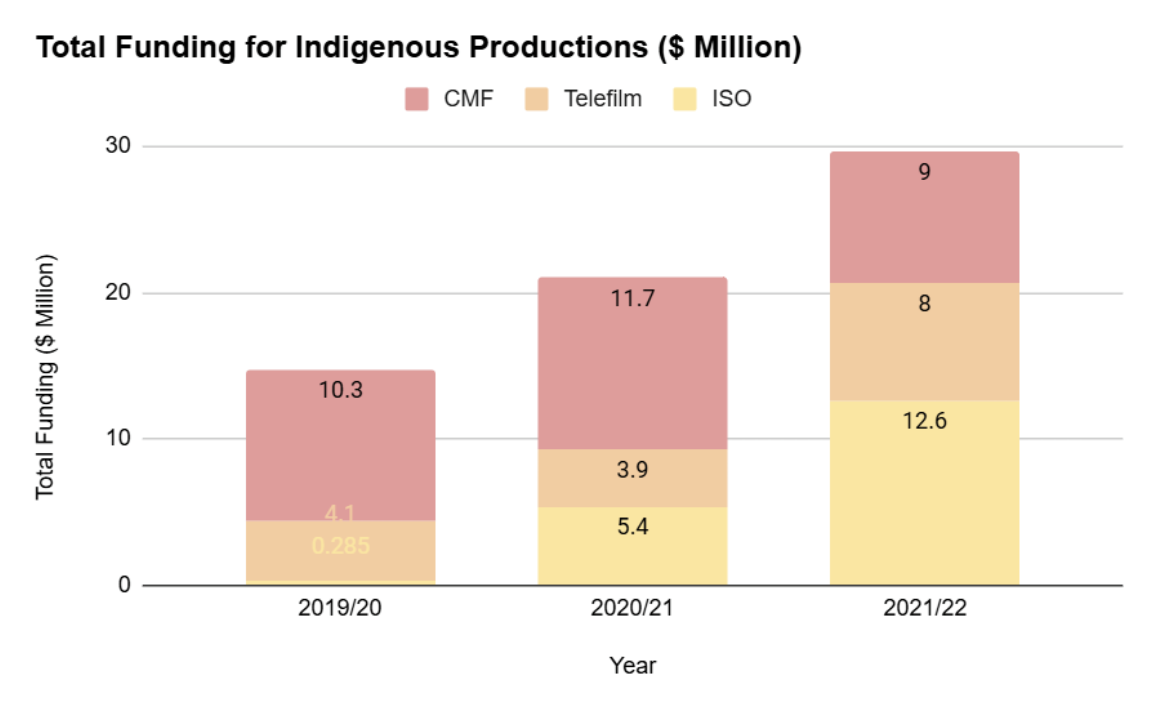
Total Funding for Indigenous Productions in $ Millions (Nordicity)
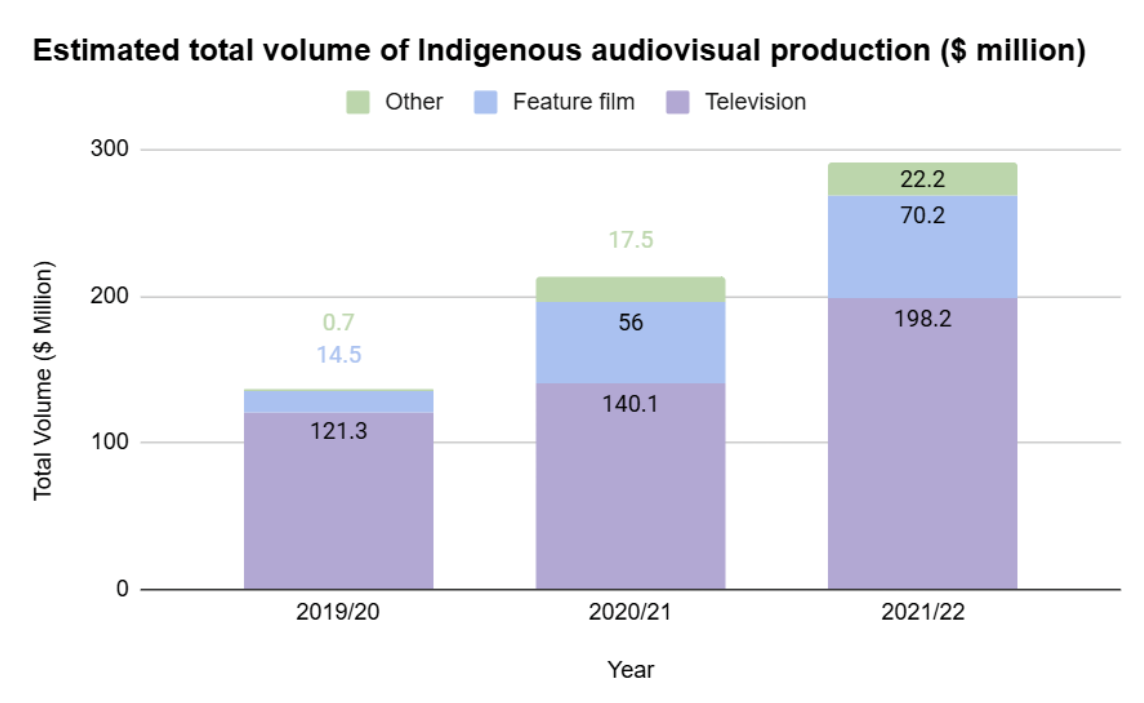
Estimated Total Volume of Indigenous Audiovisual Production in $ Millions (Nordicity)
One of these funding bodies is the Indigenous Screen Office (ISO), an independent, Indigenous-led organization that supports Indigenous creators in development, production, marketing and distribution. Recently, the Canadian Heritage Minister announced $65 million in funding for ISO over five years, ensuring long-term stability for this organization. As a result, this places Indigenous media on equal footing with English and French media funding.
This self-reinforcing cycle creates a foundation for sustainable growth in Indigenous cinema, where each success contributes to expanding opportunities for future generations of filmmakers. As Himpele notes, these networks of solidarities present an “alternative economy” in which cultural preservation, self-determination and commercial success can be achieved in tandem. Therefore, this is a cyclic process between indigenous communities and funding bodies and institutions that continue to grow in scale through time.
Diagram
The following diagram is my attempt to deconstruct the underlying networks and relations, unifying all the points I brought up until this point in the project:
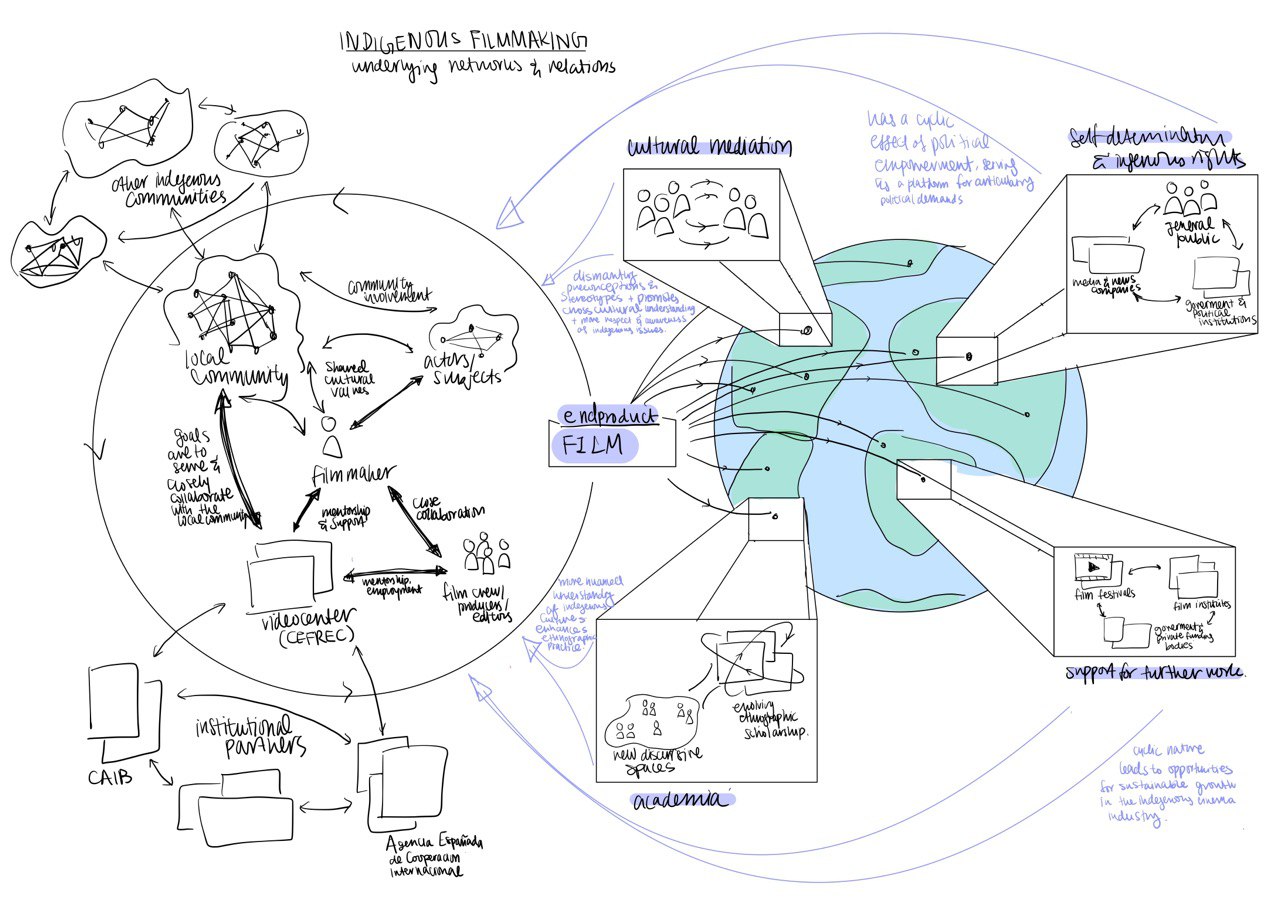
Diagrammatic Representation of Networks and Relations underlying Indigenous Filmmaking
The left side of this diagram represents the processes underlying the production of the film, which illustrates the potential relations between different groups of people, including the filmmakers, local communities, and the video centers. Additionally, this also draws in relations with other indigenous communities and institutional partners that may not be directly involved with the filmmaking process, though still play a part in supporting it.
On the right side, I highlight the 4 main processes discussed that are prevalent in the distribution and consumption of the film, and illustrate the potential stakeholders and relations within them. Additionally, I deliberately used the earth imagery, inspired by the map of the film festivals, and to emphasize the global reach of indigenous cinema.
Most importantly, the film itself lies in the center, connecting between the two underlying networks, with arrows flowing from the production networks to the distribution networks, representing cultural mediation through the film. Furthermore, these cultural mediation processes have impacts circling back into the networks in the production processes, which is emphasized and elaborated on through arrows.
It’s also crucial to recognize some drawbacks of this diagrammatic representation. For instance, these networks can change and evolve with time, whereas this representation is merely a snapshot in time, capturing the current views and discourse among the scholars discussed. Additionally, this may not illustrate the vast layers of interconnection between each film, and how they may impact and interact with each other. However, the purpose of this representation is not to capture every single detail, but to break down aspects that better our understanding of parts of the underlying relations, for different purposes.
Why bother?
The breakdown of the underlying networks of indigenous filmmaking supports Escobar’s claim that “nothing preexists the relations that constitute it”, as it reveals the inherently collaborative and interconnected nature of filmmaking (Escobar, p.101). The films emerge from complex networks involving communities, funding bodies, technical experts, and cultural organizations. They are constituted through relationships rather than existing as an independent entity.
Additionally, indigenous filmmaking inherently challenges what Escobar calls the “One-World World”, the dominant Western notion that we all live within a single world made up of one underlying reality (Escobar, p.86). It shows how indigenous communities can appropriate modern tools while preserving their ontological autonomy, thus challenging the false dichotomy between “authentic” indigenous culture and modern technology. By revealing the complex networks of relations involved in production – from community input to technical expertise to funding sources, we get to recognize that indigenous filmmaking demonstrates the existence of multiple, coexisting worlds and ways of knowing. In a way, this act further raises awareness of the issues and rights that indigenous communities are advocating for, as viewers gain insight into the historical and social factors that have shaped Indigenous experiences and continue to influence their communities.
A typical audience member is not compelled to discern the complexity of these films, only taking what is presented in the final product of the film at face value, but is unaware of the complexities underlying it. Therefore, drawing out the hidden networks associated with the film has a two way effect. First, it gives recognition to the various levels of complexities of the film. Secondly, audiences are encouraged to engage more critically with media representations of Indigenous peoples, and more generally become more critical and conscious of the world they experience.
Note that this deconstructing framework can be applied more generally, beyond indigenous films too. Take for instance, “In Her Own Time” (1985), a film documenting Barbara Myerhoff’s social and personal exploration of Judaism in the Jewish Orthodox community in the Fairfax district of Los Angeles, as she faces her mortality. It mirrors indigenous films in the sense that Myerhoff has roots in the Jewish community, and this film is mediating her rediscovery of her culture. Through the process, we witness the intersection of mortality, faith and personal identity emerge, and the film itself highlights issues and adversities that people in the community from all walks of life have undergone. My attempt at capturing the underlying networks of the film and its cultural mediation processes is as follows:
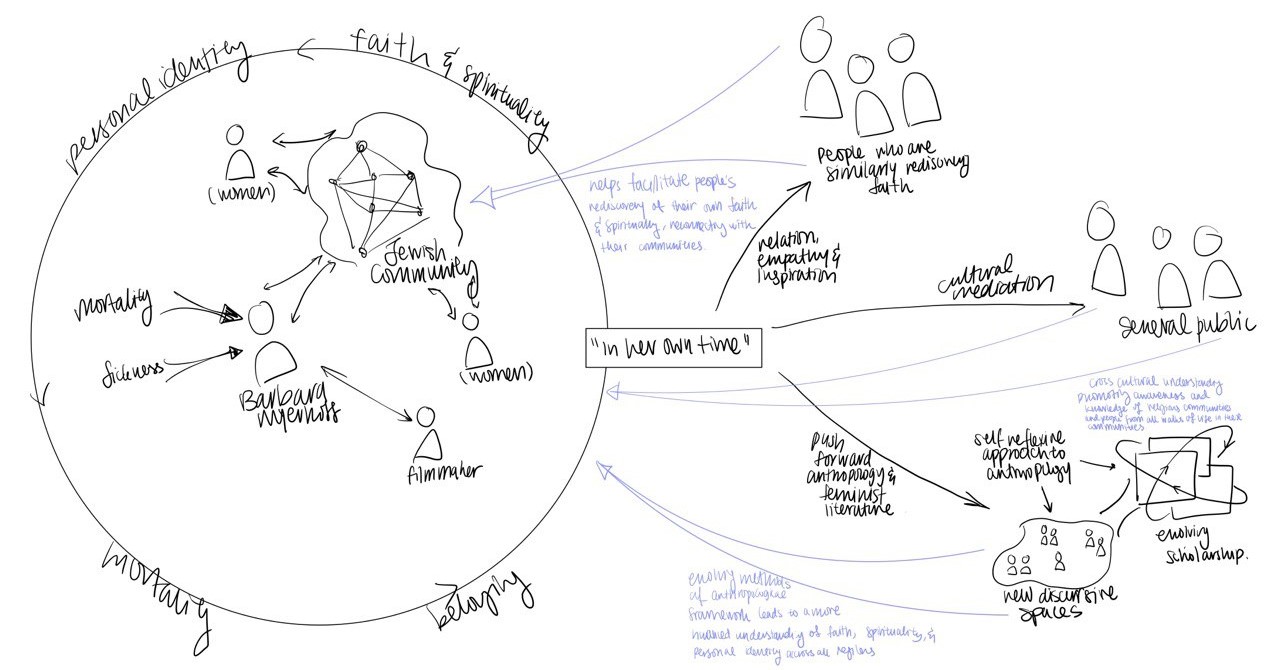
Diagrammatic Representation of Networks and Relations underlying “In Her Own Time”
Like the diagram above, the film in this diagram also acts as a central node uniting the two networks of production and distribution, and facilitates various cultural mediation processes. Additionally, this diagram incorporates the themes explored into the production network.
This illustrates that we can and should apply deconstructing frameworks to the media and information to consume, in order to give proper justice and recognition to the filmmaker’s intention, and as audiences, better understand and comprehend the sociopolitical, and economic factors that are tied to the film.
Conclusion
Indigenous filmmaking is a deeply collaborative and networked process, involving a diverse array of actors at local, national, and international levels. This network not only enables the physical production of the films but also shapes their content, distribution, and ultimate impact. The success of indigenous media projects depends on navigating and leveraging these complex relationships while maintaining a commitment to indigenous self-representation and autonomy. It is crucial to make these underlying relations visible, in order to give proper recognition to what Indigenous filmmakers and communities are advocating for, and at the same time. Particularly, as audiences, this framework encourages a more critical perspective of the media we consume, to consider it in context of the relations that constitute it, in order to gain a more comprehensive understanding of the world.
Bibliography
Escobar, Arturo. 2017. “The Background of Our Culture: Rationalism, Ontological Dualism, and Relationality,”
Ginsburg, Faye. (1995) “The Parallax Effect: The Impact of Aboriginal Media on Ethnographic Film”
Himpele, Jeffrey. (2004) “Packaging Indigenous Media: An Interview with Ivan Sanjinés and Jesús Tapia”
Imagine Native. “Other Indigenous Festivals”. https://imaginenative.org/year-round/indigenous-festivals/
Littman, Lynne. Myerhoff, Barbara. (1985) “In Her Own Time”
Masayesva, Victor, Jr. (1995) “The Emerging Native American Aesthetics in Film and Video.” Landscape(s).
Masayesva, Victor, Jr. (1992) “Imagining Indians”
Nordicity. (2023) “Indigenous Audiovisual Sector Economic Impact Assessment”. https://www.canada.ca/en/canadian-heritage/services/film-video-publications/indigenous-audiovisual-economic-impact-assessment.html
Turner, Terence. “Representation, Politics and Cultural Imagination in Indigenous Video”
