Performance as Cultural Expression, Commentary, and Visibility
Introduction
This webpage will examine how performance operates as a mode of cultural expression, commentary, and visibility through the films Paris is Burning (1990), Couple in the Cage (1993), and Trance and Dance in Bali (1952). These diverse films showcase how performance, shaped by its subjects and viewers, intersects with themes of identity, power, and authenticity, highlighting the role of subjectivity in both empowerment and subjugation.
“The Ball is Ours”: Community and Realness in Paris is Burning
This 1990 cult classic explores the lives of drag queens in New York City during the 80s, focusing on the vivacious ball culture and the social networks that they create. Balls serve as not only a performative space, but also a home, for marginalized communities to assert their identity and find belonging. One member describes the ball as “[the Ball is] like crossing into the looking glass, into wonderland… it’s not what it’s like in the world”. Through this community, drag queens are creating their own world and society. The members organize themselves into “houses”, with traditional family structures mirrored in roles like “mothers” and “children”. One house mother emphasizes, “it’s important for me to be a mother; there are so many little kids to look out for” (3 min) reflecting on the shared experience of losing birth families due to their identities, questioning what a family really is.
Central to the ball culture is the concept of realness, which is defined in this context as the ability to blend seamlessly into heteronormative ideals. One member explains that realness involves “looking as much as possible as your straight counterpart” (18:45). For femme queens like Venus Xtravaganza, achieving realness means presenting themselves in a way that defies traditional gender binaries, prompting questions about the nature of gender itself. Venus powerfully states “There is nothing mannish about me besides my reproductive parts,”. Through performance, she is deconstructing core notions of gender expression and identity.
Judith Butler’s analysis in Gender is Burning provides a theoretical framework for understanding performance and how it fits into subjectivity. Butler argues that subjectivity is shaped through interpellation, where individuals are “hailed” into existence by social norms. This process she notes “does not merely repress or control the subject but forms a curricula part of the juridical and social formation of the subject” (121). The drag balls subvert these norms by reworking, miming, and resignifying them. This pursuit of realness also risks reinscribing the very power structures it seeks to challenge, questioning how performance fits in and shapes culture.
Spectacle in Couple in the Cage
Couple in the Cage satirically critiques the Western gaze and historical commodification of indigenous cultures through performance art. The traveling “exhibit” features two performers who are “authentic Guantinauis” highlighting the absurdity of colonialist practices that treat non-Western people as objects of curiosity. A majority of the film focuses on the audience’s reaction to the performance. Their reactions vary greatly from curiosity to discomfort, with one person even asking “What do they do on their day off?” reflecting a deeply rooted capitalist/ Western mindset. One woman describes the exhibit as a “slap in the face” and then becomes a part of the artist’s performance when the camera clicks in her face. Making her a subject of the same objectifying gaze she critiques. The interplay of authenticity and performance raises questions of who controls the narrative and identities are presented and reflected back to the audience through performance.
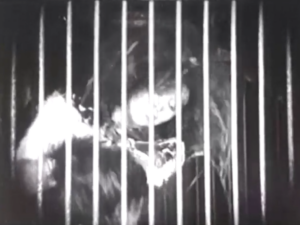
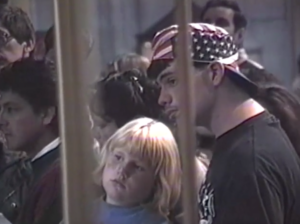
David MacDougall’s insights in the chapter “Whose Story is it?” as featured in Transcultural Cinema helps expand claims of the artists in Couple in the Cage. He argues that filmmakers and artists often impose their interpretive frameworks on their subject, potentially reducing their agency. This critique extends to Couple in the Cage, because the subject is unaware of their subjectivity and the performance manipulates the audience exposing their biases, prompting viewers to interrogate their own biases.
Ritual in Trance and Dance in Bali
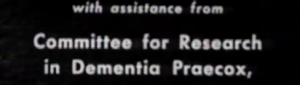
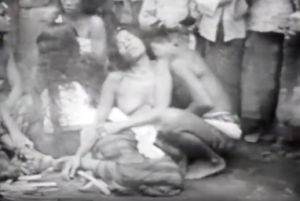
In Trance and Dance in Bali, performance transcds entertainment to become a spiritual and cultural expression. The Kris dance ritual re-enacts the struggle between life and death, with participants entering trance states, embodying this existential conflict. The film vulnerably portrays the ritual’s intricate choreography, where performers turn their knives against their own bodies, symbolizing their surrender to the divine. A key feature of the trance is that “no one is hurt; if people get hurt, then the trance is not real” (13:05). This film is at times questionably ethical and the performance seems almost exposing of the Balinese people. MacDougall’s reflections resonate well with this film. He emphasizes the constructive nature of film and need for reflexivity in representing cultural “others”. This film, and its “assistance from the committee for research in Dementia Praecox” and “Department for child study”, raises important questions of authenticity and subjectivity and how they are mediated through the filmmaker’s lens, prompting viewers to proceed with caution and consider ethical complexities.

Performance, Power, and Subjectivity
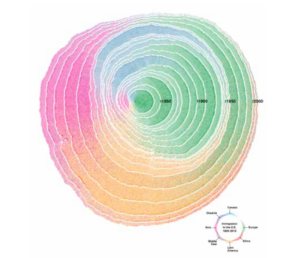
Wihbey et al.’s work on data visualization provides a useful parallel to visual performance. Their use of tree rings to represent immigration patterns transforms data into a dynamic narrative of diversity and growth. Similarly, the performances in these films visualize and materialize the lived experiences of their subjects, challenging static, reductive representations of culture. Just as tree rings reveal the layers of history, these performances unveil layers of identity, subjectivity, and power that are deeply embedded in cultural practices.
Through Paris is Burning, Couple in the Cage, and Trance and Dance in Bali, performance emerges as a powerful lens for examining cultural expression and critique. By visualizing the invisible- identity, power structures, and authenticity- these films challenge us to reconsider how performance shapes and is shaped by the world we inhabit.
Music Component
I made a short playlist and will describe why I put each song. In general, music serves as both art, performance, and a way to capture culture. Song works as a mode of data visualization and cultural understanding. By allowing the listener to form a thought of their own, the song also brings in questions posed by MacDougall where he argues that artists often impose their interpretive frameworks on their subjects. I think song’s offer an interesting perspective on performance and subjectivity that works nicely with the films.
Paris is Burning
1.Got to Be Real – Cheryl Lynn
I had to include this song. It was featured in the actual film Paris is Burning and serves as a centerpiece for the quest for realness in the film. Whether it is the ability to blend or pass to the untrained or trained eye, the search to “Look as much as possible as your straight counterpart” was thematically one of the most important parts of the theme in my opinion. Lynn’s constant repetition of “its gotta be real” represents the aesthetic and culture of the Ball’s very well and makes the listener think about what is real? The Ball’s call to “realness” and dismantling of the idea of identity and gender is beautifully shown through the film.
What you find-ah
What you feel now
What you know-ah
To be real
2. Real – Kendrick Lamar, Anna Wise
I included this song because it’s a different take on the idea of realness and I just love the song and Kendrick Lamar. “Real” is the 2nd to last track on Lamar’s album “Good Kid, Ma.a.d City”, and the chorus states
Look in the mirror and know I’m there
With my hands in the air, I’m proud to say yeah
I’m real, I’m real, I’m really, really, real
I’m real, I’m real, I’m really, really, real
I’m real, I’m real, I’m really, really, real
I’m real, I’m real, I’m really, really, real
The repetition seems like Kendrick convincing himself of realness and legitimacy. He then expresses his conflicted feelings about his life and finally at the end we hear his mom in a voicemail say
“”If I don’t hear from you by tomorrow
I hope you come back and learn from your mistakes
Come back a man, tell your story to these black and brown kids in Compton
Let ’em know you was just like them, but you still rose from that dark place of violence
Becoming a positive person
But when you do make it, give back with your words of encouragement
And that’s the best way to give back to your city
And I love you Kendrick, if I don’t hear you knocking on the door
You know where I usually leave the key, alright?
Talk to you later, bye”
This embodies Kendrick’s work of Good Kid, Ma.a.d City. Kendrick made it out of his home, Compton, and with his platform tells the story of the people who couldn’t. I think in this song he is partially convincing himself of realness but also claiming his realness simultaneously. I think this song adds another dimension of questioning realness and the experience of leaving your family and home to pursue your real self, something that a lot of the people in Paris is Burning also grapple with.
3. Vogue – Madonna
This song brings up a lot of the ideas that MacDougall highlights in “Whose Story is it?”. In Paris is Burning they use voguing instead of fighting, “Voguing is a safe form of throwing shade”. Everyone knows Madonna’s Vogue but does everyone know Willi Ninja and his choreography. Madonna sings “It makes no difference if you’re black or white
If you’re a boy or a girl
If the music’s pumping it will give you new life
You’re a superstar
Yes, that’s what you are, you know it”
While conveying a positive message, Madonna misses the mark on what voguing represents and the community that originated it. She also claims that
“Magical, life’s a ball
So get up on the dance floor”
Her life is the life that the Ball is embodying. One performer states ““Everybody’s dream and ambition as a minority is to live and look as well as a white person as a white person is pictured as being”.
Couple in the Cage
To me, this film stood out most to me as a satirical art piece that made a comment on history while also commenting on the people consuming the art.
1.Born in the U.S.A – Bruce Springsteen
This “american anthem” at face value seems incredibly patriotic but in reality Springsteen is writing from the perspective of a disillusioned Vietnam War vet and the feeling of being left behind by his country. The catchy chorus has turned it into a pro-American song which ironically comments on the ignorance and disillusionment that many Americans fall to.
2. This is America- Childish Gambino
This song is painfully obviously a critique of American Culture, and Childish Gambino’s (Donald Glover) experience as a Black man in America. Similarly obvious to the portrayal of the Couple in the Cage, where people still were blissfully unaware of what was happening, people still don’t fully understand the weight and content of the song. A short anecdote about this song was one time there was a famous raper coming to preform at my historically white affluent boarding school and the student DJ opener played this song as a remix while much of the audience continued to sing along. It felt like an ironic scene that not everyone understood.
Trance and Dance in Bali
To me, the music in the background of the film plays a crucial role on its impact on the viewer. The music is hypnotic and stressful, allowing the viewer to be more deeply immersed in the ritual and trance. Constantly repeating behind Mead’s narration, the chiming hypnotic bells are contribute greatly to the storyline.
1. Everything in its Right Place- Radiohead
I chose this song because to me it’s very eerie yet calm, similarly to how the film made me feel. I think this song does a great job teetering the line between being extremely stressful and also calming. In Trance and Dance in Bali, the ritual was stressful as an outsider but seemed almost cathartic for the participants.
