Deconstructing Ontological Dualism and Asserting Marginalized Identities
Introduction
Colonial domination has historically relied on the enforcement of rigid social hierarchies, grounded in binary distinctions such as self versus other, subject versus object, and civilized versus savage. These binaries reflect the concept of ontological dualism, critiqued by postcolonial theorist Arturo Escobar. Escobar challenges the Cartesian framework, proposing instead that identity and reality are fluid and perpetually emergent. Such fluidity destabilizes the colonial imposition of fixed, essentialized identities on marginalized groups, including Indigenous populations and queer communities.
This discussion examines identity formation, commodification, and resistance within oppressive power structures through films like Victor Masayesva’s Imagining Indians, Jennie Livingston’s Paris is Burning, and Disappearing Worlds: The Kayapo, supported by theoretical insights from Judith Butler, Terrence Turner, and others. It addresses how marginalized identities navigate stereotyping, performance, and deconstruction while confronting the discursive intersections of colonial and sexual power structures. The goal is to understand how marginalized groups assert agency amidst commodification and the hegemonic gaze. How does the capacity to decentralize power and enact agency of the subjugated? Further? Is this effective at enabling the idealizations of the oppressive society? These power structures are complex and dynamic and make themselves known in invisible and visible ways. Key to analyzing is shedding the common misconception of power as a thing, rather than a relationship. Instead, power and our engagement with it enables it to be productive in its formation of subjugated personas; reveals the relationality with which power structures emerge into effect.
Identity Formation and Stereotypes
Identity emerges at the intersection of societal pressures, individual agency, and cultural contexts. Semiotic theory, notably Sandra Pierce’s framework of iconicity (physical resemblance), indexicality (sensory correlation), and symbolism (mental association), provides a lens to understand identity construction. In marginalized groups, these markers are often co-opted into reductive stereotypes, perpetuating narratives of difference and domination.
Jennie Livingston’s Paris is Burning exemplifies this dynamic within the context of drag culture. The performances in the film navigate stereotypes of femininity and sexuality, with a drag queen’s attire indexing societal markers of womanhood. However, the hyperbolic nature of these performances renders them iconic unto themselves, exposing the constructedness of gender norms. In her book Drag, Interperformance, and the Trouble with Queerness, Katie Horowitz articulates this reproduction, “At the most basic level the words drag queen symbolize a specific embedded performer, but the term also stands for a constellation of related words like gay, man, cross-dresser, effeminate, flamboyant. Taken individually, various elements of a drag queen’s performance might index other objects, concepts, or acts: her bustier and micro-mini skirt might index promiscuity, her artificially plumped lips poutiness or kissability, her seductive hp circling penetrative sex (51). Gender theorist Judith Butler extends this point by emphasizing that gender is performative—not a stable state but an iterative act. Drag, through its exaggeration and parody, destabilizes the binary oppositions that underpin traditional notions of identity. Butler writes, “Imitation is at the heart of the heterosexual project and its gender binarisms” (Butler, 1990).
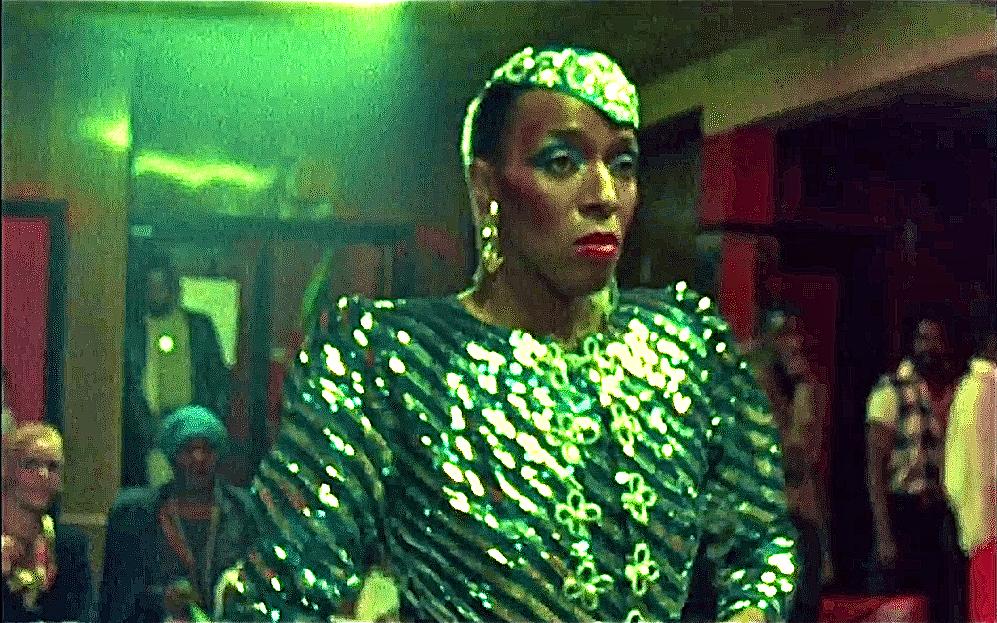
Paris is Burning (1990), dir. by Jennie Livingston
This construction and performance identity is also enacted in Indigenous identities. Victor Masayesva’s Imagining Indians critiques the colonial commodification of Indigenous identities. The film reveals how Indigenous peoples are coerced into performing stereotypes for economic survival, reducing their diverse cultures to monolithic caricatures. This critique aligns with Escobar’s call for dismantling rigid realities in favor of fluid, context-driven identities. By showcasing Indigenous individuals reenacting exaggerated versions of their cultural identities, Masayesva highlights the painful complicity enforced by colonial power structures.
The historical imposition of stereotypes stems from colonial and sexual power structures. Colonial systems classified and ranked individuals to justify domination, creating hierarchies that pathologized non-conforming identities. The hypersexualization of Indigenous women and queer individuals exemplifies how these stereotypes perpetuate dehumanization. These colonial tropes persist in modern media, reflecting the intersection of racialized and sexualized power.
Self-Commodification and the Colonial Gaze
Marginalized identities are often commodified through industries like tourism and entertainment, reflecting economic and cultural domination. In Imagining Indians participants recount being underpaid for performing stereotypical roles as one of Masayesva’s interlocutors recounts “Riding bareback all day with just a g-string on… I earned my $45 on that set. Really really worked out every bit of that $45. Still sore from it as a matter of a fact,” illustrating how economic oppression allows such dehumanization (Imagining Indians, 2:11-2:30). This commodification reflects what Paul Farmer describes as structural violence—the systemic perpetuation of inequality and exploitation. Farmer’s work in global health contextualizes the economic forces that underpin such cultural commodification, linking material deprivation with the perpetuation of subjugation (Farmer, 2003). Masayesva critiques Hollywood’s role in perpetuating these misrepresentations. He describes cinematic portrayals of Native Americans as a “half-lie”—manufactured identities crafted through the colonial gaze. This distortion shapes public perceptions, reinforcing systemic oppression by legitimizing colonial narratives.

Imagining Indians (1992), dir. by Victor Masayesva Jr.
Tourism, as Deidre Evans-Pritchard notes, perpetuates reductive narratives about Indigenous cultures. Visitors seek “exotic” experiences, imposing homogenized and static identities onto dynamic communities. In addition to visual media, “The tourism sector is also implicated because much like the mass media, tourism related content by non-Indigenous Peoples about Indigenous Peoples has tended to silence Native communities or to depict them in demeaning and stereotypical frames” (Ambros and Buzinde). Tewa artists, for example, are pressured to produce work that aligns with consumer expectations as “One recurrent situation that Indian artists have to deal with is continually being asked about the cultural significance of their work. Peo- ple buying Indian art are often very concerned with the traditionality and the “Indian-ness” of an art piece. They want a particular pot, jewelry design, storyteller doll, or whatever to illustrate a cultural story, to have symbolic and even spiritual meaning. After all, for many tour- ists, such souvenirs are not only chosen for aesthetic reasons, but also as reminders of a visit to another culture. Yet many Indian silversmiths have told this writer that they use traditional shapes and symbols to create an aesthetic effect, not to tell a cultural story” (Evans-Pritchard, 95). These extraction relationships between tourists and Indigenous persons creates a reduction in the cultural richness of their ritual as “typically these visitors who come to Tewa villages seeking an exotic cultural experience or a glimpse of what seems to be the simpler, less fragmented existence of a traditional culture. Typically, these visitors see Tewa villages as relatively uncomplicated and unified communities where ritual is part of the people’s lives and the group exists harmoniously with nature” (Sweet, 65). This dynamic alienates Indigenous people from their cultural traditions, commodifying their identities for Western consumption.
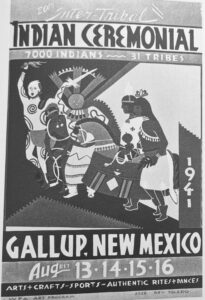
A poster advertising the 1946 Gallup Inter-tribal Indian Ceremonial (School of American Research collection: photo by Deborah Flynn)
As a consequence of this commodification, these rich and complex Indigenous cultures are further collapsed into a monolith. Hollywood films and tourists for instance, have long portrayed Native American culture as singular and shallow, homogenizing their diverse cultures into static, easily communicable tropes. These misrepresentations not only distort Indigenous identities but also perpetuate systems of oppression by shaping public perceptions and social realities. Masayesva emphasizes this by articulating that, “The Native American identity as Western civilization recognizes it is a half-lie—for in essence, they were produced by and for the White men” (Masayesva, 156). This dynamic reflects the broader colonial structure of ontological dualism, where the colonial gaze defines the terms of visibility and authenticity. The appraisal of Indigenous culture as a commodified product reveals invisible power dynamics that prioritize profit over relational and intrinsic values, further alienating Indigenous peoples from their traditions and identities.
Subversion and Self-Assertion Through Performance: Stereotypes as Double-Edged Tools
Rather than simply a site for subjugation, identity and its performance can become transformed into a vector of resistance, enabling marginalized individuals to challenge and reframe societal expectations. In Paris is Burning, drag performances serve as acts of subversion as “[Drag] literally upsets the very stereotypes it invokes…this upending might also be seen to the traditional, proscenium-like staging…[it] might also be seen to symbolize the performer-spectator relationship…these shows generally presume the absence of the so-called “fourth-wall: — the illusion of distance between audience and entertainer” (Horowitz, 23). By parodying societal ideals, participants expose the performative nature of identity. Judith Butler’s essay “Gender is Burning: Questions of Appropriation and Subversion” explores how drag destabilizes gender norms, noting that drag performers inhabit societal ideals while simultaneously critiquing them. Butler asserts, “Parodic repetition of gender norms reveals their imitative structure” (Butler, 1993). Drag ultimately serves as both fantasy and liberation as it allows the individual to inhabit the ideal space in sexual-gender hegemony: “Drag queens do not attempt to produce a facsimile of femininity or womaness – they do tend to put a premium on polished appearances and well-rehearsed performance. They want the work of drag to be evidenced through their impeccable self-styling and spectacular stage shows” (Horowitz, 26). The drag queens featured in Paris are Burning navigate and negotiate their identities in a world that often relegates them to the margins, revealing the fractures within heterosexual hegemony. The documentary showcases how performances create spaces for self-expression and subversion, yet it also raises questions about the implications and fragility of these performances in the context of broader societal norms. Thus, gender is produced through repeated actions and societal expectations, a notion that challenges the idea of fixed identities

Venus Extravaganza in Paris is Burning (1990), dir. by Jennie Livingston
Arturo Escobar’s critique of Cartesian rationalism and his framework of ontological dualism challenge the notion of a singular, objective reality, offering a more fluid understanding of power and identity. He contends, “we are not radically separate from what we commonly conceive of as external reality, but rather such reality comes into being moment by moment” (88). This perspective disrupts fixed interpretations of identity, suggesting that it is continually shaped by dynamic interactions with the world. Escobar’s recognition of multiple realities echoes Butler’s argument that reality is not preexisting but is constituted through performative acts. In Paris is Burning, the performers embody this fluidity, revealing that identity is not a static reproduction of societal norms but an active engagement with and resistance to them. Their performances expose the constructed nature of gender and identity while simultaneously critiquing and reflecting the cultural and power structures from which they emerge.
This tactic of subversion also reveals itself in Indigenous media which similarly serves as a tool for resistance. In Disappearing Worlds: The Kayapo, the Kayapo people use filmmaking to document their cultural practices and political struggles. Anthropologist Terrence Turner highlights how this practice collapses the distinction between observer and subject, allowing the Kayapo to assert control over their representation. Further, indigenous persons will engage in the parody of stereotypes historically weaponized against them. Exemplary of this is Cippy Crazyhorse, a Cochiti artist, who “manipulated some touristic images of Indians in order to confront them and thus liberate himself from ethnic stereotyping. By dressing in a suit, he symbolically reversed the image of a feathered Indian; he simultaneously enacted ad absurdum the stereotype of the dumb Indian who cannot speak proper English. Using the lady’s predictable preconceptions as the starting point of the communication, Cippy was ultimately able to cajole her into seeing him as a fully-fledged human being just like her” (Evans-Pritchard, 96). This decolonial appropriation aligns with Escobar’s vision of emergent realities, where identity and culture are actively shaped by those who live them (Turner, 1991).

Disappearing Worlds: The Kayapo, Indians of the Brazilian Rain Forest (1987) – dir. by Michael Beckham and Terrence Turner
While stereotypes can oppress, they also offer opportunities for deconstruction and liberation. In Imagining Indians, some participants reclaim stereotypes through humor and subversion. Similarly, drag performers in Paris is Burning repurpose societal ideals to create spaces of liberation. Yet, as Butler cautions, parody alone may reinforce hegemonic norms rather than dismantle them. Butler warns, “Subversion must extend beyond imitation to deconstruct the frameworks it critiques” (Butler, 1993).
The paradox of stereotypes reflects the broader tension between liberation and constraint within marginalized identities. Reclaiming stereotypes can expose their artificiality, but it also risks entrenching their presence. This dynamic underscores the need for marginalized groups to redefine their identities on their own terms, transcending the limitations imposed by external narratives.
Breaking Free: Redefining Identity From Within
Transformative agency emerges when marginalized groups assert control over their narratives. The Kayapo’s use of video technology demonstrates the power of self-representation. By documenting their community gatherings and political actions,the Kayapo do not simply “record” their culture; they participate in a dialogue with it, engaging both audience and participants in shared meaning-making; thus, creating authentic representations that challenge colonial narratives. Their video is further used to capture and preserve culture for posterity and thus enacting spontaneous cultural production where the indigenous are recording themselves for themselves.Luis Vivanco’s concept of collapsing authorship highlights the participatory nature of such practices, empowering marginalized groups to control their identities (Vivanco, 2002). In Kayapo filmmaking, they are able to capture distinct notions of beauty and pride as they absorb cameras into Kayapo frameworks and form their own culturally distinct aesthetics. Victor Masayesva’s call for a “Native American aesthetic” exemplifies this process, envisioning a cultural renaissance where Indigenous filmmakers reclaim their traditions and express human redemption through their art (158). Thus, challenging colonial claims to cultural authorship, prompting a slippage between the Kayapo’s role as both observer and subject (Vivanco). Overcoming generations of systemic oppression, “it is important to note that of recent, there have been many strides in the area of ‘digital self-determination,’ This vision challenges the colonial gaze, fostering self-determination and cultural pride.
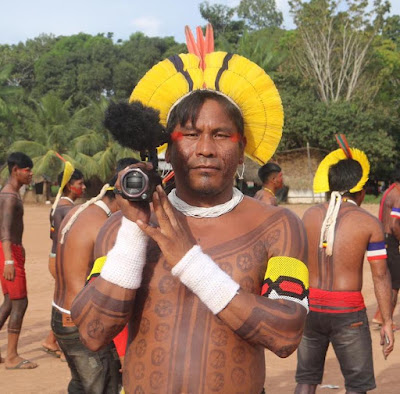
Self-portrait of video warrior Bepunu Kayapó, July 2020 – photo by Glen Shepard
Judith Butler’s theory of performativity provides a theoretical framework for understanding this redefinition. She argues that gender identity is produced the tension between conformity and defiance of societal expectations as she writes, “[Drag] is not an appropriation of dominant culture in order to remain subordinated by its terms but an appropriation that seeks to make over the terms of domination, a making over which is itself a kind of agency, a power in and as discourse in and as performance” (Butler, 137). This perspective highlights agency and empowers individuals who seek to defy these gender norms. This corroborates with Escobar’s emphasis on fluidity of culture, reality, and ide, offering pathways for marginalized groups to transcend colonial binaries and assert their agency.
Discursive Colonial and Sexual Power Structures
Colonial domination operates not only through material exploitation but also through discursive practices that regulate identity and sexuality. By imposing rigid binaries and pathologizing non-conforming behaviors, colonial systems enforce hierarchies that dehumanize and disempower. The interplay between colonial and sexual power structures is evident in the fetishization and commodification of marginalized identities, as seen in both historical and contemporary media.
The regulation of identity has been a cornerstone of colonial power. Indigenous and queer identities have been restricted and subjugated to uphold Western heteropatriarchal norms, reinforcing the dominance of colonial structures. This regulation extends into cultural representation, where stereotypes serve as tools for controlling marginalized groups.
Subversion within these structures requires not only reclaiming agency but also deconstructing the frameworks that sustain them. By challenging the binaries and hierarchies that underpin colonial and sexual power, marginalized groups can assert their identities on their terms, disrupting systems of domination.

Paris is Burning (1990), dir. by Jennie Livingston
Conclusion
Deconstructing ontological dualism and asserting marginalized identities involve a complex interplay of critique, resistance, and transformation. Texts like Imagining Indians, Paris is Burning, and Disappearing Worlds: The Kayapo illuminate the tensions and possibilities within this process. By critiquing stereotypes, challenging the colonial gaze, and reclaiming agency through performance and self-representation, marginalized groups navigate the complexities of identity formation in oppressive systems.
Ultimately, identity is not a static construct but a site of ongoing negotiation and transformation. As Escobar suggests, it “comes into being moment by moment,” shaped by the interplay of power, culture, and resistance. Embracing this fluidity fosters self-determination and challenges the structures that seek to confine marginalized communities. Through acts of subversion and redefinition, these communities assert their humanity and agency, forging pathways toward liberation.
Works Cited
Ambros, Aina Pulbill, and Christine Buzinde. “Indigenous Self-Representations in the Touristic Sphere.” Annals of Tourism Research, Pergamon, 12 Nov. 2020, www.sciencedirect.com/science/article/abs/pii/S0160738320302437.
Beckham, Mike, and Terence Turner. The Kayapo. London: Royal Anthropological Institute, 1987.
Butler, Judith. “Gender Is Burning: Questions of Appropriation and Subversion.” Feminist Film Theory: A Reader, 1998.
Butler, Judith P. Gender Trouble : Feminism and the Subversion of Identity. New York: Routledge, 1999.
Evans-Pritchard, Deirdre. “How ‘They’ See ‘Us’: Native American Images of Tourists.” Annals of Tourism Research, Pergamon, 6 June 2002, www.sciencedirect.com/science/article/abs/pii/0160738389900327.
Horowitz, Katie. Drag, Interperformance, and the Trouble with Queerness. Abingdon, Oxon: Routledge, 2020.
Livingston, Jennie, et al. Paris Is Burning. The Criterion Collection, 1990.
Masayesva, Victor. Imagining Indians. Watertown, Mass.: Documentary Educational Resources, 1992.
Shapiro, Eve. “Drag Kinging and the Transformation of Gender Identities.” Gender and Society, vol. 21, no. 2, 2007, pp. 250–71. JSTOR, http://www.jstor.org/stable/27640961. Accessed 14 Dec. 2024.
Sweet, Jill D. Dances of the Tewa Pueblo Indians : Expressions of New Life. Santa Fe, N.M.: School of American Research Press, 1985.
