The Blue Marble: A Look into the Visible and Invisible Worlds of Space Exploration
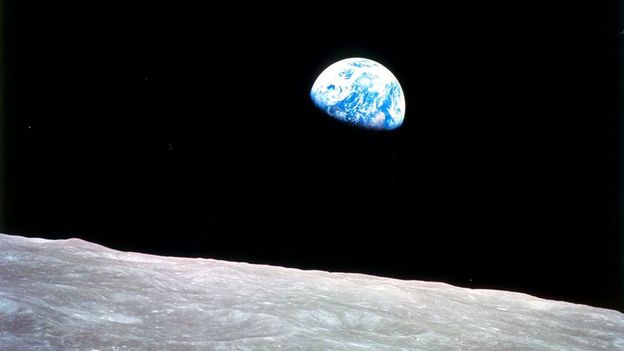
Earthrise, 1968
Abstract:
American space exploration. From a nationalistic, fast-paced, competitive achievement-based movement in the space race against the Soviet Union in the 1960s to being put on the side burner by Congress after the Nixon administration, attitudes toward space exploration of the American government and public has shifted and changed dramatically over the course of the last 60 years.
However, every time space exploration is mentioned in documentary films or TV programs, Earthrise and images of the Moon taken by the Apollo 8 crew are shown without fail, presented as the trailblazer of the age space exploration, continuing to inspire.
The constant and continued use of Earthrise indicates there must be invisible forces at play beyond the half-illuminated blue dot from the surface of the Moon. By analyzing three films (Earthrise: What it’s Like to Escape Our Planet, The New Space Race, The Mars Generation) covering three different time points in the history of American space exploration and how space exploration is represented, as well as using Gan’s diagramming relational thinking to tie invisible infrastructures behind attitudes, representation, and categorization of space and space exploration, we can begin to uncover the forces at play, both visible and invisible, and their effects.
Introduction:
Throughout the course, we discussed how invisible infrastructure and forces hide themselves from view, either behind or beyond public presentation, but how their presence could still be discerned even in observing what could be seen. For example, in one of the wildlife films we watched toward the end of the course, the ordering of filmed sequences by the editor was very deliberate in cultivating the idea the audience should empathize with the endangered rhinos rather than the poachers, dehumanizing the poachers to the extent that when the audience is shown a dead poacher toward the end of the film, they don’t react negatively to the sight of a dead human being. On the surface motivation for the film is conservation, and the motivation for its funding is that the specific idea of nature they are trying to conserve is profitable for large media companies like National Geographic and Disney.
If I applied the same analysis of media representation and invisible/visible forces we developed in this class to other topics, what would I find? As an astrophysics major, I know the most public perception of space is what space is in relation to space exploration, and the first image that people always think of is Earthrise.
Earthrise is hailed as one of the most influential pieces of photography in promoting space exploration, inspiring many to take up interest in aerospace engineering, astronomy, or even just a space aesthetic. But behind the crescent-shaped blue dot, the U.S.-Soviet space race raging on the half-illuminated planet orchestrated the snapshot in time. Today, when we look at images of space, there are still invisible forces and infrastructures behind its production. The stakeholders behind space exploration have expanded to private companies like SpaceX, new countries entering into a space race, and more.
So what’s represented and hidden when we look at images of space today?
Earthrise: What it’s Like to Escape Our Planet
This New York Times Op-Doc centers on the three NASA astronauts (Frank Borman, James Lovell, William Anders) on the Apollo 8 mission and what the mission, and the images they produced, meant to them. By overlaying their images and video of their mission, alongside soft orchestral music, over interviews with the current, much older astronauts as they reflect on the mission and their impact, the editors mean to amplify the perspectives of the astronauts through a sense of inspiration.
Excerpt from Earthrise: What it’s Like to Escape Our Planet. Here the soft, staggered music gives a sense of pondering, wonder, and space for thoughts. Overlaid with images of the Earth and space meant to also inspire awe, videos from inside the spacecraft, James Lovell, one of the Apollo 8 astronauts, reflects upon the mission. With this composite, it seems that the audience is to take Lovell’s words as something that should also inspire wonder and awe.
As noted in the video, NASA equipped the astronauts with cameras to take photos and film, with the intent for them to record anything unusual. Astronaut James Lovell remembers that that nobody initially thought to take a picture of the Earth, and astronaut Frank Borman said he “didn’t even want to take a television camera with us… The television brought back realities of what we were doing to the American people, with the people of the world” (9:14 – 9:25). Flying out to 240,000 miles away from the Earth, the astronauts were looking back on Earth, where they grew up, where their families where, and every other human being resided, lived, and died. A “blue marble” that contained all life as they knew it. And for a moment in history, when Earthrise was first presented to the world, it was if everyone could see the Earth as a small, beautiful precious dot, full of life, and all divisions fell away, that “boundaries we have are really artificial ones” (26:09).
This is a humanist perspective. A humanist perspective is best described in Sean Cubitt’s chapter, “Everyone Knows This is Nowhere: Data Visualization and Ecocriticism”, in the book “Ecocinema Theory and Practice,” stating that: “Picturing, on the other hand, is a humanism. Where populism is aways about an embattled people and their demands, realism–the theory that photography and cinematograph have a privileged relation with the world–begins with the assumption that human perception is the unique and universal criterion of truth. This is a political position only in the sense that it forecloses an essentially political struggle over the status of the real” (Cubitt 281). But such a perspective clashes so much of American and Western society is structured around categorizations and boundaries of “us” and “others”.
For instance, take U.S. census data. It categorizes a certain demographic of people who reside in the U.S. (only citizens), and organizes them by outlined racial and gender identities, creating issues in representation for those who don’t fully identify with those identities. In John Wihbey’s paper, “Visualizing Diversity: Data Diversity and Semiotic Strategies,” Wihbey and his group present a representation of U.S. census data of the racial makeup of the U.S. by year as a growing tree ring, but ultimately claim that “the project case study we present is inherently an artificial exercise,” since there is no good way to represent every identity due to the rigidity of the boundaries in the data taken (Whibey et al, 384). But to see all boundaries, from capitalist versus communist, from American versus Soviet, as artificial implies that these three astronauts saw all living humans, regardless of societal socialization, as part of the small “blue marble.” At the distance they were at, there was no visible distinction between countries, no visible distinction between cultures. There was no other relationally to be made between other humans. It was just them, and the Earth, encapsulating everything.
With their “fourth astronaut,” the camera, they brought back their view of the Earth from the Moon (23:49). To them, this was a spectacular sight that forever changed their perspectives on the world. After taking endless pictures of the lunar surface, the astronauts were greeted with a view of the thumbnail-sized Earth, a glimpse of home. Lovell mentions that he thought everyone would’ve wanted to see the view the three had, to see the “Earth as it really is” (18:42). Although this perspective implies that the “reality” of Earth is only valid when viewed as a distance, akin to the bird’s eye view perspective, only half of perspective tribal “Mallku” leaders in Bolivia were discussed to possess in the first few days of the course. Earth is both a lonely habitable zone planet in a vast universe, and also a land of internal conflict between people. Nonetheless, armed with this new perspective, the astronauts voiced their support for peaceful collaboration as one planet, rather than divisions by countries.
Much to the disappointment of the astronauts expressed at the end of the film, the world soon forgot the original meaning behind Earthrise, that everyone on Earth was one, unified in their existence on a blue dot, and went back to their normal socialization of defining themselves and others into divisions and categorizations.
Excerpt from Earthrise: What it’s Like to Escape Our Planet. Here, Frank Borman, James Lovell, and William Anders leave the audience with call for unification rather than competition in regards to the future of space exploration, to go to Mars as “human beings,” and sort out differences on Earth first in order to achieve the unification needed and represented by Earthrise to venture out into the cosmos.
With its original meaning soon pushed to the sidelines as the spectacle of space exploration dampened, Earthrise would soon begin to represent a technological milestone with its own set of implications, old and new, rather than just a planetary unification that the Apollo 8 astronauts interpreted.
The New Space Race
In the episode The New Space Race from PBS show GZero World with Ian Bremmer, host Ian Bremmer sits down with former-astronaut-turned-Senator, Mark Kelly to talk about space exploration and policies, but the conversation quickly turns to connecting space exploration to militarization and rising tensions with China.
Bremmer begins by prefacing China’s recent space exploration achievements, like landing on the dark side of the Moon, making a new space station, and plans to have a lunar base with Russia by 2035. China has also made militaristic moves like anti-satellite missiles. Comparatively, the U.S. space policy is less ambitious, although notably commercializing space travel has made transportation cheaper. Additionally, Bremmer worries that China’s space initiative is rooted in nationalistic and militaristic fervor (2:54 – 4:41). But if we apply the same analysis to the U.S. space program of the 1960s, it was very much a nationalistic and militaristic effort to surpass Russia amidst the Cold War.
Even the current space exploration climate, based on Kelly and Bremmer’s discussion, is pressured by military, geopolitics, and maintaining an advantage over competing countries like China and Russia. Kelly goes on to say that he’s confident the Artemis III mission will get Americans back to the Moon before the Chinese, certainly echoing motivations for advancing the space program during the Cold War space race.
In Kelly’s time as an astronaut, starting in the 1990s, NASA relied on the Russians to send their astronauts into space, and sense of international cooperation was fostered, although with changing geopolitics on the ground, such as Russia’s invasion of Ukraine, space policy changes alongside it.
The interview gives a clear-cut view of just how much space exploration efforts are informed by militarization and politics at present day, which calls into question the humanist interpretation of Earthrise the Apollo 8 astronauts promoted. If the push behind the Apollo missions was already motivated by geopolitics and arms-race intentions, how can a picture, that was a product of it, truly spread the message of humanism? The image itself is trapped within context of political tensions of a space race, of the Cold War, much like how the debt collection system and dehumanizing attitudes toward people in debt illustrated by The Debt Collection lab’s short film, Shame On You!, traps many Americans in a cycle of debt. Perhaps that is why it didn’t take long for the world to return to focusing on geopolitical wars and imposing more divisions of “us” versus “them,” instead of adopting a more humanist, collaborative perspective. Earthrise is trapped within the realm of geopolitics, and so is everyone else on this planet. For the Apollo 8 crew, it took leaving the planet for them to see the dissolution of this system, as their view of the Earth was reduced to a pale blue marble.
The Mars Generation
This Netflix documentary follows a group of teenagers at Space Camp, a program run by NASA to inspire and train the next generation of engineers, scientists, and astronaut hopefuls in the basics of rocketry, robotics, and handling space simulations of living on a space station or living on a base on Mars. The film gives them the moniker, The Mars Generation.
After an inspiring featurette of images of space exploration achievement, including the use of footage of the Apollo 8 mission, the documentary turns to the teens, who are incredibly passionate about space and dream of getting to Mars, trying to get the audience on the same energy level as the Space Camp teens in their attitudes toward space and space exploration. One teen, Niko, even states that he “would definitely be willing to die to go to Mars.” (55:30).
Excerpt from The Mars Generation. Here, President Kennedy’s speech is overlaid with footage from the Apollo 8 mission, cultivating a sense of space exploration achievement and pride, especially in going to the stars because “it is hard.”
Many of the teens express their interest in one day becoming astronauts and engineers, and lament the decline in funding for NASA, now operating on 0.4% of the U.S.’s national budget compared to the height of the space program progressing under an accelerated pace with 4% of the U.S.’s national budget (1:24:29), under the wing of Wernher von Braun, a former Nazi responsible for the V-2 missiles that caused devastating civilian casualties in World War II, who also went on to be a figurehead of NASA and earn the name of “the father of space travel” after his design of the Saturn V launch rocket. Von Braun was already thinking of going to Mars in his time, but with the change in space policy and public perception during the Nixon administration, those dreams were tabled in favor of shuttling astronauts to and from the International Space Station (ISS).
Another reason for the de-prioritization of space exploration, as discussed by Jim Pass in the paper “The Cultural Imperative to Colonize Space: An Astrosociological Perspective,” is that while the technology developed for space travel made its way into material culture, such as phones and weather forecasting, it has become so ingrained into everyday use that is “not present in our everyday consciousness” (Pass et al. 2).
The teens also lament the state of the world in the lack of cooperation toward a shared future in space exploration, wanting to do science for the sake of science, rather than at the whims of the government and military. At the same time, certain trainings, such as the sunken capsule training module already establishes a sense of background militarism. As Cubitt notes, “In recent narrative cinema, it is clear that control over visualization in the scientific community is the object of a political struggle between factions, in which the claims of scientific neutrality are frequently questioned, whether by populist, heroic representatives of the “little guy” or by over weening military and political elites” (294). The teens are convinced that getting to Mars is their dream, and that the military and political elites are hindering that. However, they are not against the privatization of space travel, as it reduces the cost for agencies like NASA to fund and find innovative technologies to improve space travel. For example, this past October, company SpaceX was successful in its implementation of a reusable rocket that could return to the launch site. On the other hand, current involvement of Elon Musk and his private company, SpaceX, and stories of billionaires taking commercial rides into space, so who is space travel really for?
Additionally, with more and more visible effects of climate change becoming visible on our planet and the idea of space travel being presented as escaping Earth, is the goal of getting humanity to Mars or further out into the universe one of achievement, of humanism, economic value and capital, or political competition?
Conclusion:
When we analyze images or footage of space like Earthrise today, we find that it and space exploration as a whole exists at the intersection of many worlds, both immediately visible or more abstract, and the push and pull of progress in the American space program follows the interactions of these invisible and visible worlds of politics, economics, education, scientific achievement and discovery.
Below I have tried to outline a concept web of relationalities between these worlds connected to American space exploration.
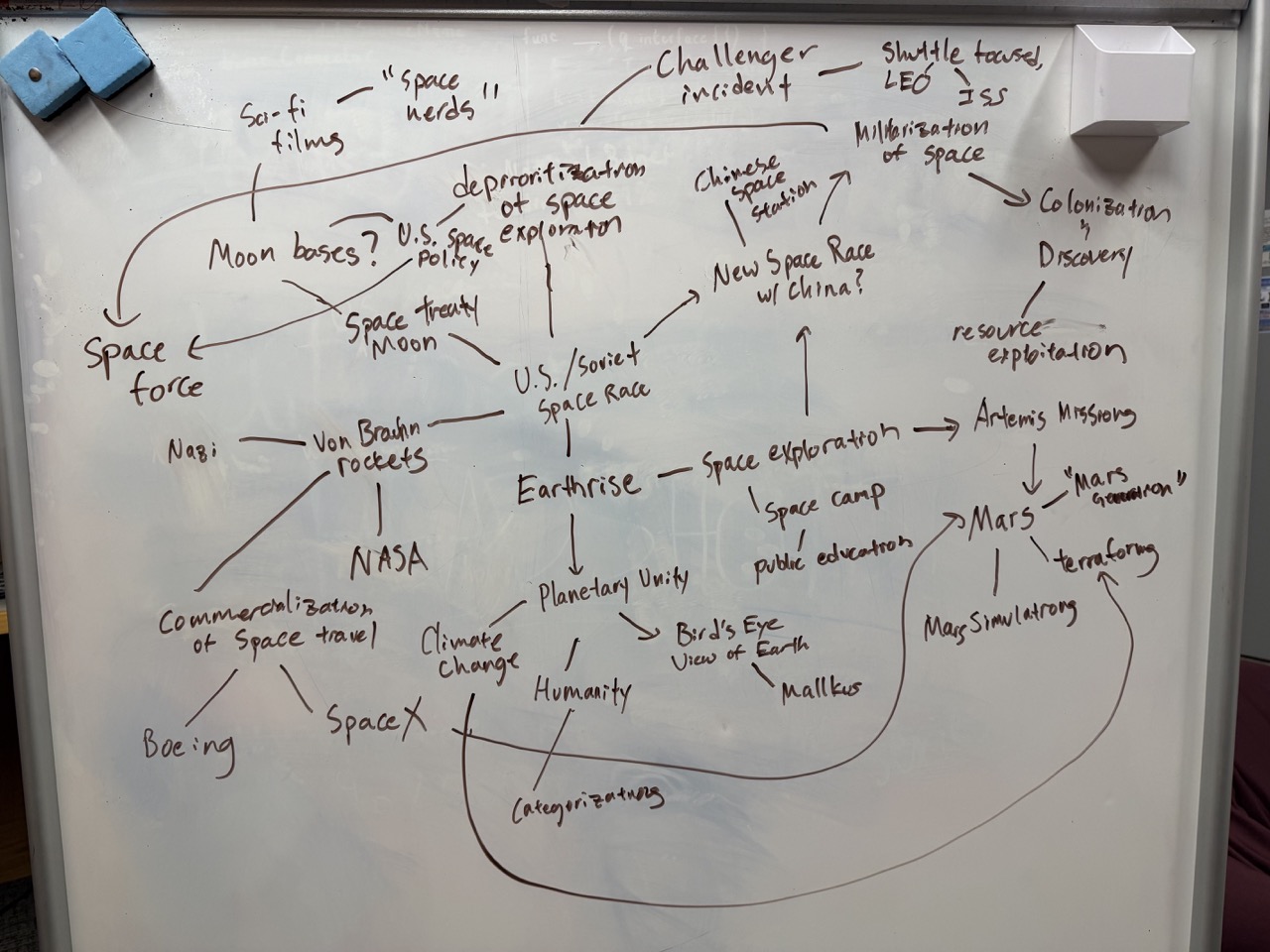
By applying the diagramming technique described by Elaine Gan in “Diagramming Multispecies Relations,” I have mapped out my own summary of the relations that I have found in my research of these three films, both abstract and physical, stemming from the image of Earthrise.
Works Cited:
- Gan, Elaine. “Diagramming Multispecies Relations.” Environmental Humanities, vol. 12, no. 2, 2020, pp. 431–449.
- Wihbey, John, et al. “Visualizing Diversity: Data Diversity and Semiotic Strategies.” Digital Journalism, vol. 8, no. 4, 2020, pp. 480–501.
- Cubitt, Sean. “Everyone Knows This Is Nowhere: Data Visualization and Ecocriticism.” Interdisciplinary Science Reviews, vol. 37, no. 4, 2012, pp. 321–334.
- Pass, Jim, et al. “The Cultural Imperative to Colonize Space: An Astrosociological Perspective.” Astropolitics: The International Journal of Space Politics & Policy, vol. 4, no. 2, 2006, pp. 197–223.
- Shame On You! Directed by Himpele, 2023.
- Earthrise: What It’s Like to Escape Our Planet. Directed by Emmanuel Vaughn-Lee, Global Oneness Project, 2018.
- The New Space Race. Directed by Ian Bremmer, GZERO Media, 2020.
- The Mars Generation. Directed by Michael Barnett, Netflix, 2017.
