St. Giles District: A Walk Down High Holborn

It’s a sunny day in London, weather so rare you decide you’d better not waste it.  It has been raining the past two days, giving you an excuse to put off getting a new cabinet. But now that the rain has let up, you decide you’d better go to the cabinet manufacturer on High Holden to purchase one. If only your sons hadn’t been so clumsy bringing in the furniture from the cart when you moved into St. Giles District last week. Fortunate for you, you had found steady work quite quickly, thus could afford such expenses. Besides, if you put it off any longer, Margaret, your wife, would surely have your head.

Turning left on Museum Street, you take the cart down High Holden. Immediately you can hear the sounds of activity. No one seemed to want to waste this day. The shouts of sturdy men reach your ears over the noise of your grinding cartwheels as they heave enormous bundles of linen into the Linen and Wool Draper’s.  A line has already formed outside Ferguson’s Grand Exhibition. You wondered what could be showing today. Perhaps later in the day you could take the family out to see. Moving on, you see a marvelous display of paper hangings outside the Paper Hanging Manufacturer and Decorator’s, resplendent with bright colors and beautiful patterns. You stop by to admire the wallpaper for a little while, but once prompted to buy something, you quickly excuse yourself to continue on your mission. Coming upon the cabinet manufacturer’s at last, you pick a cabinet about the same size and design as the one you had before. The price is ridiculous! After arguing with the shopkeeper for a good while, you finally settle for a smaller cabinet at a more reasonable price, loading it into your cart. You hope Margaret won’t notice the difference.
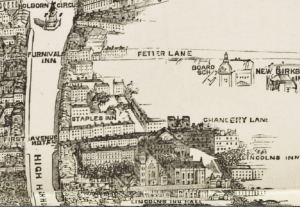
A trip on High Holborn, passing Lincoln’s Inn Hall, a hotel, two inns, and the circus.

You could turn back to Museum Street, but instead you decide to venture a little further down High Holden. You had seen so little of this district since you moved in on account of the rain: it was about time you became a little more acquainted with it.  Passing New Oxford Street, you stop for a bite in Holborn Restaurant. You hadn’t eaten all morning, after all. Pushing forward, you admire the dignified Lincoln’s Inn Hall from a distance. You had never seen such buildings on the countryside; it was truly magnificent.  Your faithful horse trods past two inns and a hotel, leading you to wonder why there are so many temporary rooms in the city. You are shaken from your thoughts upon hearing the sounds of a chittering monkey. It was walking on its hands across a rope suspended between two long poles. You are surrounded the by the sounds of festive music, see giants, dwarfs, and all sorts of wonders. You have arrived at the Holborn Circus. You have never seen a circus before! Spending hours among the entertainers, you quite forget yourself until the sun begins to set. Cursing yourself for your forgetfulness, you set on the path home again, picking up a cake from Holborn restaurant to mollify Margaret. This time, she would have your head.
St. Giles District: Flight from Overpopulation

St. Giles District gained and lost a large percentage of its population at the beginning and end of the 19th century respectively. From 1801 to 1811, the population made a huge leap from 36,502 people to 48, 536 people, a dramatic increase of about 33%. After this initial jump, the population change of St. Giles slows down to near-zero around 1831, changing little for 4 decades. Between 1871 and 1881 this suddenly changes as the population dramatically declines to around 45,000, a 16% decrease.

These changes can only be understood in the context of the rest of London and population density. St. Giles District remained in the highest category for population density throughout the 19th century. It’s a small district, but its central location and short distance from the city of London likely made it attractive for incomers from the countryside. Moreover, at the beginning of the 19th century, those areas closer to London tended to be more developed, allowing for a higher concentration of people to live and find work there. As the century progressed, however, more areas started to be developed. Given that the population density of St. Giles was so high, it’s likely that its denizens decided to move away from this area into the less occupied areas now more available to them.

This trend is mirrored in the different metropolitan districts of London. The categories on the map indicating population density are colored from light to dark. Lighter colors represent a smaller population density, while darker colors represent a larger population density.  Visually, the interactive map displays an inverse relationship between the darkness of the colors for central districts and time. This shows that as time progressed, many people moved from the center of London to the This creates a stronger argument that more occupations may have become available in the less populated districts as they developed. Thus, living in areas with a smaller population density may have allowed for more comfortable living and better job security due to a decrease in competition, creating an incentive for people to leave the center of London.

The argument for an increase in the development of areas further away from the center of London is further supported by observing the distribution of institutions over time. At the beginning of the century, most institutions are located in the center of London, but by 1890 the quantity of institutions grew and the institutions themselves became more evenly distributed, creating opportunities for more people to live in areas of smaller population density.

St. Giles District: Charitable Institutions on the Rise (1801 – 1890)

So much of London’s history involves a series of adaptations to shifting environments over time that poets have remarked the only constant in London is change. This is no less true for the metropolitan St. Giles District of London during the 19th century. Beginning with a workhouse and a hospital for poor married women in the period of 1801-1810, the district was already concerned with serving the poor in the area. This concern only expanded as time went by.

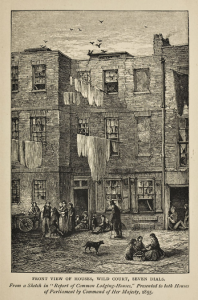
Three decades later more charitable institutions are added: two refuges for destitute boys and an association for improving the housing conditions of the poor. The refuges for the destitute boys gave the children basic necessities such as food and clothing.  The children were also put to work; they could learn trades like shoemaking,  tailoring clothes, and housework, or get sent to a farm,  the American colonies, or training ships to learn their trades.  Twenty years later a girl’s refuge was open as well, but closed by 1881. Here, girls were also trained for jobs, but instead as laundrywomen and house servants. It’s difficult to say why there were more refuges for boys than girls, however, one may speculate that the refuges may have derived much of their income from training children for trades, therefore, valued boys more than girls given the wider variety of trades available to males. The creation of these additional institutions showed how poverty increased in the district over time.  As children who lived in poverty couldn’t be supported by their families either due to their being deceased or an inability to find adequate work, these refuges were their only option.  The need for the association relating to housing conditions was also very telling of the poverty in this district. Housing security remained a large concern as slums were demolished and the poor evicted, hence the continued existence of this association up to 1890 and possibly beyond.

A sketch from the Victorian era of the slums near the refuges for destitute boys in St. Giles District.

Beginning in 1875, new charities began to enter the scene. Missionaries came to serve the poor in lodging house kitchens. In the next decade, when the missionaries and the girls’ refuge had left, an orphanage and almshouse were added to the district.  In this way, the number of charitable organizations increased or remained the same as the century progressed.  Moreover, the concerns of the organizations also remained the same: to house the poor and to take care of the children. The new organizations simply did this work in different ways.  While the refuges were gendered and oriented around teaching children a trade, the orphanage was open to any child who had lost a father or both parents and provided an education in addition to basic necessities.


London – My Favorite City

It is definitely cliche but London is actually my favorite city. While I moved away when I was 5, a part of me feels most at home there. My family visits almost every year but sadly we had to stay home this past summer due to COVID. I love the way that London has both the feeling of a bustling city and small neighborhood. fGSia6f+RS+ryYmprjhaBw

Manchester – My Favourite City

I grew up on the foothills of the Pennines, just outside of the metropolis of Manchester. For most of my childhood, I’d relish the trips into the city by train or by car to wander through the Victorian-era streets, experience the excitement of the stores that lined the streets, and explore the farmers’ markets that brought food from the verdant countryside into the beating heart of England’s northwest. With its recent boom in modern office blocks and residential towers (which, as you can see in the picture, doesn’t quite blend in with the city’s more historic architecture), it’s a city that’s constantly changing. The slightly scrappier and edgier counterpart to the more prim and proper London (an assertion I’m sure we’ll see challenged in this course), Manchester is a city that’s energetic, welcoming, and not afraid to be itself.

New York City

I’ve never lived anywhere but Manhattan, or, at the very least, I’ve never been from anywhere else.

When I return, I find solace in the reflecting pool at Lincoln Center and solitary runs around The Reservoir when the

cherry blossoms are in full bloom. And I’ll find a bodega coated corner for Sunday flowers and wander side streets and groves of brownstones.


Sydney

Image result for sydney australia

Sydney is not only my home, but also my favourite city in the world. The mix of vibrant city culture and relaxed beach vibes combine to form a city whose essence is truly unique. As an avid lover of the water, the beaches in Sydney are (in my not so biased opinion) some of the best Australia has to offer. While the harbour beaches offer something different to those that line the Pacific coast, both are worth visiting on a hot summer’s day.

Paris

Admittedly, I’m not much of a city person. I prefer the quietude of places like the small Massachusetts town where I grew up, where I feel like I have the time and space to think. But something about Paris is magical to me. I’ve been fortunate to visit the city three times now—once on a family vacation, once to tag along with my mom on a work trip, and then to study over a summer. Each time I returned, I became more familiar with the city’s landscapes and rhythm, while simultaneously discovering new aspects of its charm.

As a history major in a family of history majors, Paris provides an infinite syllabus, with museums, landmarks, and cultural sites galore. There’s a sense of living history in the city etched into its very roads and buildings that I enjoy. Each time I arrived in the city with a new context and a new perspective, from a tourist to someone living there for an extended period. Familiarizing myself with my favorite museums, study spots, and cafes made me feel part of the city even as I remained somewhat of an outsider.

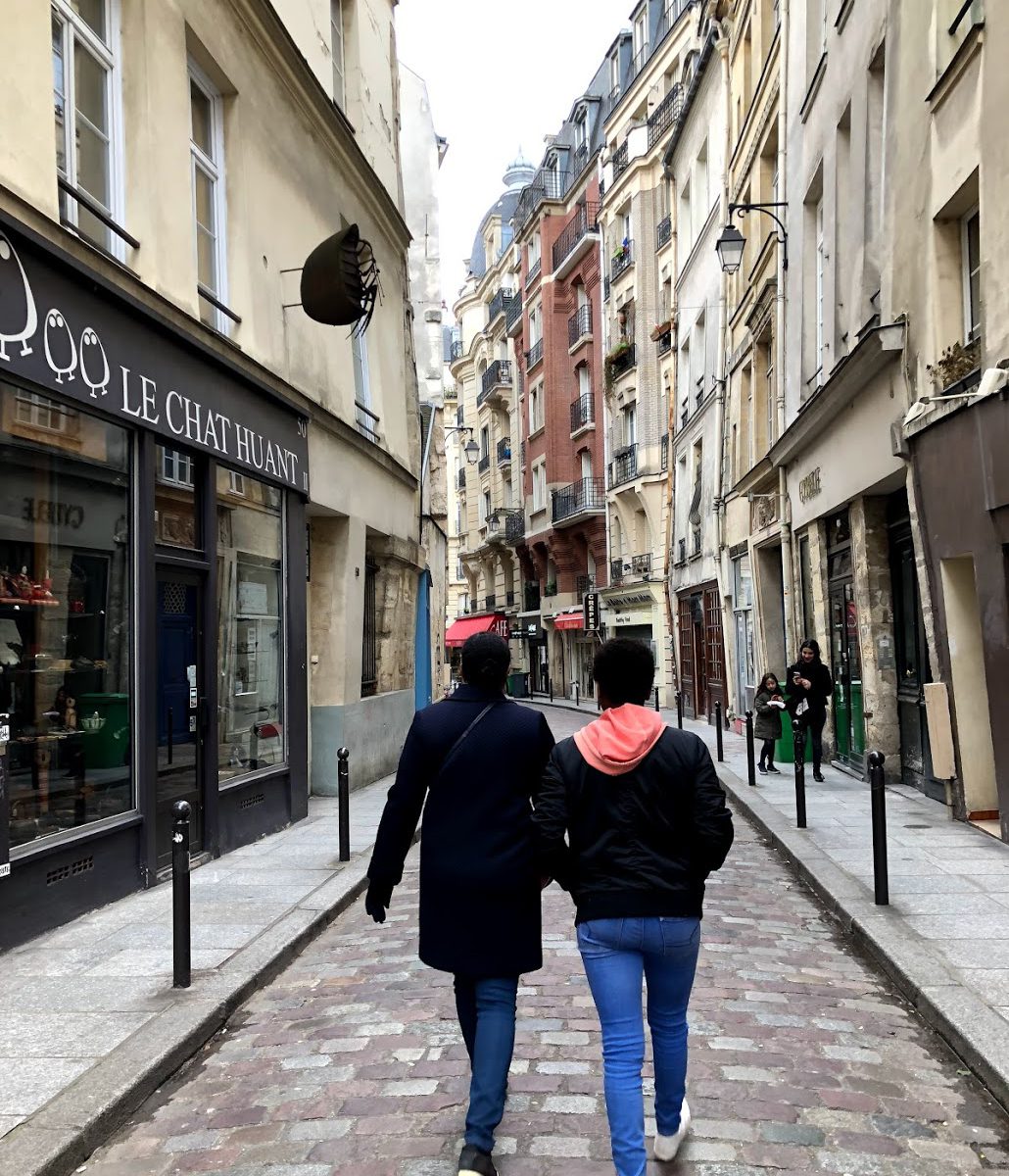
The picture at the top of this post actually captures the unexpected ways I came to appreciate Paris. This is from my second time in the city, when my twin sister and I accompanied our mom on a work trip. In the classic way, my mom claimed she knew where we were going, saying she remembered the route from our first trip to the city 4 years earlier. No need for a map, she claimed. Unsurprisingly, we quickly found ourselves lost. This sort of situation usually bothers me—I hate not knowing where I’m going. But instead of getting frustrated, I started to appreciate the walk, admiring the buildings and unique character that makes Paris Paris.

That area where we roamed for the better part of an hour, Île Saint-Louis, is now my favorite part of the city. An island within a city, it presented a surmountable challenge for me to master; a smaller, contained area for me to tackle. When my sister visited me during my summer abroad the next year, we returned to the Ile Saint-Louis, and by that time I became the tour guide, leading us to our favorite bridge overlooking the Seine and the small shop with our favorite strawberry and mango sorbet. Here we are walking around the island, sorbet in hand.

Whereas I was at first overwhelmed by the unfamiliar city and its foreign language, now I feel almost at home there. Even though I still don’t speak French and have only cumulatively spent a few months there, the memories and experiences I’ve had there have transformed Paris into my favorite city.

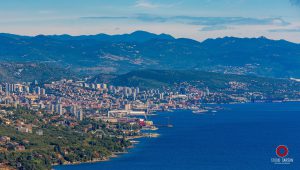
Rijeka, Croatia

When most people think of Croatia, they think of Game of Thrones and of Dubrovnik’s — King’s Landing in the popular television series — famous white stucco houses with red-tiled roofs. For me, the small, coastal country of Croatia is even more special. It is the country my grandmother is from, the country most of my extended relatives still live in, and the country I visit most in my travels. 

In my opinion, Croatia’s best feature is not the well-known Dubrovnik, which is both plagued by and reliant on high levels of tourism and cruise ships. Instead, the lesser-known Rijeka, home to my great-uncle and the rest of my family, is the city that most feels like home in a country that is alternately familiar and utterly foreign to me. Wandering the streets eating ćevapčići, shopping in the neighboring town of Opatija, spending days on my great-uncle’s small sailboat — in my mind, Rijeka will always be a sunny city of delicious fried fish, barely plausible family folklore and constant laughter. Although I am currently trapped inside and listening to snow pelt the window of my dorm room, I still can’t help but smile when I think about Rijeka (and begin counting down the days until I feel that sun again!).

For Nairobi – with Love

I haven’t traveled much, but Nairobi, seen here at night, is perhaps the greatest of all the cities I’d been to.

Though I grew up in Kenya, I came to Nairobi only much later,  when I was old enough to discover the world on my own. Initially, the city resisted me, as I imagine all cities do first—it was scary, it was overwhelming. I stayed on and as my memories of the city piled up, it slowly opened up to me and I eventually fell in love.

I clearly recall the moment I felt at home in Nairobi. It happened in Ramadan, Islam’s holiest month. One night, my friends and I were walking to a mosque at the heart of the city, and as happens sooner or later in every city, we got mugged. Later in the month, while walking from the mosque, we got mugged again. But one of the robbers recognized us at the last minute and returned our items. And it hit me just then: this was home and even the robbers knew us.

And now I miss home dearly.