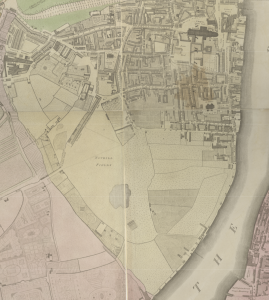
I chose to explore an area on the outskirts of Westminster. I focused on the section along the bank of the Thames stretching from Westminster Abbey to the Tothill Fields. This slice of London presented an interesting juxtaposition of highly-developed and undeveloped areas. In Horwood’s plan, the amount of open green space is striking. There are no roads in the area surrounding the Tothill Fields, and the fields themselves are left as open grassy areas (they would later become the site of a playground). This section is completely isolated, with no bridge across the river and no roads to the west. The only institution in this part of the map is the Grey Coat School. Looking here brings you to the border of the more developed part of my area of focus. The school borders the last street before the fields, Horse Ferry Road. From here, I looked at the area circumscribed by Strutton Ground Road Way on the left, with Westminster Abbey and the Thames serving as the other borders. In this section, only a few institutions are labeled. Two are churches: St. John’s Church and Westminster Abbey. The other three are seats of government: Westminster Hall, the House of Lords, and the House of Commons. The House of Lords and House of Commons are not labeled on Harwood’s map, but the 1789 Fores’s Guide identifies them. Aside from these, and Pearce’s Brewery along the riverbank, nothing is labeled. Numerous homes line the streets, thinning out as you move away from Westminster Abbey towards the Tothill Fields.
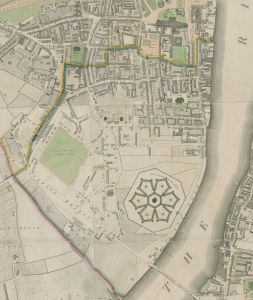
Westminster in Faden’s 1819 revision
These characteristics of the area help explain the main change between Horwood’s Plan and Faden’s 1819 revision: the construction of a penitentiary. In the once-isolated area by the Tothill Fields, a penitentiary has been built. I’ll explore the human impact of the prison’s panopticon design in the next post, but here I’ll focus on the relationship between the natural environment and the location of the prison. This area is slightly more developed than in Horwood’s Plan. The Tothill Fields are gone; there are now a few streets with houses and a butter factory. Near Grey Coat School, there is now a playground for students. Moreover, Vauxhall Bridge now connects this area to the land across the Thames, and the large Vauxhall Bridge Road makes this location more accessible. Still, the area immediately surrounding the prison is largely undeveloped, and the natural environment here makes it a fitting location for a penitentiary. The nearby river allows for easy transport of prisoners, but makes escape difficult. The open space around the prison likewise inhibits escape. Moreover, the large open space allows for the sprawling panopticon design of the penitentiary. In these two views of Westminster from Horwood and Faden, we can see how its natural environment with the Thames and open land shapes the development of this area of the city.
London constantly reinvents itself; John Thomas Smith’s Antiquities of London goes back in time to the first invention and builds the city back up from its relics and ruins. Within the confines of Bridewell and the surrounding area, this guidebook is able to highlight just how critical this place has consistently been for the city at large.
“Engravings of King Lud and his Sons [in the Bone-House of St. Dunstan’s Parish (Fleet Street)]”The engraving depicting the oldest piece of history in this section of the map is about King Lud and his sons. In the caption to the engraving, it is mentioned that King Lud lived around the same time as Julius Caesar, and the phonetic degradation of Lud’s Town is what gave London its name. The king’s legacy is not just present in the name of the city, but Ludgate Hill and Street are also named after him. Importantly, Smith notes that the intended place for the statues was currently occupied by a statue of Elizabeth I, and since there is not enough space for three statues even if they replaced Queen Elizabeth’s statue with King Lud’s, Elizabeth’s statue would be staying where it was. There is a transition from the old to the new, from past monarchies to a more current one that follows the broader idea of reinvention. Nonetheless, there still remains a tradition of sorts within the reinvention. The monarchical family changes, but the area associated with the monarchy and the monarchy itself do not.
“London Wall, Ludgate Hill”
Smith’s engravings preserve previous versions of the city, but they also are a reminder that each reinvention of the city carries traces from past selves. At the end of the 18th century when he is making these engravings, the ruins of the London Wall—which were a part of the ancient city wall—are still there. Despite a devastating fire that burnt down nearly the whole city in 1666, Mr. Holden’s family vault in St. Bride’s Churchyard is still there.
“Entrance to Mr. Holden’s family vault in St. Bride’s Churchyard”“Mrs. Salmon’s, Fleet Street No. 17”
There is a great attention to conveying the historical meaning of an engraved structure; therefore, when there is a certain engraving which misses this key trait, there are more questions raised by it than there are answered. One such engraving is the one of Mrs. Salmon’s Wax Work. The building appears to have been damaged given the fading, cracked paint on the top floor, and the fact that the building is not completely straight. Rather, it looks like certain components of the building that ought to be parallel are not because of some historical event or another. Smith’s guide, by documenting the remnants of the city’s past underlines the fragility and impermanence of the city at any one point in time as no moment in antiquity can be replicated entirely. This representation of the City of London, and Bridewell and the surrounding areas in particular shows the fleeting nature of a map of Bridewell.
The area around Bridewell brings together people from all walks of life as one might expect from a place with a garden, two prisons, multiple churches, countless wharves, and a royal history. In addition, the small houses cramped together in the spaces left in between the various institutions suggests that the area was probably relatively densely populated. This makes sense as everyone might have a different reason for living there.
“A Whistling Shop. Tom & Jerry visiting Logic ‘on board the Fleet'” from Pierce Egan’s Life in London (1821)
Someone could be in Fleet Prison because they are in debt; another might be working at the prison. The drawing of the inside of a whistling shop from Egan’s Life in London shows the range of people who are living here. Within the same room, there is a man in tattered clothes warming himself by the fire, a woman with children, some card players, and almost everyone is drinking. The clothes of the people—especially the colours and cuts of their clothing, and the types of hats they are wearing—implies that most of these people are not from the same socioeconomic class; however, it is also clear that no one is from the upper-upper class, and there are very few from the lower-upper class, if indeed there are any. How much would things have changed in, say, fifteen years from the time this drawing was made in 1821?
Charles Dickens could help us see that the answer is not that much. In his earliest novel, The Pickwick Papers, Mr. Pickwick ends up in Fleet Prison, and Dickens’s description wouldn’t appear strange to someone familiar with the prison from Horwood’s Plan.
Charlotte Brontë references another prison in this area during a game of charades in Jane Eyre: Bridewell. This prison starts off as a Tudor palace and is later converted into a hospital and prison during the reign of Edward VI. While the purpose of this building has changed over time, the various structures surrounding Bridewell are a reminder of its history through names like King Edward Street, St. Bride’s Church Yard, St. Bride’s Wharf, Crown Court, Tudor Street, Bride Lane, Bride Court…
“Poor Sweep, Blackfriars Bridge” from Mapping Modern London (1804)
Bridewell during the late 18th and early 19th century has significantly changed since its days as a royal palace. The Pass-Room from Ackermann’s Microcosm of London shows a Bridewell where women are sleeping on hay because there are not enough beds. It is probable that some of these women are single mothers since there are children in the middle of the drawing.
In addition to the prisons and people who live in the area because they are in some way connected to the prison system, another demographic to keep in mind is children working to survive. We see Blackfriars Bridge as a spot where crossing sweepers work in Modern London. This suggests there are also middle class people who are coming in and out of this part of the City of London since someone must be paying for this service provided by children. Bridewell and its surroundings is a point of entry into the district, and therefore it makes sense that the place be populous and host people from different socioeconomic backgrounds.
“Poor Sweep, Blackfriars Bridge” from Mapping Modern London (1804)
The seam joining the Thames with the rest of the City of London is the wharves: just within the area surrounding Bridewell there are over fifteen of varying sizes. This abundance makes sense with the context given in Fores’s list that London harbours over ten thousand boats. As a result, however, the boundary between the natural and built environment is blurred even more than it already was; after all, where does the river end and the district begin if the boats are part of the city?
Blackfriars Bridge as depicted in Malton’s Picturesque Tour (1792-1801)
The natural environment—most notably the Thames—influences the built environment both in terms of the types of structures that need to exist to make this district the heart of the larger city, and in terms of the names of these structures. In addition to the wharves, a point of contact between this part of the City of London and the river is Blackfriars Bridge. Without the bridge and the wharves, not only would access to the area be far more limited, but this shift away from being a hub would fundamentally change the area’s identity since multiple structures have names referring to this symbiotic relationship between the natural and the built. The two most prominent streets that connect other smaller streets together are aptly named Fleet Street and New Bridge Street. The prison located right next to the intersection of these streets is also called Fleet Prison. There are numerous other smaller streets that highlight this Thames-based identity such as Little Bridge Street and Water Street.
Another important meeting point between the natural and the built environments is the Temple Gardens. The natural body of water directly next to the garden plays into the style of English gardens that contrasted from the jardin à la française. As can be seen in the image of Temple Gardens from 1809, the artificially created nature is still meant to look realistic to an extent. This is a heightened form of nature, but is, nonetheless, reminiscent of undisturbed nature. There is a deliberate attempt to work with nature—unlike the symmetrical and perfectly trimmed topiary common in French gardens—that makes this garden stand out as quintessentially English.
Bridge Street, Blackfriars from Papworth’s Select Views (1816)
When we look at changes between Horwood’s Plan and Faden’s 1819 revision, we see there is a new and much smaller garden that is built right next to Bridewell. In addition to the garden, Bridewell also has a new chapel in its premises. Another change is the obelisk located in the intersection between Fleet Street and New Bridge Street. The obelisk must have been there since 1816 at the latest given the image of Bridge Street from Papworth’s Select Views includes the obelisk. The most substantial change in the area that alludes to technological developments of the time is the replacement of the New River Office and Yard with the Gas Light Company. The existence of the company suggests that using gas light must have been popular enough to sustain a business as early as 1819.
Bridewell Hospital and surrounding area in Horwood’s Plan (1792-9)Bridewell Hospital and surrounding area in Faden’s 1819 revision. Orange highlights refer to places that have changed since Horwood’s original map. Green highlights refer to places mentioned in the current and following posts that have not changed between the two editions of the map.
It’s the dawn of the 19th-century and we’re in London’s Greenwich District.
The population stands at 32,621. Our district has only one hospital, Royal Seamens, which cares for our disabled sailors. A decade into the century, the population grows to 36,780—an increase of 12.75 percent. No new institutions appear in this period. Another decade passes and the population is now 41,530. This is an increase of yet another 12.91 percent. The population growth in the two decades has remained the same—we’ve had a total of 27.21 percent increase in population since the turn of the century. The numbers are rising yes, but this is not substantial enough to lead to subsequent growth in the institutions in the district. We need another factor for a more significant change to occur. This comes in 1834, when the new Poor Law, which requires children to be housed in exchange for work, is passed in London. But our district has to wait a bit longer—six years, to be exact. In 1840, the Greenwich Poor Law Workhouse appeared.
Between 1841-1850, the population rose to 55,212. This entails an increase of 32.94 percent from the previous decade and an increase of 69.25 percent since the beginning of the century. The appearance of the workhouse has impacted the growth of our district in this short period—in fact, we can speculate that the workhouse might be responsible for a 20.11 percent rise in the population. But we’ve to speed later into the century for a full glimpse of the true impact of the workhouse.
Boom! We’re now at the tail end of the century. The population in Greenwich District is 131,233 people. This is an increase of 302.3 percent since the turn of the century. But we want to know what caused the population growth. In just the last half of the century, the population has risen 137.69 percent. In the first half, as you may remember, we’d a growth of only 69.25 percent. The difference is more than double. This means the workhouse has significantly increased the population of Greenwich District.
The suggestion of our data is clear. The workhouse has recruited a lot of children, many of whom had traveled from outside our district. In 1875, another workhouse had to be built to accommodate more inmates. Perhaps due to the poor conditions at the workhouses, St. John’s Hospital was built in the district. Where we’d had a hospital for seamen previously, we now have two missions — our district now caters to the spirituality of the seamen, which signifies the growth of the church in the late 19th-century.
From the experience of our district, we glean a trend, which may extend to the rest of the city. The introduction of the new Poor Law in 1834 led to the emergence of the workhouses, which were a magnet for inmates. This subsequently led to the growth of the population in the areas where the workhouses were located.
***
Up until now, we’ve gotten the impression that the upsurge in Greenwich’s population was entirely due to the workhouses, but this may not be true. Other sites in our district have also played a role in attracting residents from around the city and perhaps even the world. Greenwich was home to the Royal Observatory, which, as the image below indicates, was a popular attraction. It was located in a park, which turned into a site for social gatherings. The district was also home to astronomers from around the world. As the population grew and industry flourished, scientific discoveries began to be made. Time was measured; new maps were made and the stars and planets explored—this was Greenwich, after all. All these factors contributed to the expansion of the district and the rise of the population.
Greenwich Park, with the Royal Observatory, on Easter Monday, from Modern London.
But we’re getting ahead of ourselves.
You may be asking how these factors were interconnected. Well, let’s consider trade, which perhaps provided the most important impetus for Greenwitch’s growth. Our district housed the West India Docks, which facilitated the import and export of goods. This brought free raw materials and labor. The docks were surrounded by warehouses, which made it easier to load and reload goods, shortening the amount of time it took. This design was efficient and it was replicated all across the city, leading to the growth of the shipping industry. There was also the East India Company in our district, which was established in 1803 and even preceded the West India Docks, and it brought goods and labor all the way from India. We can imagine some of the workers must have settled in Greenwich. We can also speculate that traders moved from other parts of the city to be closer to the docks. This created an interconnected web, which linked our district to other parts of the city and the outside world all at equal measure— it was the net of capital, it was the pace of the 19th-century.
The hospital was located just across from the docks, which perhaps was meant to control the outbreak of diseases.
The West India Docks in the Isle of Dogs with Greenwich Hospital in the Foreground.
As we can see in the image below, the Empire was beginning to take shape. From the docks, the goods were sent to the warehouses and the people to the hospital. And the first part of the cycle was complete.
Greenwich Hospital, from Black’s guide to London and its environs.
***
The second part of the cycle of capital involves selling. To understand this better, we need to draw closer, right into a street in Victorian London.
This is the view from your street.
It’s past noon. You’ve reached High Street, which houses your business. The carriage creaks to a halt.
Just as you’re stepping out, the driver leans in and whispers, “Sir, your hair.”
You don’t catch the rest of what he says, but you decide you must get a haircut today and go straight into the barber.
Just like yesterday, there’s another man in the line and you’re asked to stand by. Stepping out of the shop and into the chair outside, you fish out a book from your coat and begin reading.
Crank, crank! The noise is too distracting. Craning your neck for a look, you notice a glass cutter has taken up the shop on the second floor of the building. The landlord was looking for someone to rent it.
You begin to wonder why the carriages still haven’t arrived today. When you draw out your watch from your coat pocket, you notice it’s broken. You decide to take it to the watchmaker, who says you’ll be waiting for three days for it to be fixed. This is too long.
Annoyed, you step into the street.
In distance, the carriages you were waiting for are approaching. They’re carrying garments you had ordered weeks ago. You now head to your shop to open the store.
“Sir, sir,” you hear from behind you, “it’s your turn.”
This is the barber’s voice. You pretend you haven’t heard him and fasten your pace. You run into men unloading china and a whole package of plates falls down and crushes. The china dealer is dismayed, but once he notices you’re the owner of the cloth mart, he calms down, comforted by the fact that you’ll be able to pay for the broken plates. The hosier and fringe manufacturer across from your building has also received the hosiery she had ordered and you’re worried about the competition. As you open your store, a waft of tobacco fills the air. It must be from the tobacco dealer’s direction. From your window, you catch a young boy stealthily walking out of the gold seller’s and breaking into a run. The men on the street take after him.
“I must return to 2021,” you think. But for now, you must remain a cloth dealer in 19th-century London.
On Cheapside, a street running through the City of London, tall, ornate, brick and brownstone buildings from after the Great Fire line either side of the road. There are signs outside of them for their businesses: a library, a stay and shirt manufacturer, a jeweller. There are lots of side streets with homes and businesses of their own, and the tall, brick buildings run in every direction. There are so many storefronts, and the buildings are full of windows out of which business owners fly advertisements for their goods. They remind the street of their vegetarian meals, teas for sale, and more. There are people, so many people, from all over, walking in and out of the different businesses, jumping into carriages, speeding in a rush toward their offices. The men wear bowler hats, the women dresses, and their modern daughters, shirtwaists and skirts.
This is a modern street. Lamp posts stand at each corner, and the intersections teem with carts and cabs and other carriages. They crowd together at the roundabouts and make Cheapside the notoriously busy street that it is. The sidewalk is wide enough for four people to walk in a row, though the area is too busy for that. The streets are also wide, and people walk there, too, deftly avoiding traffic. But the air is heavy, almost stifling, and not very clear. Smoke pours out from the chimneys and in cold weather or heavy rain, make for an oppressive atmosphere. There are so many horses, and dogs running freely through the street; the smell of their waste is inescapable. It is, after all, the busiest thoroughfare in London.
The most important sound on Cheapside is the bells. St Mary-le-Bow Church was built on one end of the street; all proper Cockneys are born within hearing range of her bells. At the other end of the street are the Mansion House and the Bank of England and its buildings. There is not much respite to be found here, no greenery and no quiet, but no one comes to Cheapside looking for either of those things.
The City of London stands out as one of the most interesting districts when it comes to population precisely because it experiences almost the opposite effect as all other districts of the metropolitan area. While a district like Poplar saw a 1890% increase in its population between 1801 and 1890 (from 8,278 persons to 156,510 persons), the City of London saw its population fall over the course of the 19th century to a little more than a third of its original number of persons. While the district started out with 99,663 residents in the 1801-1810 period, it ended with only 37,218 in 1881-1890. The dramatic decrease, given its pointed divergence in the population activities of the city’s other districts, deserves a closer look.
Between 1801 and 1860, the City of London saw only nominal changes in its population; the number of persons stood consistently above 90,000, with a near-return to its original numbers during the 1851-1860 period. Each decade following this period, however, experienced severe decreases to the population. First, between 1861 and 1870, the population dropped by about 14%, and the population density underwent a similar drop. Then, that percent more than doubled in 1871-1880, with a 34% decrease in the City of London population. This was followed by another 34% decrease in the population in 1881-1890.
What might have caused such dramatic decreases in the City of London’s population, decade after decade? It seems these changes can most quickly be understood when placed in the context of the increasing populations in the expanding city’s outer districts; the population moved out of central London and into its suburbs. A large reason for this was possibly the burgeoning opportunities for work at the docks being built further along the Thames (i.e. in Poplar), but another important consideration was the fact that the City of London was becoming a major financial center. Important landmarks within the district already included the Royal Exchange, the Bank of England, and the East India House. The area was thus becoming less residential and more conducive to business, and less hospitable especially to the lower classes who could now travel outside the city’s center to find work.
East India HouseThe Bank, Bank Buildings, Royal Exchange & Cornhill
Since there were no “Tallis Street Views” pertaining to the Kensington Vestry, I decided to select the following view of Oxford Street near Hyde Park near the intersection with Park Lane as a source of examination:
Tallis Street View of Oxford Street near Hyde Park near the intersection with Park Lane.
There are many terrace buildings in this section of Oxford Street, suggesting it is a hustling and bustling locale. However, in this part of the street there doesn’t seem to be quite as many businesses as further down, suggesting that perhaps this was the bridge between a more residential and commercial area. The proximity to Hyde Park suggests that this was a sort of “in-between” space, connecting the busy hubbub of one of the major streets of the city to the natural, less crowded park space. The side of the street pictured above is filled with tall buildings of an even height, while the opposite side of the street shows buildings that were more uneven. On this side of the street a boot-makers shop can be seen – the first building in a string of stores that continue well down Oxford Street.
I imagine that the smell of greenery would waft from the park over to this part of the street and would provide a sort of floral scent for people passing up and down. I would hear carriages as they traverse the street and exit in and out of the park. Wheels would turn over gravel-paved roads and I would hear the sound of horses trotting and snorting as they carried passengers to and fro. The sound of voices would fill the air as citizens converse as they walked up and down the street and wandered in and out of stores.
Bethlehem Hospital from The Queen’s London: a pictorial and descriptive record.
Not far from this location lay the Bethlehem Hospital. This hospital existed in various forms as early as 1247 but opened at its St. George Fields location in 1807, after its former premises were deemed unsafe. It was originally built for a capacity for 200, although some extensions were made during the century to accommodate up to 400 patients. Criminal patients were moved to Broadmoor in 1864. In 1930 it moved to its current site in Kent. It is the oldest psychiatric institution in the world. The nineteenth-century premises are now the Imperial War Museum.
The premises of Bethlehem Hospital are grand and imperial. The gates cast an ominous ambience over the establishment, while the extensive fencing and hedging reinforces the hospital’s desire to keep patients in and the general public out. The building itself is imposing, its image of grandeur projected mainly through its Ionic columns and large dome. A passer-by may have a sense of wariness as they walked past this hospital, marvelling at the architectural magnificence of the building whilst simultaneously becoming unnerved by the knowledge of its purpose as an asylum for the insane.
Throughout the 19th century, the population growth in the Kensington District area was substantial. This presumably occurred due to the westward urban sprawl of the city, seeing inhabitants move out of the city centre and towards the outskirts. In the 1800s, the population was recorded at 8,556, yet by the 1890s the population had reached 163,151. This demonstrates a population rise of 1900% over a period of 90 years. Interestingly, Kensington is also significantly more populated than the surrounding metropolitan districts. This may suggest something about the social class of Kensington during this time – perhaps it was more affordable than the neighbouring Westminster and Chelsea vestries. At the beginning of the century Kensington was largely dominated by market gardens with large estates, meaning population density was low. However, beginning in the 1860s there was an infrastructural boom. In 1867 and 1868 construction in the Kensington district alone accounted for 10 percent of all building erections in London. Large properties were also subdivided during this time, increasing population density by creating room for a greater number of people to settle and minimising the number of families living on large estates.
View of Cary’s new and accurate plan of London and Westminster, the borough of Southwark and parts adjacent; viz. Kensington, Chelsea, Islington, Hackney, Walworth, Newington, &c….and plans of the New London & East and North India docks (1818).
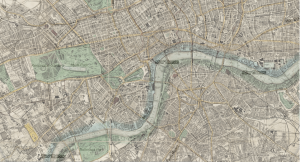
I also consulted some historic basemaps in order to get a better understanding of how the population density of the area changed over time. An 1818 map, Cary’s new and accurate plan of London and Westminster, the borough of Southwark and parts adjacent; viz. Kensington, Chelsea, Islington, Hackney, Walworth, Newington, &c….and plans of the New London & East and North India docks, reveals the Kensington district to have been relatively underdeveloped and rural during the 1810s.
View of the Stanford’s map of the British metropolis and its suburbs (Published by Edward Stanford, 1884).
From this basemap, it appears that the area is dominated by large-sized parks, paddocks and grounds attached to expansive properties. However, the Stanford’s map of the British metropolis and its suburbs (Published by Edward Stanford) demonstrates that by 1884, Kensington was far more developed. You can even see a railway running through the area. I imagine this would have increased accessibility to the Kensington district and attracted more individuals looking to settle down among the outskirts of London. This may also explain why Kensington was more populated at the end of century than its neighbour Fulham – perhaps the railways did not stretch that far at that point.
The metropolitan work district I have chosen to focus on for this project is the Kensington district. At the beginning of the nineteenth century, the only institution within the Kensington district was the Fulham Road Workhouse, which was expanded in 1876 when the infirmary was extended. It is currently occupied by Chelsea and Westminster Hospital. In the 1840s another workhouse appeared in the district called the Marloes Road Workhouse. This workhouse expanded its premises in 1880 by incorporating two other workhouses on the same road – the former St. John’s Westminster and St. Margaret workhouses. After its expansion, this institution housed 730 inmates and 470 sick and injured individuals in the infirmary.
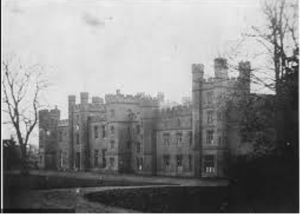
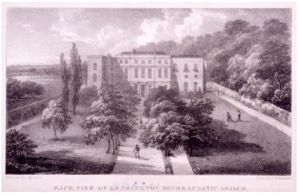
Throughout the 1820s and 1830s two lunatic asylums appeared in the Kensington district. The first was Cowper House, which housed nearly 40 patients in 1844, and the second was Kensington House Asylum institution housing 55 patients during the same time period. Both were private institutions, meaning they were profitable. This growth reflected a trend in this period where lunatic asylums offered a quick solution for the wealthy to send away “troubled relatives”. The profitability of these institutions is noticeable in their images. The grounds around the buildings are well manicured and extremely green. The buildings themselves look grand, lofty and imposing – indicative of the social class of their targeted demographic.
Cowper House housed 39 patients in 1844. It is situated on the south side of the street, roughly where Melton Court is today.
Also notable is the increase in hospitals from the 1840s onwards. The first hospital that appeared was the Hospital for Consumption and Diseases of The Chest, followed by the Cancer Hospital during the 1950s. The second was a hospital founded by William Marsden, offering treatment to poor cancer patients for free. The final hospital to appear in this district was the Chelsea Hospital for Women during the 1970s, which exclusively treated diseases unique to women. Notable is the fact that these three hospitals all appeared along or close to Fulham Road, which may have had something to do with accessibility of these areas.
Kensington House is a private lunatic asylum. It accommodated 55 patients in 1844.
In the 1860s another medical-related charitable institution emerged – the Jews Deaf and Dumb Institution. This institution was situated in various other locations before settling in Notting Hill in 1875. This is particularly interesting as it was a leading institution in teaching the deaf through the method of oral learning. At roughly the same time, London’s oldest synagogue was also established, suggesting that there was a growing Jewish Community in the North Kensington area.