Surviving Isolation: A Commentary on Clarissa’s Parties in Mrs. Dalloway

“Since she was lying on the sofa, cloistered, exempt, the presence of this thing which she felt to be so obvious became physically existent; with robes of sound from the street, sunny, with hot breath, whispering, blowing out the blinds. But suppose Peter said to her, “Yes, yes, but your parties – what’s the sense of your parties?” all she could say was (and nobody could be expected to understand): They’re an offering; which sounded horribly vague… But to go deeper, beneath what people said (and these judgments, how superficial, how fragmentary they are!) in her own mind now, what did it mean to her, this thing she called life? Oh, it was very clear. Here was So-and-so in South Kensington; some one up in Bayswater; and somebody else, say, in Mayfair. And she felt quite continuously a sense of their existence; and she felt what a waste; and she felt what a pity; and she felt if only they could be brought together; so she did it. And it was an offering; to combine, to create; but to whom? An offering for the sake of an offering, perhaps. Anyhow, it was her gift. Nothing else had she of the slightest importance; cannot think, write, even play the piano.” (Woolf, 121-122)

The presence of the omniscient narrator in Virginia Woolf’s, Mrs. Dalloway unveils Clarissa Dalloway’s struggle to balance her innermost thoughts with the external yet intimate world of the socially elite. Coupled with the overwhelmingly sensorial imagery, Clarissa’s tendency towards introspection in the opening lines suggests a deeper purpose in organizing her party. Lying on the sofa, the isolating diction the narrator ascribes to Clarissa’s “cloistered” and “exempt” state illustrates her in private seclusion, sheltered from the outside world and the social happenings of upper-crust society (Woolf, 121). However, the “presence of this thing,” the gravity of her impending party, “became physically existent,” (Woolf, 121). In possessing knowledge about interior thoughts and emotions, Woolf’s omniscient narrator relays the tangible impact that Clarissa’s departure from isolation provoked in her sudden feeling of excitement and vivacity surrounding her nearing party. Woolf’s employment of the semicolon in this opening sentence connotes a sudden shift in tone from an overwhelming sense of solitude to a visceral stream of sensory experience. The personification of the outside world that Clarissa suddenly becomes aware of– the heat of the sun, the noise from the street, and the “blowing of the blinds”– corroborates an immediate introduction of life into the bleak space surrounding Clarissa’s position on the sofa (Woolf, 121). 

Clarissa’s preoccupation with what she presupposes as Peter’s demanding inquisition into the purpose of her parties in the dialogue of her innermost thoughts (“what’s the sense of your parties”) reiterates the internal struggle Clarissa faces with defining meaning and purpose in hosting these extravagant social events (Woolf, 121). The structural significance of the parentheses Woolf effects in Clarissa’s response to this question, “(and nobody could be expected to understand),” reveals an aside into Clarissa’s innermost thoughts, where the significance of “nobody” connotes Clarissa’s self-ostracism from exterior society (Woolf, 121). Clarissa’s tendency towards introspection in this parenthetical break recognizes that her hesitation in returning to the public eye stems from a deeper, more personal reasoning that she alone can understand. 

In positing her parties as “offerings,” the diction Clarissa manipulates suggests that her social events operate as gifts in contribution to society. The effect of proposing the party as one would describe a gift or a blessing beholds a deeper purpose in her intention. However, before we arrive at this intention, Woolf structurally interrupts with another parenthetical, “(and these judgments, how superficial, how fragmentary they are!)”, marking a return to Clarissa’s internal debate between the frivolity of her parties despite her previously excited tone (Woolf, 122). Yet, in succeeding this parenthetical with a question preoccupying her purpose in life, Clarissa refocuses on what brings her existence joy. This newfound responsibility to celebrate life conflicts with the moment of bleak isolation in the passage’s opening where the deeper purpose of Clarissa’s party is unveiled to share this joy through the community engagement that her parties offer. 

Clarissa responds to her own question with clarity: living in isolation is a “waste” and should be “pitied,” therefore her purpose in life is to bring people together (Woolf, 121). Stemming from her own experience in isolation, Clarissa questions the purpose in existing without the intimate connections formed that celebrate humanity as it should operate: together. Therefore, her “offering for the sake of an offering” occupied the highest importance, not solely for Clarissa herself, but as her social motivation and responsibility to instill the joy of human interaction and engagement with her guests (Woolf, 122). In describing her parties as “offerings” and “gifts,” Clarissa relies upon her social gatherings to provide meaning to a world that would otherwise be considered wasted. Despite the superficiality she criticizes about social events, Clarissa posits her party as a gift to both herself and those amongst her social sphere to extract the essential function in hosting: Clarissa throws parties in an attempt to draw people together and offer the community engagement essential to achieving a sense of fulfillment and belonging. 

Clarissa’s desire to achieve purpose in her rediscovery of the social world reflects the notion of rebirth experienced during this post-World War I and post-pandemic locale. Recovering from the isolating effects of quarantine herself, Clarissa’s nervousness about her reintegration into society stems from her recently having been ill with the Spanish Influenza. Woolf explores the isolating effects of the war and the pandemic on human behavior and the idea of permanence in Mrs. Dalloway. However, it is in this passage that we see Clarissa struggling with post-pandemic social anxiety, as well as a nostalgia for a world before this sense of discontinuity. Clarissa raises the question amidst her inner struggle with returning to society, “(and nobody could be expected to understand),” because none of her peers had undergone similar seclusion, uncertainty, and fear that plagued Clarissa while she was ill. As someone who had evaded death herself, Clarissa’s motivation and hesitation to refocus on life becomes clear; she suffers from the social anxiety of her isolating experience, yet has returned to the forefront intending to share her appreciation for social interaction (Woolf, 121). The tension implicated in Clarissa’s internal struggle to exist in a world following the uncertainties about the aftermath of war and influenza affirms Clarissa’s socially charming yet private and protected demeanor. The language Woolf invokes to describe Clarrisa’s party as an “offering” connotes something open to the public, yet intimately privatized with a guest list. Contextualized in a way that revives the socio-political history of the early 20th-century, this tension embodies the lived experiences and attitudes of this impacted, post-war society yet inspires a new appreciation and perspective towards human belonging.
Hannah on the Threshold: Children of the Ghetto Commentary

‘The hands of the clock crept on. It was half-past nine. Hannah sat lethargic, numb, unable to think, her strung-up nerves grown flaccid, her eyes full of bitter-sweet tears, her soul floating along as in a trance on the waves of a familiar melody. Suddenly she became aware that the others had risen and that her father was motioning to her. Instinctively she understood; rose automatically and went to the door; then a great shock of returning recollection whelmed her soul. She stood rooted to the floor. Her father had filled Elijah’s goblet with wine and it was her annual privilege to open the door for the prophet’s entry. Intuitively she knew that David was pacing madly in front of the house, not daring to make known his presence, and perhaps cursing her cowardice. A chill terror seized her. She was afraid to face him—his will was strong and mighty; her fevered imagination figured it as the wash of a great ocean breaking on the doorstep threatening to sweep her off into the roaring whirlpool of doom. She threw the door of the room wide and paused as if her duty were done.

Nu, nu,” muttered Reb Shemuel, indicating the outer door. It was so near that he always had that opened, too.

Hannah tottered forwards through the few feet of hall. The cloak and hat on the peg nodded to her sardonically. A wild thrill of answering defiance shot through her: she stretched out her hands towards them. “Fly, fly; it is your last chance,” said the blood throbbing in her ears. But her hand dropped to her side and in that brief instant of terrible illumination, Hannah saw down the whole long vista of her future life, stretching straight and unlovely between great blank walls, on, on to a solitary grave; knew that the strength had been denied her to diverge to the right or left, that for her there would be neither Exodus nor Redemption. Strong in the conviction of her weakness she noisily threw open the street door. The face of David, sallow and ghastly, loomed upon her in the darkness. Great drops of rain fell from his hat and ran down his cheeks like tears. His clothes seemed soaked with rain.

“At last!” he exclaimed in a hoarse, glad whisper. “What has kept you?”

Boruch Habo! (Welcome art thou who arrivest)” came the voice of Reb Shemuel front within, greeting the prophet.

“Hush!” said Hannah. “Listen a moment.”‘ – Children of the Ghetto, Chapter 25


The passage above reflects the inner turmoil of Hannah, the daughter of a rabbi, as she chooses between running away with the man that she loves and remaining a part of her family.  It begins with a focus on time. She is thirty minutes late to meet David. As Hannah is caught in indecision, the focus on the slow, creeping movement of the hands of the clock in the first paragraph is important to increasing the suspense of the moment. This moment of suspense and fear is further captured by the anathema present in the articulation of Hannah’s feelings. Her strung-up nerves…, her eyes…, her soul”, the structure of this sentence takes us into the interior life of Hannah. We more personally feel her panic in these lines as she is frozen with indecision.

The reasons for this indecision, a choice between her religion and her love, are partly revealed by references to previous points in the passage. “Her soul floating along as in a trance on the waves of a familiar melody” clearly refers to a moment earlier in the chapter when she sits with her father through the Seder service. When she hears the choir, she says that “the words seem fateful, pregnant with a special message”.  This message is all about adhering to the strict obedience of the very Law she is about to defy. Her guilt steered her back to the words of this song, making it more difficult for her to choose her lover over her religion.

Religion continues to play a role in the meaning of the passage as the Seder dinner continues. It is Hannah’s “annual privilege to open the door for the prophet’s entry”. In the Bible, Hannah gives birth to the prophet Samuel after fervent prayer to God.  In a matter of speaking, Hannah opens the door for the entry of the prophet into the world just as her namesake opens the door during the Seder dinner. Ironically, the person waiting outside the door is David, who is not the prophet Elijah nor a prophet in the Bible. In fact, the downfall of the biblical David resembles that of his namesake, for he falls in love with the wife of Uriah although it is unlawful for them to be together (2 Samuel 11).

Realizing that David would be waiting for her once she opened the door for Elijah is the “returning collection” that “whelmed her [Hannah’s] soul”, as it meant that she could no longer ignore David. The will of David to marry her is compared to a great ocean “threatening to sweep her off into the roaring whirlpool of doom”. This is likely a Biblical reference to the great flood. In this story, God sends a great flood upon the earth to wipe out the wickedness of humanity, preserving only the righteous, Noah’s family, in an ark. Here, it seems David is among the wicked and is doomed to drown Hannah as well as himself if she goes with him. Later in the passage, David is described as “soaked with rain”, his face “sallow and ghastly”, almost as if he was already drowned. To go with David would be to risk drowning and dying with him. This is further hinted to in the passage where it says “Hannah saw down the whole long vista of her future life,…on, on to a solitary grave”. She associates death with her life with David.

This is in contrast with Hannah’s thoughts earlier in the passage. She seems to desperately want to go with David before it’s too late. When she thinks “Fly, fly; it is your last chance”, it is suggestive of the Israelites flight from Egypt. Like her, they were fleeing persecution, but unlike her, they were being persecuted by the Egyptians, while Hannah is being persecuted by her own religion. This becomes even more important in the light of the fact that they are eating the Seder meal, the meal that commemorates the Israelites’ freedom from the Egyptians. In the original instructions for how this meal was to be eaten, Moses told the Israelites that they must eat the meal in haste, wearing sandals on their feet and holding their staff (Exodus 12:11), as if ready to make flight. Hannah, too, seeks to make flight, but hesitates. When she thinks of her choice, she feels defeated, saying “there would be neither Exodus nor Redemption”. Here, Exodus refers to the fact that she cannot flee, while Redemption could refer to her belief that she cannot be redeemed, or saved from her unhappiness, by David. Redemption could also refer to her unwillingness to abandon her religion, as Jesus is called the Redeemer (and Jesus is from the line of David). Either way, Hannah’s final lines of the passage clearly show that she has made up her mind. She chooses to listen to her father, who is greeting the prophet in Hebrew, rather than David, who is speaking in English. She is drawn back to her family and religion, leading her to finally reject David.

The historical context that this story is placed in is the late 19th century. During this time, the Jewish population in Cape Town, including people such as David, began to rapidly expand. The Eastern European Jews who came to Cape Town in this period shed the traditional garb and customs of Judaism for more Anglo-Jewish customs. Coming from such a background, David’s shock at such a strict adherence to the laws of Judaism is understandable. A kohein could not marry a divorcee, a convert, a promiscuous woman, a woman who is the offspring of a forbidden marriage to a kohein, or a woman who is the widow of a man who died childless but who has been released from the obligation to marry her husband’s brother. An ordinary Jewsh man is only prohibited from marrying certain close blood relatives, the ex-wives of certain close blood relatives, a woman who has not been validly divorced, the daughter or granddaughter of his ex-wife, or the sister of his ex-wife during the ex-wife’s lifetime (jewishvirtuallibrary.org). We can see from this that the title of kohein changes much of what is expected by Jewish law, expectations that David was unwilling to reckon with. It is through exploring this context that we’re better able to understand the events that happened in Children of the Ghetto.

Whitechapel: Charity and Industry at Odds

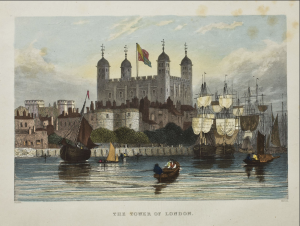
Although one of the more densely populated areas in London, Whitechapel began the nineteenth century with few social institutions. At this time, its most notable landmarks were the Royal Mint and the notorious Tower of London, which was, by now, more of a landmark than a functioning prison. London Hospital, charged with healing the poor, the Magdalen Hospital For Penitent Prostitutes, and two organizations that served food (Spitalfields Soup-Ladling Society and the Eastern Dispensary) were dispersed throughout the district. The institutions and their images reveal a stark division. This southernmost area of the district home to industry and government building resembles a different world the the London Hospital, located in the northernmost area of the district. Where the Tower of London is depicted as an almost fairytale romanticized image, the London Hospital lacks ornament or festivity. One representative of the power of the state and its city, the other an expression of its weakness and vulnerability. 

.Tower of LondonLondon Hospital

Between 1801 and 1830, development seemed to be more acutely focused on industry. The only two such institutions that would emerge during the period were both for sailors (the Asylum For Destitute Sailors and the Sailors Home. Furthermore, a grove of lower income housing or as the Victorian London Map describes “slums” occupy the area just East of the Government building. Only 26 years later would construction begin on the three enclosed docks bordering the Thames. Thousands would be displaced, forced out without refuge or compensation. The image of the smaller of the three docks remain, St. Katharine Dock. Only a lone manless boat stands in the place of a once bustling community. 

St. Katherine Dock

In 1859, the Whitechapel workhouse would be built on the ruins of the Spitefield Parish Workhouse. The establishment of a workhouse would suggest a large influx of a lower income population as well as a greater immigrant presence. This conjecture aligns with population data during the time. Between 1840 and 1860 the population increased by over 15,000 persons. However, just when the workhouse was established the Magdalen Hospital For Penitent Prostitutes was shut down. The reason for this anomaly may be due to the Contagious Disease Act of 1864, which called for the investigation and imprisonment of any women confirmed or even suspected of prostitution. This suggests charitable work for this particular group may have become less desirable or harder to fund leading up to the passing of the act. The King Ragged School And Girls Refuge would sprout up in its place. 

In fact, the next two decades, between 1861 and 1880, would see an increase in the number of refuges for both young men and women as well as almshouses. While the population actually decreased during this period by 3,186 persons, the founding of these institutions may have been in reaction to or because of an increased awareness of the growth during the decades prior. In the following two decades, the number of these accommodations would continue to grow. A new kind of institution emerged during this period that was interested in offering free education and enrichment, not for the purpose of schooling young children in a particular skill, but cultural institutions. Whitechapel Art Gallery and Whitechapel Library both served this purpose. While Whitechapel’s identity as a place of industry and government was solidified, so did its awareness of its new and less prosperous population grow.

Three Perspectives on Shoreditch Street

Shoreditch Street : Tallis Street Views

And a brightly waxed orange clasped in the fist of a young man catches your eye and disrupts the early morning gray that hangs low in the

The Cries of London, as they are daily practiced : in forty-eight engravings of those most prominent in its squares, streets, and lanes -1804

air, only cleared by the rush of arms and legs and faces. Spotting your intrigue, he vies for your attention, shouting “Oranges! Fine Oranges!” in futile hope for a profit. But you aren’t there of your own accord. You have a list, well at least one in your mind’s eye -they stopped writing down the errands when they realized you couldn’t read much more than your own name. A hint of jasmine and bergamot and rose still cling to your employer’s basket, but it’s far too soon replaced by the ash of the soot-covered chimney sweep, and the scent of the butcher’s blood-soaked apron. A chicken, a duck, a rabbit, hang by a thin piece of twine in the window. You can barely recognize their shapes, excoriated, wearing only coats of pink flesh, but you know too well those feet, those ears, that beak.  


Or perhaps you nearly stumble out of your carriage and onto the uneven street, paved in centuries old cobblestones. You’re in need of a frock for two weekends next. But before you can swing the door open to the seamstress’s shop, and be welcomed by a small symphony of bells, an unfamiliar to

Leigh’s new picture of London

ngue diverts you elsewhere. Two young boys wear tattered jackets and shapeless hats, nursing a bottle filled with an amber liquid. They laugh and stumble along in the chill of the early evening, before slipping around the corner and out of your sight. Polish, you wager -it must have been. Would you spring for silk? Or would you be content with a brightly dyed cotton?


But maybe you’ve just walked out of the East India House with its towering ionic columns and relief fit for the Parthenon. Ink stains the cuff of your sleeve, and afternoon tea your teeth. It’s quieter outside a place like this, where more often carriages trod than feet. A horse sighs and another laps at a small trough of water. A breeze roars in from the Thames, carrying with it the gentle stench of sewage, sour in your mouth. But you don’t linger long. You let the crowd carry you up Bishopsgate and onto Shoreditch Street, and flick a farthing at the boy sweeping your path clean. 

East India House

A Long Established City Center Experiences Inconsistent Growth

An area near to the city center, home to the Tower of London and important industrial sites such as the entrance to the London docks pictured below, the population of Whitechapel District grew at a consistent rate of approximately 5-7,000 persons per decade for the first half of the nineteenth century. Remaining one of the most densely populated areas throughout the entirety of the century, unlike nearby districts such as Shoreditch St. Leonard’s Vestry, Bethnal Green Vestry, and Mile End Ole Town Vestry, which saw dramatic increases in population in the first half of the century, Whitechapel saw only steady increases. One slightly larger uptick in population between 1840 and 1860, which saw an additional 15,616 individuals settle in the area, may have been due to increased intercontinental travel caused by events such as the Irish Potato Famine. Whitechapel District was already a long established city center and densely populated, unaccommodating to drastic increases in population. Much of its northern territory, which bordered the Thames, held important industrial, legal, and financial institutions, which would not be ideal areas for additional housing and new growth. 

Entrance to the London Docks

 In the second half of the nineteenth century, the population stagnated with only slight decreases. From 1850-1890, the population fell by only 8,396. In the same period, the neighboring City of London saw a 61,890 person decrease over the same 50-year period. In comparison to the City of London, which underwent the transformation of being one of the most to least densely populated areas over the course of the century, Whitechapel definitely had room for growth. The variety of institutions, some of which could only survive in lower-income densely populated areas like the Whitechapel Workhouse, accommodated a larger population. Additionally, by the mid-point of the century, growth may have occurred primarily in the north of the district, as several refuge’s and other charitable organizations were established in the area. However, as population declined, so did these institutions, most notably the workhouse, which indicates that work may have been sought elsewhere.


The Queen’s London: a pictorial and descriptive record of the streets, buildings, parks, and scenery of the great metropolis in the fifty-ninth year of the reign of her majesty Queen Victoria

The seemingly endless stream of bodies pictured on a Sunday morning on Wentworth street, which straddles the border of the City of London and Whitechapel District, illustrates just how densely populated the area could become. The image includes a caption, attributing some of the thoroughfare to weekend shoppers buying errands, even depicting a presumptively Jewish immigrant fruit vendor, in the lower right corner of the image. The noise is described as “deafening,” in which a slew of different foreign languages can be heard. The moment captured offers insight not only to the sheer quantity of people in the area, but also the variety of their backgrounds and employment. 

A Tuesday Stroll Down Tottenham Court Road

An aerial view of Tottenham Court Road, from “London: illustrated by eighteen bird’s-eye views of the principal streets.”

You have to keep your wits about you, strolling up Tottenham Court Road on a Tuesday. The horses and carriages that pummel the cobblestones of this long arterial street are the most deafening of all the noises you hear; everyone seems to be in a rush to catch their train from Euston back up to Birmingham, wanting to make the five-hour trip in the hazy sunlight of this warm May morning, and arrive home before it gets too dark. The street peddlers give the carts a run for their money, though, flogging their vegetables outside Mortimer Market in high-pitched screeches, before running to evade the bobbies charged with disbanding such unruly conduct.

Strolling up from Oxford Street, the first thing you smell is the whiff of porter from Meux’s Brewery (the smell is delicious, but you’re hoping the walls of the brewery don’t explode like they did in 1814 with the London Beer Flood). The intellectual types pour out from Great Russell Street, seeking their midday repast after a morning among the books at the British Library and the wondrous sculptures of the Parthenon at the British Museum. They dive into Lansdall’s, the baker’s, (and no doubt will try their luck at the brewery afterwards), but you carry on up past Danks’s carpet warehouse and stroll northwards. A gorgeous piece of china catches your eye in Moore and Co, so you end up spending a good twenty minutes perusing the furniture from across the world before negotiating a good deal on the teacup you saw in the window as you passed by.

A bustling portion at the top of Tottenham Court Road, illustrated by Tallis (1838-40).

By this point you’re quite tired, so you jump into Leopard Coffee House on the corner of Francis Street for a quick drink but end up whiling a couple of hours away in a good game of whist. There are all kinds of curiosities along Tottenham Court Road – baskets, boots, silk, pans, iron kettles and more are for sale, as you continue on your walk up the street. It’s not quite as flashy as Regent Street, but it has all manner of products for the discerning consumer. Indeed, every now and then, you’ll hear a baker or a confectioner offering a sample of their wares. Up near the top end of the street, you catch a glimpse of University College’s vast dome and its domineering portico, and can’t help but be inspired by these architectural feats on offer in this temple for learning.

Developing New Towns on the Margins: Population in the St Pancras Vestry District

The metropolitan works district of St Pancras Vestry experienced rapid population growth throughout the 1800s, with its population increasing by almost nine times throughout the century.

A portion of Cary’s 1802 map, showing St Pancras and the surrounding areas. Notice how empty most of the district appears.

In 1801-10, the population of the district stood at 31,779, making it the tenth most populated district in the city. It’s worth noting that, according to Cary’s 1802 map, only a tiny fraction of the district had been built upon, with most development in the district’s southern tip closest to central London. Indeed, this 1802 map only covers about a third of the district, suggesting that St Pancras Vestry does indeed represent the northern frontier of the city’s area.

The population of the district continues to rise steadily, hitting 100,000 by 1831-40, as we see more institutions crop up towards the north of the district. This seems to suggest that the size of the city is expanding, as migrants to London seek accommodation on what were once the city’s outer fringes. This is confirmed by Cross’s 1859 New Plan of London, which shows healthy development in Camden, Kentish Town, and Haverstock Hill (though not nearly as dense as more established areas like around Westminster and the City).

Cross’s 1859 New Plan of London. Development seems to be rapidly moving northwards.

By 1890, the population of the district stands at just over 235,000, making it one of the most populous districts in the city. We see a couple of institutions opening around the Kentish Town area, suggesting that these northern locales have been firmly cemented as towns in their own right. It is worth noting, however, that the density of the district still remains relatively low during the entire period, hovering well below the London average throughout the 19th century. The district itself is quite a large, thin strip that radiates from the centre of London northwards, so it is unsurprising that density remains low throughout the period.

I would also suggest that most of this increase in population happens towards the north and centre of the district, as the southern tips of St Pancras Vestry become more orientated towards business, education and healthcare.  As mentioned in my last blog post, many of these institutions crop up along Euston Road and around Fitzroy Square, and a number of train stations (and a huge loading yard) was built in the south of the district in the mid to late 1800s. With so much non-residential development in the area south of Euston Road, one might suggest that the southern tip of the district experienced much slower rates of population growth (or even suffered depopulation) as these new businesses, non-profits and transport hubs staked their claim for a slice of the city’s footprint.

From Fringe to Centre: Institutions in the St Pancras Vestry district

I chose to examine the St Pancras Vestry district, to the north of the city. The district, which represents a long thin slither running north to south, only has five institutions in it between 1801 and 1810: a women’s refuge, two orphanages (one for children aged 8-11, and one “adult orphan institution”), and two workhouses. This seems reasonable for the period, considering it is one of the most lightly populated districts of the central London area with a population of 31779. Most of the institutions seem concentrated in the southern portion of the district, which seems to hold true for the entirety of the nineteenth century.

The 1820s sees the establishment of University College, built with a grand Corinthian portico and large dome that becomes a landmark for the southern portion of the St Pancras Vestry district. “Nearly all subjects are taught here,” explains The Queen’s London (a “pictorial and descriptive record” of the city’s architecture), with the college founded “in order to provide an educational centre free of all religious tests.” Across the road, University College Hospital is built in the 1830s ­­– a building which, tellingly, needed to be expanded in the 1840s and then later refurbished in 1897 to meet the exploding population of the St Pancras Vestry district which we’ll explore in the second blog post. A lunatic asylum, Western House, also appears in the 1830s, but closes down by the 1860s.

University College, with its dome and portico. Taken from “The Queen’s London: a pictoral and descriptive record”

The 1870s and 80s see an explosion of institutions in the district. Three of the eight Homes for Working Girls in London are clustered around Fitzroy Square, in addition to three hospitals – the London Skin Hospital, Oxygen Home, and the Home Hospitals Association. A couple of other medical institutions are dotted along Euston Road, including the Central London Throat, Nose and Ear Hospital, the British Hospital for Skin Diseases, and the New Hospital for Women. Other institutions in the district also have links to medicine, too; after being discharged, women might go to the Female Preventive and Reformatory Institutions Home for Friendless Young Women of Good Character, or the Reformatory for the Fallen. In addition, we see a couple of institutions – an orphanage, another hospital, and lodging for pensioners ­– crop up in the north of the district, demonstrating the slow but steady movement of people out of the busy city centre and northwards towards places like Camden and Highgate.

The grand exterior of St Pancras station, taken from “The Queen’s London”

In addition to becoming a hub for knowledge through its universities and hospitals, St Pancras Vestry also became a transport hub by the end of the century, playing host to three of London’s mainline terminals. While waiting for a train at St Pancras station ­– the grandest of the three stations in the district – one could not help but be amazed by the “splendid Gothic pile” of the station’s exterior façade, or the vast interior train shed which is described by The Queen’s London to be the largest roof held up by a single pillar anywhere in the world.

Continue reading “From Fringe to Centre: Institutions in the St Pancras Vestry district”

Visualizing Westminster Through Papworth’s Select Views of London

Papworth's Select Views of London
Papworth’s Select Views of London

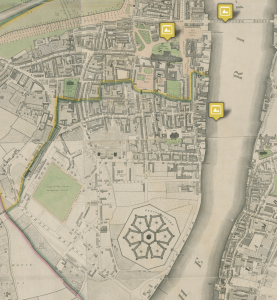
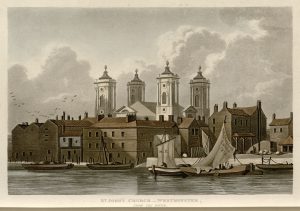
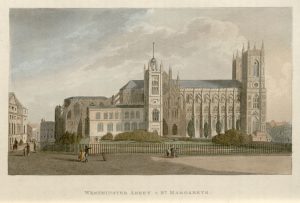
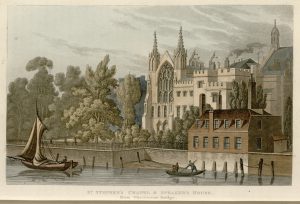
I looked at John B. Papworth’s Select Views of London, published in 1816. There are only three plates related to my area. One is a view of St. John’s Church from the river. Another displays Westminster Abbey. The third shows St. Stephen’s Chapel and the Speaker’s House from Westminster Bridge. Thus, the guidebook highlights the religious and political focal points of the region, but leaves the rest unmarked. I found this lack of notation intriguing. It further underscores this juxtaposition I have previously described between the high and low ends of society. Moreover, Papworth’s choice to leave the rest of this area untouched suggests that he sees it as unremarkable. The full title of the book is Select Views of London; with Historical and Descriptive Sketches of Some of the Most Interesting of its Public Buildings. Thus, each plate (and the absence of a plate) is laden with intentional decisions. What determines an “interesting” building? Interesting to whom, and why? The large panopticon certainly drew my eye to the area as I viewed it from 2021, but that was not a public building Papworth wanted to bring attention to. Nor was the school and surrounding playground. This reminds me of another theme of Oliver Twist, which is the way those in power cast aside both children and prisoners as less than full human beings. Papworth sees the governmental and religious institutions in the area as valuable and notable for readers to know about and visualize, but he does not see the educational and penal institutions the same way. The continuity and contrast between how I see this area and how Papworth marketed it in 1816 is very interesting to me.  

Looking at the buildings that Papworth does depict reveals a few interesting notes. First, this guidebook initially caught my eye because it presents visual representations of the landmarks, rather than textual descriptions. The maps are limited in only showing an overhead, largely black and white view of the city. Papworth’s illustrations add color, dimension, and perspective to the our view of Westminster.

St. John's Church Westminster, from the river
St. John’s Church Westminster, from the river

Rather than being a shaded polygon on the map, we see St. John’s Church as it would look from the Thames, and we see how its riverside location shaped the scene, with sailboats in the foreground of the image. Moreover, the sails appear to be in motion, being taken down from some of the boats, and the birds are in mid-flight. This gives dynamism to the image and puts us in the scene, bringing it to life.

Westminster Abbye & St. Margaret's
Westminster Abbey & St. Margaret’s

The plate displaying Westminster Abbey similarly adds to our understanding of life in London at this time, as we see people on and around the abbey grounds going about their days. We see children and families strolling along the street, and someone on horseback. In the background on the left we can make out people riding in a covered carriage. The people’s dress suggests that they are well-off which contrasts with the sense we got of the other area of Westminster around the penitentiary. 

St. Stephen's Chapel & Speaker's House, from Westminster Bridge
St. Stephen’s Chapel & Speaker’s House, from Westminster Bridge

The view of St. Stephen’s Chapel and the Speaker’s House also presents a window into London life. We see people on boats on the river, adding to our sense of how the Thames is another space of interaction and motion in the city in addition to the streets and buildings. We also see the juxtaposition of the natural and the built environments again, with numerous trees in the foreground and smoke coming out of a building in the background. As the introduction to the site noted, London at this time is far ahead of other English cities in its industrialization and population growth. This image hints at the tension between the natural and the human that characterizes this era. Thus, Papworth’s guide is as interesting for what it depicts as for what it leaves untouched. 

The Panopticon and the Human Side of Life in Westminster

The panopticon design of the penitentiary

To understand the human side of life in London at this time, I focused on the penitentiary in the 1819 revision of Horwood’s map. One of the key aspects of nineteenth century London that we have discussed is the criminalization of poverty, including for children like the characters in Oliver Twist. The penitentiary highlights this impulse for punishment. Moreover, the design of the penitentiary points to how entrenched this approach to governance is. The prison is constructed as a panopticon. The intention of this design is to emphasize constant surveillance. Every cell is within view of a central security tower. While the guard cannot always observe every prisoner, the fact that the prisoner does not know if he is being watched at any given time forces him to always be on guard. This architecture, and the social theory that underlies it, shows how the built environment of London at this time evinces the philosophies and ideologies that predominated. Another key feature of the prison that struck me is the emphasis on isolation. There is one small entrance to the complex; the rest is completely walled off. Within these outer walls, each section of the prison is also walled off from all the others. It looks like the only way to pass from one arm of the panopticon to another is via the central sector around the chapel. This further underlines how the purpose behind the prison is primarily to punish, not to rehabilitate, and to strip the prisoner of his humanity. In light of this, the presence of the chapel in the center of the prison is especially interesting. As previously mentioned, churches are among the few institutions in this area of the city. In our conversations about Oliver Twist, we discussed how religion and government were often intertwined in London at this time. In that light, it makes sense that there would be a chapel within a correctional institution, especially since crime was viewed as a personal, rather than societal, failing.

Grey Coat School
The Grey Coat School and playground
Westminster Hall, The House of Lords, and the House of Commons


Zooming out from the penitentiary, we can understand some more of the human dimension of life in Westminster. The presence of the prison suggests that some of the people living in the area are its employees. Along with the butter factory in Faden’s map, whose employees also presumably live in the area, this appears to be a working class part of the city. Moreover, the school (and its expansion with the playground by 1819) suggests a significant number of families live in this part of the city. The proximity of the legislative and judiciary arms of government may suggest that government officials reside nearby as well. Thus, there is an intriguing juxtaposition between the upper and lower classes as you move from the area around Westminster Abbey and the governmental buildings towards the penitentiary. In this one segment of London, we can see a wide swath of what life was like, and the social theories behind it.