
Shakespeare’s Shadow in Mrs Dalloway

An illustration of a book in a spotlight, with portraits of William Shakespeare and Virginia Woolf on facing pages.
Images of Shakespeare and Woolf. (Courtesy of Vinimay Kaul).

Shakespeare looms large over Mrs Dalloway.

In the passage I selected, Septimus finds a justification for his attitude about life in the work of Shakespeare, even when this is only fiction that he has concocted himself. 

Shakespeare also draws the curtain between husband and wife: Rezia’s inability to read Shakespeare defines her as a stranger, at least in the eyes of Septimus. Ultimately, Septimus and Shakespeare become inseparable, veteran and soldier intertwined.  Rezia even wonders if she will ever have a son like Septimus— in this case, Septimus is elevated to legend, just as Shakespeare had been. In fact, we are told that the war was in part fought in the name of Shakespeare. 

Shakespeare’s shadow also extends beyond this passage.

For instance, Clarissa Dalloway clings to Shakespeare’s words and draws her strongest motivation from them. And this begins early on. When we first encounter her, Mrs. Dalloway is haunted by memories of Peter Walsh, a scene reminiscent of Antony and Cleopatra

Take the partying words of Antony and Cleopatra in the play: 

Sir, you and I must part, but that’s not it. 

Sir, you and I have loved, but there’s not it: 

That you know well.

(The Complete Pelican Shakespeare, 1664, 86-89).

A version of those words becomes almost a refrain on the first page of Mrs. Dalloway. “Was that it?” Mrs. Dalloway asks herself again and again as she probes her memories, particularly those involving Peter Walsh. This comparison of the pair to perhaps the best-known lovers in literature means Clarissa and Peter were also once in love, but they were kept asunder by fate. 

Mrs. Dalloway also rehashes another refrain from Shakespeare, which is even more potent than the first one:

Fear no more the heat o’ the sun

Nor the furious winter’s rages. 

(Oxford World’s Classics, Mrs Dalloway, 11).

Whenever her anxiety mounts, Mrs. Dalloway turns to this phrase. “Fear no more,” she whispers to herself. This, it must be noted, is in complete opposition to Septimus’s interpretation of Shakespeare. Hers is one of hope; his of desperation. Yet both are referencing the same poet. 

The relationship between Clarissa Dalloway and Sally Seton is also compared to the one between Othello and Desdemona. When Othello reunites with Desdemona early in the play, he breaks into extreme exaltation, declaring “if it were now to die ‘twere now to be most happy’, a line quoted in Mrs. Dalloway (44). This suggests Clarissa was also in love with Sally. 

So Clarissa, like Shakespeare’s Antony, has many relationships—Sally, Peter, and tragically, Richard. And just like Antony, she ends up in the wrong marriage. 

That is why I would argue Mrs. Dalloway is deeply influenced by Shakespeare’s tragedies. In fact, the novel can itself be considered a tragedy. This is achieved through the death of Septimus, which mimics Cleopatra’s. 

In essence, Mrs. Dalloway is a novel of failed marriages. On a smaller scale, the passage I selected illustrates this point. Rezia and Septimus are unable to understand one another. This is attributed to their temperaments: the husband is cultured; the wife is practical. From this, we can also glean the gender disparities in society. The man can afford to study Shakespeare, while the woman is expected to undertake monotonous trimming. The husband can engage in abstraction as the wife worries about having children. We can also draw a distinction between the foreigner and the veteran citizen. Rezia is unable to understand Septimus and Shakespeare both. But on a larger scale, the dualities keep multiplying and they all echo Shakespeare. This leads me to further speculate that Septimus is supposed to be an archetype for English culture, a force as great as Shakespeare’s legend. Of course this legend was deeply scarred during the war. The mapping of Septimus’s insanity is then an act of disassociation of the English culture, a commentary on what should be kept and what should be left behind.
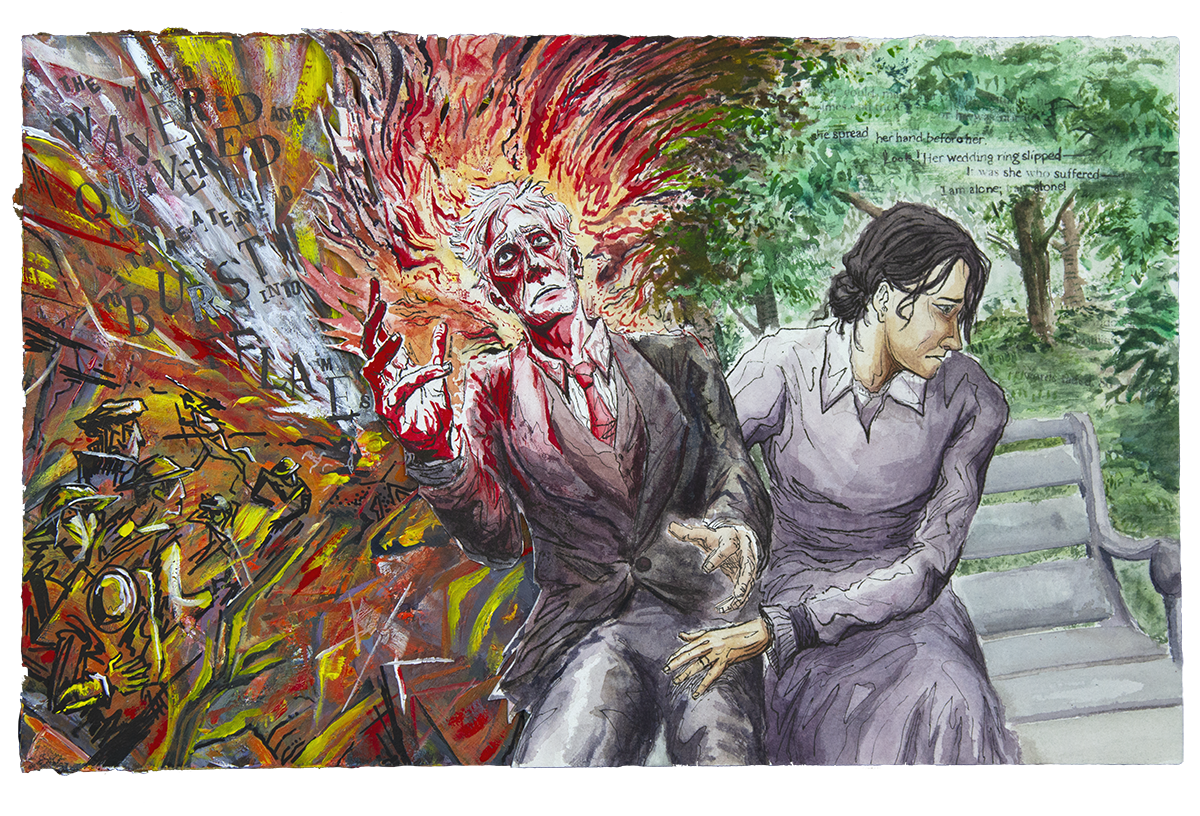
Marriage and Madness in Mrs Dalloway

p2 web.png
courtesy of MassArt Illustration Thesis 2019

Here is the passage I choose:

“Here he opened Shakespeare once more. That boy’s business of the intoxication of language—Anthony and Cleopatra—had shrivelled utterly. How Shakespeare loathed humanity—the putting on of clothes, the getting of children, the sordity of the mouth and the belly! This was now revealed to Septimus; the message hidden in the beauty of words. The secret signal which one generation passes, under disguise, to the next is loathing, hatred, despair. Dante the same. Aechylus (translated) the same. There Rezia sat at the table trimming hats. She trimmed hats from Mrs. Filmer’s friends; she trimmed hats by the hour. She looked pale, mysterious, like a lily, drowned, under water, he thought. 

“The English are so serious,” she would say, putting her arms round Septimus, her cheek against his. 

Love between man and woman was repulsive to Shakespeare. The business of copulation was filth to him before the end. But, Rezia said, they must have children. They have been married for five years.

They went to the Tower together; to Victoria and Albert Museum; stood in the crowd to see the King open Parliament. And there were the shops—hats shops, dress shops, shops with leather bags in the window, where she would stand staring. But she must have a boy.

She must have a son like Septimus, she said. But nobody could be like Septimus; so gentle; so serious; so clever. Could she not read Shakespeare too? Was Shakespeare a difficult author? She asked.”

(Mrs. Dalloway, Oxford World’s Classics, 115-116)

***

Septimus represents the abstract and Rezia the practical. And as the husband and wife drift apart, their worldviews diverge as well. This passage sketches the deterioration of Septimus’s mind and by extension his marriage. 

While Septimus had once found Shakespeare “intoxicating”, he now finds him rather dull. Previously, he had considered Shakespeare a great poet and had even gone to war in his name. 

But this has since changed. Now, he merely hears “a boy”, a word he uses to denigrate a poet that is considered a national treasure. 

For Septimus, even the act of reading has become “business”, a tiresome chore. 

So he assigns Shakespeare a different meaning, one befitting his current state of mind. A parallel is drawn between Septimus’s past and his present: what was once beauty has for him become contempt. He finds life too repetitive and this is captured in the recurring assonance—”putting”, “getting”, and “sordity”. These words deliver the meaninglessness previously only hinted in “business”: what bothers Septimus is not so much life itself but rather the energy and work it requires. 

“Beauty” is also contrasted with “loathing, hatred and despair”. This rather defeatist language demonstrates Septimus’s desperation. He moves from one extreme to the other. For him, there is no middle ground. And it all happens in his mind. At one point, he was intoxicated by language. Now, he is depressed by it. Practicality has no significance for him and he is also losing interest in the abstract (represented by Shakespeare) 

Rezia is the physical representation of practicality. Her work— the ”trimming” of hats—strikes Septimus as yet another chore. His view of her work can be apprehended in the recurrence of variations of the word “trim”. To Septimus, Rezia is “drowned, under water”. He is unable to make any sense of her work, which is admittedly not done for pleasure but rather out of obligation.

Though practical, Rezia misses to notice the gravity of Septimus’s condition. She is seeking a distraction from work and expects her husband to return her touch, but Septimus remains aloof. Because she is herself a stranger in the country, Rezia attributes her husband’s distance to the nature of the “English”, thus misunderstanding him. Everything she desires is “repulsive” to Septimus: “the business of copulation” and “children”. Rezia even wants “a boy”, the very word Septimus uses to disparage Shakespeare. 

In the end, Septimus is repulsed by Rezia as well. His mind is fading and his marriage, too.

The Street Dance: An Upper-Crust Celebrity Intrigue in ‘Mrs Dalloway’

The crush was terrific for the time of day. Lords, Ascot, Hurlingham, what was it? she wondered, for the street was blocked. The British middle classes sitting sideways on the tops of omnibuses with parcels and umbrellas, yes, even furs on a day like this, were, she thought, more ridiculous, more unlike anything there has ever been than one could conceive; and the Queen herself held up; the Queen herself unable to pass. Clarissa was suspended on one side of Brook Street; Sir John Buckhurst, the old Judge on the other, with the car between them (Sir John had laid down the law for years and liked a well-dressed woman) when the chauffeur, leaning ever so slightly, said or showed something to the policeman, who saluted and raised his arm and jerked his head and moved the omnibus to the side and the car passed through. Slowly and very silently it took its way.

Clarissa guessed; Clarissa knew of course; she had seen something white, magical, circular, in the footman’s hand, a disc inscribed with a name — the Queen’s, the Prince of Wales’s, the Prime Minister’s? — which, by force of its own lustre, burnt its way through (Clarissa saw the car diminishing, disappearing), to blaze among candelabras, glittering stars, breasts stiff with oak leaves, Hugh Whitbread and all his colleagues, the gentlemen of England, that night in Buckingham Palace. And Clarissa, too, gave a party. She stiffened a little; so she would stand at the top of her stairs.

Virginia Woolf, Mrs Dalloway (p. 17)


After perusing some of London’s highest-end boutiques in preparation for the evening’s big party, Clarissa Dalloway ends up on Bond Street when a celebrity convoy rolls past. The passage – much like the rest of Mrs Dalloway – is packed with information; indeed, in the passage presented above, there are only eight sentences. That is not to say that their construction is uniform, however; the three longer sentences meander in their unfurling of information, much like one might imagine the car doing on the unimpeded stretches of its journey. The shorter ones that end each paragraph, however, feel like they interrupt the text, just as the “crush” of people glaring at the convoy and the omnibus impede the car on its journey through the streets.


The first sentence of the second paragraph demands particular attention for its sprawling nature.  The narrative perspective of the sentence seems to jump multiple times, while keeping its focus squarely on Clarissa and how she perceives the street scene before her; indeed, at one point when it feels like the focus is just about to shift away from Clarissa onto following the car down the street, Woolf adds a bracketed aside, noting that “(Clarissa saw the car diminishing, disappearing)”. Having said that, occasionally it can be tricky to pin down whether the narrator is voicing their own perspective, or that of Mrs Dalloway; for example, the footman’s disk is “inscribed with a name – the Queen’s, the Prince of Wales’s, the Prime Minister’s?”. Although likely that we are hearing Mrs Dalloway’s thoughts here, it is uncertain, considering the penchant of the novel to rapidly cycle through characters’ thoughts and points of view.


It also adds to the uncertain mood of the sentence as a whole – first Clarissa “guessed” who was in the car; then she “knew of course” who the occupant was; then, the narrator seems to question whose name is really on the disc that allows the car passage through the streets.  In the passage, Clarissa is presented as both questioning and self-assured, headstrong and yet unsure of herself, as she is for much of the book. By the end of the paragraph, though, Clarissa becomes much surer of herself once again; we are told that she “gave a party,” (implied to be the on the same level of those at Buckingham Palace!), then that she “stiffened a little,” as if to assert her own dominance, like she would “at the top of her stairs” later that evening while surveying the scene of the party.


Asides such as these that appear out of nowhere also crop up in the first paragraph, and in particular the nature of Woolf’s invocation of “Sir John Buckhurst, the old Judge” who stands on the other side of the road from Clarissa. Buckhurst appears completely out of nowhere in the passage, as seems the tendency of Mrs Dalloway in general to jump from character to character, and occasionally to make a single, seemingly throwaway, reference to a random person. In mentioning Buckhurst across the road – and especially in yet another bracketed explanatory aside, that “(Sir John had laid down the law for years and liked a well-dressed woman)” –  Dalloway’s status as a socialite who can go anywhere in London and pick an acquaintance of prominent societal standing out of the crowd.


It is not simply Dalloway’s evocation of material wealth and social capital that makes this passage rich; the descriptions Woolf offers throughout the passage are particularly fascinating for their delicate, precise nature. For example, the interaction between the chauffeur and the policemen is laid out in particular detail, with the exact, dance-like movements of both noted by the narrator in a way that underlines the hyper-observant nature of the text. I also find the description of the disc that the footman holds as “white, magical, circular,” interesting; the first and third descriptors seem sensical and objective, whereas the description of the disc as “magical” feels somewhat more out of place, as if to heighten the prestige of the (presumably) royal party that Dalloway tracks in the streetscape. The narrator then comments how the convoy “burnt its way through […] to blaze among candelabras, glittering stars, breasts stiff with oak leaves, Hugh Whitbread and all his colleagues, the gentlemen of England, that night in Buckingham Palace.” This list has an almost dream-like wistfulness to it, particularly in its beginning with the more abstract descriptions; later in the list, we see Dalloway (through the narrator) emphasise her role in the upper portions of English society, by reminiscing over “that night in Buckingham Palace.”


With more space and time, I would very much like to dive even deeper into the class-based context of the passage. In the second sentence of the excerpt, Clarissa reels off names of the upper-class social sporting calendar, wondering whether the crush was “Lords, Ascot, Hurlingham,” referencing the upper crust of cricket meets, horse races and polo matches respectively. We then see Clarissa’s somewhat disdainful attitude towards the middle classes after that, noting how “ridiculous” it was that they were wearing “furs on a day like this.” I would love to explore how areas such as Bond Street create aspirational spaces for the middle classes – and, inevitably, spaces in which they face the ridicule of the upper classes for trying to be things that they are not.

The Geographical and Historical Context of Mrs. Dalloway’s Walk

The geographical and historical context of the passage serve as particularly helpful means to introduce themes of class difference in relation to post-war legacy.  As Clarissa walks, she passes Devonshire House, Bath House and “the house with the china cockatoo.” This refers to a set of homes owned by wealthy socialites who threw extravagant parties, which Clarissa and her friends would attend. “The house with the china cockatoo” was the home of Baroness Burdett-Coutts, who used to hang a white china cockatoo to be visible in a window and indicate that she was in residence, a nod to the Royal Standard (Diana Orton, Made of Gold: a biography of Angela Burdett Coutts). But, already these homes either have faded or are in the process of doing so in the post-war era: Burdett-Coutts died in 1906 so the grandeur of her parties would have been just a figment of this 1923-era Clarissa’s memories of youth, and the famous Devonshire House was demolished in 1924, shortly after the time of Clarissa’s walk. Unlike when these homes were “all lit up at once,” many of the wealthy fled the city during the war, leaving behind their homes as grim reminders of how utterly different post-war London was from the past revelry. Just as this passage invites us to ponder individual legacy, the reader must also grapple with post-war legacy as it reflects onto the very buildings Clarissa passes. Perhaps we are meant to view these formerly great houses as models of post-war decay, showing just how much the elite were impacted by the War as well as lower classes, that this truly was the war that spared no one. Alternatively, the empty houses show the reader just how removed the social elites were from wartime horrors — abandoning their city mansions but not their country estates, sacrificing their parties but not their limbs. Although the upper-class Clarissa ponders a sense of universal human connection or a collective “well of tears,” the historical context of the passage suggests that this theory may be too naive; that, rather than bond, the true legacy of WWI may be to further divide the different social classes of London.

An image of Devonshire House from the road in 1896.
A portrait of Baroness Burdett-Coutts, circa 1840.

Clarissa’s Walk in the Park: Human Connection, Death and Legacy in Mrs. Dalloway

“Her only gift was knowing people almost by instinct, she thought, walking on. If you put her in a room with some one, up went her back like a cat’s; or she purred. Devonshire House, Bath House, the house with the china cockatoo, she had seen them all lit up once; and remembered Sylvia, Fred, Sally Seton—such hosts of people; and dancing all night; and the waggons plodding past to market; and driving home across the Park. She remembered once throwing a shilling into the Serpentine. But every one remembered; what she loved was this, here, now, in front of her; the fat lady in the cab. Did it matter then, she asked herself, walking towards Bond Street, did it matter that she must inevitably cease completely; all this must go on without her; did she resent it; or did it not become consoling to believe that death ended absolutely? but that somehow in the streets of London, on the ebb and flow of things, here, there, she survived, Peter survived, lived in each other, she being part, she was positive, of the trees at home; of the house there, ugly, rambling all to bits and pieces as it was; part of people she had never met; being laid out like a mist between the people she knew best, who lifted her on their branches as she had seen the trees lift the mist, but it spread ever so far, her life, herself. But what was she dreaming as she looked into Hatchards’ shop window? What was she trying to recover? What image of white dawn in the country, as she read in the book spread open:

Fear no more the heat o’ the sun

Nor the furious winter’s rages

This late age of the world’s experience had bred in them all, all men and women, a well of tears” (Woolf 9).

The titular character of Virginia Woolf’s Mrs. Dalloway, Clarissa, begins this passage by naming her “only gift”: a near-instinctive sense of others’ characters. She describes these instincts through a metaphor, comparing them to how a cat — an animal popularly regarded as a uniquely insightful judge of character — might respond to an unfamiliar person. For a character frequently described as the consummate hostess by family and friends, this metaphor seems to offer the reader an explanation for Clarissa’s social success. However, Woolf complicates this metaphor through her use of a semicolon, writing that, with a new person, “up went [Clarissa’s] back like a cat’s; or she purred.” Here, Clarissa’s concern about a new person is presented as her first response; her comfortable, friendly “purring” only occurs after a break in the sentence. Clarissa is fundamentally interested in people but she is also wary of them, leading the reader to wonder whether Clarissa sits entirely comfortably with human connection, even as she spends the rest of this passage considering its power.

Clarissa soon extends this idea of connecting with and impacting others into an exploration concerning legacy after death. Woolf employs anaphora to show how Clarissa interrogates herself on the question of death. “Did it matter then…did it matter that she must inevitably cease completely…did she resent it; or did it not become consoling….” The repetition of the word “did” suggests a sense of active urgency driving towards answering the question. Even more striking, once Clarissa reaches a sort of conclusion with the repetition of “did,” the sentence itself does not conclude. Clarissa rhetorically asks, “Did it not become consoling to believe that death ended absolutely? but that somehow in the streets of London, on the ebb and flow of things, here, there, she survived…” Here, the sentence structure mirrors the point that Clarissa makes about legacy. Even though the natural stop of the sentence is the question mark that follows the idea that death ends absolutely, Woolf chooses to not capitalize the “but” that would have begun the next sentence. Thus, rather than two separate sentences, the sentences merge into one and continue on: a representation of the unbroken life force flowing into legacy-after-death that Clarissa ponders. 

The notion that one can live on after death in the people and places one encountered in life is a huge part of Clarissa’s sense of the world, and very similar to what Peter describes as Clarissa’s “theory” later in the novel (153). In this passage, Clarissa imagines herself after death as a mist laid out “between the people she knew best, who lifted her on their branches.” Beyond the obvious connotation of being lifted towards Heaven and physically supported by the loved ones left behind after death, this imagery of mist is powerful when trying to understand Clarissa’s ideas about death and legacy. On the one hand, mist acts as a blanket covering the trees here, evoking a sense of comfort or of peace for loved ones. However, there is also a strong thread running through this image that Clarissa’s legacy might not be the comfort she imagines — rather, it comes “between the people she knew best,” acting as an obscuring agent more than as a peaceful one. Just as Peter struggles to interpret Clarissa throughout the novel, here too there is a suggestion that Clarissa’s legacy after death might be in forcing the “people she knew best” into futile efforts to comprehend her (after all, they are not called the ‘people who knew her best’). As with the cat metaphor that begins this passage, here too human connection serves as a stressor as well as a boon.

All of this musing about death and legacy brings the reader to the conclusion of the passage, in which Clarissa’s eye is drawn to a quote from a book in the window of Hatchards. It reads, “Fear no more the heat o’ the sun / Nor the furious winter’s rages,” pulled from Shakespeare’s Cymbeline. It is an excerpt of a song that Guiderius sings to two dead bodies at his feet, Cloten and Imogen (disguised as the page Fidele). The song looks at death through a lens of hope, and uses apostrophe to tell the dead to rejoice because they have escaped the many fears life presents, like the heat of the sun or the raging winter. Once again, Clarissa is drawn towards death as a welcome escape from life’s challenges. The allusion to Cymbeline also serves another purpose, though this interpretation is admittedly more of a stretch. In Cymbeline, both Cloten and Imogen lie dead, but Cloten is genuinely dead while Imogen merely appears dead, but is actually only temporarily weakened by the effects of poison (Act IV, Scene 2). These characters can be read as doubles of Septimus and Clarissa. Despite how Septimus and Clarissa are linked as two liminal figures, existing between life and death, only Septimus actually dies in the book. Crucially, even at this early stage in the novel (before the reader has been officially introduced to Septimus), he still casts a subtle shadow over Clarissa’s meditation on what death may actually offer to a sufferer.

Seeing Double: Navigating Trauma in Mrs. Dalloway

“There was nobody. The party’s splendour fell to the floor, so strange it was to come in alone in her finery.

What business had the Bradshaws to talk of death at her party? A young man had killed himself. And they talked of it at her party—the Bradshaws, talked of death. He had killed himself—but how? Always her body went through it first, when she was told, suddenly, of an accident; her dress flamed, her body burnt. He had thrown himself from a window. Up had flashed the ground; through him, blundering, bruising, went the rusty spikes. There he lay with a thud, thud, thud in his brain, and then a suffocation of blackness. So she saw it. But why had he done it? And the Bradshaws talked of it at her party!

She had once thrown a shilling into the Serpentine, never anything more. But he had flung it away. They went on living (she would have to go back; the rooms were still crowded; people kept on coming). They (all day she had been thinking of Bourton, of Peter, of Sally), they would grow old. A thing there was that mattered; a thing, wreathed about with chatter, defaced, obscured in her own life, let drop every day in corruption, lies, chatter. This he had preserved. Death was defiance. Death was an attempt to communicate; people feeling the impossibility of reaching the centre which, mystically, evaded them; closeness drew apart; rapture faded, one was alone. There was an embrace in death. (Mrs. Dalloway, 184).

In her foreword for Mrs. Dalloway, Maureen Howard notes that Virginia Woolf described Septimus as Clarissa’s “double” (xi). This passage juxtaposes the two characters, linking them. To achieve this, Woolf isolates Clarissa, setting her apart from the party. As the “party’s splendour fell to the floor,” Clarissa is able to reflect on her own identity (184). Woolf emphasizes two themes in this moment of reflection for Clarissa: being forced to confront death, and what that confrontation means for her. Four times, Woolf repeats an iteration of the Bradshaws talking of death at her party. Clarissa is upset that such a weighty issue has come into her carefully-curated space. Amidst the usual long, flowing sentences of Woolf’s prose these short sentences catch the reader off guard, much like the news of Septimus’s suicide knocks Clarissa out of her usual rhythm. Woolf further highlights this through the use of em dashes within these short phrases, further punctuating them: “And they talked of it at her party—the Bradshaws, talked of death. He had killed himself—but how?” (184). Thus, through her prose Woolf shows the reader how learning of Septimus’s death punctures the bubble Clarissa has constructed via the party. Importantly, Septimus remains unnamed in Clarissa’s mind. He is just a “young man” to her (184). For Clarissa, Septimus represents death itself, and what it means to her. 

To explore this meaning, Woolf illustrates the connection Clarissa feels towards this young man, despite not knowing who he is. Clarissa puts herself in Septimus’s shoes, not only wondering what he must have felt, but feeling it herself: “her dress flamed, her body burnt” (184). Rather than framing the sentence as, “Clarissa imagined that he had thrown himself from a window…”, Woolf simply writes, “He had thrown himself from a window” (184). Thus, Woolf shrinks the distance between Clarissa and Septimus. Something links them that enables Clarissa to put herself into his frame of mind. Yet as clearly as she “saw” Septimus’s suicide, Clarissa wonders “why he had done it?” (184). As Clarissa considers this, Woolf draws out the differences between the two characters. While Septimus “had flung it away,” “they”—Clarissa and her party guests—“would grow old” (184). As Clarissa mulls their divergent paths, Woolf uses anaphora to emphasize the mundane future Clarissa faces. The repetition of the word “They” distinguishes Clarissa and her peers from Septimus. Yet, Woolf’s use of the third person, even as Clarissa describes herself, also links Clarissa and Septimus even as their life paths contrast. Clarissa knows she is part of the group that “went on living,” yet she does not say “we” (184). This partial belonging characterizes much of Clarissa’s character throughout the novel, as the reader gets hints that her status as the social nexus of her society is a carefully constructed identity which requires her to mask parts of her true self. Between these moments of anaphora as Clarissa contemplates how life will go on for her, Woolf returns to using long sentences stretched out with parentheticals and semicolons. In these asides Clarissa lists the social burdens that await her when she returns to the party. Woolf’s rhetorical devices here convey to the reader how these obligations feel to Clarissa—as things piling on, overlaying these inner feelings. 

Woolf further explores this burying sensation as Clarissa explores the meaning of Septimus’s suicide. Woolf again uses repetition to communicate her theme, repeating an undefined “thing” that Septimus “had preserved” through his death. Within the paragraph, the language mirrors the meaning. The “thing” becomes buried amidst the words and commas, like the thing itself feels “wreathed about, defaced, and obscured in [Clarissa’s] own life” (184). Septimus’s death shows Clarissa that what “mattered” in life is missing in hers, “let drop” amid the “corruption, lies, chatter” of her society (184). While she allows it to slip away, Septimus refused to do so. Thus, Clarissa realizes, “Death was defiance” (184). Rather than suicide being an act of resignation (as Dr. Bradshaw viewed it) Clarissa sees it as an intentional choice, “an attempt to communicate” (184). Clarissa understands Septimus’s message while others cannot. She sees that the sensation of being “alone” can be a comfort. Instead of seeing it as isolation, she believes there “was an embrace in death” (184). Thus, through Clarissa’s internal reflection on Septimus’s suicide, Woolf shows how the characters’ perspectives are similar. Despite not knowing Septimus or the circumstances of his death, Clarissa intuits what he feels. Even though she will live on, she understands what compelled Septimus to take his life. She sympathizes with the need to hold onto the “thing… that mattered” and how death can feel like an “embrace” when life feels like anything but. 

Thinking about the historical context of the novel helps the reader understand what it is that connects Clarissa and Septimus. Both characters are struggling with the aftermath of traumatic experiences: Clarissa recovering from her bout with influenza and Septimus from the shell-shock of World War I. Yet the characters’ arcs show how they deal with this trauma in very different ways. Clarissa suppresses that pain—early in the novel she reflects that she “drew the parts [of her self] together…. never showing a sign of all the other sides of her” (37). Septimus, however, is unable to escape his trauma while he lives and becomes trapped inside it—trapped by his own mind but also by the failure of those in a position to help like Dr. Bradshaw, who cast his interiority aside. Through these two characters recovering from trauma, Woolf explores the broad psychological effects of the turbulent time in which she writes. By aligning Clarissa—who appears on the surface to be a typical well-to-do upper class British woman who is contented with and in control of her life—with the nearly-incapacitated Septimus, Woolf suggests that the trauma of this era affects all parts of society. Neither the shell-shocked veterans nor the pandemic-surviving housewives can find the care and resolution to their trauma that they need; both are neglected and overlooked by society. The customs of society force both Septimus and Clarissa to suppress their pain; Septimus’s refusal to conform affects Clarissa so much because feels some of the same pressure. Thus, through the doubles of Septimus and Clarissa, Woolf depicts both the trauma that hangs over postwar Britain and the society’s failure to effectively address these wounds. 

Futility, Sex & Revenge in Eliot’s The Fire Sermon

III. THE FIRE SERMON

A rat crept softly through the vegetation
Dragging its slimy belly on the bank
While I was fishing in the dull canal
On a winter evening round behind the gashouse
Musing upon the king my brother’s wreck
And on the king my father’s death before him.
White bodies naked on the low damp ground
And bones cast in a little low dry garret,
Rattled by the rat’s foot only, year to year.
But at my back from time to time I hear
The sound of horns and motors, which shall bring
Sweeney to Mrs. Porter in the spring.
O the moon shone bright on Mrs. Porter
And on her daughter
They wash their feet in soda water
Et O ces voix d’enfants, chantant dans la coupole!

Twit twit twit
Jug jug jug jug jug jug
So rudely forc’d.
Tereu

~~~

My chosen passage begins with the image of a rat, immediately establishing one of the poem’s recurring symbols. The rat is vile, degenerative and infamous for its ability to transmit disease and lurk in dirty places. This image is consolidated in the onomatopoeic “slimy belly”, which the rat “drags” along the bank — the word “slimy” evoking disgust, just as the rat’s slinking draws attention to its physical and figurative lowness.

The passage then shifts to describe the speaker as fishing in the “dull canal” — the assonance suggesting a lifelessness contradictory to the normal association of water as life-giving. The word “fish” introduces the allusion to “The Fisher King”, an Arthurian legend that refers to a “King” who, after being injured becomes impotent and turns the world barren. In order to restore the land to fertility, the knight Parsifal must endure various trials, reach the Perilous Chapel, and answer questions relating to the Holy Grail. While Parsifal’s quest speaks of hope, Eliot’s wasteland appears fixed in The Fisher King’s state of endless futility.

This idea of a cold, sterile world is continued in the following line beginning ‘on a winter evening’. Winter is the darkest season where growth is inhibited. Further, it is “evening”, a liminal time belonging to neither day nor night. Light lingers but the onset of darkness is imminent, thus invoking a portrait of a speaker, and perhaps a civilisation, on the brink of its demise.

The following line, beginning with “musing”, draws the reader into the internal thoughts of the speaker. Here the speaker is pondering ‘the king my brother’s wreck / And on the king my father’s death before him,’ — an allusion to Shakespeare’s “The Tempest” in which Prospero schemes revenge on his brother who cast him off to an island and usurped his role as Duke of Milan. This allusion is striking for two reasons. Firstly, the repetition in “king my brother” and “king my father” blurs familial distinctions thus confusing the nature of traditional, reliable institutional structures. Secondly, Eliot alludes to a story that hinges upon revenge – a theme reinforced through other allusions I will discuss later in my analysis.

Sex is another point of interest for Eliot in this excerpt. The line, ‘but at my back from time to time I hear’, is a reference to Marvell’s, To His Coy Mistress — its alliteration and repetition suggesting time creeps up from behind, ticking away to its ultimate conclusion. In Marvell’s poem his speaker acknowledges that if he had an infinite amount of time, he would woo the woman to whom he speaks. However, he argues that given the imminent ageing of their bodies, the woman should forego her coyness and sleep with him. Thus Eliot twists the meaning of the allusion in a manner that demeans traditional values of a woman’s chastity and a man’s chivalry.

The concept of sex equalling connectivity is similarly challenged in the following lines where Eliot introduces “Mrs Porter”, a character in an Australian drinking song sung by soldiers stationed in Egypt prior to being sent to the front. “Mrs Porter”, and her similarly mentioned daughter are prostitutes. The rhyming of “Porter”, “daughter” and “water” encourages a rhythmic meter of a soldier’s merry song — but in reality alludes to young men doomed to die, and mother and daughter prostitutes trying to scrub themselves clean. This allusion is used in conjunction with another — John Day’s, Parliament of Bees which recounts the Greek myth of Diana and Actaeon and, like The Tempest, is centred around revenge. In the poem, Actaeon comes upon Diana, the goddess of war, bathing unclothed. Noticing him, Diana turns him into a stag so that he may never speak of what he saw. Thus, in his allusion, Eliot reduces Diana to a common sex object — the belittling of such a revered figure furthered through the mocking tone evoked by the rhyming couplets.

In the final stanza, Eliot creates a sense of uneasiness by abandoning a more traditional verse for repetitive stressed syllables —“Twit” and “Jug” and iambs — ‘So rudely forc’d / Tereu’. Here he references Philomena, who, in Greek mythology, was raped by her brother-in-law Tereus, who later silenced her by slicing her tongue. Unable to speak, the Gods took pity on Philomena making her nightingale — but while Eliot’s reference could be seen as redemptive, in nature, it is the male, not the female nightingale that sings.

In The Waste Land, Eliot interweaves a variety of collective moods and personal experiences in order to cultivate a tone that is rooted in sterility and meaninglessness. Historically, Eliot uses a plethora of imagery – the scurrying rat which evokes images of soldiers in the trenches, the mention of bones and bodies – to capture a nihilistic post-WWI zeitgeist.

The poem is representative of a time where the war was over but ‘revenge’ brought only disenchantment. Thematically Eliot explores these concepts through his allusions to Shakespeare and John Day. In a world that has been irreversibly changed through suffering, the notion of “revenge” appears empty and any true solace unachievable.

A new era of industrialisation forced an end to romanticism and a confusion as to how society might reconfigure itself in this state of “in-between”. Urbanisation brought a lack of traditional guidance — in family, Elizabethan conventions and religion that failed to ease the deep post-war grief. Eliot’s experimentation with poetic construction can then perhaps be seen as a reflection of this uncertainty, as he shifts from traditional verse to jarring stressed syllables and iambs.

In light of this suffering, Eliot reveals how civilians sought meaning through connection, ultimately turning to sex (“Mrs Porter”, “His Coy Mistress”). However, through these allusions Eliot degrades the value of sex examining how individuals’ attempts to cultivate connectedness were only met with disappointment.

Finally, we can consider Eliot’s own disenchantment as a soon-to-be middle-aged poet grappling with a desire to write with authenticity. Hospitalised for depression in 1921, he perhaps looked to the authenticity of others, littering the poem with allusions. Through these constructs he explored the lingering repercussions of war, the torment of an inability to find meaning in intimacy, and a loss of hope for the future of society as a whole.


Historical and Geographical Context of Children of the Ghetto

The historical moment of the 19thcentury as well as the geographical of the east end is clearly presented through Zangwill’s soup kitchen scene. The passage comes from the first chapter of Children of the Ghetto, following a prologue which described life in the ghetto and the strong personal and religious community that was found there in the past. The contrast between the community seen in the prologue and in the first chapter is incredibly strong. In the past, rich individuals (the Takeefin) “gave charity unscrupulously” to the poorer members of their community but in the first chapter we see “the President addressed the meeting at considerable length, striving to impress upon the clergymen and other philanthropists present that charity was a virtue.” While not stated directly, in the passage above Zangwill appears to be mocking the new generation of Takeefin who seemingly need the poor to validate their charitable acts in order to perform it which undercuts the basis of their charity  I believe that the rich’s attitude towards charity was less condescending and came more from a genuine desire to help others in past generations as the community was congregated in closer proximity to one another and the rich felt a connection to the people that they were serving. In the passage I discussed above, the rich have transformed from a helpful neighbor to a semi-divine because the community is no longer as closely in touch spiritually or geographically. In the time period of the book, the rich lived “far away” in neighborhoods like Belgravia while the larger poor community was left in Spitalfields as opposed to when nearly all of the Jewish population of London was living in Whitechapel. The passage illustrates the effects that decentralizing the Jewish community has taken on the feeling of community and the spiritual reasons for upholding Jewish values.

This map shows where the original ghetto was located, where the soup kitchen described in the passage is, and where some of the rich Takeefin now reside (far from the majority of the Jewish community in Spitalfields).

Rhetoric in Children of the Ghetto

“They felt hungry, these picturesque people; their near and dear ones were hungering at home. Voluptuously savoring in imagination, the operation of the soup, they forgot its operation as a dole in aid of wages; were unconscious of the grave economical possibilities of pauperization and the rest, and quite willing to swallow their independence with the soup. Even Esther, who had read much, and was sensitive, accepted unquestioningly the theory of the universe that was held by most people about her, that human beings were distinguished from animals in having to toil terribly for a meagre crust, but that their lot was lightened by the existence of a small and semi-divine class called Takeefim, or rich people, who gave away what they didn’t want. How these rich people came to be, Esther did not inquire; they were as much a part of the constitution of things as clouds and horses. The semi-celestial variety was rarely to be met with. It lived far away from the Ghetto, and a small family of it was said to occupy a whole house. Representatives of it, clad in rustling silks or impressive broad-cloth, and radiating an indefinable aroma of superhumanity, sometimes came to the school, preceded by the beaming Head Mistress; and then all the little girls rose and curtseyed, and the best of them, passing as average members of the class, astonished the semi-divine persons by their intimate acquaintance with the topography of the Pyrenees and the disagreements of Saul and David, the intercourse of the two species ending in effusive smiles and general satisfaction. But the dullest of the girls was alive to the comedy, and had a good-humored contempt for the unworldliness of the semi-divine persons who spoke to them as if they were not going to recommence squabbling, and pulling one another’s hair, and copying one another’s sums, and stealing one another’s needles, the moment the semi-celestial backs were turned.” – Children of the Ghetto, Chapter 1

In Children of the Ghetto, Zangwill attempts to embody the voice of the Anglo-Jewry, displaying the realities of life in the poor Jewish neighborhoods of East London. From the prologue to his first chapter, he creates the foundation of his story; he investigates the liminal space that Jews of the 19th century occupied between the tight knit community of the ghetto and the modern attempt to mesh with British life while remaining true to their community and heritage. The passage above illustrates Zangwill’s use of realism tinged with irony and sarcasm. We can see all of these elements from the first line of the paragraph when the narrator describes the poor who gathered at the soup kitchen writing, “they’re hungry, these picturesque people.” There is a clear use of sarcasm here as the large impoverished crowd would look nothing but picturesque (as one can see in the photo 1). It is interesting to note where the narrator appears to be placed in relationship to Esther, the young poor girl we are following throughout the first chapter. By describing the crowd this way, Zangwill seems to be placing the narrator behind the eyes of the rich, philanthropic individuals serving at the soup kitchen, who look at the poor naively and seemingly condescendingly. The use of a third person narrator throughout the story allows the story to observe multiple entities at once to better showcase the wide range of perspectives and characters within the story. In this scene, the third person narrator allows us to see how the Takeefin have become separated from the greater Jewish community both emotionally and physically through the use of sarcasm.

Throughout the passage there are numerous mentions of “semi-divine” beings and superhumanity in reference to the Takeefin, or rich Jewish class, who become religious quasi-archetypes as we view them through Esther’s eyes. Yet despite her divine view of these individuals, she holds contempt for them for their lack of worldliness. The use of irony further flavors the scene as the narrator shows us how out of touch the Takeefin are with the poorer members of Jewish society – they are divine entities with little connection to those they are supposed to be serving. Zangwill dehumanizes the Takeefin by referring to the individuals as “it”, illustrating the lack of a relationship between  them and the poor, a drastic change from the days of the ghetto. This can be clearly seen when he writes, “The semi-celestial variety was rarely to be met with. It lived far away from the Ghetto, and a small family of it was said to occupy a whole house. Representatives of it, clad in rustling silks or impressive broad-cloth, and radiating an indefinable aroma of superhumanity, sometimes came to the school.”  The Takeefin are being dehumanized by the narrator, yet the continual use of sarcasm serves to illustrate how out of touch they are with the larger Jewish community as the narrator mocks them.

Zangwill also uses various methods of juxtaposition when describing the rich and poor members of community. We can see the tensions between the worldly and the semi-divine in the final two lines of the paragraph. Both lines are almost identical in structure and length and the juxtaposition between the façade and reality of interactions with the Takeefin illustrates the growing lack of true understanding within Anglo-Jewish community. The first line presents the façade saying, “then all the little girls rose and curtseyed, and the best of them, passing as average members of the class, astonished the semi-divine persons by their intimate acquaintance with the topography of the Pyrenees and the disagreements of Saul and David, the intercourse of the two species ending in effusive smiles and general satisfaction.” By calling the girls and the Takeefin “two species”, the narrator is emphasizing the cultural divide that has appeared between these different factions of Jewish life. The line also presents the performance that is required of the children in order to gain the grace of these divine beings, insinuating that the Takeefin need to be catered to in order to obtain their charity. The next line illustrates the worldly reality saying, “But the dullest of the girls was alive to the comedy, and had a good-humored contempt for the unworldliness of the semi-divine persons who spoke to them as if they were not going to recommence squabbling, and pulling one another’s hair, and copying one another’s sums, and stealing one another’s needles, the moment the semi-celestial backs were turned.” By substituting the worlds rich and poor with the divine and the worldly, Zangwill is able to starkly present how separated these two factions of Jewish society have become. The narrator illustrating how easily these “godly” individuals are able to be fooled by the earthly beings, using sarcasm to nullify their divinity by calling attention to their flaws.

These dualities present in Zangwill’s writing reflect the two sided lives that the individuals in the story live – one side Jewish and the other British, one side isolated and the other filled with community, and one side poor and the other rich. Children of the Ghetto produces pathos in its readers as we are shown a group of people who are in between two worlds – the modern British world and that of the Jewish ghetto.

Drawing of customers of the Jewish Soup Kitchen.
The outside of the soup kitchen referenced in this passage.

Peter Walsh’s Flashback: Memory, Austen, and Tradition in Mrs. Dalloway

Virginia Woolf, Mrs. Dalloway, pp. 60-61 (Penguin, 2012 edition):

“He sat down beside her, and couldn’t speak. Everything seemed to race past him; he just sat there, eating. And then half-way through dinner he made himself look across at Clarissa for the first time. She was talking to a young man on her right. He had a sudden revelation. ‘She will marry that man,’ he said to himself. He didn’t even know his name.

For of course it was that afternoon, that very afternoon, that Dalloway had come over; and Clarissa called him ‘Wickham’; that was the beginning of it all. Somebody had brought him over; and Clarissa got his name wrong. She introduced him to everybody as Wickham. At last he said ‘My name is Dalloway!’—that was his first view of Richard—a fair young man, rather awkward, sitting on a deck-chair, and blurting out ‘My name is Dalloway!’ Sally got hold of it; always after that she called him ‘My name is Dalloway!’

He was a prey to revelations at that time. This one—that she would marry Dalloway—was blinding—overwhelming at the moment. There was a sort of—how could he put it?—a sort of ease in her manner to him; something maternal; something gentle. They were talking about politics. All through dinner he tried to hear what they were saying.”

Through using free indirect discourse in Peter’s recollection of the day Clarissa met Richard Dalloway, Virginia Woolf’s language mimics the pace and nature of Peter’s thoughts, allowing the reader to peek into his point of view despite the third person narration. From the perspective of someone who was at Bourton that day and did not have access to Peter’s mind, he appears to not care much for his environment as he barely moves and does not speak; however, since Woolf shows us Peter’s line of thought, we know that this expressionless exterior is a result of his inner conflict. This mute and immobile state is reflected in the punctuation. In the first sentence of the passage, there is a comma before “and couldn’t speak,” causing the reader to pause like Peter. Most of the sentences in the passage are fragmented by semicolons, dashes, and commas. Peter is nervous, because he is not aware of everything that is happening and is too afraid to do anything at that moment, and the punctuation emulates his emotions. It is almost as if he is trying to stop—or at the very least slow down—time through semicolons and dashes; however, he only manages to speed his perception of the passage of time by trying to slow down while everyone else is moving at normal speed. As a result, “everything seemed to race past him.” The rest of the first paragraph in the passage has no pauses within sentences as Peter is rushing to make up for lost time. The following two paragraphs, however, revert to using increasingly fragmented sentences as Peter gets more and more nervous. The inconsistent pacing from sentence to sentence is disorienting, and the reader is able to feel Peter’s discomfort.

Peter’s anxiety comes from his limited viewpoint. He “sa[ys] to himself” that Clarissa will marry Richard, but he does not talk to Clarissa about this fear. When the narrator confirms Peter “didn’t even know [Richard’s] name,” we also understand from the use of the word “even” that this lack of knowledge frustrates Peter. He seems disappointed at how little he really knows Clarissa’s life. Here is this man who Clarissa will one day marry, and Peter does not even know his name. It is clear that Clarissa does not know Richard at this point either; however, Peter has a fatalistic tone that suggests he pinpoints the end of his potential relationship with Clarissa to this event. Despite being in the room, Peter is an outsider to Clarissa and Richard’s meeting. “All through dinner he tried to hear what they were saying,” meaning he was not actually able to listen. Again, there is that nervous tone exacerbated by the five dashes, two semicolons, and question mark used in the sentences leading up to this line. It makes sense that Peter cannot hear anybody else as he is too distracted by his own thoughts, leading to a myopic recounting of events.

The fragility of memory further complicates Peter’s recollection of the events of that day, making Peter an unreliable narrator. Peter superimposes his current thoughts into the past “for of course it was that afternoon, that very afternoon, that Dalloway had come over.” The addition of “of course” is Peter’s current thought. At the time, Richard was just some guy. However, Peter is having a hard time believing his luck in what he is recounting, which explains the desire to pretend all of his regrets were predestined. The incredulous tone is evident in the repetition of “that afternoon” with the addition of “very” for emphasis the second time around.

Peter’s relative insignificance to Clarissa is explored in Woolf’s allusion to Pride and Prejudice. Clarissa accidentally calls Richard “Wickham,” the charming yet deceitful soldier in Austen’s novel. In that case, is Clarissa Lydia? Or is she Elizabeth, disillusioned with Wickham’s character? Since she will eventually marry Richard Dalloway, it is tempting to say Clarissa is Lydia; however, Richard refuses his identity as Wickham by “blurting out ‘My name is Dalloway!’” He is described as “awkward,” and he shares Mr. Darcy’s pride and wealth. Nonetheless, it does not feel appropriate to compare Clarissa’s marriage to that of Lizzy’s, because there does not appear to be that similar happiness. Here, we see Woolf’s twist. In Mrs. Dalloway, Darcy is split into two characters: Richard and Sally. Pride and Prejudice makes it abundantly clear that Elizabeth Bennet is interested in Darcy because he makes her happy, but also because he is wealthy, and “to be mistress of Pemberley might be something!” (P&P, ch.43). Austen does not make her protagonist choose between security and happiness in the end. Woolf does. Clarissa’s kiss with Sally Seton is the happiest moment in all of her life, but Richard Dalloway provides a certain security that Sally could never. This leaves Peter as Mr. Collins. Earlier in the novel, Clarissa thinks to herself that she made the right choice marrying Richard as being in a relationship with Peter would have never worked, which parallels the relationship between Elizabeth and Mr. Collins.

In A Room of One’s Own, Woolf talks about the importance of tradition and the want of a “common sentence ready for [women authors]” (ch.4). In Mrs. Dalloway, there is a deliberate evocation of women authors past, especially Austen (Woolf not only explicitly mentions Austen’s characters but also develops Austen’s frequent use of free indirect discourse in her own writing); this is a novel steeped in tradition. At the same time, there is a reinvention of tradition. In addition to Austen, Woolf is also reinventing the themes and styles of contemporary authors—most notably Joyce and Proust. The novel takes place over one day in June, like Joyce’s Ulysses. In addition, there are two protagonists, one of whom could be seen as a semi-autobiographical Woolf, akin to the relationship between Stephen Dedalus and Joyce. What is more, both novels depict the ordinary moments of life as beautiful and worthy of the same examination and reflection as the actions in epics. In this veneration for the daily, Mrs. Dalloway is also taking elements from Proust’s body of work. However, especially in this passage, Proust’s influence is most visible in the representation of memory as both fragile and sometimes involuntary. As a result of this simultaneous reinvention and preservation of tradition, Mrs. Dalloway becomes a bridge between the past and the present.