
A short collection of events and moments that have defined Monica Ali’s life thus far.
An Overnight Success: A Brief Biography of Monica Ali
Monica Ali is an award-winning, best-selling writer. She is most renowned for her breakthrough novel Brick Lane, which brought attention to the Bangladeshi immigrant experience in London.

Ali is the daughter of English and Bangladeshi parents and was born in Dhaka, Bangladesh in 1967. In 1971, aged three, Ali’s family moved to Bolton, England, in order to escape the civil war that erupted in Pakistan. After attending the Bolton School, she studied Politics, Philosophy and Economics at Oxford University and graduated from Wadham College. She then entered the field of publishing, working in the marketing department of a small publishing house before moving into sales and marketing management positions at the publishing house Verso. Ali married a consultant, Simon Torrance, and gave birth to her first child in 1999. She subsequently begun to experiment with writing fiction, but soon found that short stories did not suit her. After giving birth to her second child in 2001, Ali’s father died. His death prompted her to begin work on her first novel, “Brick Lane”. It was published in 2003 to critical acclaim and was adapted into a film released in 2007. Ali now lives in London with her family.
Steve McQueen: Timeline
Steve McQueen: A Legend in the Making

Steve McQueen was born in Ealing London on October 9th, 1969. McQueen is the son of a Grenadian father and Trinidadian mother, both of whom immigrated to London before his birth. McQueen grew up in a working-class background as his father was a bricklayer and his mother worked at a maternity hospital. McQueen attended Drayton Manor High School in his early years and while he enjoyed school, he earned poor marks in all subjects aside from art. He faced institutionalized racism throughout his time at Drayton and in interviews he claims that his talent for art saved him from becoming a manual laborer for the rest of his life. Following his passion for the arts, McQueen went on to attend the Chelsea College of Art and Design, Goldsmiths University, and NYU Tisch School of the Arts. Despite originally being interested in the fine arts, he developed a love for photography and film which have been his primary pursuits throughout his adult life. His most notable works include: Hunger, Shame, and 12 Years a Slave,for which he won an Academy Award for best Motion Picture – the first black man to do so. His most recent work is Small Axe,a series of five films that depict what life was like for British West Indie immigrants following the Windrush Generation. His goal through projects such as this one is “to correct certain wrongs, to give a platform to [people who have been denied one]… I can’t stand injustice. I can’t stand it.” McQueen has consistently been said to be one of the top most influential directors in Britain, and we can all look forward to whatever his next project will be.
Monica Ali Timeline
This timeline highlights important publications and crucial historical events in Monica Ali’s life.
Charles Dickens Image Gallery


Monica Ali Biography
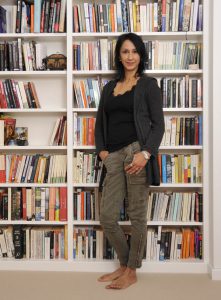
Monica Ali was born on October 20, 1967, in Dhaka, East Pakistan (now Bangladesh), to a Bangladeshi father and English mother. Her father worked as a teacher, and her mother was a counselor. However, due to their controversial interracial marriage, the Ali family emigrated to England in 1971 following a Civil War outbreak in Pakistan. Settling in Bolton, near Manchester, Ali went on to study at Oxford, where she completed a degree in an interdisciplinary program combining philosophy, politics, and economics. After university, Ali worked in the marketing department of a publishing house before going on to subsequent jobs in sales and marketing. She married consultant Simon Torrance, and in 1999, gave birth to her first child, a son named Felix. During this time off, Ali began experimenting with writing fiction. In 2001, Ali’s daughter, Shumi, was born; however, shortly afterward, Ali’s father died. This loss prompted her to reflect on family values and history, which subsequently encouraged the manuscript for her first novel, Brick Lane, published in May 2003. Following the success of Brick Lane, Ali continued to write professionally, publishing Alentejo Blue (2006), In the Kitchen (2009), and Untold Story (2011). Ali currently resides in London with her family.
Charles Dickens Timeline
Charles Dickens: A Brief Biography
Charles Dickens was born in Portsmouth on February 7, 1812 to a middle-class family. His father was a clerk in the navy pay office, a job that paid well, but due to John Dickens’ extravagance, became insufficient to support the family. By 1824 Charles’ father was put in debtor’s prison. Charles, who had the fortune of beginning education at 9, was forced to cut it short at age 12 by working at Warren’s blacking factory for 3 years. Charles resumed education after this 3-year retreat, but was soon removed once again to work as a clerk in a solicitor’s office. In 1833, he became a parliamentary journalist for The Morning Chronicle. There, he began writing a series of sketches under the pseudonym “Boz” and published the first installment of The Pickwick Papers in 1836, the same year he married his wife Catherine Hogarth. The Pickwick Papers became incredibly successful, launching his literary career. He went on to publish an autobiography, author many books, edit weekly periodicals, write plays, and lecture against slavery in the United States. In 1865, he was in a train accident from which he never recovered. Five years later he had a stroke, ending his life.
Revulsion Toward the Human in Virginia Woolf’s Mrs Dalloway
“Here he opened Shakespeare once more. That boy’s business of the intoxication of language—Antony and Cleopatra—had shriveled utterly. How Shakespeare loathed humanity—the putting on of clothes, the getting of children, the sordidity of the mouth and the belly! This was now revealed to Septimus; the message hidden in the beauty of the words. The secret signal which one generation passes, under disguise, to the next is loathing, hatred, despair. Dante the same. Aeschylus (translated) the same. There Rezia sat at the table trimming hats. She trimmed hats for Mrs. Filmer’s friends; she trimmed hats by the hour. She looked pale, mysterious, like a lily, drowned, under water, he thought.
“‘The English are so serious,’ she would say, putting her arms round Septimus, her cheek against his.
“Love between man and woman was repulsive to Shakespeare. The business of copulation was filth to him before the end. But, Rezia said, she must have children. They had been married five years.”
Mrs. Dalloway, 88-89
Woolf begins this passage with Septimus’s post-war reflection on Shakespeare. The passage takes place after Septimus’s return from the war with Rezia. The painting of Septimus’s earlier “intoxication” with Shakespeare’s language as “boy’s business” illustrates more than just the ending of a fascination or interest. The alliteration in “boy’s business” brings attention to it, gives it a name that sounds almost silly, that can be dismissed or condescended when read aloud. The use of the word “intoxication,” meanwhile, evokes a certain kind of sensuality. At this point, years after the war, the sensuality has “shriveled utterly.” Woolf’s language subtly tells her reader that while Septimus assures himself that he has matured or been enlightened—he has moved on from his “boy’s business”—what has really occurred is an absolute loss of sensation. Septimus points it out himself earlier on when he says he cannot feel anything. But it has seeped into his reading of plays that once intoxicated him, so the reader cannot necessarily trust Septimus’s readings.
Thus, when he remarks how “Shakespeare loathed humanity,” really it is Septimus who loathes humanity. Woolf piles up imagery for the reader to understand the depths to which Septimus can no longer feel, employing repetition of “the” to generate almost her own kind of assault on the reader’s senses. Septimus loathes “the putting on of clothes” because he can no longer feel the joy of nice fabric or the decorative properties of clothing; he loathes “the getting of children” because he no longer feels sexual excitement; he bemoans “the sordidity of the mouth and belly!” He takes no pleasure in the taste of food, and feels a disgust in the human body. The word “sordidity” employs repetition of sounds in itself, so the reader might understand that Septimus’s loss of feeling, the “shriveling,” is not so much the result of an extended lack of feeling, but the constant assault that has been placed on his senses while in the war.
Woolf repeats the word “trimming” three times when describing Septimus’s observations of Rezia. The effect is almost chant-like, or like a nursery rhyme, and reveals the way Septimus finds her actions silly, especially when compared to these great truths he believes to have uncovered, from none other than classic writers. Then he compares her to a “lily, drowned, under water.” This might be an allusion to Shakespeare, where Woolf Rezia equates Rezia to Ophelia from Hamlet. Hamlet, concerned with great issues of his father’s death and proper succession, rejects Ophelia. Septimus is thus like Hamlet; burdened with these great truths, or his own beliefs that the world’s “great signal” is of loathing, hatred, despair, Septimus rejects Rezia and avoids giving her children.
Woolf’s prose turns matter-of-fact as Septimus recounts an act of physical love from Rezia: how she puts her arms around him, “her cheek against his.” There is no sensation here, no stirring of emotion either positive or negative. One can practically see the coldness with which he responds, how he stiffens, utterly not at ease, as Rezia reaches out to him. Then the prose turns even colder, the sentences even shorter and straight to the point. “Love between man and woman was repulsive to Shakespeare. The business of copulation was filth to him before the end.” Shakespeare wrote comedies whose endings were marked with marriage. This is not Shakespeare’s opinion; it is Septimus’s. After all, the reader already knows Septimus regards the human body with disgust. How could he ever endure sex?
We’ve discussed at length in class the novel’s historical context as taking place after World War I, leading to discussions of shellshock and mental health in regard to Septimus. I think Woolf illustrates a really interesting understanding of trauma here, however, perhaps even ahead of her time. Today we understand that a characteristic of trauma and PTSD is the constant assault on a person’s nervous system, often triggered through sound or other sensory experiences that remind the victim of the traumatic event. Woolf’s prose, in its constant repetitions and almost bombarding Septimus with sensory experiences, might be trying to replicate the same feeling. In this way, the passage illustrates the ways in which literature can bring to life a phenomenon that might not yet be clinically understood.
Another intriguing historical context is of the novel as a post-pandemic work. Septimus’s aversion to touch, though primarily a symptom of his PTSD, feels incredibly fitting as a response to influenza. It is comparable to the social distancing we undertake in the COVID-19 era, and the near constant anxiety people feel when confronted with contact with another person’s body. The complete revulsion he feels toward the human body seems to have more to do with his general hatred of human existence; however, it would not be farfetched to think of it too as a disgust toward a physical being that carries disease.
Rezia’s character raises the question of women’s history here. I wonder whether she had different rights in England as an Italian immigrant, but either way, women’s suffrage was established in England following World War I. Septimus married her because she was the youngest of the sisters, because she was the “gayest,” perhaps because he thought her silly and unable to challenge him. I wonder whether we are meant to think of her assertion at the passage’s end—that “she must have children”—as a result of this era of women’s expanded liberty. Or is it more of a supplication?
Then, there is the literary context. We now know Woolf as an important voice in the British literary canon, but her inclusion of authors such as Shakespeare, Dante, and Aeschylus illustrates for her reader both what is regarded as a literary canon at the time, and how deeply she deviates from it. Aeschylus comes from Ancient Greece, Dante from the medieval era, and Shakespeare from Elizabethan England. They all wrote in verse and are regarded as important figures, whether in classics or medieval literature. Woolf’s writing, in its plunging into characters’ consciousness and unconventionally structured prose, is revolutionary against this literary backdrop.