Each Friday by noon, two members of the class will send 300-500 word responses to the most recent seminar to CNW and KN, who will post these here. As our final project develops, specific assignments toward that work will appear below as well.
September 14
CNW response:
Introductions revealed a wide breadth of disciplines represented in the room: English, African American Studies, French, Anthropology, Religion, Architecture, Art&Archaeology, Comparative Literature, Classics, History. And a wide array of creative practice, dance, theater, calligraphy, music, poetry, filmmaking, photography, among others. An auspicious combination for our purposes.
The class rituals were outlined, its recent history sketched. Descriptions of the last two final projects – one based on photography, the other on sound studies – hopefully conveyed a sense of what might be possible for us in December. The resources at our disposal will surely yield something unexpected.
With logistics out of the way, we got to the task at hand: grappling with disciplinarity and its inter-, trans-, and anti- permutations. KN wrote the four university divisions on the board and students triaged departments into their proper divisions at Princeton. Mistakes were made due to our institution’s unique system of categorization.
The Klein/Frodeman/Perloff/Edwards/Turkle readings left me pensive. Questions like the following lingered: How does acknowledgement of a predisciplinary period change how we view contemporary debates about disciplines? How should we grapple with the fact that before the “disciplining process” began, interdisciplinarity was the default mode, so to speak? Does that suggest a conservative impulse, a desire to return to the good ol’ halcyon days before we were imprisoned in our disciplines? Was Perloff wrong to suggest that a student in a literature department should know something about literary form? (The line was “I have heard graduate students discussing the vagaries of Romantic self-consciousness in Shelley’s ‘Ode to the West Wind’ who cannot tell you what an ode is, what an apostrophe is, or why [much less how] this one is written in terza rima?” [658].) A compromise in the Perloff/Edwards debate, I suggested, might be that literature students return to their study of form, perfect it, and THEN apply it to other disciplines (i.e. the study of metaphors and other rhetorical figures in political speeches, advertising, journalism, social media content, etc.) Isn’t the problem really that so much has accumulated through the centuries, it is impossible to ever know enough? Is this why disciplines formed? Because our brains were too full? (On this subject, I highly recommend Ann Blair’s book Too Much to Know: Managing Scholarly Knowledge before the Modern Age.) Turkle’s piece asked us to think about objects as potential tools for bricolage, that is, repurposing things for uses other than their intended ones. I’d love to know which objects you use in this way, for scholarly and/or creative applications. How might one playfully undermine the archive’s use? The footnote’s use? The chalkboard’s use? The note-taking app’s use?
KN response:
I.
September 17, 1970: At the first session of the seminar the members decided to stress form over content. It’s the stress I prefer, but I’m worried that they see it as an either/or proposition—and have opted headlong for a full-blooded encounter group. I think I learned with last year’s seminar that it’s a mistake simply to convert an academic format into a therapeutic one; it’s the combined form I’m searching for—not the straight informational nor straight confrontational. But like last year, I’m uncertain enough about what I’m heading toward so that when the ball is carried clearly into one court or the other, I have trouble clarifying what I sense is my justifiable resistance.
II.
The above passage is a journal entry documenting Martin Duberman’s response to teaching the first day of class for an “unstructured course” he offered at Princeton titled “American Radicalism.” (The course was the subject of this 2022 PAW profile.) A professor in the Department of History, Duberman was an iconoclastic scholar-activist who nonetheless took the profession of history seriously—and sought to question its epistemological foundations from within. In fact, he included this entry in his 1972 book Black Mountain: An Exploration in Community, a history of the experimental college that operated in the North Carolina Blue Ridge Mountains (1933-1957) that doubles as a self-reflexive examination of the craft of historiography. Interwoven in the narrative are Duberman’s musings on teaching (at Princeton) and his worries about the kind of story he’s telling—as well as his coming out, which serves as a way of addressing the stakes of the college’s puritanical streak when it came to sexual expression. Having already won the Bancroft Prize (regarded as the top prize in the field of American history) in 1961, Duberman left Princeton in 1971 to take up a post at the City University of New York, where he became a major figure in the gay rights movement of the decade.
III.
I read Duberman’s journal entry not long before our own first session of HUM 583: Interdisciplinarity and Antidisciplinarity, co-taught with CNW. The entry appears on pages 268-269 (of 578 pages), so it really was a matter of serendipity that reading it aligned with preparing for the course. Here’s what resonated with me when I returned to the passage after the first day: “it’s the combined form I’m searching for—not the straight informational nor straight confrontational.” CNW and I reconceived this fall’s seminar around that mix of information and confrontation, with the latter simply meaning our effort to identify students’ personal stakes in the material. To do that, we zoomed in on the course’s title, which has been on the books since the seminar was conceived as the curricular capstone for the Interdisciplinary Doctoral Program in the Humanities (IHUM). Recognizing, too, that the course provides a forum for all graduate students to discuss how interdisciplinarity relates (or doesn’t) to their work, we decided to proceed with a fresh sense of our charge: figure out what we collectively mean by interdisciplinarity and antidisciplinarity by, first, establishing a baseline understanding of disciplinarity (and the disciplines).
Like Duberman, I don’t know how that mix of information (Klein and Frodeman, Perloff, Edwards) and confrontation (academic divisions at Princeton activity) came off for the class. The good, as far as I can tell: key points about the rise of the disciplines that took us six weeks to get to last year we more or less introduced in this session. On this point, the activity CNW and I executed helped make palpable, alive, at-hand the abstract formulation of knowledge production in the modern American research university. And when we did get to IHUM’s slightly more open way of conceiving humanities research at Princeton, I was humbled by KK’s question, “Why not open IHUM to all units (i.e., graduate students) on campus—not just those ‘approved’ by our mandate?” This struck at the core of just how difficult it is to do interdisciplinary work that actually challenges the way knowledge is produced and assessed in higher education. CNW offered a response to KK’s question, “The sciences may not feel that they need us to do their work,” is both perceptive and revealing of the shape of the university today. Even though the sciences’ concerns feel far-flung from our seminar, it’s precisely by acknowledging that distance upfront that we can begin to do work from our own (op)positionality.
What didn’t go as well as I might have wanted? I know I should’ve spent more time with my object lesson. The Turkle reading was a good entry point into this component of the seminar, but we didn’t get to discuss it at great length. Our readings and group activity took up much of the classroom time we had available to us—and I don’t regret that. (I did a callback to Turkle during the activity, explaining how her stature as a world-renowned historian of science and technology [at MIT, no less] still doesn’t qualify her to contribute to Division III or Division IV professional matters.) But even as time ran out on me, I couldn’t help but notice that—without any explicit planning—CNW and I had brought in examples of technological obsolescence. CNW’s cart of office supplies and my burned mixtape CD (and note how “tape” is retained in that lingo) surely had something to say in themselves and to each other. And, deep down, they might reflect our own hesitation about teaching not just HUM 583 but at all in our contemporary situation of AI at once exploiting the university’s (human, physical, immaterial) resources and selling it back to the university as learning tools. We didn’t get this far, but such dialogue is, I think, the intent behind the seminar’s object lessons.
IV.
Isn’t it interesting to consider that over 55 years ago HIS 308: American Radicalism had attempted to do a version of what HUM 583: Interdisciplinarity and Antidisciplinarity seeks to do in 2026? Duberman was a rebel in his time for teaching an ungraded undergraduate course whose intellectual subject overlapped with with its pedagogical ethos. What happened between that time and now, such that Duberman’s experiment seems at once familiar in theory and inconceivable in practice? What are we, in HUM 583, trying to learn, or relearn, about experiments in education at Princeton?
September 21
HR response:
If our first discussion introduced us to departmental divisions at Princeton and histories of interdisciplinarity in several fields, our second probed what it looks like to navigate disciplines, moving from MH’s intellectual biography, to HH’s question (why compare?), to Florian Fuchs’s account of his training in Kulturwissenschaften.
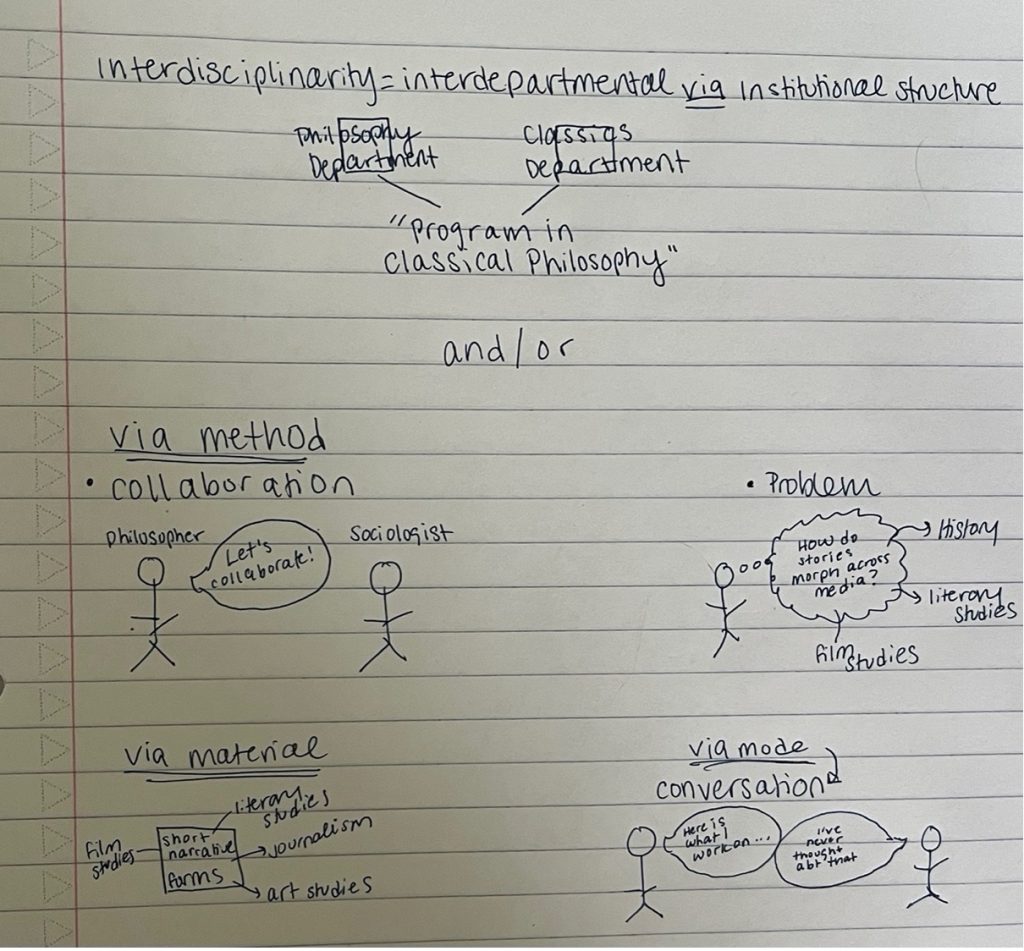
Before coming to Princeton, I had conceptualized interdisciplinary as synonymous with interdepartmental, which is Austin’s definition. He explains that interdisciplinarity is not intrinsic to a text, but “the byproduct of a…system of intellectual categorization whose form is dictated by locally specific institutional forces” (272). Interdisciplinarity, on this account, is structured institutionally in “area studies” programs and the “double major.” Yet the issue, which some readings mention, is how to navigate these institutions when departmental specialization morphs into insularity (I had an undergrad professor who described the university with a quasi-parable: “once upon a time people built towers, and they threw stones at the other towers… and these are called departments”).
But our readings and class dialogue have led me to think: can interdisciplinarity instead be catalyzed by objects? made up through relational practice? Can it exist without institutions?
Material and method keep circling for me as I mull over these questions. On material, several readings suggest some objects of study contain internal logics that unavoidably catalyze interdisciplinary inquiry. I’m thinking of the “hybrid genres” that led art historians to look to the social sciences and music scholars to challenge their discipline’s boundaries (Klein & Frodeman, 147-8). Likewise, Fuchs ends his chapter claiming that short narrative forms “disregard” the separations of academic disciplines, instead enacting “transgressions of genre, media, and epistemological borders” (248). Moreover, how does it feel to encounter these objects of inquiry that intrinsically lead to interdisciplinarity—are they ever objects like Turkle’s evocative objects, both fragments of our emotional lives and catalysts of thought? Fuchs spoke about the joy his approach to material gave him, and MH said she would have fun in her inquiries.
On method, the readings explicitly name collaboration as interdisciplinary phenomenon. Robinson (a literary critic) writes how she collaborated on a book about feminist scholarship with a philosopher and a historian (278); Henkel and Torgovnick mention that collaboration between people from different disciplines generates new insights (279, 282). Fuchs named another method: the problem-oriented. His training in Germany encouraged him to follow problems and continue his inquiry past disciplinary “walls.”
Our discussion also made me think about conversation as a discursive mode of interdisciplinarity. MH described the interdisciplinary exchanges she had with researchers during her time in special collections libraries. I recognize this too in the Writing Center where I work, where each Fellow dialogues with student writers from different disciplines. Such a conversation-based model is meant to generate thinking without presupposing disciplinary knowledge of the writer’s field.
So, if one can arrive at interdisciplinarity via material, method, or mode of discourse, does interdisciplinarity always manifest as institutional structure (a grant, a double major, a program) or can it itself be a practice (a conversation, a collaboration)?
I sketched these ideas before drafting my response to help me think, sharing in case a visual is useful to anyone else too!
JG response:
We began with an object: a roll of expired camera film housed in a small paper box. Photographs shot on expired film invite unpredictable effects upon their development: discoloration, blur, streaking. Chance draws attention to singularity. We think of photography as a capturing of its own mechanism of repetition: reproduction. Yet no two “expired” photographs, even when shot under the same lighting, taken of the same subject, ever exhibit identical, or even quite comparable, effects.
What is comparison? Comparo, “to couple together (in pairs, or in the same relation, or in judgment),” but also: “to prepare (with zeal),” “to arrange,” “to procure (what one does not yet possess or what is not yet in existence).” The word “pseudomorphism” came up in the context of interdisciplinary comparison. In sliding a critical framework between (disciplinary) contexts, do we not disrespect the singular crystallization of a given object? Does not a discipline, in the application of its own thematizing framework, likewise discipline singularity out of the picture?
What discipline proudly (or reluctantly, depending with whom you speak) advertises its comparative lens? This is Comparative Literature. In outsourcing language-specific literary study to home language departments, within which Comp Lit faculty sometimes hold joint appointments and sometimes do not, its system veils the ‘who’ of labor, scrambling important institutional statistics.
The same non-localizing of the ‘who’ of labor – a non-localizing which slyly accompanies the institutional discourse of “interdisciplinarity” – can be used as bureaucratic cover for labor adjunctification.
Whose labor, and for whom? That is, to pass over into the reception of such labor: Who act as audience to interdisciplinary (“comparative”) effort? Can the scholar seamlessly cross over into the role of critic, of public intellectual? Modernists in Art History departments are at ease, perhaps even conscientiously compelled, to write “publicly” – to “opinionize” – for journals such as Artforum, whereas those studying the older traditions sometimes criticize this slippage. The question of the form of a “publicity” with a basis in scholarly rigor, or the question of what that rigor entitles, or justifies, splits a discipline along the faultlines of its own self-periodization.
Contrasting definitions (or deconstructions) of interdisciplinarity in the 1996 MLA survey reveal the politics immanent to its conceptual murkiness. Henkel points to the absence of co-authorship within and across literature departments, as compared to the sciences. Murray argues that importation of findings and methods from another discipline into one’s own can be successful only so far as such importation accounts for the historical production of disciplinary stability. The scientific discourse of “evidence” forgets, from the outset, that the sense of its discourse is presupposed by literary, historical and religious phenomena. It forgets that it is a discourse.
Our visitor, Florian Fuchs, considers himself a thinker of genre: the meaning he gives the term is precise, yet the pool of “evidence,” or material, which he syncretizes, as well as his manner of syncretization, is capacious, unlimited: a “chaotic criss-crossing of the meaningful-meaningless mixture” (to quote Ernst Bloch). His is a civic gesture, akin to the sort he tracks in his recent book, which demonstrates the ways in which contemporaneous forms of storytelling undo logics of representation that appear, at first glance, to govern their aesthetics and, as a consequence, to deny genuine aesthetic comment. Speaking of the filmmaker Steyerl, Fuchs writes: “What she desires to be ‘documentary’ is thus a form of genre, rather than a mode of representation.” Steyerl makes a gross hyperbole of a contemporary aesthetic framework, drawing attention instead to the cradle of utterance, to genre, inventing this ‘genre’ anew in the form of a genre pronouncing upon the often-meaningless (or disingenuous) complex of contemporary aesthetic production and therefore inhabiting – embodying – its critique. Florian gives us here a definition of “embodied interdiscipline” applicable both to artworks and to the orientation of scholarly criticism.
September 28
EC Response:
Our discussion in the first half of class was grounded by the terms set out in C.P. Snow’s essential “two cultures” text – an essay whose afterlives, re-readings, and even rewritings perhaps exceed even its initial impact. Broadly, I was struck by the way that, even if we might have contested Snow’s conclusions about the different identities of scientific versus literary culture (and we did – especially his implicit preference for the sciences!) we all seemed to accept his premise that disciplines do, in fact, constitute cultures. In other words, perhaps what is most essential to take from this text is its formulation of academia as just as social and situated as it is professional (and, therein, universalizing in its claims of knowledge). This analytic of academic life as its own culture or set of cultures might carry over to Hare’s reconceptualization of the culture of the university as place of community building rather than knowledge acquisition. It might also apply to Veblen’s conception of the status of useless knowledge in the formation of an elite. That is, even if those authors may have differed in their understanding of precisely what cultures universities and disciplines promote, they help us see the way academic thought relies on convention and custom in a manner not indistinct from other forms of living.
It was fitting, then, that our guest in the second half was an anthropologist, Elizabeth Davis, who is attuned to precisely these methods of cultural analysis. Davis began by speaking about the essay we read by French ethnologist Jeanne Favret-Saada about witchcraft in France. Davis narrated both the disciplinary significance of this text and its role in her own intellectual formation – a dualism of personal and professional that we might say is consistent with our understanding of academia as culturally conditioned. (In other words, the texts that are essential to us might be so because they have a particular purchase in the academy at our moment of intellectual formation – either because of their conformity to or departure from disciplinary norms; it’s hard to separate out the historical and personal in this kind of question). Favret-Saada helped us discuss how anthropologists might move beyond a transparent understanding of speech as a medium of communication and read it as a not-always-true manifestation of other desires, beliefs, etc. I was interested in this idea that anthropological fieldwork, with its reliance on the interview, might offer a theory of communication (not only culture) – and that this theory might have broad implications beyond that particular discipline.
To this point: as an art historian, I find that close-looking is the most effective tool I can take from my discipline and apply beyond its borders. Davis, whose book The Time of the Cannibals includes an extended photo essay comprised of archival material from Cypriot news outlets, also helped us think about the role of images outside of the history of art. Much like the non-transparency of language in ethnographic speech, the archival image is, of course, highly coded. To this end, we asked: to what extent does the plasticity of images (via AI, etc.) affect our ability to read them as truthful generally? Davis’s work on conspiracy helped her see that it will not reward anyone’s time to stabilize the veracity of images in relation to audiences. Rather, we need to develop new analytic tools for looking at images in an environment where their veracity is in question. Here, I feel the tools of my discipline are made more, not less, essential by the instability of images in life broadly.
MS Response:
Last week’s objects: a bottle of Advil (liquid gel capsules), a mock postcard featuring a hotline graphic, and a type specimen book. While these objects expanded on our established interest in the obsolete in some ways, they also invited new conversation about the evolution of technology (the hotline, in this case) over time and the strange appeal of quotidian objects. I was also left wondering about the nature of drafts and templates. Elements such as the constraint and repetition of typeface, the molded uniformity of industrially manufactured plastic, and the “blank” page of the working draft raise questions about process, repetition, and discipline.
Our discussion of this week’s texts (Hare, Veblen, Snow) pointed to several conflicts, stress points, or fault lines that characterized these pieces. For instance, Hare’s proposal for a Black studies department explores tensions between integration and segregation, knowledge accumulation and community building within the university. Further, Veblen critiques leisure-class standards of learning, pointing to a conflict between bourgeois ideals and those of “everyday life”. Finally, we spent the most time discussing Snow’s elaboration of the rift between the “two cultures” (the scientific and literary). Returning to the theme of evolution over time, I was very interested in whether and how these texts translate to the contemporary moment. For instance, as we discussed, it seemed that most of us are not socializing with scientists, which may indicate the continued relevance of the two-culture divide. However, in terms of discontinuity, I found Snow’s characterization of scientific optimism less convincing today, as scientists increasingly serve as unheeded prophets of doom. With their evidence-based warnings about climate issues and public health routinely dismissed, scientists seem less certain that “something can be done,” and increasingly convinced of the “tragic” nature of the social condition.
For me, the concept of the “fault line” was particularly helpful insofar as it reinforces that these three articles each take place at critical moments of change. It seems that just as these geographic features are a product of shifting earth and rising pressure, our authors respond to “tangible changes” (Veblen), “a state of crisis” (Hare), and the impending split of “the intellectual life of the whole of Western society” (Snow). Here, I wonder about the function of disciplines as a response to various kinds of crises: knowledge, political, economic, etc. Moreover, as our authors each engaged in comparative projects in some way, is there something about a crisis that makes us want to compare? Finally, is the university ever not in crisis?