Each Friday by noon, two members of the class will send 300-500 word responses to the most recent seminar to CNW and KN, who will post these here. As our final project develops, specific assignments toward that work will appear below as well.
September 14
CNW response:
Introductions revealed a wide breadth of disciplines represented in the room: English, African American Studies, French, Anthropology, Religion, Architecture, Art&Archaeology, Comparative Literature, Classics, History. And a wide array of creative practice, dance, theater, calligraphy, music, poetry, filmmaking, photography, among others. An auspicious combination for our purposes.
The class rituals were outlined, its recent history sketched. Descriptions of the last two final projects – one based on photography, the other on sound studies – hopefully conveyed a sense of what might be possible for us in December. The resources at our disposal will surely yield something unexpected.
With logistics out of the way, we got to the task at hand: grappling with disciplinarity and its inter-, trans-, and anti- permutations. KN wrote the four university divisions on the board and students triaged departments into their proper divisions at Princeton. Mistakes were made due to our institution’s unique system of categorization.
The Klein/Frodeman/Perloff/Edwards/Turkle readings left me pensive. Questions like the following lingered: How does acknowledgement of a predisciplinary period change how we view contemporary debates about disciplines? How should we grapple with the fact that before the “disciplining process” began, interdisciplinarity was the default mode, so to speak? Does that suggest a conservative impulse, a desire to return to the good ol’ halcyon days before we were imprisoned in our disciplines? Was Perloff wrong to suggest that a student in a literature department should know something about literary form? (The line was “I have heard graduate students discussing the vagaries of Romantic self-consciousness in Shelley’s ‘Ode to the West Wind’ who cannot tell you what an ode is, what an apostrophe is, or why [much less how] this one is written in terza rima?” [658].) A compromise in the Perloff/Edwards debate, I suggested, might be that literature students return to their study of form, perfect it, and THEN apply it to other disciplines (i.e. the study of metaphors and other rhetorical figures in political speeches, advertising, journalism, social media content, etc.) Isn’t the problem really that so much has accumulated through the centuries, it is impossible to ever know enough? Is this why disciplines formed? Because our brains were too full? (On this subject, I highly recommend Ann Blair’s book Too Much to Know: Managing Scholarly Knowledge before the Modern Age.) Turkle’s piece asked us to think about objects as potential tools for bricolage, that is, repurposing things for uses other than their intended ones. I’d love to know which objects you use in this way, for scholarly and/or creative applications. How might one playfully undermine the archive’s use? The footnote’s use? The chalkboard’s use? The note-taking app’s use?
KN response:
I.
September 17, 1970: At the first session of the seminar the members decided to stress form over content. It’s the stress I prefer, but I’m worried that they see it as an either/or proposition—and have opted headlong for a full-blooded encounter group. I think I learned with last year’s seminar that it’s a mistake simply to convert an academic format into a therapeutic one; it’s the combined form I’m searching for—not the straight informational nor straight confrontational. But like last year, I’m uncertain enough about what I’m heading toward so that when the ball is carried clearly into one court or the other, I have trouble clarifying what I sense is my justifiable resistance.
II.
The above passage is a journal entry documenting Martin Duberman’s response to teaching the first day of class for an “unstructured course” he offered at Princeton titled “American Radicalism.” (The course was the subject of this 2022 PAW profile.) A professor in the Department of History, Duberman was an iconoclastic scholar-activist who nonetheless took the profession of history seriously—and sought to question its epistemological foundations from within. In fact, he included this entry in his 1972 book Black Mountain: An Exploration in Community, a history of the experimental college that operated in the North Carolina Blue Ridge Mountains (1933-1957) that doubles as a self-reflexive examination of the craft of historiography. Interwoven in the narrative are Duberman’s musings on teaching (at Princeton) and his worries about the kind of story he’s telling—as well as his coming out, which serves as a way of addressing the stakes of the college’s puritanical streak when it came to sexual expression. Having already won the Bancroft Prize (regarded as the top prize in the field of American history) in 1961, Duberman left Princeton in 1971 to take up a post at the City University of New York, where he became a major figure in the gay rights movement of the decade.
III.
I read Duberman’s journal entry not long before our own first session of HUM 583: Interdisciplinarity and Antidisciplinarity, co-taught with CNW. The entry appears on pages 268-269 (of 578 pages), so it really was a matter of serendipity that reading it aligned with preparing for the course. Here’s what resonated with me when I returned to the passage after the first day: “it’s the combined form I’m searching for—not the straight informational nor straight confrontational.” CNW and I reconceived this fall’s seminar around that mix of information and confrontation, with the latter simply meaning our effort to identify students’ personal stakes in the material. To do that, we zoomed in on the course’s title, which has been on the books since the seminar was conceived as the curricular capstone for the Interdisciplinary Doctoral Program in the Humanities (IHUM). Recognizing, too, that the course provides a forum for all graduate students to discuss how interdisciplinarity relates (or doesn’t) to their work, we decided to proceed with a fresh sense of our charge: figure out what we collectively mean by interdisciplinarity and antidisciplinarity by, first, establishing a baseline understanding of disciplinarity (and the disciplines).
Like Duberman, I don’t know how that mix of information (Klein and Frodeman, Perloff, Edwards) and confrontation (academic divisions at Princeton activity) came off for the class. The good, as far as I can tell: key points about the rise of the disciplines that took us six weeks to get to last year we more or less introduced in this session. On this point, the activity CNW and I executed helped make palpable, alive, at-hand the abstract formulation of knowledge production in the modern American research university. And when we did get to IHUM’s slightly more open way of conceiving humanities research at Princeton, I was humbled by KK’s question, “Why not open IHUM to all units (i.e., graduate students) on campus—not just those ‘approved’ by our mandate?” This struck at the core of just how difficult it is to do interdisciplinary work that actually challenges the way knowledge is produced and assessed in higher education. CNW offered a response to KK’s question, “The sciences may not feel that they need us to do their work,” is both perceptive and revealing of the shape of the university today. Even though the sciences’ concerns feel far-flung from our seminar, it’s precisely by acknowledging that distance upfront that we can begin to do work from our own (op)positionality.
What didn’t go as well as I might have wanted? I know I should’ve spent more time with my object lesson. The Turkle reading was a good entry point into this component of the seminar, but we didn’t get to discuss it at great length. Our readings and group activity took up much of the classroom time we had available to us—and I don’t regret that. (I did a callback to Turkle during the activity, explaining how her stature as a world-renowned historian of science and technology [at MIT, no less] still doesn’t qualify her to contribute to Division III or Division IV professional matters.) But even as time ran out on me, I couldn’t help but notice that—without any explicit planning—CNW and I had brought in examples of technological obsolescence. CNW’s cart of office supplies and my burned mixtape CD (and note how “tape” is retained in that lingo) surely had something to say in themselves and to each other. And, deep down, they might reflect our own hesitation about teaching not just HUM 583 but at all in our contemporary situation of AI at once exploiting the university’s (human, physical, immaterial) resources and selling it back to the university as learning tools. We didn’t get this far, but such dialogue is, I think, the intent behind the seminar’s object lessons.
IV.
Isn’t it interesting to consider that over 55 years ago HIS 308: American Radicalism had attempted to do a version of what HUM 583: Interdisciplinarity and Antidisciplinarity seeks to do in 2026? Duberman was a rebel in his time for teaching an ungraded undergraduate course whose intellectual subject overlapped with with its pedagogical ethos. What happened between that time and now, such that Duberman’s experiment seems at once familiar in theory and inconceivable in practice? What are we, in HUM 583, trying to learn, or relearn, about experiments in education at Princeton?
September 21
HR response:
If our first discussion introduced us to departmental divisions at Princeton and histories of interdisciplinarity in several fields, our second probed what it looks like to navigate disciplines, moving from MH’s intellectual biography, to HH’s question (why compare?), to Florian Fuchs’s account of his training in Kulturwissenschaften.
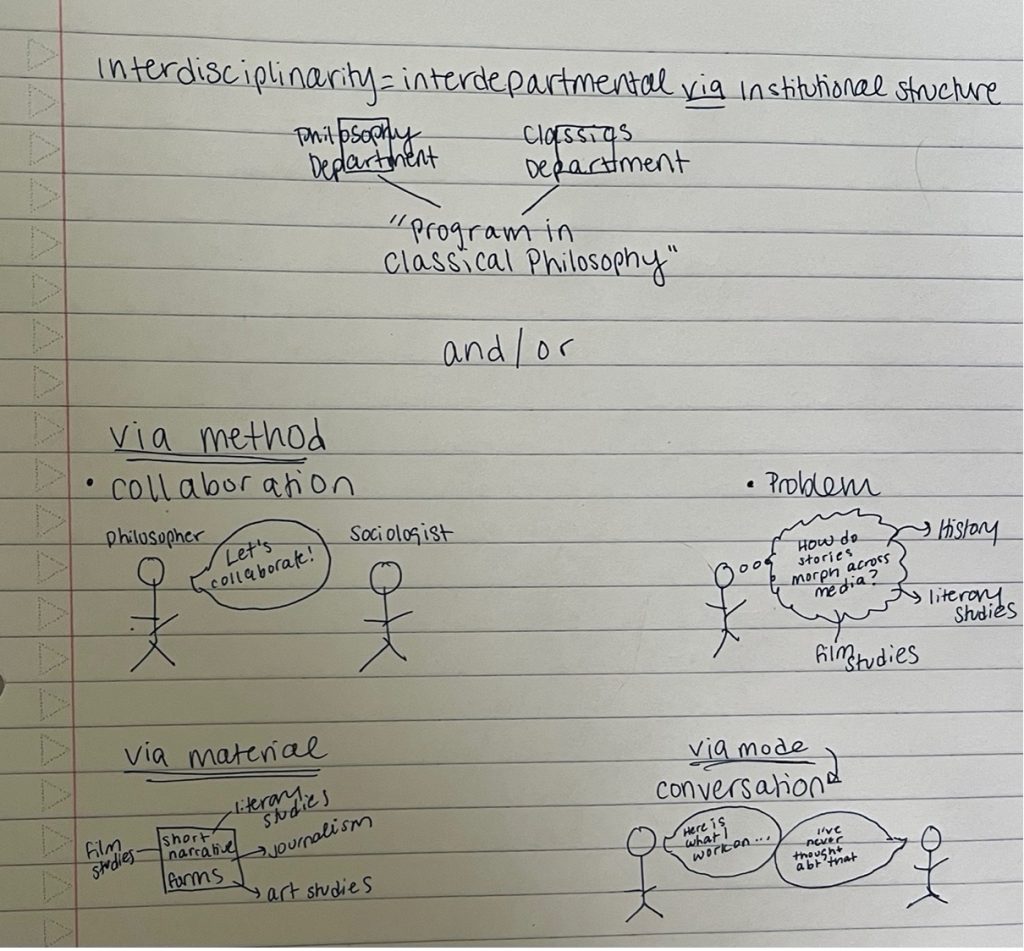
Before coming to Princeton, I had conceptualized interdisciplinary as synonymous with interdepartmental, which is Austin’s definition. He explains that interdisciplinarity is not intrinsic to a text, but “the byproduct of a…system of intellectual categorization whose form is dictated by locally specific institutional forces” (272). Interdisciplinarity, on this account, is structured institutionally in “area studies” programs and the “double major.” Yet the issue, which some readings mention, is how to navigate these institutions when departmental specialization morphs into insularity (I had an undergrad professor who described the university with a quasi-parable: “once upon a time people built towers, and they threw stones at the other towers… and these are called departments”).
But our readings and class dialogue have led me to think: can interdisciplinarity instead be catalyzed by objects? made up through relational practice? Can it exist without institutions?
Material and method keep circling for me as I mull over these questions. On material, several readings suggest some objects of study contain internal logics that unavoidably catalyze interdisciplinary inquiry. I’m thinking of the “hybrid genres” that led art historians to look to the social sciences and music scholars to challenge their discipline’s boundaries (Klein & Frodeman, 147-8). Likewise, Fuchs ends his chapter claiming that short narrative forms “disregard” the separations of academic disciplines, instead enacting “transgressions of genre, media, and epistemological borders” (248). Moreover, how does it feel to encounter these objects of inquiry that intrinsically lead to interdisciplinarity—are they ever objects like Turkle’s evocative objects, both fragments of our emotional lives and catalysts of thought? Fuchs spoke about the joy his approach to material gave him, and MH said she would have fun in her inquiries.
On method, the readings explicitly name collaboration as interdisciplinary phenomenon. Robinson (a literary critic) writes how she collaborated on a book about feminist scholarship with a philosopher and a historian (278); Henkel and Torgovnick mention that collaboration between people from different disciplines generates new insights (279, 282). Fuchs named another method: the problem-oriented. His training in Germany encouraged him to follow problems and continue his inquiry past disciplinary “walls.”
Our discussion also made me think about conversation as a discursive mode of interdisciplinarity. MH described the interdisciplinary exchanges she had with researchers during her time in special collections libraries. I recognize this too in the Writing Center where I work, where each Fellow dialogues with student writers from different disciplines. Such a conversation-based model is meant to generate thinking without presupposing disciplinary knowledge of the writer’s field.
So, if one can arrive at interdisciplinarity via material, method, or mode of discourse, does interdisciplinarity always manifest as institutional structure (a grant, a double major, a program) or can it itself be a practice (a conversation, a collaboration)?
I sketched these ideas before drafting my response to help me think, sharing in case a visual is useful to anyone else too!
JG response:
We began with an object: a roll of expired camera film housed in a small paper box. Photographs shot on expired film invite unpredictable effects upon their development: discoloration, blur, streaking. Chance draws attention to singularity. We think of photography as a capturing of its own mechanism of repetition: reproduction. Yet no two “expired” photographs, even when shot under the same lighting, taken of the same subject, ever exhibit identical, or even quite comparable, effects.
What is comparison? Comparo, “to couple together (in pairs, or in the same relation, or in judgment),” but also: “to prepare (with zeal),” “to arrange,” “to procure (what one does not yet possess or what is not yet in existence).” The word “pseudomorphism” came up in the context of interdisciplinary comparison. In sliding a critical framework between (disciplinary) contexts, do we not disrespect the singular crystallization of a given object? Does not a discipline, in the application of its own thematizing framework, likewise discipline singularity out of the picture?
What discipline proudly (or reluctantly, depending with whom you speak) advertises its comparative lens? This is Comparative Literature. In outsourcing language-specific literary study to home language departments, within which Comp Lit faculty sometimes hold joint appointments and sometimes do not, its system veils the ‘who’ of labor, scrambling important institutional statistics.
The same non-localizing of the ‘who’ of labor – a non-localizing which slyly accompanies the institutional discourse of “interdisciplinarity” – can be used as bureaucratic cover for labor adjunctification.
Whose labor, and for whom? That is, to pass over into the reception of such labor: Who act as audience to interdisciplinary (“comparative”) effort? Can the scholar seamlessly cross over into the role of critic, of public intellectual? Modernists in Art History departments are at ease, perhaps even conscientiously compelled, to write “publicly” – to “opinionize” – for journals such as Artforum, whereas those studying the older traditions sometimes criticize this slippage. The question of the form of a “publicity” with a basis in scholarly rigor, or the question of what that rigor entitles, or justifies, splits a discipline along the faultlines of its own self-periodization.
Contrasting definitions (or deconstructions) of interdisciplinarity in the 1996 MLA survey reveal the politics immanent to its conceptual murkiness. Henkel points to the absence of co-authorship within and across literature departments, as compared to the sciences. Murray argues that importation of findings and methods from another discipline into one’s own can be successful only so far as such importation accounts for the historical production of disciplinary stability. The scientific discourse of “evidence” forgets, from the outset, that the sense of its discourse is presupposed by literary, historical and religious phenomena. It forgets that it is a discourse.
Our visitor, Florian Fuchs, considers himself a thinker of genre: the meaning he gives the term is precise, yet the pool of “evidence,” or material, which he syncretizes, as well as his manner of syncretization, is capacious, unlimited: a “chaotic criss-crossing of the meaningful-meaningless mixture” (to quote Ernst Bloch). His is a civic gesture, akin to the sort he tracks in his recent book, which demonstrates the ways in which contemporaneous forms of storytelling undo logics of representation that appear, at first glance, to govern their aesthetics and, as a consequence, to deny genuine aesthetic comment. Speaking of the filmmaker Steyerl, Fuchs writes: “What she desires to be ‘documentary’ is thus a form of genre, rather than a mode of representation.” Steyerl makes a gross hyperbole of a contemporary aesthetic framework, drawing attention instead to the cradle of utterance, to genre, inventing this ‘genre’ anew in the form of a genre pronouncing upon the often-meaningless (or disingenuous) complex of contemporary aesthetic production and therefore inhabiting – embodying – its critique. Florian gives us here a definition of “embodied interdiscipline” applicable both to artworks and to the orientation of scholarly criticism.
September 28
EC Response:
Our discussion in the first half of class was grounded by the terms set out in C.P. Snow’s essential “two cultures” text – an essay whose afterlives, re-readings, and even rewritings perhaps exceed even its initial impact. Broadly, I was struck by the way that, even if we might have contested Snow’s conclusions about the different identities of scientific versus literary culture (and we did – especially his implicit preference for the sciences!) we all seemed to accept his premise that disciplines do, in fact, constitute cultures. In other words, perhaps what is most essential to take from this text is its formulation of academia as just as social and situated as it is professional (and, therein, universalizing in its claims of knowledge). This analytic of academic life as its own culture or set of cultures might carry over to Hare’s reconceptualization of the culture of the university as place of community building rather than knowledge acquisition. It might also apply to Veblen’s conception of the status of useless knowledge in the formation of an elite. That is, even if those authors may have differed in their understanding of precisely what cultures universities and disciplines promote, they help us see the way academic thought relies on convention and custom in a manner not indistinct from other forms of living.
It was fitting, then, that our guest in the second half was an anthropologist, Elizabeth Davis, who is attuned to precisely these methods of cultural analysis. Davis began by speaking about the essay we read by French ethnologist Jeanne Favret-Saada about witchcraft in France. Davis narrated both the disciplinary significance of this text and its role in her own intellectual formation – a dualism of personal and professional that we might say is consistent with our understanding of academia as culturally conditioned. (In other words, the texts that are essential to us might be so because they have a particular purchase in the academy at our moment of intellectual formation – either because of their conformity to or departure from disciplinary norms; it’s hard to separate out the historical and personal in this kind of question). Favret-Saada helped us discuss how anthropologists might move beyond a transparent understanding of speech as a medium of communication and read it as a not-always-true manifestation of other desires, beliefs, etc. I was interested in this idea that anthropological fieldwork, with its reliance on the interview, might offer a theory of communication (not only culture) – and that this theory might have broad implications beyond that particular discipline.
To this point: as an art historian, I find that close-looking is the most effective tool I can take from my discipline and apply beyond its borders. Davis, whose book The Time of the Cannibals includes an extended photo essay comprised of archival material from Cypriot news outlets, also helped us think about the role of images outside of the history of art. Much like the non-transparency of language in ethnographic speech, the archival image is, of course, highly coded. To this end, we asked: to what extent does the plasticity of images (via AI, etc.) affect our ability to read them as truthful generally? Davis’s work on conspiracy helped her see that it will not reward anyone’s time to stabilize the veracity of images in relation to audiences. Rather, we need to develop new analytic tools for looking at images in an environment where their veracity is in question. Here, I feel the tools of my discipline are made more, not less, essential by the instability of images in life broadly.
MS Response:
Last week’s objects: a bottle of Advil (liquid gel capsules), a mock postcard featuring a hotline graphic, and a type specimen book. While these objects expanded on our established interest in the obsolete in some ways, they also invited new conversation about the evolution of technology (the hotline, in this case) over time and the strange appeal of quotidian objects. I was also left wondering about the nature of drafts and templates. Elements such as the constraint and repetition of typeface, the molded uniformity of industrially manufactured plastic, and the “blank” page of the working draft raise questions about process, repetition, and discipline.
Our discussion of this week’s texts (Hare, Veblen, Snow) pointed to several conflicts, stress points, or fault lines that characterized these pieces. For instance, Hare’s proposal for a Black studies department explores tensions between integration and segregation, knowledge accumulation and community building within the university. Further, Veblen critiques leisure-class standards of learning, pointing to a conflict between bourgeois ideals and those of “everyday life”. Finally, we spent the most time discussing Snow’s elaboration of the rift between the “two cultures” (the scientific and literary). Returning to the theme of evolution over time, I was very interested in whether and how these texts translate to the contemporary moment. For instance, as we discussed, it seemed that most of us are not socializing with scientists, which may indicate the continued relevance of the two-culture divide. However, in terms of discontinuity, I found Snow’s characterization of scientific optimism less convincing today, as scientists increasingly serve as unheeded prophets of doom. With their evidence-based warnings about climate issues and public health routinely dismissed, scientists seem less certain that “something can be done,” and increasingly convinced of the “tragic” nature of the social condition.
For me, the concept of the “fault line” was particularly helpful insofar as it reinforces that these three articles each take place at critical moments of change. It seems that just as these geographic features are a product of shifting earth and rising pressure, our authors respond to “tangible changes” (Veblen), “a state of crisis” (Hare), and the impending split of “the intellectual life of the whole of Western society” (Snow). Here, I wonder about the function of disciplines as a response to various kinds of crises: knowledge, political, economic, etc. Moreover, as our authors each engaged in comparative projects in some way, is there something about a crisis that makes us want to compare? Finally, is the university ever not in crisis?
October 5
HH response:
For last week’s class, Ari brought a whole case of multicolored Play-Doh, which was met with enthusiasm from members of the class including Kinohi and Christy. Some seventy years after its invention, this childhood staple continues to satisfy persons of all ages and creeds: a deceptively simple, potentially transdisciplinary object. Various things were made: two cats (that were supposedly in love), a stalk of corn, a robot, among others. Jesse, on the other hand (no pun intended), brought a Fez-sourced wooden Hamsa, or Hand of Fatima, an amulet of protection associated with both Jewish and Islamic cultures. Its significance is often connected to the number five, which carries several auspicious resonances in both religious contexts. While wildly different, the two objects seemed to have a similar material and metaphysical effect on the class: both generated a magical wonder and awe among their participants. What a wonderful way to begin class.
What followed the “oohs” and “aahs” of the object presentations, and the requisite housekeeping matters, was a short discussion of the readings, all of which proposed some sort of systemic educational reform. Writing in the early 1960s, amid the Cold War and debates around the growing division between the humanities and the sciences, R. Buckminster Fuller argues against increased specialization, instead imagining a world in which the most creative minds are mobilized to solve humanity’s most pressing issues. As compelling as it was to read Fuller’s text, I remain skeptical of his faith in the capacity of creative intelligence to better the world. Consider Hendrik Verwoerd, the so-called “architect” of South African apartheid—a very gifted academic and all-around intellectual—who engineered and institutionalized a regime of racial separateness and disenfranchisement that systemically oppressed the black African population in every sector of South African society. Apartheid here was the outcome of knowledge, expertise, and institutional power galvanized towards profoundly destructive ends. I digress slightly, but this history complicates the assumption that greater creativity or a more expansive intellectual framework necessarily produces more just outcomes. Perhaps the question is not how we (or should we) overcome specialization, but through what ends do we put our knowledge to work (consider also, for example, the work of professors and students in Division IV and V in service to the U.S. military………).
Our conversation also turned to the purpose of academic writing and two authors were mentioned—Rizvana Bradley and David ??—whose use of language and sentence structure encourages a “deacceleration [reading] method.” Might academic writing induce a similar reading experience as poetry, which for me, is a writing style that I must read slowly, over and over, until finally a sliver of meaning lands? Is academic writing like a conceptual art piece, initially confounding the viewer but gradually revealing something through sustained attention?
Speaking of looking closely and longer, our guest Marshall Brown’s collages present seemingly congruent images that, when properly examined, reveal a splicing together of disparate structures from the built environment. Brown’s use of collage as a vehicle for stressing the force of uncertainty that exists in the world, for exploring the complexity of how cities do or do not get built was fascinating, my favorite reflection from this visit. I was especially interested in the relationship between seams and seamlessness. What does it mean to make uncertainty the material of a work rather than something to be eliminated? I worked with an artist on a very complicated sculptural sound installation for two years who believed in the idea of seamlessness, and for art to be a “magic trick.” I like this ethos, but there’s also something to be said about refusing the illusion of a unified, seamless whole.
Lastly, we ended with Brown circling back to the art world, a world that he was “invited into” and which seems to appreciate and understand his practice more than his chosen field. Comparing his experience of being called upon by the art world to that of Arthur Jafa’s, Brown’s engagement with art administrators and audiences seems fruitful and fulfilling, although, I would argue that just about everyone is invited into the art world. I can’t count how many meetings I’ve been in where we are debating whether or not an artist—working in any medium—is “ready” or not or if it’s the “right” time to offer an opportunity to them. It’s one of the hardest truths about this proclaimed “art world” that unfortunately does not bend for anyone, unless that is, you pay your way in somehow. Even that’s a tricky game. Brown’s experience nevertheless raises a productive question: what becomes possible when a practice is recognized by a field outside the one in which it was trained?
AC response:
-Ari’s brilliant introduction of Play-Doh and Jesse’s unvarnished wooden Hand of Fatima, acquired in Fez but originating in the Atlas Mountains, offered an unexpected point of departure for thinking about collage. Play-Doh brought to mind Benjamin’s account of children’s attraction to the remnants of the adult world: play not as innocent imitation, but as a practice of appropriating and recombining what familiarity has rendered self-evident. This recalls the surrealist attempt to recover the extraordinary within the ordinary, while Jesse’s amulet invited questions about magic, belief, and the supra-sensuous dimensions of objects that resist explication. Their displacement into the seminar seemed to enact something of Benjaminian montage and Brechtian estrangement, unsettling the habitual contexts through which objects acquire meaning.
–Marshall Brown’s visit brought us back to a recurring question: what does it mean to work across disciplinary boundaries, and what exactly is being crossed? His reluctance to identify himself as an architect, preferring to say that he works in art and architecture, displaced disciplinary identity from something one possesses to something one practices. Yet we found ourselves asking an architect why he did not build buildings.
—I was particularly interested in Brown’s insistence on the visibility of the seam. Rather than seamlessly incorporating heterogeneous fragments, collage makes perceptible the operation through which they are brought into relation. There seems to be something Brechtian in this refusal of seamlessness: the constructed image cannot pass entirely as a natural or self-evident whole. Yet the seam also participates in producing a new aesthetic coherence. This tension complicates Jonathan Lethem’s The Ecstasy of Influence, which challenges the assumption of autonomous artistic originality. Whereas Lethem’s disclosure of his sources makes the genealogy of his text legible, Brown described having little interest in systematically cataloguing the fragments he appropriates. Does the seam make their relationships more legible, or does their recomposition obscure the histories from which they have been extracted? This raises a question about artistic authority. If originality no longer resides in producing individual elements, does it simply move to arranging their relationships? Does exposing the seams alter that authority, or become an end in itself? Perhaps the question is less whether collage overcomes authorship than whether it changes the relationship between maker, material, and viewer.
—-Guattari’s insistence that transdisciplinarity must become transversality seems pertinent here: bringing disciplines into contact is insufficient if their underlying modes of organization remain intact. Harney and Moten challenge the demand for integration and improvement itself. Their notion of partial education proposes study as an unfinished, collective practice resisting the production of the self-possessing individual. Brown’s fragments, after all, ultimately become a work bearing his authorship, whereas Harney and Moten’s partiality troubles the logic of individuation that makes such ownership possible.
—–If collage offers a way of thinking about interdisciplinarity, the question may not be simply what can be brought together, but who determines how its fragments are related, what must be excluded for a composition to hold, and whether those relationships remain open to rearrangement. This returns me to the objects with which we began: the seminar temporarily established a relation between things with different histories, uses, and claims to knowledge. Might collective inquiry sustain such encounters without requiring them to resolve into a coherent whole?
October 12
MH response:
What a fun, exciting class we had this week, focusing on fabrication, materiality, and connections between being a practitioner and being a writer. We started out in the Lewis Library Makerspace and learned more about the resources this space has to offer us as students at Princeton. I was particularly thrilled to learn about the existence of the Book Lab within the Makerspace! We were charged with selecting a material, and we were given free rein to use other resources in the space to transform our materials into something else; our classmates fabricated many imaginative objects in a short twenty-minute period. We witnessed a hanging sculpture of wire and paper, a clay-felt-wire diorama of Greek tragedy, a lovely fabric pouch with paper-poem appliqué, and several iterations of a bound felt codex (differently imagined and fabricated), among other wonderful creations.
I was struck by the idea in our reading from Reparative Craft the idea that Sedgwick’s textile practice models her reparative reading practices (Edwards 5) – this feels like a fruitful idea to me as I attempt to synthesize my interests in bibliography, book arts, and medieval Latin literature, that my craft or positionality as a practitioner can model my methods of reading.
This week’s objects resonated for me with our focus on craft and hands-on learning/research. MM brought a printing transparency used for screen printing, and I loved seeing the evidence of past use on this object – bits of leftover ink, various markings and graffiti on the frame. JG brought a frontispiece leaf from his copy of the I Ching, which he said he keeps on his refrigerator, so it remains in sight. I’m struck by the interaction between these two objects, how the frontispiece is the outcome of some sort of printing technology while the screen precedes the print.
Finally, Jeff Dolven’s visit brought varied and rich discussion around trans-scalar encounters, hands-on learning, thinking of oneself as a practitioner, and interdisciplinarity as proto-disciplinary interactions vs. interactions between fields in their most advanced forms. On our way back from the makerspace, we all took photos of what Horton calls “trans-scalar encounters,” or “catalyzing events that take place when an observed adapted to a milieu defined by a particular scale of typical encounters structures and processes at a different scale” (Horton 8). Our trans-scalar encounters led us to interact with more literal scalar objects, maps and globes, but also led us to interact with the non-human and consider scales of monumentality, parody, and experience of the environment.
Finally, in our discussion of Jeff’s “The End of the Sentence” and the syntactical and expressive differences between speech and writing, KB brought up an interesting example of the trouble of trying to translate a consent document into Trinidadian patois, which is traditionally not written; the form of the document conflicts with the conventions of the language. I’ll continue to think about exteriorization of language as speech versus writing and the ways these modalities shape our ideas and thought patterns.
October 26
JC response:
What is the difference between obsolescence and expiration?
From a latin root, olēscō meaning to grow, obsolescence means to grow against. Compare, of similar extraction, adolescence. Expiration, on the other hand, is etymologically a breath let out. Technological “ecosystems” like Apple’s have increased the transaction costs of swapping between otherwise substitute goods (a Galaxy for an iPhone), enabling corporations to increase hardware profits by planning obsolescence. Expiration is also, to some extent planned: chocolate, for instance, is usually edible long after it has “bloomed,” due to its emulsifiers breaking down–but it is usually marked to expire before that unappetizing transformation takes place. Obsolescence seems more relational than expiration. Having a fresh carton of oat milk in your fridge will not cause your week-old 2% to expire. But a laptop can make a typewriter obsolete. Both obsolescence and expiry are transitive in this sense: something is only ever obsolete or expired relative to some use or purpose or standard. An orange that has molded has expired for consumption but not for making antibiotics. But we don’t usually mark this transitivity when we talk about obsolescence or expiration. This or that, we say, is obsolete, is expired. For whom? For what?
Prompted by our interestingly gendered objects–a woman’s old tennis racket, a man’s old make-up–we spent the first part of class discussing obsolescence, a theme for the course, and how it differed from expiration. That obsolescence has hung so near our discussions so regularly suggests it may have some bearing with respect to the course’s topic: disciplinarity. Are disciplines obsolete? Is interdisciplinarity obsolete? Should it be replaced with trans- or anti- disciplinarity? Or is this kind of critical study of the institution obsolete, a luxury of a time when the university was not under so dire a political threat–and now strategic essentialism is what is called for?
We also discussed the urban. The urban, curiously, was, by many of the writers whose texts we had in the room this week, contrasted to the university. The initial story seemed to be that the city was preferable to the university: if the campus is, as one writer noted, a bucolic fantasy, perhaps the city more frequently occasions collective assemblages of enunciation. But there are some things possible in the university that are not possible in a city, especially, in a city committed, as, for instancem Singapore is, to totally educating its citizens–H pointed this out, complicating the story of urban preference.
We went down several rabbitholes, about Buckminster Fuller and East St. Louis, and about the geodesic dome: both a high modernist achievement of technoarchitecture and a counter cultural symbol adopted by the communards of Drop City. We discussed protest strategy and the rabbithole itself, as like a protest, as a kind of partial education, a line of flight, either suicidal or liberatory, as a suggestion of method.
Our guest, Professor of Latin American Studies Javier Guerrero, spoke on the labor and leadership involved in interdisciplinarity. Reflecting on his presiding over the congress of the interdisciplinary constellation, Latin American Studies, to which he belongs, he discussed the challenges of 1) translation (for instance, explaining the importance of embodiment to political scientists, or the importance of Gloria Anzaldua for thinking Latin American experience in the US and Mexico to colleagues from South America), 2) direction (host cities must be selected years in advance so one must make do with the city they are dealt; other stakeholders may not approve of the path one wants to take), and 3) politics (guest artists being unable to legally make it to the conference due to Trump immigration policy). Refocusing intellectual effort, connecting disciplines, none of these things are done without effort, labor, or on a level field without political headwinds: all things to keep in mind as we devise our course deliverable.
November 2
JN Response:
The object of a transparent lock serves us well as a metaphor for the work of scholarship. Viewed from below, the systems which subjugate us do so in part by confounding us with their mystique. Capitalism functions by making itself an opaque lock whose inner workings are utterly obscure (something similar can be said about premodern religious institutions and other claims to power). Without understanding what happens inside the lock, one might well imagine it to be impenetrable to those lacking the key; in the same way, the opacity of power guarantees its survival. Scholarship is that mode of engaging with the world from a distance in order to see these systems for what they are: transparent locks which, with enough practice and finesse, can easily be picked.
Extending the metaphor, MS encouraged us to think of lockpicking as a metonym for a claim to the commons and a threat to the ideology of private property. By extension, the work of scholarship (of which I take critique to be a constituent part) is fundamentally an exercise in transgression, in trespassing on private land and transforming it into a commons. Interpretation has a storied history with the logic of locking and unlocking; to cite a favorite example, the 10th-century Iraqi rabbi Saadia Gaon described the Song of Songs as “a lock whose key has been lost long ago.” Reread in this radical key, we might say that the key in this situation, itself created by the lock-makers, is ultimately unnecessary. Scholars are key-less lockpickers who understand the inner workings of their objects of inquiry and provide common access to territories (texts, histories) which were previously rendered inaccessible by design.
Why dwell on this? Our conversations in this course have focused on avenues for radical transgression within the structure of academia, most pressingly the transgression of academic disciplines. Absent from this conversation has been any serious discussion of the radical potential of scholarship itself when done well and done rigorously. In pressing JF in the second half of class I meant to home in on this point: that rigorous disciplinarity, with all the technical training it entails, is precisely what lends scholarship in the humanities its radical efficacy, even (and perhaps especially) when that disciplinarity is applied creatively beyond the limitations of academic publishing. At its worst, interdisciplinary scholarship reduces the disciplines in question to a lowest common denominator. At its best, it applies mastery in a given discipline (botany, classics, theology) to creative expression in another (fiction, poetry, nature writing). In these final weeks I look forward to discussing the place of disciplinary rigor in more depth.
AC Response:
“Picking the Disciplinary Lock:” November 2, 2026 Key Terms
This write-up summarizes the class discussion through a set of key terms that began with our object lessons and grounded our analysis of the readings and guest conversation.
The Familial/Familiar: Ella’s shared object, her late grandmother’s nameplate reading “Mrs. Comberg,” prompted discussion about “the familial” in the academy and where/how it is evoked. In one sense, the familial is isolated from the “main content” of scholarship and indexed in places like acknowledgments and dedications. In other cases, concepts like the “intellectual lineage” appropriate the familial, situating the scholar within a new family system defined by institutional affiliations, recommenders, and interlocutors.
- Autotheory: From the word “auto” meaning “self” and the Greek “Theoria” meaning contemplation, speculation, or viewing. Autotheory refers to scholarly approaches that emerge from the author’s lived, embodied experience and perspective, reviving the “self” as a legitimate ground of knowledge. This approach not only challenges neutrality and objectivity as scholarly goods; it also blurs the distinctions between different modes of writing. Together, Christy, Kinohi and Miriam articulated a brief genealogy of “autotheory” and its conceptual predecessors, identifying a “first wave” of scholars in the 1950s and 60s who emphasized “standpoint” and subject position in their writing and criticism, leading to “second wave” interventions in Black Studies and GSS departments.
But the term “autotheory” also raises questions about why the self as a ground of study is categorized under the banner of “theory” (as opposed to, say, praxis or poesis)? What are the implications of autobiographical methods or approaches being labeled “theoretical” in fields such as history, philosophy, or anthropology versus literary studies or critical theory? For example, what is at stake when archaeologists Dunnavant and Flewellen draw from Saidiya Hartman’s “Venus in Two Acts” (Dunnavant and Flewellen, 722) versus when Jeff Whetstone employs critical fabulation in “Magnolia Macrophylla?”
- Biography/Fiction: As discussion continued, the lines between autotheory, biography, and fiction (both in writing and in photography) increasingly blurred, posing the question of how we know and verify what we know? What differentiates these different modes of storytelling and determines “rigor?” Citation? Intellectual lineage? Research? Experience? Are these factors even discrete? Does the “self” not motivate the performance and curation of each?
Picking the Lock: Inspired by Mariama’s object lesson, “Picking the lock” became a key (no pun intended) phrase throughout class discussion. Mariama brought two sample locks, as well as lock picking equipment, from a workshop hosted by her local anarchist bookstore. She described and demonstrated the process of picking a lock: while the transparent lock allows the novice lockpicker to see the process, more complicated locks require the picker to rely on other sensory cues including sound, tension, and haptic feedback.
- The Collective/Collaborative: The theme of the collective reappeared from past class discussions. Mariama described lockpicking as a form of knowledge stewarded by and for a collective—an ethic that each of the readings attempted to put in practice as well. We discussed again how the academy undervalues collective work (another form of anti-familiarity) and reaffirms the idea of academic labor and scholarly “rigor” as proprietorial.
- “Troublesome knowledges”: Mariama borrowed this term from the Wiggin, Premoli, and Sarti readings to describe the skill of lockpicking. While lockpicking tools themselves are not illegal, they can easily become evidence of criminality in the possession of someone who has been arrested or detained. Class discussion riffed on this idea. What happens when knowledge, materials, or sources “break containment” from a particular field or from the academy itself? Is this the work of interdisciplinarity? Does disciplinarity function as a mode of spatial organization, a “lock” that determines what matter is in place or out of place?
