
Henry Laufenberg and Zhiwen Wu
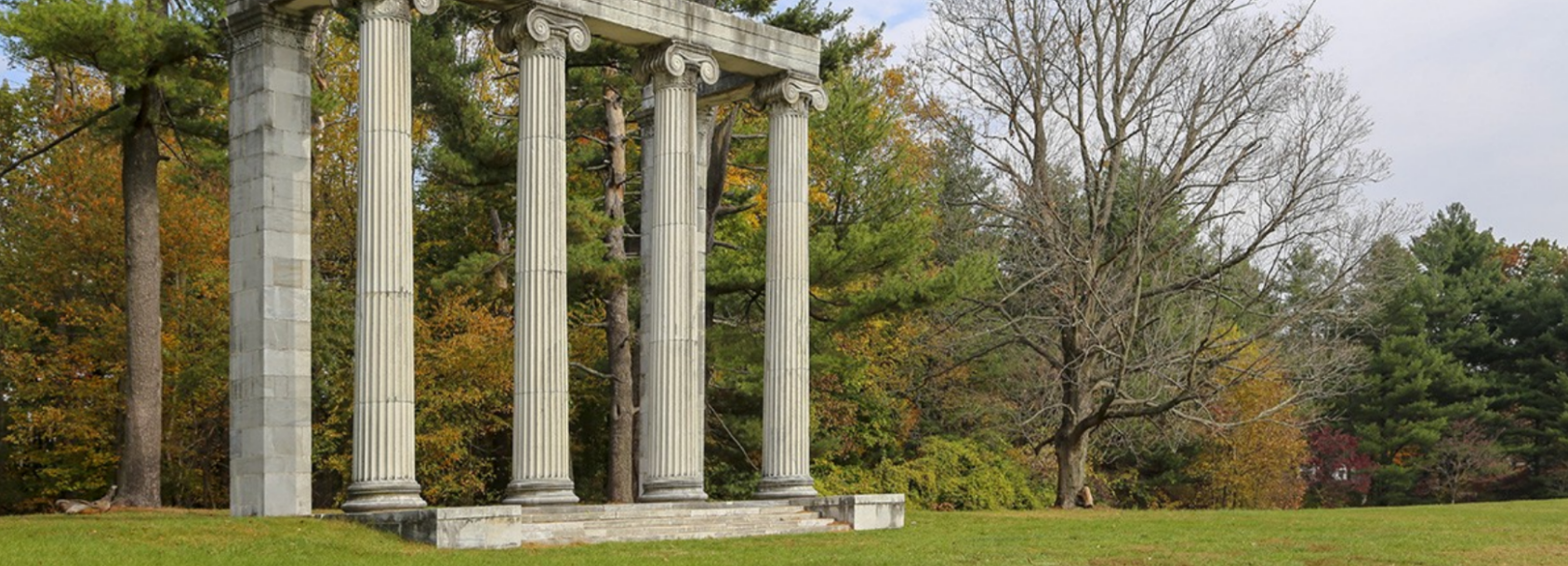
In 1777, George Washington and his army turned the tide of the Revolutionary war when they took to a field just outside of Princeton University and achieved the Americans’ first victory over the British Forces in an organized battle (where both sides were prepared for the fight) in what became known as the Battle of Princeton. 1 The site on which this battle was fought is now memorialized as the Princeton Battlefield State Park, but despite the significance of Washington’s victory, the battle to preserve the site rages on. Without the dedication and sacrifice of a great number of individuals dedicated to public history—the creation and dedication of historic sites and monuments for public use—the site of this battle would have been developed and forgotten long ago. Such individuals are still necessary for the site to continue carrying on its legacy.
During the century that followed the Battle of Princeton, not much attention was paid to the land on which it was fought. The battlefield site remained an undeveloped field, and there is no record of any attempt to commemorate the battle that was fought there. This changed in the late 1800s, when a set of monuments honoring General Hugh Mercer were erected on the site (figure 3).2 Postcards depicting these monuments were being sold to tourists by the 1890s. 3
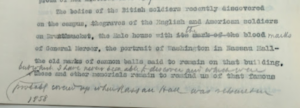
Unfortunately, historians were not the only people whose interest in the site had increased—the late 1890s also saw a number of developers begin to draw up plans for projects at the battlefield. These projects ultimately foiled, an early example of historically-conscious individuals standing up for the preservation of the site. The individual in question who saved the site was a man named Moses Taylor Pyne, a Princeton University trustee (and the namesake of a pair of campus buildings) whose interest in the area’s history has been well documented. The Firestone Library Archives houses a speech he gave in 1919 highlighting Princeton’s place in history, 9 pages of which are devoted to the Battle of Princeton (including the statement that “well may Princeton be proud of her historic battleground”). Elsewhere in the speech, he references “the old marks of cannon balls said to remain on [Nassau Hall]” since the battle, adding by hand in the margins “but which I have never been able to discover and which were probably covered up when Nassau Hall was renovated in 1858” (figure 2).4 His passion for Princeton’s place in American history didn’t just drive him to walk around buildings looking for cannon scars – it also inspired him to protect the battlefield he praised from the developer’s plans. Pyne prevented a trolley from being built across the battlefield site in 1899 by purchasing a large portion of the land, and he did the same in 1903 to hinder the construction of a housing development. 5 As such, the battlefield land (which happened to be directly adjacent to Drumthwacket, the colonial manor where Pyne lived and today functions as the New Jersey governor’s mansion) was privately owned for the first portion of the twentieth century. Nonetheless, attempts to commemorate the battlefield’s place in the American revolution continued. In 1921, the Oregon State Society of the Sons of the American Revolution erected three granite monuments on the battlefield which depicted the major events of the Battle of Princeton. 6 Thus, although the Princeton Battlefield has a long history of threatened development, such developments were prevented by the actions of individuals, local communities, and society as a whole who all seeked to preserve and commemorate the history of the battlefield.
Moses Pyne’s granddaughter Agnes Pyne Hudson ultimately saw her grandfather’s vision to its conclusion when she donated the land he had purchased to the state of New Jersey in 1946, paving the way for the creation of Princeton Battlefield State Park. Without the Pynes and their dedication to public history, the Princeton Battlefield Memorial Park would never have been created. 7
The actions of the public historians of the nineteenth and twentieth centuries led to the official recognition of the Princeton Battlefield Site by the US Department of the Interior as a member of the National Register of Historic Places in 1966 (with a considerable expansion in 1989). 8 This federal recognition provides formal support for the preservation of the site, but does not cover the entire battlefield area – within the last decade, plans were made to convert a portion of the battlefield owned by the nearby Institute for Advanced Study (IAS) into housing for the Institute’s faculty members. 9 It was once again thanks to individuals dedicated to public history that this development was prevented and the land was preserved.10 But, such actions were not without a cost. A large number of individuals came together and donated a whopping $4.5 million to the American Battlefield Trust, an organization filled with people dedicating their time and energy to the preservation of historic sites. 11 The Battlefield Trust offered this money to IAS in exchange for the purchase of the institute’s section of the battlefield. Though this was 450% of the land’s $1 million appraisal, the plan was rejected by the IAS. 12 It took an impassioned speech to the State Legislature from Senator Kip Bateman to convince the institute to accept this proposal. 13 Given the power of the IAS stemming from its long history of being an academic powerhouse and its leading research, the IAS has significant influence on its local community and environment, yet the ability of individuals combined with local, grassroot organizations to still be able to shape the decisions of the institutions shows the power that individuals and the local community have. 14 However, the overpaying by individuals and local organizations show that there is still work to be done in ensuring that individual and local voices are represented and not taken advantage of.
Today, the park remains open for recreational and historical purposes. Of the 639 reviews on Google Maps, the three most frequently used words in the review of the Princeton Battlefield State Park are walk, picnic, and revolutionary war. 15 Such words highlight the use of the park for both recreational and commemorative uses, providing the community with trails and fields to explore while also paying tribute to the relevance of the park to the Revolutionary War. Further, with an average rating of 4.6/5 from the 639 reviews and the most common review being 5/5 by a significant margin, the site is highly rated and liked by those who left a review of the site. 16
The struggle to preserve the site of the Princeton Battlefield demonstrates the importance of individuals who care very deeply about public history. Despite its immense historical significance, this site would have been destroyed several times over if not for the efforts of Moses Pyne, Agnes Hudson, volunteers at the American Battlefield Trust, the donors that helped purchase land from IAS, Senator Bateman, and many, many others. The battlefield will almost certainly be threatened again in the future – if we wish to continue defending the site, it is vital for the public historians of today and tomorrow to defend it as fiercely as our predecessors did.


- Alfred Hoyt Bill, The Campaign of Princeton, 1776-1777 (Princeton, NJ: Princeton University Press, 2015), 100-116. ↩
- Gen. Mercer Monument and Cannon Princeton, N.J. 1908, Postcard. Temme Co., 1908. ↩
- Monument marking spot where General Mercer fell in the battle of Princeton, N.J. Postcard. Albertype Co., circa 1890. ↩
- Moses Taylor Pyne, “Statement of the Committee on the War Memorial” (Speech, The Trustees of Princeton University, Princeton, NJ, April 10, 1919). ↩
- “History of the Princeton Battlefield Society.” Princeton Battlefield Society. 2022. https://pbs1777.org/history-mission/. ↩
- Ibid ↩
- “Princeton Battlefield Society.” Americana Corner. n.d. https://www.americanacorner.com/preserving-america/princeton-battlefield-society. ↩
- United States National Park Service. Princeton Battlefield National Register of Historic Places Registration Form, Washington, D.C.: Department of the Interior, 1989. https://npgallery.nps.gov/GetAsset/f4f08e66-bd67-4ca3-a4d6-cf1e29324f96. ↩
- Alexandra Altman, “Princeton Planning Board Unanimously Approves Amended Plans for Faculty Housing,” Institute for Advanced Study, November 7, 2014. https://www.ias.edu/news/facultyhousing-approval-november2014. ↩
- “Faculty Housing Plans,” Institute For Advanced Study, 2016, https://www.ias.edu/about/campus-lands/faculty-housing-plans. ↩
- “About the American Battlefield Trust.” American Battlefield Trust. n.d. https://www.battlefields.org/about. ↩
- George Will, “A battle to save the Princeton Battlefield,” Washington Post, April 8, 2016. https://www-washingtonpost-com.ezproxy.princeton.edu/opinions/a-battle-to-save-the-princeton-battlefield/2016/04/08/3d40e344-fce4-11e5-9140-e61d062438bb_story.html. ↩
- Senate Environment and Energy Committee: The Committee will hear testimony on the proposed faculty housing development project by the Institute for Advanced Study on land adjacent to Princeton Battlefield State Park. 216th New Jersey Legislature, 1-3 (2015) (statement of Kip Bateman, Senator of the 16th district). ↩
- “Top 10 Academic Institutions in 2018 Normalized.” Nature. June 19, 2019. https://www.nature.com/articles/d41586-019-01924-x. ↩
- Google Maps, Reviews, accessed May 5, 2024, https://www.google.com/maps/place/Princeton+Battlefield+State+Park/@40.3308976,-74.6869759,15z/data=!4m8!3m7!1s0x89c3e14d8de81fc9:0xc28206ff13e9032b!8m2!3d40.3308981!4d-74.6766762!9m1!1b1!16s%2Fm%2F03y91y9?entry=ttu. ↩
- Google Maps, Reviews, accessed May 5, 2024, https://www.google.com/maps/place/Princeton+Battlefield+State+Park/@40.3308976,-74.6869759,15z/data=!4m8!3m7!1s0x89c3e14d8de81fc9:0xc28206ff13e9032b!8m2!3d40.3308981!4d-74.6766762!9m1!1b1!16s%2Fm%2F03y91y9?entry=ttu. ↩