Month: July 2025 (Page 4 of 4)

Bach Archive & Satire Doodle

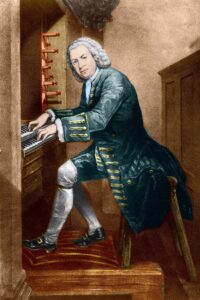
The annotations, edits, and markings made by musicians on some of Bach’s original manuscripts were what stood out to me the most during our first visit to the Bach archive . It was fascinating to see how Bach’s performance ideas shifted and evolved throughout the course of his life as his works were performed, and how some of his ideas were recycled in different pieces or edited to fit a different piece’s requirements. I felt incredibly privileged by the opportunity to see some of the original scores (penned by his copyists) and the account books that included his signature.  I also enjoyed our later visit to the Bach VR exhibit, which highlighted an increase in accessibility beyond the scholarly realm to Bach’s life and works – I found his use of the snuff box amusing, his anecdotes about his childhood and life entertaining, but was a little unsettled by the idea that Bach was supposed to be talking to me…

Of particular interest to me during our primary visit was the cartoonish satire doodle in one of the choristers’ chorale books:

First, I think this scribble humanizes Bach’s choristers. It is easy to forget, as we discussed repeatedly during our time in Leipzig, that those we consider ‘greats’ were human too, and faced the same human interactions and emotions that we have today. It also uncovers a rare moment of humor, reminding me of the long history of political satire. Clearly, the rehearsals and work of the Thomanerchor cannot always have been as serious as I imagine them – was the chorister bored? Or perhaps sneaky? Or did he take the book back to his lodgings with him? It is fun to imagine the possibilities about how this image came about.

The doodle itself is indicative of a mindset of ridicule toward the Leipzig guards who paroled the city walls, hinting at an attitude of mockery on the part of the chorister in question. Perhaps this chorister thought that the guards were useless – after all, they are depicted as rats – or otherwise invasive and unnecessary. The rats look almost unable to use their large weapons, which stand much taller than them, suggesting that they are unable to do their jobs. Moreover, their heads are pointed upwards, making them look oblivious of their real responsibilities. All this indicates to me an attitude of mockery, distrust, and ridicule of the military presence in Leipzig from the chorister — perhaps he considered Leipzig’s defenses insufficient, or perhaps this is a criticism of the necessity of guards (is the music contained in the chorale book perhaps the antithesis to the militance or inefficiency of the guards in Leipzig?)… What can we take away more broadly from this image beyond the chorister’s own musings?

Peter Wollny noted that as of yet they had not been able to decipher the text around the doodle, and at that point in the course, my German was not good enough to attempt to figure it out myself. It would be fascinating to me to further uncover what was meant by this cartoon with the words that surround it!
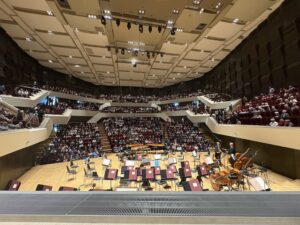
Bach – Honegger – Brahms, Gewandhaus Concert

Last Friday, we were treated by InterDaF to a concert at the Gewandhaus. This was my first time inside of the venue and I quite liked the design. Even better, my seat was in the front row behind the orchestra which ended up providing a very unique concert experience.

The first piece was a Bach concerto for harpsichords played on three grand pianos with a reduced orchestra. This, I must admit, was a little bit jarring for me. After hearing Bach for the past week played on period instruments in strict historically-informed practice, I was at once caught off guard by the more modern sound. The orchestra played more or less without vibrato, and the pianists all played with crisp tone and minimal sustain pedal, and yet … I felt as if I was listening to a romantic concerto and by the end I was kind of underwhelmed. Bach is often so densely textured and, for me, if it doesn’t breathe it risks becoming incomprehensible. In a thick, homogeneously blended sound, I find it much harder to track the individual lines. This is to say that the music becomes reduced in my ear to really only its harmonic content. When the instruments’ sounds decay faster, it creates space in the music that allows me to hear each line entering, swelling, receding, exiting, etc. For me personally, modern pianos combined with modern string instruments don’t really offer that possibility, or at least didn’t in this concert. Nonetheless, the musicians and soloists played brilliantly of course and I did enjoy it very much, I suppose I’m just nitpicking.

The second piece, the Honegger, I enjoyed as well, perhaps more so as it went on. As I am somewhat new to appreciating 20th century music, I’m not sure I have anything further to say, except that I particularly liked the climax in the third movement when the trumpet soloist finally entered with the chorale line. The final piece, the Brahms 4, was definitely the highlight of the concert for me. It’s a symphony I am familiar with but not one that I know extremely well, which made it a joy to rediscover through this concert. The full orchestra was one of the best I’ve heard and the variety of dynamics and colors they were able to achieve was extraordinary. However, what made it a special experience for me was actually where I was sitting. I was so close that I could read off the timpanist and bassoonists’ scores as they were playing! Seeing the timpanist’s play up close, I was simply astounded by his level of precision. I was so close that I felt like I was almost in the orchestra, and I was able to see very clearly how the musicians near me were reacting to the conductor in real time. Personally, seeing visually how what I’m hearing is actually getting produced makes me so much more engrossed in the music.

Overall, these things made this a very memorable concert experience!

Bach Assimiliert III Review

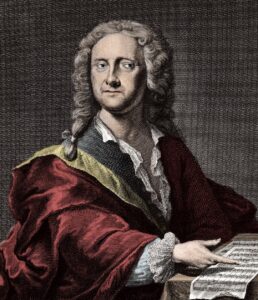
One of my favorite concerts during the Bachfest was “Bach Assimiliert III” in the Evangelisch Reformierte Kirche, featuring works not only by Bach but also by many of his contemporaries, including Telemann, Albinoni, Prince Johann Ernst, and Vivaldi. Most principally, I found this concert very enjoyable because it was a change of pace from the very harmonically dense sacred music I had been listening to for the past few weeks, and instead offered the much more relaxed music of the courts. I especially enjoyed the opening Telemann Suite TWV 55:Es4 as it gave me the exposure to French dances I had missed in the Cello Suite concert. Of the seven dances (+ ouverture and air) exhibited in the suite, I would have to say the two bourees were my favorite, as they were built on very similar motives but had completely contrasting characters. The bubbling of growing excitement from the first bouree melting away into the more subdued second, reflecting on its former before erupting again in the same jubilance, was, for me, a perfect exhibition of Telemann’s compositional class.
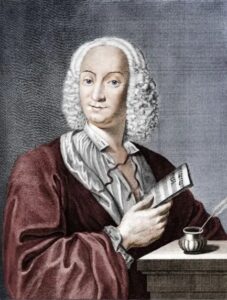
Another noteworthy piece of the program was the work by Prince Johann Ernst, who died at just 19 years old. I found, much like with a lot of Mendelssohn’s works, that you could hear the youthfulness in the music, but there was still a substantial degree of refinement in the composition. Aside from this, it was nice to hear a work from Albinoni and a concerto from Vivaldi’s L’estro armonico, which I would say is my favorite collection for Vivaldi’s violin concertos. Finally, I appreciated how, despite being played on modern instruments and bows, the performers did observe the music from a historically informed view, using vibrato sparingly and adding ornamentation when appropriate.
Overall, I found it very illuminating to hear works from a wide range of composers in the same time period alongside Bach to listen to the similarities and differences highlighted by each composer in comparison. It was a great reminder that Bach was not alone in the “island of compositional might” that some of us put him in, but rather, he was also inspired by many of his contemporaries and sought to replicate their success in his own music.

No 106 Reflections Review

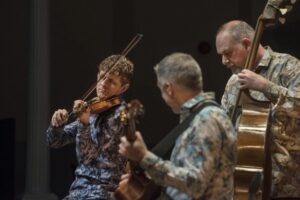
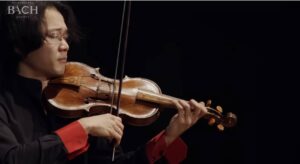
On the same night as the Cello Suites concert, I instead went to the Leipzig Zoo for Concert No. 26 “Reflections” with the Tim Kliphuis Trio and Shunske Sato, the former concertmaster and artistic director of the Netherlands Bach Society. I have been in love with Sato’s playing ever since I began listening to historically informed performances of Bach, so I couldn’t miss this opportunity to witness him play in person, even if the Cello Suites concert did present as a very tempting alternative.
Nevertheless, after a brief tour of the Zoo and dinner, the concert was a very big change from the music I had been hearing for the past week. I don’t really know what I was expecting, buying a ticket to an open-air concert in the Zoo featuring modern arrangements of Bach, but it was definitely a pleasant surprise. The concert began with a jazz arrangement of the 3rd Brandenburg Concerto, with supposed inspirations taken from all the other Brandenburg Concertos as well (though I was not able to hear any). It did make me realize, however, how unfamiliar I am with each concerto and how much I rely on hearing the instrumentation to identify which one I am listening to. I also found it interesting that, despite playing on an instrument from the 1800s (I overheard Sato talking about his instrument with a colleague I suspect is from the Netherlands Bach Society) and using a modern bow, his technique remains very baroque. His bow hold and the way he supports his instrument all stayed consistent with how he played on early instruments, and it also sounded in his playing, even in a jazz context.
Overall, I found the concert to be a very well-constructed take on Bach and other composers in a “Transformed” way, including an arrangement of Pachelbel’s canon, Handel’s “Arrival of the Queen of Sheba”, and, unsuspectingly, Copland’s Rodeo Hoedown that I found very cheesy but also well-made. My favorite part of the concert was, without question, the encore, where Sato played a selection of Bach solo violin repertoire, and the Kliphuis Trio played an arrangement of Strauss’s “Morgen.”

Germany’s Churches

“It feels so weird to clap in a Church,” I whispered to Ruth as we stood clapping for the singers who had just finished performing the “Art of Dying” cantatas. It was a new, strange, and somewhat jarring feeling for me, having grown up playing violin for a Church choir, taught to never clap or expect applause with Church music, to give standing ovations to orchestral performers and singers in both the Nikolaikirche and Thomaskirche.


Throughout this course, I was prompted to reflect on the fascinating multifaceted roles of European Churches.


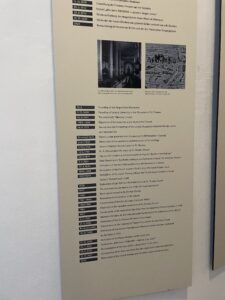
First, the sites of the Churches we visited are extremely historically significant, which immensely enhanced my visits and appreciation for our concert venues. It is amazing that the Thomaskirche, for example, was visited and even frequented by figures the likes of Luther, Bach, Mozart, and Wagner. And the Nikolaikirche was renowned philosopher Leibniz’s birthplace! More recently, the Nikolaikirche was the site of the “Monday Demonstrations” that were part of the 1989 ‘Peaceful Revolution,’ mobilizing 70,000 people to walk the streets of Leipzig on the GDR’s fortieth anniversary in one of the most significant political uprisings preceding the fall of the Soviet Union. All this to say — it is incredible how much you learn and retain from a few Church panels (and a visit to the Zeitgeschichteliches Forum) – and incredible to be able to listen to concerts in these historically significant buildings!


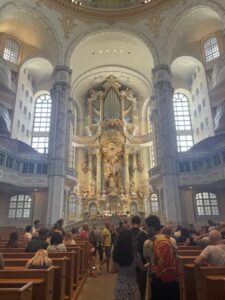
Next, the Churches stand as symbols of riveting debate around religion, secularism, and pluralism. For instance, in the thirteenth century, the site where the Thomaskirche now stands was home to an Augustinian Monastery. That the Thomaskirche went from Catholic to Lutheran in a matter of a few centuries is fascinating — it was also cool to really be able to appreciate the importance of the religious reformation which was taught repeatedly during my high school years (also, shoutout to the Stadtgeschichtliches Museum). It made me think about how important it is to consider religious pluralism and inclusion on a larger historical scale. On a similar note, I was fascinated to learn upon my visit to the Frauenkirche in Weimar that the Church was only fully rebuilt in 2004, almost fifteen years after the fall of the Berlin Wall. Even though the Thomaskirche and the Nikolaikirche were kept in shape during the GDR years (perhaps to attract Western tourism), the Frauenkirche, facing the same fate as many religious institutions under the rule of the USSR, was left in ruins. It was not rebuilt until the eventual reunification of Germany. Even then, it had to encourage a huge fundraising campaign in order to raise sufficient funds. Its basement space included an exhibition, some ruins, and a space to reflect on the role of religious spaces in the modern age. 


Finally, I found it interesting to think more about the ethics of tourism in Churches. Is it appropriate to charge people to visit religious spaces? What are the ethics of performing concerts in Churches, out of their intended religious context? What role should tourism play in these spaces?


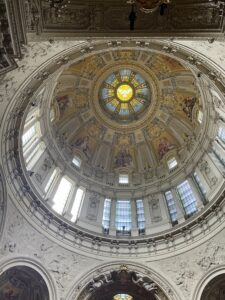
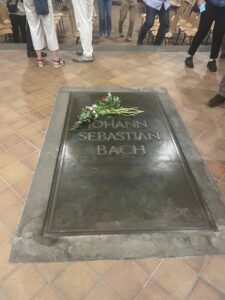
Below: Thomaskirche History, Berlin Cathedral Dome, Frauenkirche Interior, Bach’s grave


Newer posts »

The McGraw Center for Teaching and Learning
328 Frist Campus Center, Princeton University, Princeton, NJ 08544
PH: 609-258-2575 | FX: 609-258-1433
mcgrawdll@princeton.edu

A unit of the Office of the Dean of the College

© Copyright 2026 The Trustees of Princeton University

Accessiblity | Privacy notice