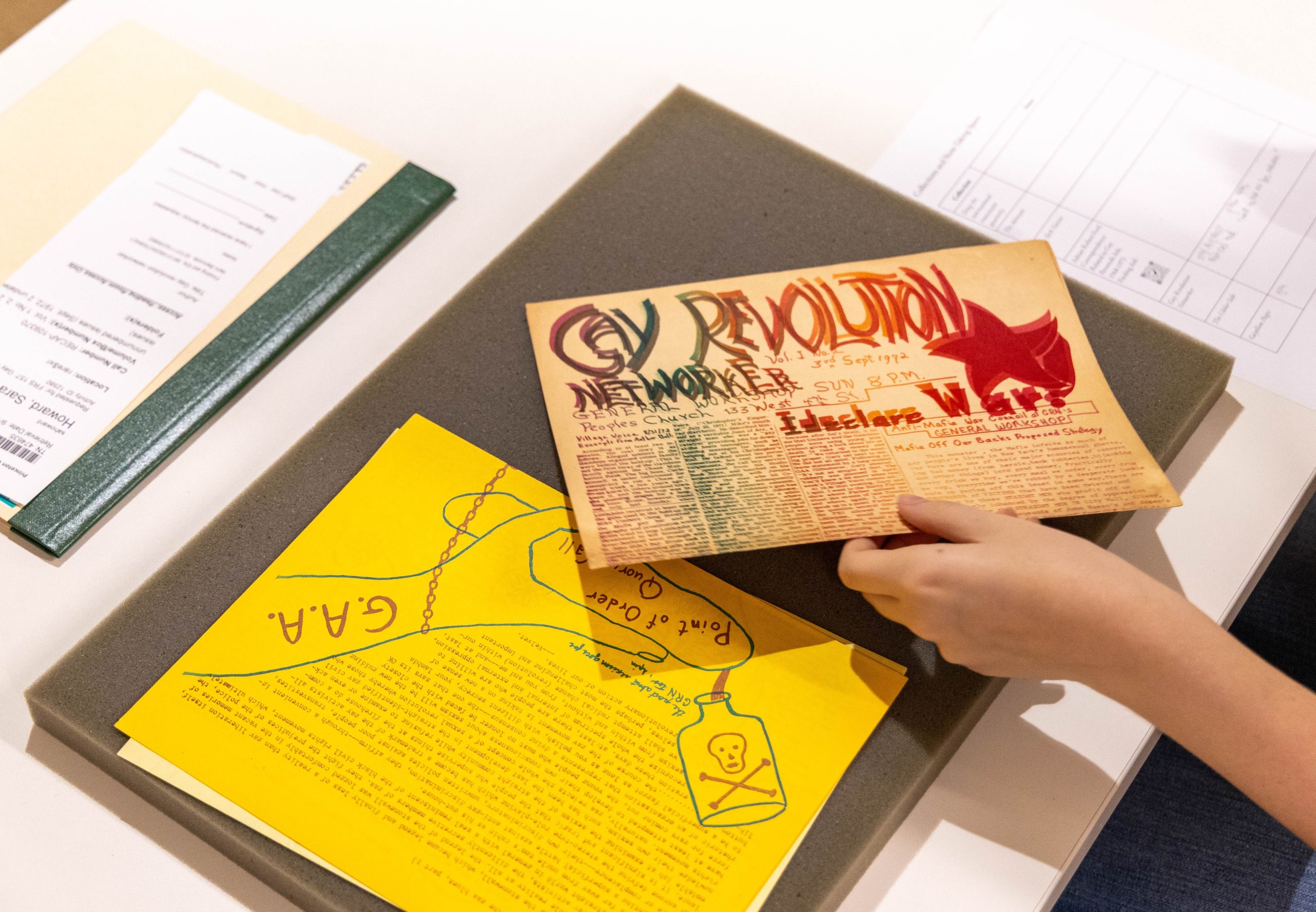
Sources
To build our dataset of addresses, we mined four different publications: Drag, New York Native, The Networker, and Gayellow Pages.
The majority of our entries came from The New York Native.
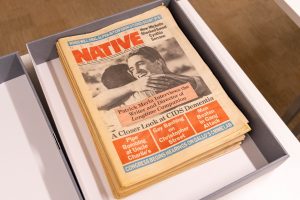
Photo Credit: Brandon Johnson
The New York Native was a gay biweekly newspaper, published with New Magazine, Inc. (Ortleb) from December 1980 to January 13, 1997, covering a range of controversial topics relevant to gay culture and being (“New York Native Records”).The magazine was directed towards gay men and lesbians and acted as one of the most influential gay publications in America during its publishing years. The paper was known for its thorough news pieces and extensive cultural reporting of gay happenings and city life in New York City (“New York Native Records”). Furthermore, at the end of each issue of the New York Native, there is a page dedicated to the “Native Calendar” where the reader can find any events happening within the queer community of New York City (“New York Native nr. 2”). The paper was the only gay paper in New York City at the beginning of the AIDS epidemic and was the first to report on the disease, while most papers ignored the crisis in its entirety due to the political implications of writing about a “gay disease” (Ortleb). We primarily focused on the 1980s and 1990s, examining issues from 1987 and 1990.
We supplemented the 149 locations with 43 addresses from The Networker and 26 from the Gayellow Pages, and 15 addresses from Drag.
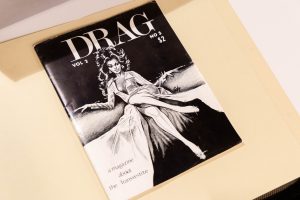
Photo Credit: Brandon Johnson
Drag was a foundational magazine, published by Lee’s Mardi Gras Enterprises, Inc., for people who identified as transfeminine in the 1970s. Each issue provided events in drag culture, community news, and the struggles faced by the drag community. Furthermore, the end of each edition documents flyers for upcoming events happening around New York City intended for members of the LGBTQIA+ community. In total, the Drag magazine contains 29 issues that were published between 1971 and 1983. Each magazine issue is a mixed-media piece – it contains articles, editorials, and photo spreads featuring drag queens.
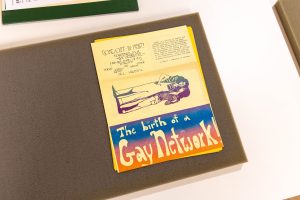
Photo Credit: Brandon Johnson
The Networker was a zine-style publication sourced from Come!Unity publication house, an anarchist-accommodating queer-oriented print house in operation from 1971 to the late ‘70’s. The Networker’s unapologetically political angle and intersectional goals come through in its expressive, form-defying zine entries and on-the-ground resource assemblage. What transphobic, moderate organizations at the forefront of the movement censured, the Networker featured; its pages hold addresses for bisexual dances, the Mental Patients Liberation Project, the gender-non-conforming Queen’s Liberation Front, and Sylvia Rivera and Marsha P. Johnson’s Street Transvestite Action Revolutionaries (STAR) shelter for unhoused gender-non-conforming youth.
The Gayellow Pages were a well-distributed directory of the late 1970s that was and is intended particularly to make available to LGBTQ+ persons access to businesses, services, and organizations that are at least non-discriminatory if not affirming. By the early 1990s, the publication had spread across the United States, including large urban and smaller city populations. Compared to mainstream yellow page directories, the Gayellow Pages filled a vital niche in a socio-political era before LGBTQ+ identities were accepted by mainstream culture, often acting as a community guide of the far-too-often marginalized queer social space. Gayellow Pages was not an advocacy pamphlet or newsmagazine, but a comprehensive business and organizational directory openly marketed to an LGBTQ+ consumer base. It listed an array of services from bars, health care providers, lawyers and counseling professionals, social organizations, bookstores, nightlife, travel agencies, etc., highlighting which were supportive of or LGBTQ+ owned.
Our timeline was more expansive with these supplemental publications. For Drag, we catalogued addresses from 1972-1977; for The Networker we examined 1972-74; and the Gayellow Pages brought us forward to 1992/93.
Method
Initially, we planned for each student to identify the first 25 addresses (including repeat addresses) in the issue they had selected. This included addresses mentioned in advertisements (though not personal ads) as well as those mentioned within the text of articles and PO Boxes.
We excluded addresses for spaces/meetings outside of New York City.
We had some challenging decisions when coding for type of space and type of event and worked to form consensus around decisions. For instance, when the address was a location that provided electrolysis services, we considered the place to be medical, rather than a business.
In the end, there were only 15 entries from the Drag magazines (rather than 25), as the current digitized magazines by Princeton’s library contain only 15 ads that are not personal ads. We chose to exclude personal ads in Drag to maintain consistency with the methodology of the students parsing the other publications, even though it did not allow us to have 25 entries from Drag. And, since The Networker had a shorter run, it was possible for us to code all the addresses in that publication, exceeding the initial goal of 25.
