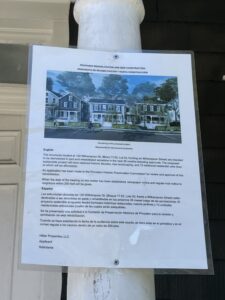
On Witherspoon Street, just blocks from the looming FitzRandolph gates that mark the entrance to Princeton University, notices hang on three dozen homes announcing their proposed demolition. The plan centers on the Witherspoon-Jackson neighborhood, historically Black and now predominantly the home to Latin American immigrants, and reflects a contentious debate on affordable housing development that has consumed Princeton for decades.
“In the beginning, nobody from those houses were aware of that it was happening,” said Veronica Olivares-Weber, a former member of Princeton’s Health and Human Services Commission and a leader in the town’s migrant community.
The units that will be torn down are “not safe, stable, secure housing,” said Tom Pinneo, board chair of Housing Initiatives of Princeton and head of Pinneo Construction. Many of the homes, Olivares-Weber said, lack heating and basic services.
“They need to be changed to make sure that they’re in better condition,” she said, “but I want to see people from the old town making sure the families who are currently living there are going to have a plan.”
As Olivares-Weber understands it, Hillier Properties’ plan is to tear down 36 houses. Seventy-four new units will be built in their place. 15 will be designated as affordable.
Demolition notices put up months ago point to 13 additional constructions, 4 being affordable. Without a formalized plan, Witherspoon residents are confused about what will happen to their homes, Olivares-Weber said. Hillier Properties did not respond to interview requests.
Whatever the precise numbers, with only a percentage of the new constructions designated as affordable, most of the current residents will not be able to stay on Witherspoon. “The math doesn’t add,” she says.
Given the neighborhood’s history of displacement, Olivares-Weber fears how the demolitions could affect Witherspoon families, “they’re families that don’t have full time jobs; they work in restaurants, they receive low salaries, they don’t have income to put aside and say, ‘Oh, I’m going to go to another house.’”
Hillier Properties’ plans to prioritize current residents for smaller units behind the proposed renovated ones; pay relocation costs for the families; and help with their rent, said Matt Mlezco, the founder of affordable housing advocacy group Princeton Grows. This “would be such a great example of what smart equitable housing policy looks like,” he said. “Of course, my understanding is none of those plans are formalized yet.”
Olivares-Weber isn’t confident in this support. “They say they have a plan but haven’t put anything in writing,” she said. She described a lack of Spanish outreach and translators at community meetings, as well as a generally cold reception at the planning meeting they attended. “The feeling was that they were not very welcome in the meeting,” she said.
And even were financial support to be offered, Olivares-Weber fears displacement of families that have lived here for many years.
“Relocation means not only in Princeton. ‘Relocate’ can be in the towns that are close to Princeton,” she said. “These families, they don’t have a car, right? They’re walking to their work. They’re walking to their schools. If you’re being relocated to another town, you cannot go to the Princeton schools where your friends are.”
Tom Pinneo thinks that Princeton undervalues the economic impact immigrant displacement would have. “What if the workforce went on strike for a day or a week?” He said, “I think there would be like much more, holy cow, we really depend on these people.”
Olivares-Weber hopes for more concrete plans so that families can plan for the future. “Some people are scared. Some people don’t know what to expect. Some people are hopeful that they’re going to help them. And some people will look for places to go because they know it’s going to happen, but we don’t know when.”
Local affordable housing advocates point to an overall lack of affordable housing as the root of displacement worries on Witherspoon. “It’s easy to look really narrowly at any one development or any one redevelopment project and think about a lot of the short-term implications,” said Matt Mlezco, “but to understand how we got here, you have to understand the backdrop of decades of not doing enough to build and provide affordable housing puts a lot of pressure on housing now.”
Mlezco explained that, “part of the reason why so much attention gets focused on the Witherspoon-Jackson neighborhood is it’s one of the very few places in town where you can actually build apartments or anything that isn’t a single family detached house.” Were there affordable housing in other parts of town, a family leaving their home wouldn’t mean leaving Princeton, he said.
In its infancy, Princeton had two parts: a township wrapped around the borough, explains Justin Lesko, the Planning Director of Princeton’s Planning Board. The suburban zoning codes of the township and the more urban codes of the borough are still in place, he said. Therefore while the side of Witherspoon closer to campus is zoned for multi-family homes, farther from the university, only single family homes can be built.
Although the Mount Laurel doctrine of 1975 requires all New Jersey towns to provide their “fair share” of affordable housing, this was not enforced until 2015 when “the state judiciary finally stepped in and said, okay, enough’s enough,” Mlezco said.
Historic Preservation – a designation meant to protect historically significant houses – is often used as a tool to block the construction of affordable housing, says Tom Pinneo, who has won three Historic Preservation awards.
“Affordable housing overlays” in parts of Princeton can be used to build multi-family housing in areas zoned from single family homes, but the process is much more bureaucratic, Pinneo says. A house is “historic if you want to build affordable housing, it’s not historic if you just want to build another single family home”
With a “profound lack of affordable housing,” Mlezco said, a false binary choice of undignified housing or forced displacement has been normalized, but “it doesn’t have to be that way.”
