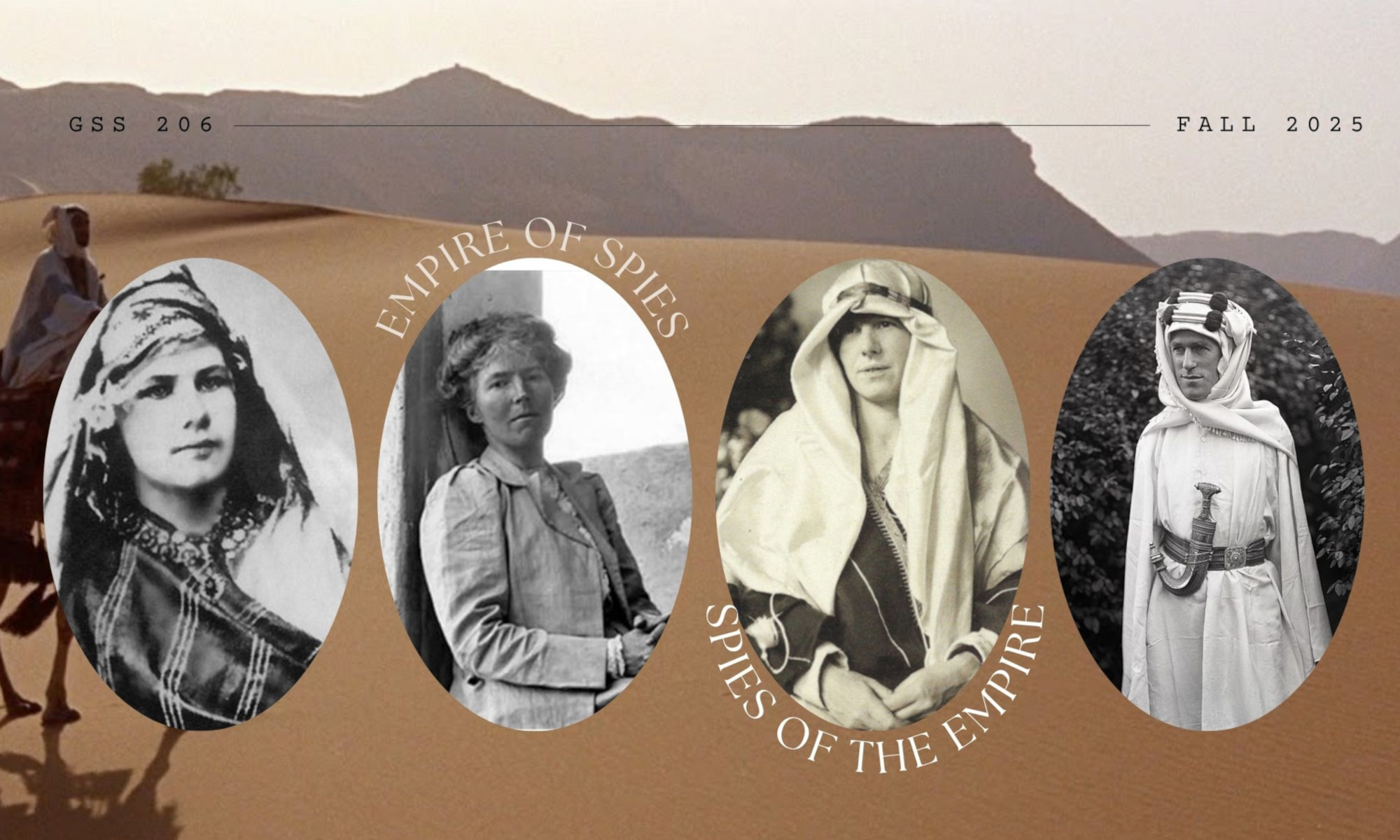
There’s a peculiar paradox that stood out to me in our discussion of T.E. Lawrence compared to his female contemporaries in colonial exploration such as Gertrude Bell, Freya Stark, Isabelle Eberhardt. Lawrence seemed most opportunistically positioned, the spy in the right place at the right time, and yet our discussions of him always required going back to the myth of Lawrence. While the women in our texts are frequently discussed not as cultural figures but personal ones (i.e. the forewords to their letters), Lawrence has been calcified into a central figure of the long-lost “Orient,” and as such cannot be discussed outside of this myth. More accurately, if one seeks to discuss the “real” Lawrence, you must first navigate the myth of Lawrence—which is likely to leave you with more questions than answers, after all. It is important to understand that this is a buy-in Lawrence makes to some extent in his lifetime. This narrativization was not a choice made posthumously by stuffy Oxfordites, but rather one he consciously played into on some levels, and was haunted by on others. The result? Lawrence of Arabia: the unified hero, the sovereign self, and ultimately the kind of man who traded in certainties of the imperial hours. The imperial narrative required him to be more than human, and in doing so, made him less.
This is where the critical work on masculine autobiography becomes urgent, particularly Leigh Gilmore’s observation about how men are framed as “autonomous individuals with inflexible ego boundaries who write autobiographies that place the self at the center of the drama.” This framework isn’t just embedded throughout our depictions of male self-reflexivity. It’s also essential to colonial narratives that desperately need for self-maintenance. In essence, empires require their male heroes to be monuments, not men (especially if in the vein of Greco-Roman tradition). It required them to embody unified selfhood because fragmentation, doubt, and relationality would undermine the justification for colonial authority.
But as Marling notes, this “inflexibility of male ego boundaries” is a cultural ideal, not a cultural reality. The obliterative force of imperial narrativization reduces Lawrence to this ideal rather than allowing him to exist as he actually wrote himself: fragmented, anxious, and ambivalent about his role in the Arab Revolt. The Seven Pillars of Wisdom is not the confident autobiography of a unified colonial subject, regardless of its publisher’s intent; it’s far more nuanced. While Lawrence (or maybe even his publishers) attempt to dress the book in the garb of imperial wisdom, the images of violence he can’t help but return to (such as the torture of a prisoner) haunt him. Like all our other spies, Lawrence is implicitly responsible for furthering the European colonial project. But he, perhaps, is something even more tortured: an imperial figurehead. Thus, the imperial project couldn’t afford readings of The Seven Pillars that account for the nuances in Lawrence’s thought. In 1922, exhausted and disappointed by the outcome of the Arab revolt, his friends encouraged him to write an abridged version of The Seven Pillars to secure income. What was left out of this subscriber’s edition was a foreword in which Lawrence discussed his heartfelt shame in the Arab Revolt’s betrayal by colonial powers and his own contentions with his complicity. The fact that so few copies of this chapter remain in existence that the last one was auctioned for £65,000, exactly a 100 years after its publication says much about the crafting of Lawrence’s literary persona. Namely, that (in the West, at least) it needed Lawrence the myth more than it needed Lawrence the person.
Women in colonial spaces are implicitly condemned to subversion: they can be eccentric, complex, even contradictory, because they aren’t carrying the symbolic weight of the empire itself, unless representing its virtue or fragility. They are exceptions to the rule, which expects female subordination to the maintenance of the colonial empire at home or on the settlement via childcare, housekeeping, etc. but never intellectual and physical participation. No easy mythological narrative can be bound together from these contradictory shards of their lives. But Lawrence was not subject to these stereotypes to such a degree, and thus his identity had an ability to be rendered “coherent” even if through false pretenses. He had to be the hero. His narrative had to be one of mastery and certainty because the alternative—a British officer colonized by doubt, unable to maintain the boundaries of his own selfhood, victimized by sexual violence yet reenacting it in order to somehow shed himself of guilt as the assaulted and as the colonizer—would have been a dangerous admission that the men running the empire were as fragmented and uncertain as everyone else.
To read Lawrence with attention to fragmentation and ambivalence is to resist that obliteration. It’s to recognize that the myth of unified masculine selfhood was always a lie that served the empire’s purposes, not a truth about how men actually experienced their lives or wrote their stories. If one seeks to discuss the “real” Lawrence, you must first navigate the myth of Lawrence. But is it a greater boon or tragedy that Bell, Stark, and Eberhardt were never afforded myths in the first place? They were allowed complexity by default because they were never expected to be heroes. Lawrence’s fate, and the fate of masculine figures within the project of imperial mythmaking more broadly, is simple: to be chosen as a hero means losing the right to be understood on human terms. It’s a trade-off, as unsettling as it is to make.
Okay, now that that’s done: mandatory viewing material…Lawrence/Ali edit to Olivia Rodrigo…do you guys feel the love!!!!!!