Isabelle Eberhardt vs. Dendrology

In my First-Year Seminar ‘The Memory of Trees: Analyzing Climate History Through Dendrology’ we often discuss authors’ motivations when writing their work. For the past couple weeks, motivation for both Isabelle Eberhardt and those writing about her has also been a topic of discussion. Even though the content of the two classes differs, one about trees and the other about a woman in the early 1900s, motivation drives the readings that we use in both. Why authors wrote what they wrote, what their internal motivations were, and what they hoped to portray to their audience are questions asked in both classes. 

For a lot of the texts we read in my First-Year seminar, the motivation is very obvious, the author wants to share their findings for their study and explain why they are important for society as a whole. They are consistently trying to convince their audiences that they are bringing new important knowledge to scientific conversations. When looking at the introductions written in both The Passionate Nomad by Rana Kabbani and Writings in the Sand, Vol. 1 by Marie-Odile Delacour and Jean-René Huleu their portrayals of Eberhardt differ quite dramatically. In Writings in the Sand, the authors characterize her as this tragically romantic figure who was the “first” person to give a true depiction of the “East” (when in reality people had been writing about the region for a long time). They use repetitive exaggerated language to describe her life’s journey, calling her upbringing ‘turbulent’, ‘tragic’, and ‘tormented’. They clearly paint her as a victim and therefore excuse many of her choices she makes once she reaches Northern Africa. It is clear that both authors are in awe of Isabelle Eberhardt and want their readers to be in awe as well. Rana Kabbani takes a different approach in her introduction to The Passionate Nomad. She portrays Eberhardt in a much more realistic light without the hyperbolic language. Kabbani is very clearly not in awe of Eberhardt, writing that she was “painfully thin, flat-chested, with decayed teeth, an abundance of bodily hair, and no periods”. She also doesn’t excuse Eberhardt’s actions, saying that she had “lost all sense of reality and self respect”. Kabbani is not trying to depict Eberhardt as a tragic, romantic figure. She doesn’t even try to put her in a positive light. She realistically portrays Eberhardt as the drunken, high, vagabond she was. 

Eberhardt’s motivations behind her writings, journey, and relationships are much more unclear. What were her intentions when she was passing information to Lyautey? Was she trying to protect the Algerian Arabs or did she want to feel like she belonged to the French? The struggle with Eberhardt is that deep down, she wanted to belong somewhere. She grew up in a household with a father who didn’t claim her as his daughter and an exiled mother. She moved to North Africa to find solace in the Sufi male society. Yet, she claimed to want to be completely alone and did not settle roots down with any specific group. She hated the French but she married her husband to become a French citizen (though those motivations were more centered around wanting to get back to Algeria). She wanted to be a nomad while purposely trying to destroy the nomad populations in Algeria by relaying information to the French. Part of what makes Isabelle Eberhardt the mysterious figure that draws many to obsession is the fact that no one truly knows what drove her to make the decisions she did. The ambiguity in her motivations fascinates her audience, it is what draws people to her a century after her death. 

Motivation is important in both scientific and biographical writing. In both of these classes, we need to analyze the reasons why writers write what they write (whether the topic is analyzing tree rings or a woman exploring Algeria in her 20s). It allows the reader to gain a deeper understanding of the author’s intentions and of the texts themselves.
Birds and Freedom – Isabelle Eberhardt

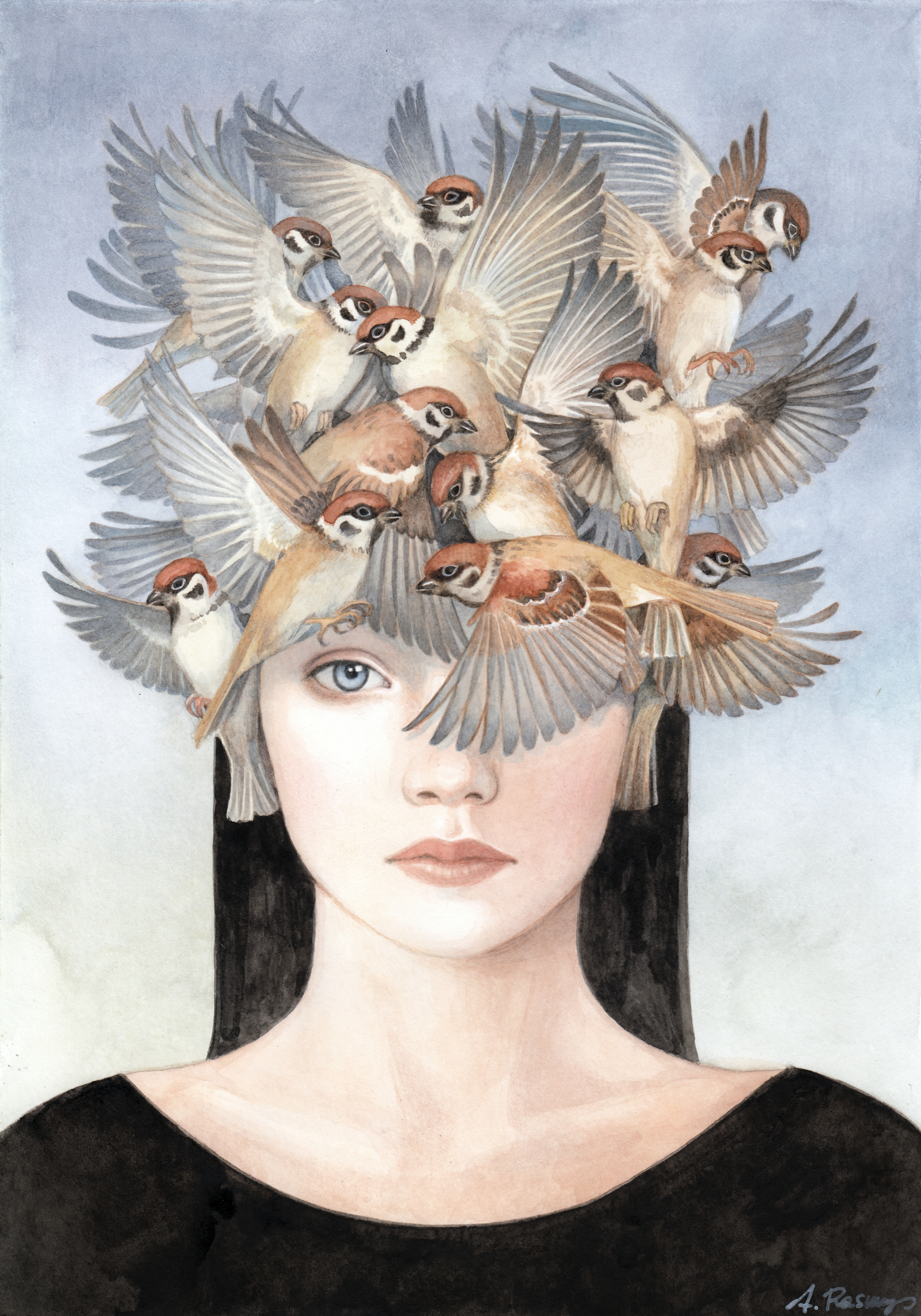
Nostalgia for Freedom I - Every Day OriginalNostalgia for Freedom I by Angelika Rasmus

Nostalgia, wanderlust, sadness, longing… obsession, encapsulation, fracture

“Nostalgia for a place for which I have no name” – Isabelle Eberhardt

This painting by Angelika Rasmus encapsulates the beauty and curse of Isabelle Eberhardt’s flight to Algeria through the unit’s readings on her and her adventures.

Writings from the Sand, Vol 1. An emerging theme was Eberhardt’s fragmentary and impressionistic prose, constantly shifting and exposing her fragmented state of mind. In the painting, the sparrows invoke a fleeting, ungraspable state, circling her consciousness as she juggles her “loyalty” to Algeria, to her Sufi brotherhood, to the French and Layuatey. No single narrative, very known to be a woman despite male-presenting.

Daily Journals, a recurring theme of where, when, what is my (Isabelle’s) inner peace. The tension and turbulence of her circumstances and the situation she puts herself in through her physical dilemma festering from her relations with others, her addiction to keif, her sense of identity and allegiance.  The calm face in the painting suggests her journalistic state, controlled, obedient, however detached from the fractionally expressed thoughts. The woman’s face mirrors the way her journals juxtaposes her self-expression and reflection of constant upheaval in her life through her family life to the conditions she lived in Algeria.

Passionate Nomad (Introduction) “She was a vagabond, a wanderer, not only because of frenzied boredom and innate restlessness, but because she had no real roots anywhere, and therefore belonged nowhere.” Like a bird, with no place to truly call home, constantly in flight, migrating to a place that may seem like a temporary home, but even then not exactly. Eberhardt is a paradox amongst a multitude of things: European-born yet Arabized at least in her “learning” of Islam and the Sufi brotherhood, a woman inhabiting male roles, and a romantic wanderer yet wickedly realist of her own experiences in colonial Algeria. In the painting, there is a sense of lulling calmness, chaos above, individuality of the lady yet multiplicity of the sparrows, and a sense of clarity vs obscurity. There is no stable interpretation of Eberhardt, as can be seen through her readings, her work, her writings.

Eberhardt can not be understood as a simple vagabond or a nomad, she is an anomaly, she is a flock of fractured selves pieced and held together by one strip of sanity in which for her would be the predestined fate that Islam decrees.  Her desires to locate a sense of feminism and being a westerner going into “exotic” lands and do “adventurous” things parallels a life of the sparrow (bird). The obscured eye within the painting suggests a partial blindness, and often noted by many, her using what she could understand to fuel her decisions to the best of her abilities as she grew up with a multifaceted sense of education. The way Eberhardt lives is in constant search for something, whether that be feminism, freedom, escape, a search for meaning, perhaps even a place to call her roots. 

I can’t help but also interpret the multitude of birds in conjunction to the symbolism of birds signifying not only freedom, but depending on the bird, sometimes death, allusion to danger, destruction. Sparrows, in particular, can portray a persistent and obsessive quality. To which Eberhardt was most if not all at certain points of her life in Algeria, especially in the way she was obsessed with Algerian culture and was trusted into the Qadiriyya, and thus not only using Islam as her one string of sanity, but also compelling her mother to also convert (obsession becoming contagious). Her obsession with the male-perspective of Islam allowed her justification to a lot of her decisions, despite her fracturing mental and physical health. Liberation but imprisonment within her own self.

Inventing Her Origins

“The story of her birth is a novel in itself … Did she know who her father was? Did she invent one while disowning her parent? … A mystery never cleared up” (xvi from Introduction)

I couldn’t help but think about the variations of stories Isabelle told about her father. I believe Eberhardt deliberately crafted conflicting accounts about her father as a strategy of reinvention. These contradictions were not simply “personal confusion,” rather they became a tool she used to manipulate perception, gain trust, and adapt to different audiences. I think by revising her origin story again and again, she controlled her narrative, positioning herself to navigate new spaces and extract what she needed from others.

The mechanism here, I think, was subtle but powerful. By presenting one version of her father as noble or intellectual, she could invite admiration and open the door for others to share details about their own family backgrounds or cultural pride. By telling another story where her father was absent, illegitimate, or mysterious, she could evoke pity or curiosity, emotions that often lead people to reveal more about themselves in an effort to comfort or advise. Each story about her origins worked like bait: it caught people off guard just enough to open them up and draw them into conversation. In these moments of sympathy or intrigue, people likely gave up information they would not have shared in a straightforward exchange. The more uncertain they were about who she really was, the more they filled the gaps with their own disclosures. In that way, her stories didn’t just hide her, they actively pulled information from others.

This is part of what led me to a broader conclusion about Eberhardt: she was clearly a spy. She didn’t randomly decide to go to Algeria as a nomad; she was sent there with a purpose. While she may have developed genuine attachments to Islam and to Arabs along the way, these feelings do not erase her collaboration with the French government near the end of her life. In fact, her shifting emotions such as doubt, love, hatred, belonging, etc. fit the profile of someone working under cover. Her calculated and constant reinvention as well as her extreme efforts to gain trust all align more with her being a spy. If she were truly only a vagabond, she would not have needed to so carefully craft her identity or perform these elaborate acts of belonging.

That “unresolved mystery” and the way she weaponized narrative itself as both a mask and a weapon really sticks with me. She wasn’t just hiding the truth of her origins, she was performing, shifting her story to keep people off balance and stay in control. And it’s wild how much people have become obsessed with that. They romanticize her because she never let herself be pinned down, because she lived in that blur between truth and invention. At this point, “the myth” of Isabelle Eberhardt almost feels bigger than the woman herself and that’s exactly what she set up by turning her life into a story others couldn’t stop chasing.

-Givarra Azhar Abdullah

Isabelle Eberheardt + “Slouching Towards Bethelehem”

I found myself regarding Isabelle Eberheardt in a very critical light, one that reminded me of how Joan Didion regards the young hippies of Haight-Ashbury in the 1970s. To me, the most refreshing text on Eberheardt was the introduction to Passionate Nomad, which highlights Eberheardt’s carelessness and essential uselessness in Algeria, to herself, and to those around her. This take on Eberheardt was similar to Didion’s disdainful, unimpressed portrait of hippies in the titular essay of her collection Slouching Towards Bethelehem

The Passionate Nomad introduction paints Eberheardt as beyond her time in that she was more akin to a 1960s hippie orientalist than a real colonialist. It refers to her as a symbol of the moral decay of Western Europe going into the twentieth century, especially of moral decay in European colonies, just as Didion paints the hippies as symbolic of wider moral decay within the American empire in the 60s and 70s before the rigid, fascistic Reaganism of the 80s. Her exploits in Algeria remind me of the Beatles in India, the hippies doing ayahuasca, or people going to “find themselves” backpacking in Southeast Asia—orientalists who like the aesthetics of transgression and the freedom they can claim as “vagabonds” and “outcasts” without any of the responsibilities of real revolutionary action. 

They were young teenagers who ran away from the constrictions of the nuclear family to find Haight-Ashbury a gateway to sex, drugs, and intertia, just as a young Eberheardt fled the constrictions of Geneva society to find Algeria a gateway to similar forces of decay. Neither group showed real interest in political action, despite a fascination with and empathy for local causes (for Eberheardt, Algerians, and for the hippies, often indigenous Americans, or Vietnam). They simply sought their own pleasure, often through exploitative means, and kept going until they ran out of funds. 

To me, these similarities point to broader parallels between the European political mood of Eberheardt’s era and the American political mood of the 1960s-early 70s. What might such parallels tell us about patterns of imperial growth and responding backlash? What about the nature of an imperial culture might, at its moment of internal decay, lead young people to attempt to abandon their privilege—yet fail to fully reject the culture that made and privileged them?

Prompts for Blogposts

Prompts for Blogposts: Empire of Spies


(Adapted from Anna Kornbluh, Northwestern U)


CONNECTIONS to pursue in your Blogposts:

one -two pages of casual writing (min 300, max 600 words) responding to one of the following prompts (a different one of your choice for each unit)


The goal of the reflections is to have ideas; the writing need not be fully polished


  • Describe something you learned from class discussions in this unit that you didn’t know just from doing the assigned readings.


  • Connect something you learned in class through readings/discussions in the unit you are writing about, to something you are learning in another of your classes this semester.


  • Compare assigned readings from two different texts by same author we read/discussed in a unit, or between two authors from two different units; make connections between the two.  Do they share themes?  Forms?  Tone?  Historical context?  Do you find them equally interesting?


  • Look back at the very first paragraph of a text we read by one of the writers under discussion, and discuss how the opening lays the groundwork for the rest of the work/other writings by same author.  Quote specific lines, phrases, or images to back up your claims.


  • What are some sentences you found interesting in this unit’s readings?  What made you notice these?  What do you notice in the passages/sections from to which these sentences belong?


  • Using quotes from this unit’s texts, persuade someone (friend or foe, your grandma or your senator) to change their mind about something important.


  • Compose a five song playlist to accompany an assigned reading from this unit, and write a few sentences for each song, explaining your choices and their connection to the reading/s.


  • Describe an idea you had in response to the readings/discussions for our class – any idea, about literature, the writer/s under discussion, or the world, or yourself.  How might you pursue this idea, in your studies or elsewhere?  Could this idea be a new direction in life? How might it become the basis for a new public policy or public mindset?


  • Choose a passage (no more than 10 lines) from one of the readings this unit and rewrite it, changing at least one of the literary aspects such as: person (change from first to third-person or vice versa), tense (change from past to present etc), focalizing character (i.e. write it from a different character’s perspective), style (adjectives, diction, description, tone). Then write a paragraph or two about the effect of your changes (on you, possibly on other readers).


  • Compose a yelp review to strangers, or a letter to a specific person, or a tiktok style video, recommending a text (film/video/short story/travelogue from this unit’s reading.


  • Find an image – a painting, a photograph, a graphic drawing – something that already exists because a human made it – that would make a good illustration for this unit’s readings.  Explain why you think that.


  • If you could assign this unit’s reading to anyone – your professor of another class, your lover, your boss, aliens from another planet, the president of another country – who would it be and how would they benefit from it? (you don’t have to discuss all of the assignments—pick and choose!)


  • You go on vacation with one character from a text on our syllabus (could be one of our “spies”! Or someone they write about or film representation of them).  Who is the character, what do you two have in common (or how do you differ), where do you travel, is it enjoyable?  Refer to the text (s) you choose for evidence in explaining your trip.


  • Is there an idea or image or line from our readings that has stuck with you for more than the week or unit when it was discussed?  What are you continuing to think about it?  Why do you think it has had this effect?


  • Final Connection Blog Entry: (extra credit)


Read over your entire portfolio of blogposts and describe the progress you have made in thinking and writing about the material assigned in the class.  If you opted to co-write 2 or more reflections, be sure to consider that process too.  What are some of your favorite ideas you’ve had in this class?  What would you like to know more about?


Hello world!

Hello Students of Spies of Empire!

Lets have some fun interrogating the machinery of Empire as it reveals itself through the shenanigans of some of its more famous–or infamous!—writer-spies-archeologists-travelers: spies one and all!

We will think about what “spying” means” and whose interests it serves–and ask when it can be a force for good or evil, control or being controlled.

More to follow….for now, welcome to the course!