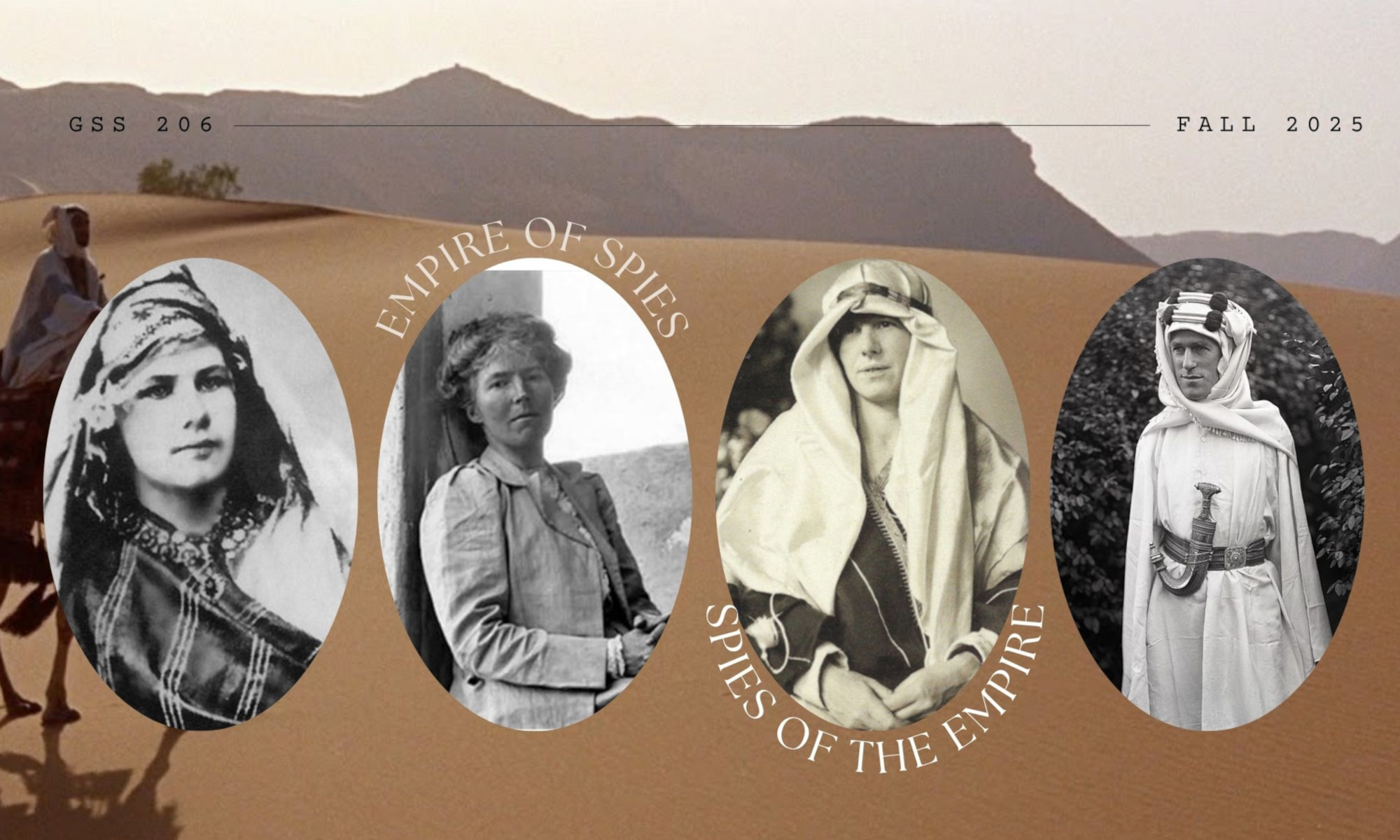
An idea or concept that has stuck with me since it was mentioned was the way T. E. Lawrence describes his own self-punishment and self-erasure in Seven Pillars of Wisdom. The idea that Lawrence took it upon himself to punish himself for his account of assault in Dera. I keep thinking about it because it makes me think about our other spies and how despite how difficult times got, they pushed themselves to be this figure, to become someone that sheds their past life similar to how a snake sheds its skin. Other spies embrace the danger and adventure as a second skin. Lawrence’s, in specific, self-discipline and self-destruction as more than just responses to trauma but attempts to overwrite who he is with a part of himself that he can’t (or won’t) reconcile with. He frames his suffering not just as something done to him, but as something he must continually enact on himself to maintain the persona he has constructed. I also think about his somberness and how that one scene in Lawrence in Arabia where King Feisal was holding his hands and the tension that was occurring, but it for a split second looked like he was going to draw back perhaps as a form of self infliction? This further sparks my interests of how espionage narratives often revolve around not just an external conflict but an internal fracture of self, no longer self preservation but searching for familiarity. The spies or intelligence official’s work becomes a punishment once you get attached to where you are, perhaps even a opportunity to discipline or reinvent the self. I think it’s really compelling to think about how much of identity is based off building what they are trying to escape. When I also think about narratives I think about how Lawrence constantly positions himself as an outsider also as a way of punishment. In Seven Pillars of Wisdom, he is suspended between identities, British but doubts the British, fights with the Arabs but cannot truly be one of them. He becomes a legendary figure, but internally he feels deeply fractured. Pain as punishment both to rectify his wrongs and to be purified. An interesting concept to think about that I have been pondering. The myth Lawrence creates of self-inflicted punishment demands sacrifice, and the pain he embraces becomes the proof of that myth. In trying to control his story and elevate himself into a heroic figure, he also destroys parts of himself to maintain that image. When I pivot to modern day as we see the duality between present-day current events, especially in university. I actually see this same kind of duality in a lot of college students. We’re constantly juggling who we really are with who we think we’re supposed to be, academically, socially, professionally. It reminds me of Lawrence because so many students end up shaping themselves around an image or expectation, sometimes to the point of burning out or feeling disconnected from their own interests. While it’s not self-punishment, it can feel suffocating to be in a pressure cooker that ultimately can get over burdened with all the different aspects of college life there is.
The Bystander
I will be rewriting the torture part of Seven Pillars of Wisdom from the perspective of a bystander. The graphic scene is included in Chapter LXXX.
I stood near the wall, pretending to check the lantern, though there was nothing wrong with its flame. The others had already thrown the prisoner across the bench. He was frail—British, I presumed—with the grit he kept pressed between his teeth. His body buckled as they forced his wrists and ankles into place. I worked in these prisons, so I had seen beatings before, but they never made me feel this uneasy. Something about the way he clenched his jaw, as if bracing for pain he expected and almost welcomed, did not sit right with me.
Who is this man?
The corporal came back up the stairs with that Circassian whip he polished like a favorite blade. For a moment I thanked God that I was not on the opposing side. He snapped the lash by the prisoner’s ear. A clear taunt in regards to the impending lashing he was about to receive. The prisoner did not answer. He sharply breathed once and held still.
The first strike left clean streaks, bright and deep like fresh tracks on snow. He faintly counted them, as if insulting the corporal with his consciousness. The corporal grew angrier and the lashings got worse. I would turn away if it did not render me in contempt. His back trembled not only from pain, but from anticipation, a hint at the terror held just beneath the surface.
When he finally slid to the floor in a daze, he looked almost peaceful. As if he had drifted somewhere far away from the beating. I could not understand why this was so difficult for me to watch. Maybe it was the stubbornness he had or the way he remained so still.
Whatever it was, I felt ashamed to be standing there and simply being the bystander.
Rewriting this passage from the perspective of a bystander changed the emotional gravity of the scene. I particularly wanted to emphasize Lawrence’s quietness. In the original text, which is from Lawrence’s perspective, he framed silence as heroic endurance. I wanted to shift the perspective to someone watching these events unfold because I wanted to confront something that maybe Lawrence was not willing to see, which was how brutal, complicated, and practiced that response must have been. I do not want to sound Freudian, but this event of him getting whipped most likely did bring back memories of his mother hitting him. To me and other bystanders, the silence in Seven Pillars of Wisdom was giving old survival strategies that were resurfacing for Lawrence. Also, on the comment of the bystander assuming that Lawrence was British. I got that idea from the Gertrude Bell clip we watched, where she said “exploration is a British thing” or something along those lines. I decided to put my own spin on that.
Freya Stark and the Seven Sisters

Around ninety-seven years ago, Cornhill Magazine would publish an article about the French imperium in Syria. The author of this work went by the name of Tharaya. We now know that this was only a pseudonym for the legendary Freya Stark. The name Tharaya is actually the Arabic name for the open star cluster commonly referred to as the Pleiades. This cluster contains seven stars and can be found to the right of the Orion constellation. The above image— or rather the stories and meaning that humanity has ascribed to the stars whose majesty this picture tries to replicate— manages to capture a fair amount of Ms. Stark’s essence.
The fact that Freya Stark even chose the name Tharaya is itself insightful. As previously mentioned, Tharaya was and is still more commonly known as The Pleiades. Most of Stark’s western audience would likely not even know that the two names referred to the same stars. However, as someone who prided themselves in truly assimilating with Middle Eastern culture, it is unsurprising that she would adopt an Arabian moniker despite the culture dissonance it may have caused. Moreover, Tharaya’s literal English translation is “She Who Illuminates the World.” This is quite a heavy title to impose on oneself. While some may see this as arrogance on the part of Stark, it may be more accurate to interpret this as her having an understanding of the gravity of her work. In an age before the internet, most people’s perception of the world came from the experiences and writings of adventures like Freya Stark. As a result, Stark likely felt a duty to shine a light on and shape the narrative of the Arab world she came to love.
Further connections between Freya Stark and these stars can be seen when considering their significance to the Greeks. In Greek mythology, the Pleiades were seven sisters who, due to their immense beauty, were chased by Orion the Hunter. This chase continued until Zeus turned the sisters into stars in order to escape. However, Orion would eventually also be turned into a constellation, and continue to chase the sisters through space. It would not be unreasonable to assume that Stark wished to be desired and pursued in a similar way to the Pleiades. When referring to her adventurous life, Passionate Nomad asserts, “In the beginning she did not have a specific goal, other than wanting to be a writer—and, above all, to be loved. Yet in the end love was the one thing at which she failed…” While Freya Stark had attachments to various men, she always felt as though the injury she sustained diminished her looks so severely that she would truly never be desired.
Some may have noticed that the Passionate Nomad refers to Tharaya as “the dazzling star at the center of the constellation Pleiades.” So, why did I discuss the Pleiades as a whole? Upon doing my own research, it seems that when people mention Tharaya they are almost universally referring to all seven stars. Within the same sentence, Passionate Nomad also refers to the Pleides as a constellation instead of a star cluster, so they may just need a general astronomy lesson. With that being said, even if we take Tharaya to be the central star of the Pleiades, we still see a desire for love. The central star of the Pleiades is called Alcyone. In Greek mythology, outside of being part of the Pleiades, Alcyone is best known for her love stories with Poseidon and Ceyx, The particulars of these stories are of lesser importance. What is noteworthy is that, as a mythological figure, Alcyone is deeply associated with a lover. This association is one that, for previously mentioned reasons, Freya did not have yet desired greatly.
For my anime fans, Alcyone is what Neo Genesis Evangelion (Eva) was originally going to be titled. Without going into too much detail, Eva, at its core, is a story about self-acceptance and the importance of loving yourself even without external validation (whether that be from lovers, parents, etc.). Seeing as Eva released in 1995, Freya Stark obviously had no idea this story would be created, let alone almost be named Alcyone. Regardless, she struggled with many of the problems that Eva tackled, and I believe could have really benefitted from experiencing the show. To be honest, I just thought it was a cool connection.
Rewriting Stark
My Passage: “The woman in the baths possessed the inimitable quality of a ghost: blurred against the sun, swallowed by the horde of us congregating. A veil clung to her neck. Her bareness still seemed wanting. Outside the realm of novelty, there was not much explanation for what drew her to us but if one were to exist, it would be not how she looked as much as her looking. I understood her gaze was not a gaze as much as it was a way to see nothing. She was not French, at least not entirely. The woman in front of us was instead a stranger, at once cowed by her shadow and utterly at ease, leaning away from her guide to pronounce, with feeling, her answer to our nonverbal query — she was a Brit, a friend. This was as interesting to me as it was uninteresting. What had interested me most in this exchange was the unsaid: which end she sought fixed to the Damascan mean. Or maybe the unsaid remained something else entirely. After she took her formal photograph, she leapt the threshold. Her body swayed back but returned no looking. I did not know if she had ever been a girl. I did not yet know if she knew it was possible to love something so dearly and wrongly, that your body bent helplessly toward your beloved’s opposite end, with no will toward one’s own loving.”
Original Passage: “They had all come up so close to me and I thought them a villainous-looking crowd. Someone murmured to the old man: “French?” “English,’ said I hastily: “we are your people’s friends.” This had an extraordinarily soothing effect on the atmosphere. I asked if they would mind moving away from me for the picture, which they did in silence. When I had taken it I thanked the man who seemed master of the bath and turned to my old man to have the door unfastened: this also was done in complete silence, but just as I was stepping out two or three of them asked me to turn back and look over the baths. This you may imagine I did not do. I was very glad to have that door open, though I suppose it was all really quite all right. I wish now I had taken the picture with more care, for I don’t imagine any European has been in that particular place before.” (Letters from Syria, 76)
Analysis:
What I consider most essential in my transformation of Stark’s writing is the reorientation of perspective: centering the “villainous-looking crowd” rather than Stark herself. In doing so, the scene becomes a counter-expression of the original encounter, told through the eyes of a native who possesses equal power to observe and judge Stark, just as she admires and pities the Levant. This narrative choice preserves the single-person perspective of Stark’s writing while reconfiguring it to welcome the polyphonic voice of the colonial subjects she sought to describe. The counter-grammar of my palimpsest renders autonomous and singular the people who, in Stark’s words, exist only as a monolithic crowd.
Even more significantly, the unnamed colonial subject finds the ability to occupy Stark’s positionality — even to sympathize with her as he dissects her “dear and wrong love.” This reciprocity exposes what Stark’s narrative omits: the colonial asymmetry at the heart of travel writing, in which the Western traveler seeks to know “the people” but cannot imagine being equally known by them. The observer fever dreams the Orient while refusing to see it as a mirror reflecting the hypocrisy of her gaze. Yet the palimpsest is careful not to condemn her; the narrator pays attention to Stark’s hybrid identity — French or not, knowing or unknowing—and emphasizes the fluidity of selfhood in the colonist-colonized relation, along with the vulnerability inherent in human connection. Both are elements Stark’s original text leaves unaddressed (by design, of course) and thus my intervention fleshes out a response to these omissions.
Freya Stark and Freudian Psychology
In Passionate Nomad, Jane Geniesse ranges from implying to outright diagnosing Freya’s adult choices and tendencies as a result of her tumultuous childhood. Her desire to please? A consequence of being devoted to a narcissistic mother. Her love for the outdoors? Her father’s influence in making her walk through the woods alone. Her love for extravagances? A need to offset the poverty she grew up in. Her desire for freedom and exploration? The result of her helplessness while sequestered in Italy. The list goes on and on, and wrapped within the layers of her psyche appears to be an interlocking relationship between the Freudian idea of domesticity and childhood with the gendered fantasy of the East.
Alice in Wonderland, or originally, Through the Looking-Glass, and What Alice Found There by Lewis Carroll is largely regarded as a metaphor for a young girls’ psychosexual self-discovery. Written in 1871 and an instant literary classic, it feels a bit divinely coincidental when Freya writes in Perseus and the Wind, “Whatever the ultimate origins, the book of Genesis gives a summary of the repeated story: delight in external things, and then human hunger for truth beyond. Eve, Psyche, Pandora, they would look, not, like the Lady of Shalot, away home the mirror, but through it, to see what is hidden behind the moving show: until the face of things becomes an impedi- ment to them and a torment, a barrier to the simplicity of truth.” Here, Stark equates herself with mythical figures of creation and exploration, but the critical lens we’ve applied to her in class makes her out rather to be the young Alice: bumbling through Wonderland, running away from the confines of mundane life, chased by some fear and ghost of her childhood. This analogy sets up how, in the minds of female colonial explorers such as Stark, the East functioned as a psychosexual space of “self-discovery.” In a world where every action was policed, freedom only existed and fantasy, and the East was a living embodiment. On some level this mentality persists even today, with common tropes of mid-life crisis prompting a trip to India
Freya Stark Playlist: What She Missed
Honestly, the more I read Freya Stark and watched the films about her, the more uneasy I felt. She’s clearly brilliant and bold (there’s no denying that) but something about her voice never sits right with me. She notices everything, but it’s like she never actually feels what she’s seeing. There’s a constant distance, as if she wants to understand the world, but only on her own terms, only while she’s still the one holding the map.
So I made this playlist to respond to what she couldn’t say, what she couldn’t feel.
1) Marcel Khalife – “Ummi (My Mother)”
(Linked to: Letters from Syria and Beyond Euphrates)
In Letters from Syria and Beyond Euphrates, Stark walks through Damascus and Baghdad describing every detail: the graveyards, the veils, the “three separate quarters.” She’s observant to the point of precision, but she never really steps inside what she’s seeing. When I listen to Khalife’s “Ummi (My Mother),” that distance completely disappears. His voice feels like warmth, like home. When he sings, “I long for my mother’s bread, my mother’s coffee,” it’s belonging. Khalife makes what Stark calls “the Orient” feel human again. He sings from within what she only describes. Reading her after hearing him, I realized how often she confuses curiosity for connection.
2) Ahmad Kaabour – “Ounadikum (I Call to You)”
(Linked to: Passionate Nomad, Chapter 19)
There’s one line from Passionate Nomad that stuck with me: “It hardly made sense to make the Palestinians pay with their homes and lands for injuries done to Jews by European Christians.” She’s right, but she says it like an observer writing a report, not someone grieving a people’s loss. Ahmad Kaabour’s “Ounadikum” is the exact opposite of that. When he sings, “I call to you, my people,” it’s urgent, not detached. His voice makes her writing feel distant, like moral language without emotion. Stark’s “they” never becomes “we,” and that’s the difference.
3) Fairuz – “Zahrat al-Madā’in (The Flower of the Cities)”
(Linked to: Passionate Nomad and her 1944 press comments)
When Stark writes about Jerusalem, she does it with a kind of calm that’s almost cold. She calls it “friction between Jews and Arabs,” as if she’s describing weather. Fairuz’s “Zahrat al-Madā’in” destroys that calm completely. When she sings, “Jerusalem, flower of cities,” it’s both a prayer and a cry. You can feel the heartbreak in every word. She aches, grieves, and feels (unlike Stark who seems to only be analyzing).
4) Tracy Chapman – “Talkin’ ’Bout a Revolution”
(Linked to: Freya Stark’s 1944 press tour comments)
During her 1944 press tour, Stark calls the Arabs “the rightful owners of Palestine,” which sounds bold until you realize she’s still speaking as part of the British machine that made the whole crisis possible. She names the problem but never challenges the power behind it. Tracy Chapman’s “Talkin’ ’Bout a Revolution” is like that silence finally breaking open. Chapman doesn’t stop at moral awareness; she pushes toward change. Her song says what I wish Stark had the courage to: not just this is wrong, but this must end.
5) Le Trio Joubran – “Masār”
(Linked to: Towards the Unknown Land – Nepal)
In Stark’s final film, she’s carried through the mountains of Nepal by a team of porters. She looks fragile but composed, smiling faintly as she says, “If it fails, it fails.” The moment is framed as graceful acceptance: an aging traveler facing limits with humility. However, to me, it felt like comfort disguised as wisdom. Even at the end of her life, she’s still being carried (literally) by others whose presence is unnamed. Le Trio Joubran’s “Masār” sounds like that scene. It’s beautiful, but it refuses peace. It feels like remembering something you can’t fix. When I listen to it, I imagine it filling the silence in Stark’s film: not judging her, but not forgiving her either. Just holding her quietness up to the light and asking what’s underneath it. It made me think about how reflection isn’t the same as reckoning. Stark reflects endlessly (on landscapes, people, herself) but her reflections never really cost her anything. Masār feels like what real reckoning would sound like: the moment when beauty stops protecting you, and you finally have to sit with what you’ve done.
Freya Stark– Writings Reflected in Beautiful Music
Freya Stark has been the (if not one of) most intellectually stimulating, accomplished, and devoted spies that we have encountered thus far in our seminar. This playlist will be curating some songs that echo this moral and emotional landscape of Freya Stark’s writings and discussions we’ve had over the last 3 weeks, especially towards her ambivalent stance between devotion and exile as well as humility and power. These songs will be reflecting her own cross-cultural sympathies and her layered identity. I think Freya Stark is a really interesting individual, her loyalties will ultimately is always towards Great Britain, but her complexities in how she sees the Arab World and her seeing faith as beauty in everyday life rather than a dogma makes me view her with a more ethical and reliable lens (although we do have our critiques). Her ability to craft her own story through her own choosing and focusing on her travels makes her a great person to analyze.
“Aaj Jane Ki Zid Na Karo” – Farida Khanum (1960s, poet was Fayyaz Hashmi)
This ghazal’s entreaty “Don’t insist on leaving today” encapsulates the sorrow of transience that permeates Letters from Syria and Perseus in the Wind. In our class discussions, we explored how Stark’s existence fluctuates between belonging and departure, between service and solitude. Khanum’s voice embodies that same duality: restraint, longing, and quiet dignity. Similar to Stark’s prose, it avoids sentimentality while brimming with emotion. The song’s languorous rhythm reflects Stark’s evenings in Damascus or Baghdad, moments caught between closeness and distance, faith and exile. It transforms into an anthem for her moral restlessness: desiring to remain, yet aware that she must perpetually move forward.
“El Helwa Di” – Sayed Darwish
The class emphasized Stark’s admiration for “ordinary service”, her belief that empire fails when it strips people of dignity or agency. Darwish’s song about Cairo’s morning workers gives life to that idea. “Empire redeemed through care.” In Baghdad Sketches, Stark likewise finds holiness in ordinary acts: women baking bread, men sweeping courtyards at dawn. The song reflects her conviction that service ennobles the human spirit and that true civilization is measured not by empire, but by small kindnesses. The song’s gentle strings embodies the grace present within empire as seen through Stark’s eyes, strength for the Arab world lies in its humanity and hospitality not its politics the way the British does. However, Stark still uses moral language to critique empire from within. In Passionate Nomad, Geniesse captures this tension: Stark defends Britain’s Arab policy while privately empathizing with Arabs betrayed by the post-WWI settlement.
“Desert Rose” – Sting ft. Cheb Mami
Cheb and Sting’s English and Arab duet creates the same cultural duality as seen through Letters from Syria. This song represent the constant back and forth with the East and the West, reasoning and reverence. Stark is noted to be “morally exiled”, too Western to belong to the East and too “Eastern”/changed in her perspectives to return and be content at home. This song is the exile to everything she is, perfectly framing Stark as sensual, distant, yearning, yet still patriotic. Stark once wrote, “The desert does not separate; it teaches us the beauty of distance.” Stark’s fascination with Arab “service” and her writings that accustomed affectionate realism rather than Orientalist distance, however she still had her 1930s British views as seeing British’s roles as a moral tutor of the Arabs.
“Riverside” – Agnes Obel
Reflective, quiet, sorrowful, mirroring the tone of Perseus in the Wind where Stark is contemplating beauty, life, aging, and faith. Solitude of travel, the river representing her travels and what she’s saying. Obel sings how she “sees how everything is torn in the river deep. And I don’t know why I go the way down by the riverside..” analogous to Stark and her travel writings and her “feminine ethics of observation”. “The world’s beauty,” Stark wrote, “is the highest service a soul can render.” “Riverside” sounds like the stillness of that service. Stark’s gender and her perspective is very much seeing feminine virtues redeeming imperial contact and this process of her continuing to embody empathy and service through her stops and in conjunction with this song, the analogy of her travels to being along the river.
“Arrival of the Birds” – London Metropolitan Orchestra
While this song is purely instrumental, it is fitting for it to be regarded as Freya Stark’s ultimate life theme song. Stark’s numerous writings can be regarded as the lyrics as her writings have been grand, full of rich text to be deciphered, ultimately mimicking the feeling of returning home changed. The tone of the song is very grand, dignified, tapered right as it would approach arrogance. The song invokes discovery, wonder, and the quiet till of achievement. In Perseus in the Wind, she wrote that “the human spirit grows only when challenged,” and this song embodies that belief. It’s not victory by domination, but victory through understanding. This piece encapsulates her quiet ventures from her childhood struggles to her early travels to her dignified later years as Dame Freya Stark.
Shaping Perception
Freya Stark is the only one of the spies that we’ve studied that has had the ability to truly tell her own story. This is mainly because of the fact she didn’t die a tragic, untimely death like Bell, Eberhardt, and Lawrence. For both Eberhardt and Bell, their collections of letters were compiled by loved ones or family members (Florence Bell for Bell, and Victor Barrucand for Eberhardt). Since both of the women were dead, they did not have control over the choice or parts of letters that were selected for their books. Therefore, they were unable to control their own narratives. The same can not be said for Stark. In Beyond Euphrates, a story told through selected diary entries and letters, Stark picks and chooses what she wants to be read and seen by her audience. Furthermore, she comments on each of these excerpts, leading her audience towards a certain thought or belief. She is allowed to write her own story, to control her own narrative (though I’m sure others have many critiques of her (I know we have…)).
This follows the concept of “history is written by the victors”. While Stark is not necessarily a victor, she conquered not dying too young like her peers. It gave her the power to shape her public persona. Stark isn’t the only person or group of people to do it. After the Civil War, the Daughter of the Confederacy rewrote the textbooks to favor the Southern perspective (or rid them of any wrongdoing) that are still used today. Even though the women were unable to vote or had any “power”, they shaped the education systems in the south for hundreds of years. They changed the perception of the decisions made about slavery and other controversies during the Civil War by those in power in the South to be more favorable.
This power to shape your history or perception continues to influence the political scene today. As the government bans books, censors topics in higher ed, and defunds important research it is attempting to rewrite our history. We are allowing those in power to change our perception of reality and their view on history is becoming the accepted view. Trump forcing the Smithsonian to remove any exhibit or piece that would put the United States in a bad light is a prime example of reshaping the perception of the US. In allowing this, we are actively seeing our history be changed.
Freya Stark may have been one woman, but her continued legacy is a result of her ability to maintain control over how others perceive her. This idea is applicable to a wide range of situations, from the Civil War to current politics and we need to be aware of its power.
An Uncomfortable Journey with Freya Stark
*while writing this, I did take some creative liberties so this Freya is based on real Freya
If I had to choose a travel companion from our readings, I would pick Freya Stark herself. I do not think she would be pleasant company, but the discomfort would be instructive. I imagine u somewhere in contemporary Baghdad, a city she knew intimately in the 1930s, now transformed beyond her recognition.
We would share a talent for observation but diverge completely in what we do with it. Whereas Stark collected details about women’s jewelry and Bedouin customs, I would be watching her watch them. I would note her gaze even as she would be in casual conversation. She would probably find me frustratingly direct with the way I would keep asking her about her work with Stewart Perowne and Adrian Bishop. I would also ask her about those cocktail parties at South Gate while Iraq burned with nationalist fervor.
The tension would be palpable in the markets she once wandered through in disguise. She would want to show me the hidden corners she discovered, the nocturnal Ramadan celebrations she witnessed. There, I would keep pointing out the British Embassy, the old intelligence offices, and the sites of colonial violence. When she would try to romanticize the Bedouin “raw and traditional,” I would remind her of the cruel things she justified.
What we would have in common is curiosity. We both have a restless need to understand how societies work. Where her curiosity served empire, mine would serve its unraveling. She would probably recognize in me the same stubborn independence. But she would hate how I would use that independence to question everything she stood for.
The trip would end badly, I think. Maybe at one of those archaeological sites she loved to claim as “discoveries.” Those many ruins she bragged about visiting alone. I would ask her what gave her the right to “discover” places people had been living in for millennia. She would call me ungrateful, claiming that she had preserved so much knowledge. When we would part ways, we would each be convinced the other had missed the point entirely.
In the end, though, I would learn something valuable from traveling with her: how empire’s most effective agents are not the obvious villains, but the complicated and talented people who genuinely love what they are helping to control.
Freya Stark: Empire of Loneliness in Edwards Hopper’s ‘Morning Sun’
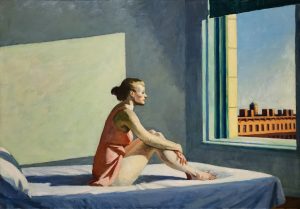
Edward Hopper was a painter who explored American solitude and loneliness more broadly. While Hopper depicts scenes that are rather simple, they still evoke so much emotion. They force the viewer to face emptiness head-on. In Morning Sun, a woman sits on her bed, stares out the window to the sky. But somehow, it feels lonely. Is it the emptiness of the room? Bare walls, a solo figure, a cloudless sky, a simple bloc of buildings, the look on the subject’s face? While studying Freya Stark, it seemed to me that loneliness also permeated her narrative. Stark, perhaps more than the other spies we’ve studied, makes travel seem exceedingly beautiful. Her travel writing stands on its own and would successfully cover her trail (but not dissolve ALL suspicions of her) if we did not know she was a spy. It’s both relaxing and meaningful, adventurous and eye-opening. This makes her spywork particularly captivating and sinister. Quotes like “And if our Empire melts away I think it will not be because we have lost the love of serving but because we have been denying that love to other people, so depriving them of a chance to practise virtues that could make them happy as much as they do us” (Perseus in the Wind, 15) and “It was the fashionable thing to be anti-British in Baghdad at that time” (Baghdad sketches 42) take on a new light. No longer is Stark a judgemental and hoity-toity British traveler, she is an invested patron and benefactor of empire itself. Psychoanalytically, I think much of this is rooted in her low-class (and therefore racialized) upbringing. Her life was deeply nontraditional: a confused family unit, unloving proto-feminist mother, romantically deviant father figure. All of this contributed to her desire to not only be accepted, but to belong to something, to Britain and its empirical values. She took on the identity of a foreigner, despite being British. “She spoke English with a slight foreign accent, [which] made her an immediate object of suspicion to the British authorities,” even though as she writes, “It makes me feel a kind of pariah from my own kind, and awfully disgusted… I am not even pro-native certainly as much of an imperialist as any of the people here” (Ruthven 152, 153). Imagining Hopper’s figure as Stark, in this way, feels significant to me. If the figure is read as Stark, she looks out to the horizon in a trap of loneliness, empty space behind and before her. She works towards empire because of her desire for belonging, but to what end? The room is empty, but so is the view outside the window. All that shows is one bloc of buildings, not even the ground it stands on. This takes on the significance of the consequence of empire: a building with no (or at least an uncertain) foundation. While the sun shines on the subject, the room itself is not warm-toned. It’s cool blue and cold, like a solitary hospital room, evocative of Stark’s nursing experience and her time being ill. The subject’s eyes are dark, perhaps contemplative, her mouth straight and serious. Is she lonely, sad, regretful? What does it mean to her to look away from the presumed comfort of the bed she sits on? She has no cushioning behind her back, despite there being a pillow within reach. Instead, her only comfort seems to be a self-soothing hold. Furthermore, we only see one side of the figure’s face, much like how Stark presents herself (literally and metaphorically): a seemingly innocuous figure with the incredible ability to hide what is underneath the surface. The figure is an incongruity, the only vibrant pink of the piece, yet shadow covers parts of her. Her color is diminished and she almost blends in with the wall behind her. Hopper captures, if read in the context of Freya Stark, the loneliness of empire, its shaky foundation, and the consequence to (not only its victims, but also) its perpetrators. Empire is inherently empty: a sun with no warmth, a bed with no comfort, a room where one is forced to always look ahead, but never successfully move forward.