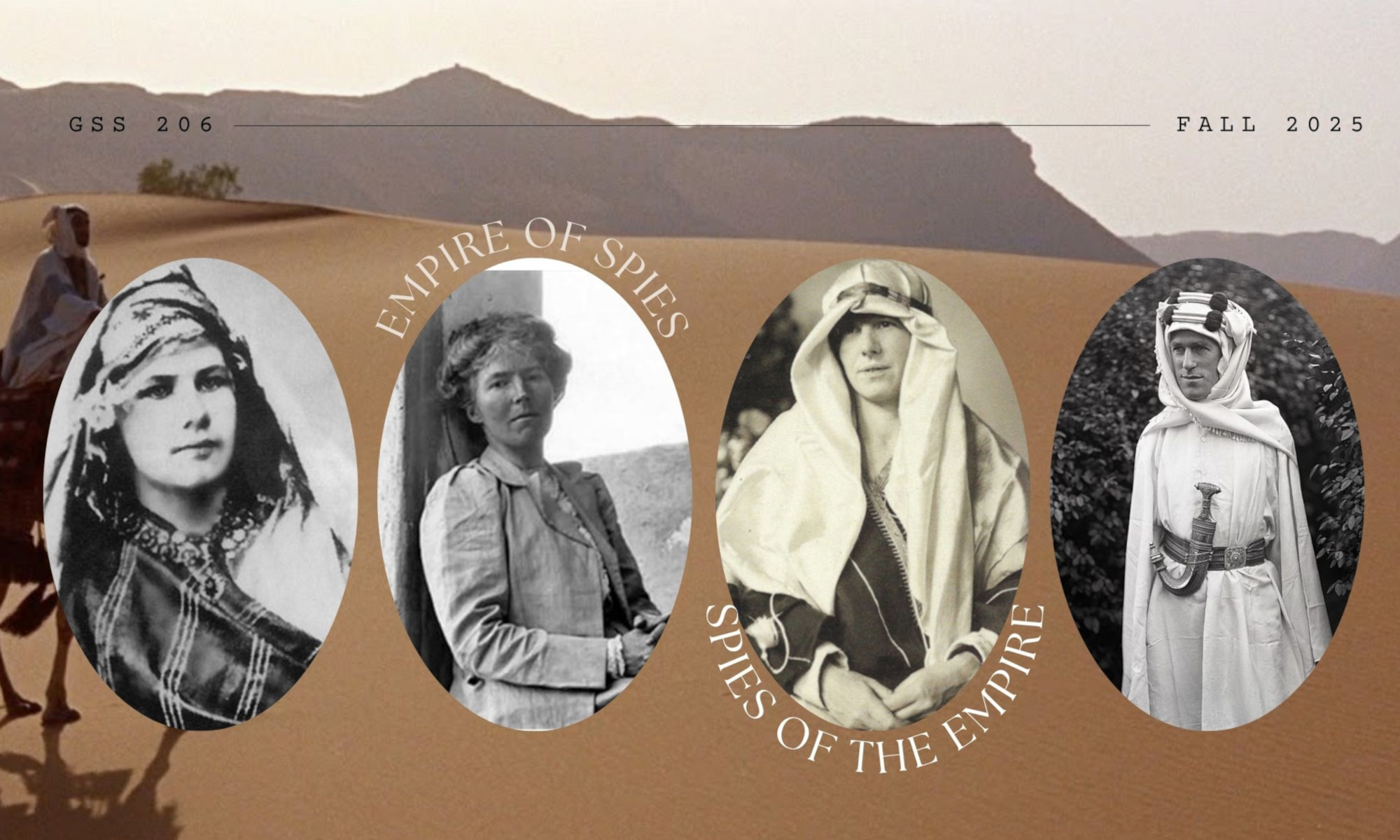
End of Semester Reflection (Extra Credit)

Reviewing my blog posts, I can trace a gradual shift in the way I approached questions of narrative power, authorship, and the ethics of representation. What began as close reading of individual writers steadily developed into a broader philosophical investigation: How does a narrative assert authority? What kinds of knowledge and what kinds of erasure does it produce? And what does responsible reading look like when the texts themselves emerge from imperial contexts?

My first post on Isabelle Eberhardt started from a sense of discomfort with her conflicting origin stories. At first, I treated these contradictions as unusual biographical details, but the more I examined them, the more they pointed toward a deeper issue: the deliberate construction of the self as a form of power. Her shifting accounts were not evidence of confusion but a method of controlling access to herself and shaping the responses of others. Writing that post pushed me to consider narrative instability not as failure, but as strategy.

By the second post on the Balfour Declaration, my focus moved from individuals to the political force of language itself. The distinction between “a national home” and “the national home” revealed how grammatical choices can carry enormous ethical consequences, allowing ambiguity to mask responsibility and justify domination. As I analyzed the document, I became increasingly aware that my frustration with its wording reflected a larger concern about how vagueness operates as an instrument of power. Language in these contexts helps construct reality, and sometimes erase it.

The playlist response to Freya Stark allowed me to approach her writing from a different angle. Her observational precision is impressive, yet I found myself more attuned to what her narrative style consistently avoided: emotional involvement, reciprocity, or genuine recognition of the people she wrote about. Using music to frame my critique helped me articulate the tension between aesthetic appreciation and ethical engagement. It made me think seriously about the limits of empathy in travel writing and about how beauty can sometimes obscure the violence embedded in a narrative stance.

By the time I reached T. E. Lawrence, I was more attuned to the rhetorical habits that run through many of these writers. Lawrence’s early admission of his own bias, rather than destabilizing his authority, effectively strengthens it. His self-awareness allows him to preempt critique and maintain control over the narrative. This led me to consider how a text constructs epistemic authority not only through what it includes, but through the way it anticipates and absorbs objections. Confession becomes another technique of consolidation rather than a gesture of vulnerability.

Across all four posts, I see my writing shifting from description to analysis of the underlying logics that shape these texts: imperial frameworks, narrative ownership, aesthetic distance, and the subtle but consequential operations of grammar. I hope to study more explicitly how empires produce and regulate knowledge, and how marginalized voices challenge or reconfigure those epistemic structures. I am especially drawn to the question of when storytelling becomes an ethical practice and when it becomes a form of harm.

Lawrence’s Self-Made Authority

As I read Seven Pillars, a few sentences stood out because they exposed the contradictions and self-shaping that Lawrence leans on throughout the book. One of the clearest examples is his early admission that this is a “self-focused narrative…unfair” to the soldiers and even to his British colleagues. On the surface it sounds humble, almost like he’s trying to be transparent, but I think it was more like a pre-emptive shield. By naming his bias up front, he gives himself permission to center his own experience anyway. And honestly, that annoyed me. It’s like he wants to claim subjectivity when it suits him, but still make his perspective the emotional and intellectual anchor of the entire revolt. He gets to frame the story while acting like he’s too self-aware to be blamed for it.

In Chapter I, when he says the campaign stripped fighters of “ordinary morality, pity, and a sense of individual responsibility,” I noticed how quickly the revolt became a stage for his inner psychological drama. The way he talks about moral decay and alienation overshadows everything else. He’s choosing which emotions to foreground, and they almost always circle back to him. Instead of exploring the broader ethical or political meaning of what’s happening, he turns the whole desert into a metaphor for his own unraveling. The chapter ends up feeling less like a collective wartime experience and more like Lawrence working through an existential crisis. How much of this “suffering” is something everyone felt? How much is part of the persona he’s building: half heroic, half damaged philosopher-soldier?

Then in Chapter II, when he defines “the Arabs” mostly through language and shared social structures. He’s drawing a giant map, dividing people into neat categories, and presenting all of it like it’s objective fact. His descriptions sound academic, but they flatten real differences and turn whole populations into abstractions. This reminded me how quickly ethnographic writing, especially by someone who already sees himself as a cultural interpreter can slip into essentialism without ever admitting that’s what’s happening.

Basically, all of this made me way more aware of how Lawrence sets himself up as the voice we’re supposed to trust. He admits things, sure, but then he turns around and uses that to frame everything on his terms.

My Yelp Review of Theeb

Hello my fellow yelpers! I recently watched the 2014 period drama thriller, “Theeb”. Written and directed by Naji Abu Nowar, the film premiered at the 71st Venice International Film Festival. This movie, unlike many shot in a similar area, picturing a similar time period, is completely in Arabic (with the exception of a few English words spoken by the British soldier (played by Jack Fox) sent to blow up the railway). Nowar also only used non-professional actors from the Bedouin community in Southern Jordan. This also differs from the norm in movies about this time period, namely in Lawrence of Arabia (1962) where Prince Feisal (an Arab character) is played by Alec Guinness (random white dude). 

The very interesting and very notable aspect of this movie is the absence of women. Originally I came to the conclusion that Nowar was simply a sexist. However, upon further research I discovered that Nowar was planning for there to be women in the movie but none of the Bedouin women in the community they were filming were willing to be in the movie. Nowar didn’t want to lose any authenticity by bringing in professional actors, which led to the whole no women thing. 

The plot line is very simple: Theeb and his older brother help guide Edward, a British soldier, through the desert, they are ambushed and Theeb is the only survivor, one of the attackers becomes friends with Theeb, they set off the two of them, and the movie ends with Theeb killing the attacker (“because he killed my brother” as Theeb says to Ottoman guards). The last scene of the movie watches Theeb riding off into the desert on a camel he has now learned how to corral (I always appreciated how Theeb was able to cling onto the back of a camel, FOR HOURS, the strength that he has is astou

nding). Honestly, my biggest issue with the film is that I was worried and am still worried about what happened to Theeb after the movie. How did he survive on his own in the desert? Where did he go? The unfinished ending left

me slightly frustrated. 

I would 100% recommend this movie to anyone, especially those who have watched Lawrence of Arabia. It provides a very different perspective to many of the movies that depict the time period. Not only does having the entire movie be spoken in Arabic change it, but using non-professional actors also adds nuance. It takes away the “oriental glow” that surrounds the whole Lawrence of Arabia type of story and allows viewers to actually see the Arab perspective during this time. Nowar alludes to the very real struggles that Arab guides had during the Ottoman Empire with the installation of the Hejaz Railroad. Also, Wadi Rum and Wadi Araba are beautiful and Nowar’s cinematography is excellent. I truly compel you all to watch this, it was a very interesting watch and one that changed the perspective on the time period. 

See you next week with the next movie, yelper fam!

Final Reflection on the Course & The Writing Process (extra credit)

Over the semester, my blogposts evolved from a close reading to a gradual thematic overview of understanding espionage, identity, and travel writing and my own theological frameworks.

My writing overall became a culmination of the myths our historical figures have curated for themselves:

  • In Bell: the myth of the courtier, the civilizing advisor, the indispensable “Major Miss Bell.”
  • In Stark: the myth of the benign imperial wanderer, redeemed by feminine service.
  • In Eberhardt: the myth of the vagabond outsider, a bird of perpetual flight
  • In Lawrence: the myth of martyrdom and self-inflicted purification.

My earliest post on T. E. Lawrence centered on self-punishment and self-erasure. At first, I focused on Lawrence as a singular figure: a man fragmented by trauma, trying to remake himself through suffering. But even in that last piece, I began reaching beyond biography, linking his self-discipline to modern forms of identity pressure, even comparing it to the lives of university students. By the time I wrote about Stark and Bell, I was no longer treating personal contradictions as isolated oddities. As the course progressed, that reflex, to trace connections outward, became more intentional and structured. I learned to use individual cases to diagnose broader phenomena about empire, loyalty, narration, and gender. In the Stark playlist, I tried to think about the moral world Stark believed she was living in and what world she actually created. The musical curation forced me to think about tone, the environment, the emotional cadence and how these shape our perspectives in understanding a historical figure. In finding an image for Eberhardt, birds represented her well in her relentless freedom and seeing her as multiple pieces of a whole person brought internal reflection forward.

Some of my favorite ideas that have emerged have been feminine ethics of observation and the use of gender in diplomacy, birds as metaphors for fragmentation, spying as someone suspended between truth and myth, self-invention.

I would like to know more about the ethics of travel writing such as what responsibilities do figures have when representing cultures and when does it cross boundaries and what do those boundaries look like? What suffices? How would modern day spying shift conversations of gender, mobility, and sexuality working within political spheres?

Overall, this class made me go deep into the inner workings of state-building, helping recognize the ins and outs of political entities, but also letting me challege and questions the different stigmas, social work, and politics in play.

T.E. Lawrence’s Problem with Fame

In class, we often discussed to what extent Lawrence truly despised his fame. It seemed that our class’s  general consensuses was that Lawrence likely enjoyed the notoriety that he received from his exploits. As time passed, though, he came to have a great distain for said fame. This resentment likely coming from a place of shame over his inability to secure Arab independence. However, I disagree with the general consensuses. I believe that Lawrence likely always had, at least, some aversion to any sort of stardom. My opinion is largely based in the writing of Lowell Thomas. This may come off as surprising, because Lowell is know for saying that Lawrence “had a genius for backing into the limelight.” At first, this quote might seem to imply that Lawrence always unintentionally found himself in the spotlight. Describing this tendency as a genius, however, implies that to some degree it was intentional. I find this assertion to directly contradict statements Lowell made in the Foreword and Chapter 1 of this book With Lawrence of Arabia. In the Foreword Lowell states:

“During the time that Mr. Chase and I were in Arabia, I found it impossible to extract much information from Lawrence himself regarding his own achievements. He insisted on giving the entire credit to Emir Feisal and other Arab leaders, and to his fellow-adventurers, Colonel Wilson, of the Sudan, Newcombe, Joyce, Dawney, Bassett, Vickery, Cornwallis, Hogarth, Stirling, etc., all of whom did magnificent work in Arabia.”

Additionally in Chapter 1, Lowell comments:

“Even concerning his connection with the Arabian army he would say nothing, except to give the credit for everything that happened in the desert campaign to the Arab leaders, or to Newcombe, Joyce, Cornwallis, Dawney, Marshall, Stirling, Hornby, and his other British associates.”

From these quotes it is evident that, even while in Arabia, Lawrence did not desire to receive any credit. At this time, Lawrence still likely believed that he could secure Arab self-determination. In fact, he was likely aware that his level of influence was directly correlated to his notoriety. Yet, he still kept fame at an arms distance.

Despite these dismals, Lowell would still go on to make the aforementioned comment on Lawrence’s genius for backing into the spotlight.  Why would he do this? I think Lowell’s words likely stemmed from circumstance. Lawrence criticized Lowell for apparently exploiting his image in the latter’s films. So, in order to abstain himself,  Lowell likely played into the idea of Lawrence covertly finding the limelight.

Orientalism, Ornamentalism, Brownface/Yellowface in Old Hollywood

Something that immediately stuck out to me while watching Lawrence of Arabia was Alec Guinness’s performance as King Faisal and Anthony Quinns’ performance as Auda abu Tayi. While both actors were both obviously caucasian, both took lengths to appear more Oriental, with Guinness darkening his lashes with mascara and Quinn going as far to wear a fake nose prosthetic and darken his skin with dye. This was, of course, done instead of casting any native actors in major roles for the production. This immediately brought to mind a related study on the usage of yellowface in older Hollywood films (adjacent to this topic but still overall connected through the theory of Orientalism) that I had encountered in another class, particularly through the case study of Anna Mae Wong. 

Anna Mae Wong, the first Asian American actress to make it to big Hollywood, often starred in Orientalized and hypersexualized roles in major blockbuster productions such as “Daughter of the Dragon,” and “The Thief of Baghdad” (the latter, interestingly, takes place in Baghdad where an entirely white cast plays Muslims while Anna Mae Wong plays the ambiguously Asian and scantily clad slave). She is situated in the unique position of being both a pioneer and a perpetrator/opportunist, as while she did open the doorway for Asians in Hollywood, she did so through an Orientalist lens. Notably, she was also passed up the main female lead O-Lan in The Good Earth in favor of a yellowface Luise Rainer, a film that snagged both best picture and best actress at the Oscars in 1938. Anna Mae Wong introduces an offshoot on Said’s Orientalism — Anne Anlin Cheng’s Ornamentalism, an essay that defines ornamentalism as a “conjoined presences of the oriental, the feminine, and the decorative.” With this definition there is a clear implication of the loss of power: if a woman is to be so drastically associated with an aesthetic that she “live[s] as an object,” then she must, by association, have the same power as that object. In essence, she lacks agency. Her presence is admired, yet it holds little power. 

Anna Mae Wong perfectly fit into the framework of ornamentalism, and the legacy of Eastern representation can be understood through a relative comparison. Guinness and Quinn play Middle Eastern characters, but their power is excused by the fact that they are, ultimately, white. The same can be said of Peter O’Toole, but flipped. This can also be applied off the screen: Lawrence is neither a woman or Oriental, but it is fascinating that he is coded under both identities. His struggle with homosexuality, both inner and outer through other people’s perceptions, as well as his familiarity with the Bedouin, complicates his legacy as a man of great agency. 

Final Conclusions (extra credit blogpost)

Writing blogposts for this class has been very different than for Transnational Feminisms in a REALLY fun way. I’ve enjoyed thinking of our spies in a more creative lens and pulling from MY world around me. In Transnational Feminisms sometimes I just wrote about whatever I wanted LOL, but this time, I always found a way to connect the two. It actually worked really well in forcing me to think of my daily life analytically as well as encouraging me to let some creativity into my studies. It became like an English class in that way, which was SUPER fun. I really enjoyed making the playlist for Gertrude Bell, which I spent HOURS poring over. Writing about her through music helped me understand her life and espionage almost literarily, and also begrudgingly made me feel less biased against her. Same with Lawrence! By seeing these spies as, yes, actors, but also human beings, I think my notes became less critique/taking a strong stance (which is sort of what studying English has trained me to do) and more understanding/connecting dots in the lives of the spies as well as to the modern world. It was always shocking because I’d come to a conclusion, craft an idea about each spy, then go back and connect it through the class readings. Maybe it’s just a lack of confidence, but I was always shocked to find evidence that supported my non-academic connections. I was also shocked at just how much using non-academic sources to fine tune my thinking helped my academic perspectives (ESPECIALLY Lawrence as Sookie LOL). In general, I’d like to know more about modern-day spies, or keep building on the research skills I used to write my midterm play. In class and in Lawrence in Lahore, we talked a lot about everything being interconnected, but as I did my own research on more modern politics, I was shocked to find just HOW true it is. Overall, I want to continue to learn creatively and research with an artistic lens because it opens up entire worlds of thinking that my English-influenced instinct to always take an arguable stance prevents me from doing. 

Lawrence and Ordering

I was struck, especially in our more recent classes, about how much of Lawrence’s life has been dedicated to ordering and “making right” various events, actions, memories, etc., and failing to do so. He tried to reorder his sexuality to align with the British male heterosexual ideal and failed; there’s evidence that he pursued relationships with boys like Dahoum, along with those first lines from Seven Pillars. He tried to do right by the Arabs into whose political life he had inserted himself unsolicited but refused to abandon British imperial interests, and so failed, since he could not do right by every standard, all of the time. He tried to order and control thoroughly his own body by testing its limits, and failed, and his testing devolved into the erotic, masochistic flagellations he inflicted on himself. 


If I had to guess, I would locate the origin of this impulse in his childhood and the strictness of his upbringing, interrupted by bursts of chaos or violence, like when he discovered his parents’ scandal and when his mother beat him. Perhaps he inherited the impulse to make things right from his mother, who some of the scholars we’ve read postulate brought her children up so strictly and religiously to compensate for the nonconformity of her marriage.


To me, Lawrence’s impulse toward ordering also makes Mousa’s clarifications about the holes in his accounts of his time in the Middle East more interesting. What purpose did it serve for him to invent, at least in some respect, these incidences of violence and nonconformity, such as the events of Deraa, or to take credit for more work in the Revolt than he actually deserved? He could have, as some scholars wrote, been inventing these episodes as a means of self-punishment and self-revelation—i.e., he knew there was something nonconformist about him, or he recognized internally some homosexual impulse, and so felt the need to invent Deraa so that he could order himself in the world. He felt the need to punish his own nonconformity by exaggerating/falsifying it and projecting it to the world, so that people would understand where he lay in the order of the world.


He might have taken more credit than he deserved for the Arab and British efforts in the Middle East because of his guilt over his failure to safeguard the rights he had promised the Arabs. By making it appear as though he had done more than he had, Lawrence could right his place in history; his misdeeds could be outweighed by revolutionary action.


If I had more time/space, I would have tried to understand Lawrence’s upbringing through a psychoanalytic framework, which I believe would help in understanding some of his choices, especially those that seem contradictory. Altogether, I believe that Lawrence, despite appearances, was unsure of who he was, what he wanted to be, or even what he was doing as he did it. He was passionate, but frequently irresponsible, not dissimilarly from Isabelle Eberhardt. His impulse to order the world to his vision is more Bell-like, and the fluidness of his identity was in some ways like Freya Stark’s. I’m glad we saved Lawrence for last—I’ve liked being able to compare him to our previous spies.

TE Lawrence & True Blood’s Sookie Stackhouse: Love Bites!

True Blood is set in a world where vampires have recently come out of hiding due to the scientific advancement of a synthetic blood, True Blood. Sookie begins the show as a beautiful, innocent town weirdo. Everyone knows she can read minds, and in fact, she hates the trait herself. However, she realizes she cannot read the minds of vampires, and thus begins her many dramatic vampire affairs. The lore eventually grows and it is revealed that Sookie is a mindreader because she is part fairy (the show’s getting really bad…), which makes her blood alluring to vampires. Here is where my parallel really begins. 

Lawrence, perhaps more than our other spies, was able to manage a balance of being an insider-outsider. While he donned an Arab drag, he wasn’t pretending to be Arab. He was able to travel between worlds because of his “ability to penetrate the inner self of the Arab individual” (Mousa 5). In relation to Arabs then, Lawrence had to be different. He was not one of the in-group; his relationships with Arabs was rooted in individuality, the recognition of difference. Like he says, “I can understand it enough to look at myself and other foreigners from their direction, and without condemning it. I know I’m a stranger to them, and always will be: but I cannot believe them worse, any more than I could change their ways” (Lawrence quoted in Garnett 156). Strangely, Sookie mirrors this insider-outsisder paradigm in her relationships with vampires. She can easily slip into their world because she is different. She doesn’t want to become a vampire or adopt their lifestyle, but they give her a reference point of normalcy–what she finds alluring about them. Furthermore, Sookie uses her ability to mind read to spy for vampires. She occupies human space (she visually appears human, can daywalk, and her power is invisible), but can also traverse the vampire world because of her fairy powers (which are based in light, and can therefore hurt vampires), her connections to the in-group, and the promise of her allure. She is both sympathetic and aggravating. She uses others, but gets used, and treats herself as the center of the universe. Her favorite line is: “If our relationship ever meant anything to you, you’d do this for me.”

Lawrence is somewhat the same. Mousa’s An Arab View and Theeb portrayed Lawrence as much less powerful than other iterations of his tale. He was simply a man in the right place at the right time with the right connections. Whatever role he did play in the Arab Revolt, it was exaggerated. He made promises he could not keep and we’ll never know if he actually thought he could make them happen. He used the Arabs for his own psychosexual, sado-masochistic exploration of the self through the east. He was a vampire! In the same way Sookie is, at least. Sookie spies for vampires but because she cannot read their intentions, often finds herself in situations where she has been cornered, manipulated, and even extorted by the very vampires she is psychosexually, sado-masochistially obsessed with (think: biting and blood, vampires are inherently tied to the concept of pain/consumption, fine line of pleasure/pain). Like Lawrence, she is both spy and insider-outsider, although she’s generally the one who ends up losing. I’d also argue she is sexually exploited in a way Lawrence was able to exploit others because of his rank. His gay love letters are described by Norton as “love letters from a slave to his master.” It brings up the question, how much information can one relationship have before it becomes exploitative? Could Sookie ever have a relationship with a vampire that doesn’t have a ridiculous power imbalance? With a human? Could Lawrence ever do the same with Arabs he claimed to love and work for? With his beloved Dahoum?

Spying necessitates betraying others, but in that, it must be wondered if that also means betraying oneself. Can one really love a person (or people) they exploit? It might be a reach, but to some extent all spy stories are vampiric.

Final Blog Post (Extra Credit)

Looking back over my portfolio, I can see a clear progression in the way I think and write about travel literature, empire, and the figures we studied. My earliest post, the Yasmina playlist, was driven by empathy and atmosphere. My initial approach was to look for feeling and emotional resonance. As the semester continued, I began to shift my writing to focus more on examining power, especially with Gertrude Bell and Freya Stark. At the end, with Lawrence, I was more intrigued about the psychology of the spies we were studying.

One of my favorite ideas I developed this semester was presented in my “Bystander” blog post. Reframing Lawrence’s torture writing helped me confront something that his narrative often avoids: the uncomfortable representation of performance, trauma, and discipline that is embedded in his demeanor. I explored how the heroic silence was simply a form of survival strategy that could be linked to his internalized need for punishment and also just trauma from the past. I liked this idea because it helped me do a more complicated and human reading of Lawrence.

An important thing I was able to do through these blog posts and the midterm was experiment between analytic and creative writing. Creative writing, like Bystander, the Yasmina Playlist, and the play I wrote, allowed me to look at the spies’s travel writing as performative. They were constantly staging themselves after all, whether as experts, wanderers, diplomats, or heroes. I was able to question why these authors chose to present themselves in the way they did, which I have never done before in a class. Through analytic reading and writing, I was able to learn to read these texts with a specific lens in mind. Looking at the writing with all of these factors, like political structure and alliances, helped reframe it.

Going forward, I would love to know more about how people actually affected by these spies remembered these figures. A lot of what we read came from the Western world. But I would like to know how, say the local people of the past saw Gertrude Bell. I am also a sucker for psychoanalytic analysis, so I would love to see what psychologists think about some of these spies. Something else that would be interesting is to think about what these narratives would look like if they written today. How would Lawrence write about himself today?