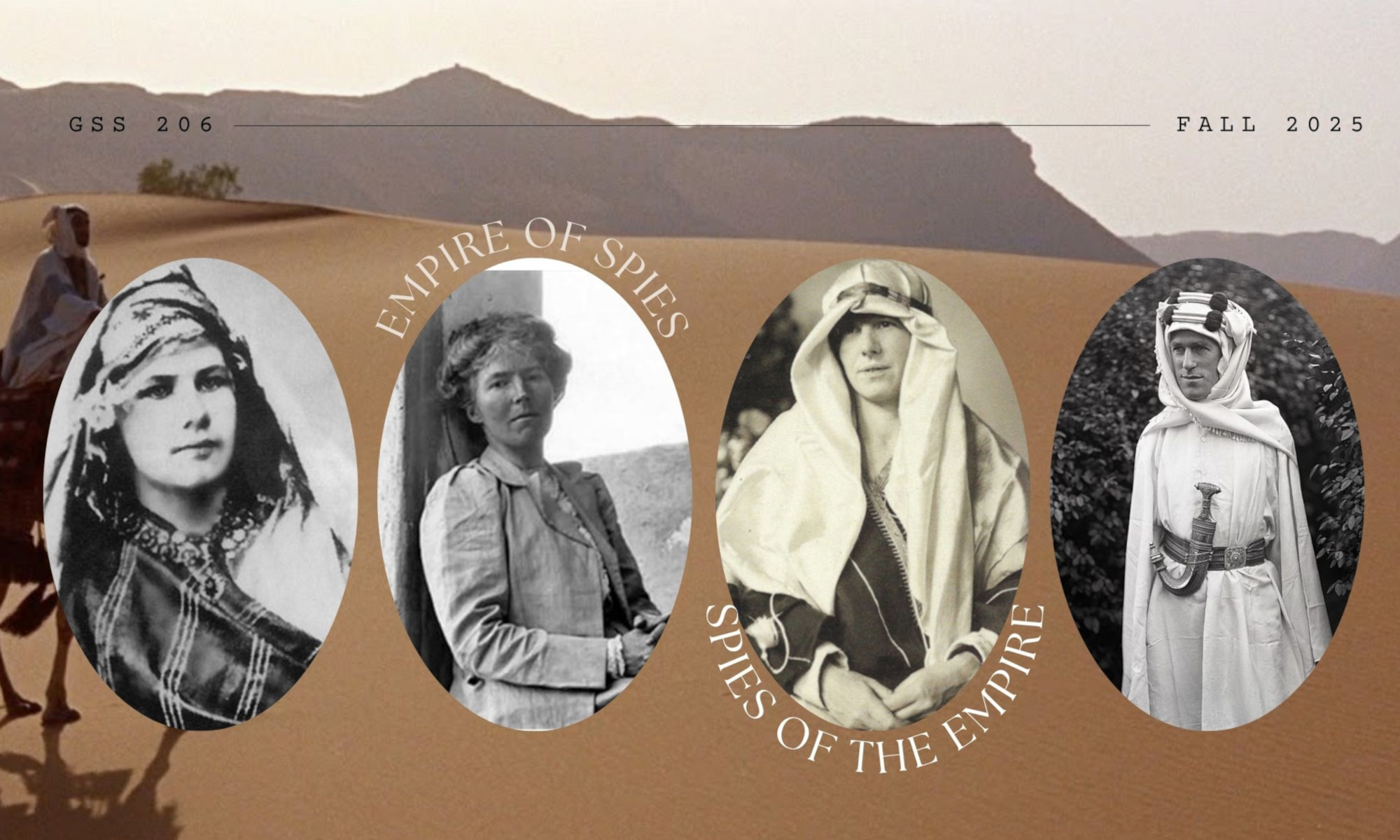
*I am going to do a different take on this prompt and imagine my vacation to Petra in Jordan with Gertrude Bell in the modern day. It imagines a portion of our day as we walk through the ruins. Italicized text was taken out of readings we did in class.
It’s a hot and windy day in Jordan. Gertrude and I are on the third day of our week-long vacation through the ruins of Jordan. We are currently in Petra. Gertrude refuses to wear modern-day dress, instead choosing to wear the same muslin gowns that her mother, Florence, had sent her throughout her time in Baghdad. Crowds of people surround us, tourists with their families. Men and women are dressed in over-the-top Oriental outfits, selling trinkets and camel rides to the tourists. It is safe to say that it was a typical day in Petra (at least in the modern day Petra). I am unfazed by the bustle, but when I look over to Gertrude her face tells a completely different story.
“This place used to be a fairy tale city, I camped amid a row of ornate tombs, three stories high, what has happened to this place?” she asked me with a disgusted look on her face. I laugh, telling her that this is normal. As we make our way through the crowd, Gertrude walks with her nose in the air, ignoring everyone around her. We are approached by a man dressed in bedouin attire. When he begins to speak to us in English Gertrude looks offended. Scoffing, she exclaims, “This is not the real East, I wish I was in Iraq. I like Iraq. It’s the real East”. The man, confused, walks away. I tell her that she shouldn’t talk to people like this. Her response was to glare and bustle away.
As I trail behind her, I hear her muttering, “Oh how degraded this place has become. All these people, the children, the women. The Arabs have ruined it with their greed. Their need for money and tourism. If the British were in charge this would never have happened. We would have kept it preserved. Only the best could visit, the bravest, certainly no women or children. Only the true explorers.” Once I catch up to her, she suddenly stops, clearly she did not want me to hear what she was saying. Those thoughts were only for herself. Instead, she comments on the weather “it’s breathlessly, damned hot”. I chuckle, telling her that if she didn’t refuse the modern fashion of shorts or light linen pants and a t-shirt she wouldn’t feel so hot. Brushing my comment off she walks away.
We make our way up the hike to the Monastery. I don’t blame her, it is hot. As we climb our way up the steps she remarks that when she had been in Petra last she made this hike on camelback, “Why do these people insist on walking? Camels are much more efficient!”. Laughing, I continue on without comment.
She can be a little bit stuck up. I think she would prefer I wasn’t here at all, that she was all alone in this place. Maybe with her servant Fattuh. She definitely doesn’t want any other tourists here. She would much rather cosplay a lone adventurer than be one of the many. Be the first European women to see these places. She is clearly knowledgeable and interested in our surroundings but would rather explore solitarily.
“Let’s go back to our hotel, maybe there we will be treated with the respect we deserve” she says, interrupting my thoughts. Knowing that I can’t change her mind, I agree to be done for the day. Hopefully some of the other places we visit will be more authentic for her.

LOL! This is really funny and creative, Emma! I also think you brought up a really interesting point: the hierarchy of the east. I find this to be really prevalent in the modern day, too. Exoticism goes hand in hand with hierarchy, I guess. Exotic places are only en vogue if they are west-adjacent enough. Think: Emirates tourism/Qatar and the World Cup, etc. Or from a historical lens (Petra is a really good example of this). My mom is really into watching videos of outdoor markets/lowkey travel vlogs and says she is only interested in travel in the ordinary, which I think of very often. How much of travel is just exocitism or projecting our dreams/ideals into a place? My mom always says she feels more relaxed when in Algeria, but I always remind her it’s because she doesn’t work there anymore, it’s an escape from daily life. Are we safe from exoticizing our own homelands? Is that ok to do? Anyways, your blogpost inspired a tangent in me, but I really enjoyed it!
Self-exocitism! You might enjoy my story “Bloody Monday” in this collection https://www.academia.edu/36448008/And_the_world_changed in which there is this line: “You have become exotic to yourself”–directed at me by a British prof w a ponytail!
Very creative and on-the-nose re: lure of exoticism wherein the traveler (today’s tourist!)–wishes to “preserve” the “other” in a forever timeless, people-less space/time!
A