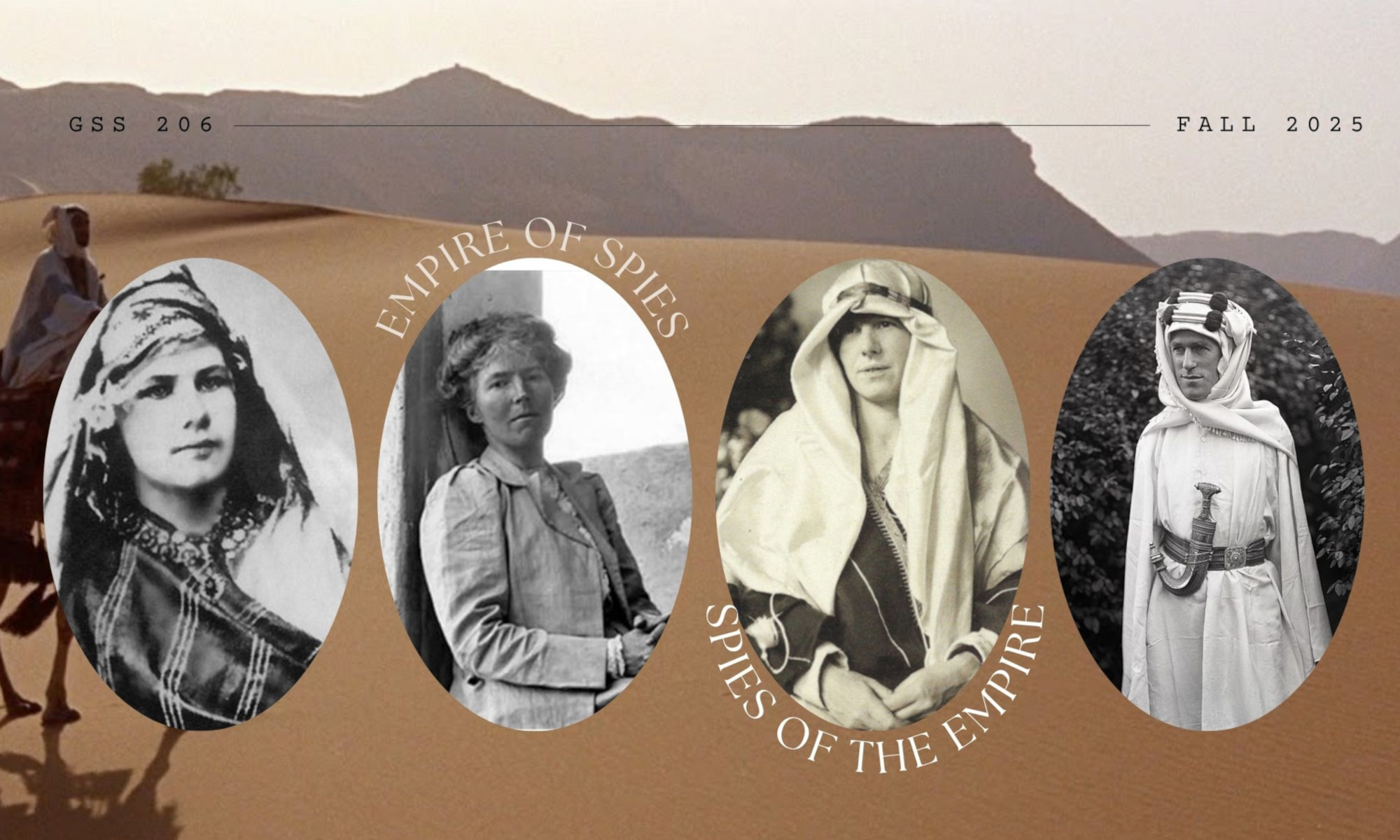
“Ride through [the bazaar] on a summer morning, when its vaulted coolness will offer you a grateful shelter from the sun, and before its activity has been hushed by the heat of mid-day.” Gertrude Bell’s Persian Pictures bursts open with images like this: shafts of light cutting through domes, merchants sitting cross-legged among their wares, mule bells ringing through the crowded arches. I felt transported, and yet, I also felt the distance in her gaze. Reading Bell reminded me of my own road trip from Tangier to Mauritania – where I looked Moroccan, until my Arabic yielded me not a local. I was kin and stranger, welcomed and held apart. Bell writes Persia with that same tension: sympathetic, but detached.
That detachment is double-edged. It sharpens her sketches – the bazaar alive in dust and color, the hidden gardens that bloom like secret paradises, the mourners of Hussein caught between devotion and performance. But it also limits them. Persia, in her hands, becomes spectacle and history, a land she can describe but never fully inhabit. Her authority rests not on intimacy, but on the power to interpret – to render the unfamiliar legible for those at home.
Still, Bell’s Persia endures because it mirrors the paradox of travel itself. To move through another place is to be both transported and estranged, drawn close yet never fully at home. Reading her, I am reminded that distance is not failure but condition – that what lingers is not only the image of Persia she saw, but the uneasy truth that to observe is always to stand slightly apart.

Love the way you write, Keletso—poetic, detached, also imbued with a certain melancholy of vision that comes from the recognition of the condition of being a traveler even as it excites one’s faculties.
However, this unit’s post was supposed to focus on Isabelle Eberhardt, not Bell. Perhaps in the next post you can write about her work and life and what you saw in it; look at the prompts in case they are helpful in shaping a response. And pick a few categories to tag as well
Bell is really interesting for this reason. I think her definitions of love and admiration are sort of inherently rooted in her role of power. She only loves Iraq or Persia or wherever in the desert/sown she is as much as she can exert her power over it. I think your take is particularly intersting in this regard because it implies that her linguistic beauty, her ability to see where she travels as beautiful, is itself a power play. “Beauty is in the eye of the beholder,” but sometimes the beholder has a gun and the bautiful can only sit there and be stared at! I suppose it’s both a matter or understanding and a matter of implication. This makes me think of American Manifest Destiny artwork. You’ll sometimes see Native Americans in the open west, looking away from the viewer. Are they supposed to be inviting us to come? Or simply existing in a space that is their own? What is a representation is also an invitation to interpret. Art is scary in many ways because it’s so uncontrollable. Alas!