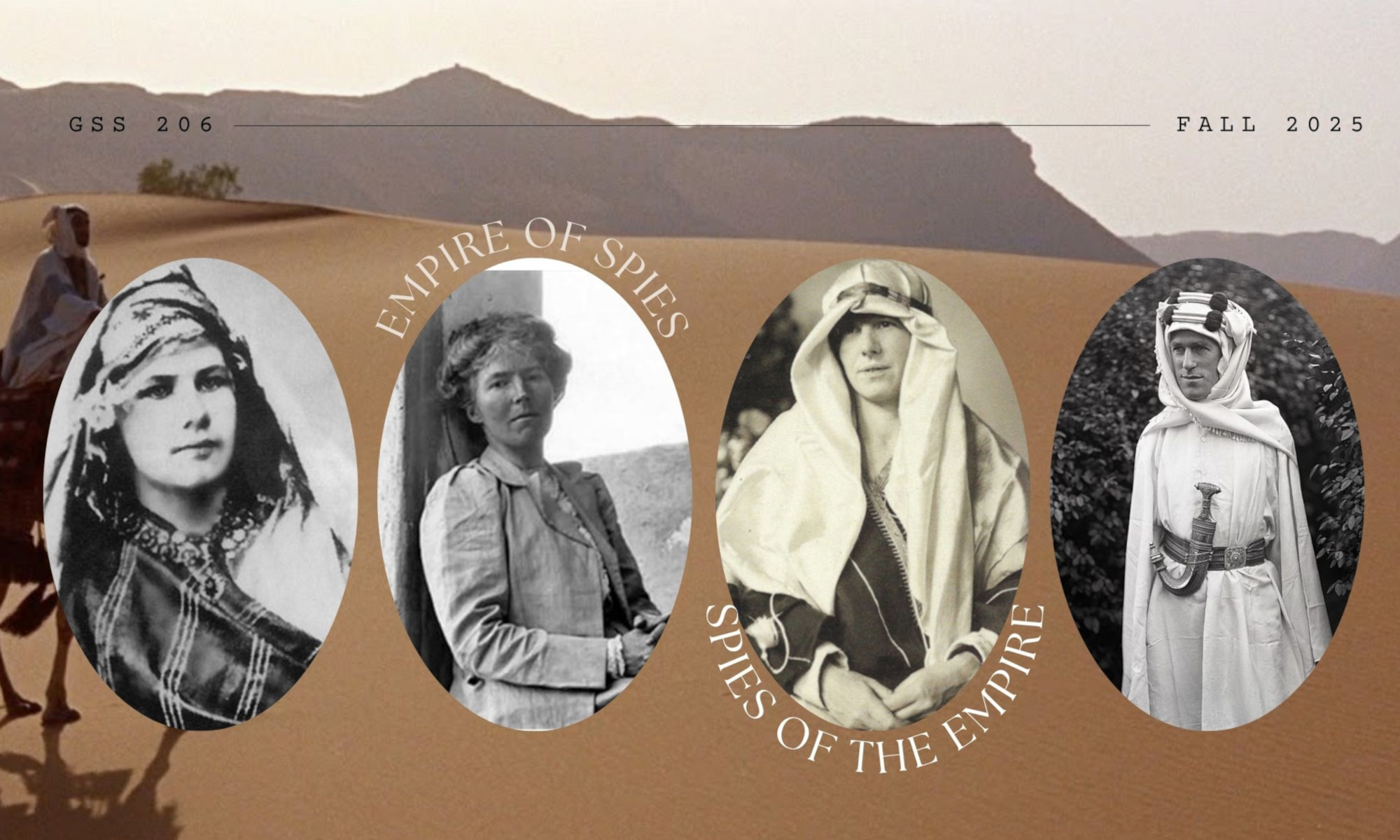
I found myself regarding Isabelle Eberheardt in a very critical light, one that reminded me of how Joan Didion regards the young hippies of Haight-Ashbury in the 1970s. To me, the most refreshing text on Eberheardt was the introduction to Passionate Nomad, which highlights Eberheardt’s carelessness and essential uselessness in Algeria, to herself, and to those around her. This take on Eberheardt was similar to Didion’s disdainful, unimpressed portrait of hippies in the titular essay of her collection Slouching Towards Bethelehem.
The Passionate Nomad introduction paints Eberheardt as beyond her time in that she was more akin to a 1960s hippie orientalist than a real colonialist. It refers to her as a symbol of the moral decay of Western Europe going into the twentieth century, especially of moral decay in European colonies, just as Didion paints the hippies as symbolic of wider moral decay within the American empire in the 60s and 70s before the rigid, fascistic Reaganism of the 80s. Her exploits in Algeria remind me of the Beatles in India, the hippies doing ayahuasca, or people going to “find themselves” backpacking in Southeast Asia—orientalists who like the aesthetics of transgression and the freedom they can claim as “vagabonds” and “outcasts” without any of the responsibilities of real revolutionary action.
They were young teenagers who ran away from the constrictions of the nuclear family to find Haight-Ashbury a gateway to sex, drugs, and intertia, just as a young Eberheardt fled the constrictions of Geneva society to find Algeria a gateway to similar forces of decay. Neither group showed real interest in political action, despite a fascination with and empathy for local causes (for Eberheardt, Algerians, and for the hippies, often indigenous Americans, or Vietnam). They simply sought their own pleasure, often through exploitative means, and kept going until they ran out of funds.
To me, these similarities point to broader parallels between the European political mood of Eberheardt’s era and the American political mood of the 1960s-early 70s. What might such parallels tell us about patterns of imperial growth and responding backlash? What about the nature of an imperial culture might, at its moment of internal decay, lead young people to attempt to abandon their privilege—yet fail to fully reject the culture that made and privileged them?

A very interesting post Claire–and I appreciated your linking critiques of IE to those Didion made of the Haight-Ashbury hippies. Yet while at one level these readings strike truthful notes, its important to remember that the hippie phenom of the 60s is linked to progressive movements of the era that brought us (certain!) women’s rights, civil rights and an end to the Vietnam War. It is this paradoxical quality that also underwrites IE’s “adventuring” in Algeria to some degree, no? colonial and anticolonial motivations run side by side in her work and life–which is what makes her the quintessential spy!