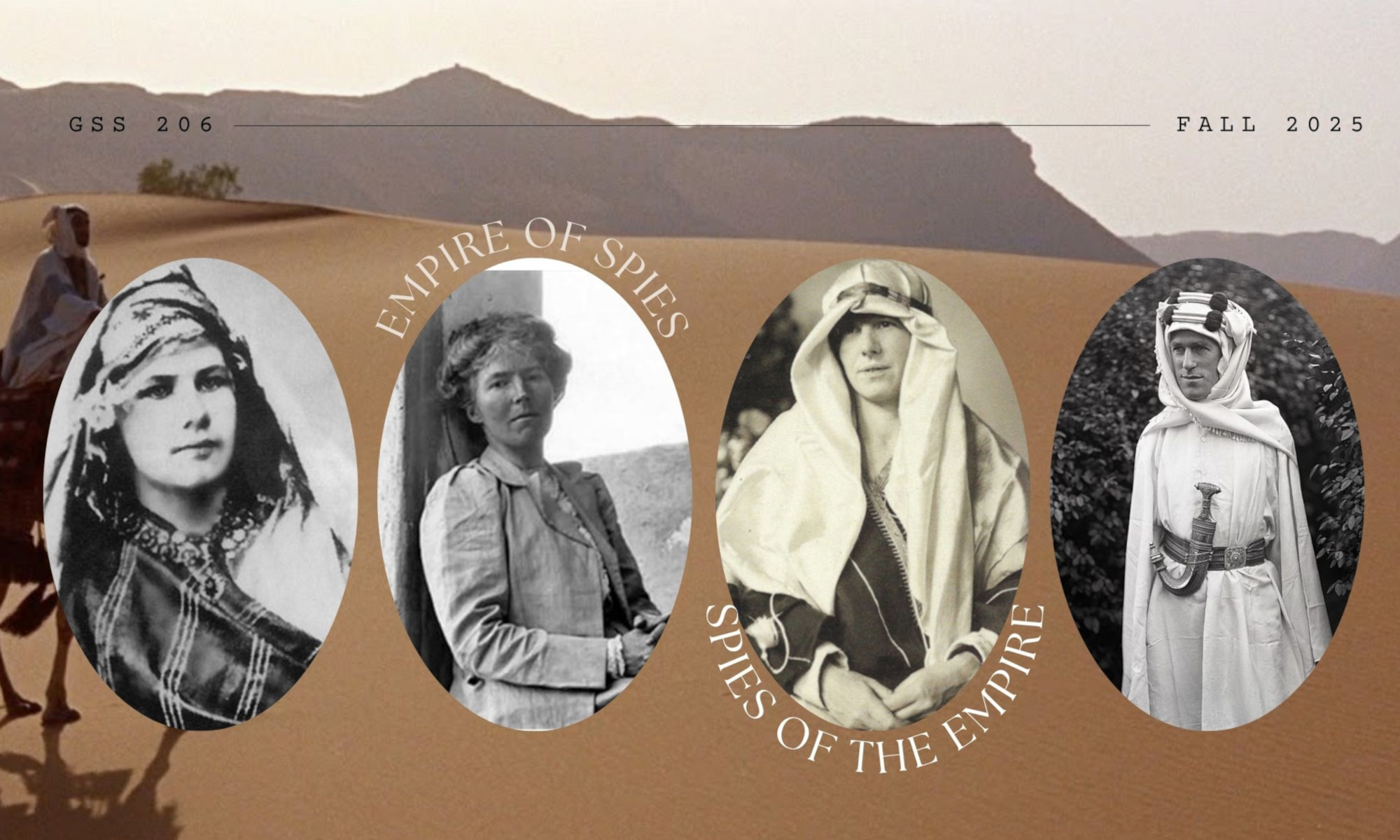
In my First-Year Seminar ‘The Memory of Trees: Analyzing Climate History Through Dendrology’ we often discuss authors’ motivations when writing their work. For the past couple weeks, motivation for both Isabelle Eberhardt and those writing about her has also been a topic of discussion. Even though the content of the two classes differs, one about trees and the other about a woman in the early 1900s, motivation drives the readings that we use in both. Why authors wrote what they wrote, what their internal motivations were, and what they hoped to portray to their audience are questions asked in both classes.
For a lot of the texts we read in my First-Year seminar, the motivation is very obvious, the author wants to share their findings for their study and explain why they are important for society as a whole. They are consistently trying to convince their audiences that they are bringing new important knowledge to scientific conversations. When looking at the introductions written in both The Passionate Nomad by Rana Kabbani and Writings in the Sand, Vol. 1 by Marie-Odile Delacour and Jean-René Huleu their portrayals of Eberhardt differ quite dramatically. In Writings in the Sand, the authors characterize her as this tragically romantic figure who was the “first” person to give a true depiction of the “East” (when in reality people had been writing about the region for a long time). They use repetitive exaggerated language to describe her life’s journey, calling her upbringing ‘turbulent’, ‘tragic’, and ‘tormented’. They clearly paint her as a victim and therefore excuse many of her choices she makes once she reaches Northern Africa. It is clear that both authors are in awe of Isabelle Eberhardt and want their readers to be in awe as well. Rana Kabbani takes a different approach in her introduction to The Passionate Nomad. She portrays Eberhardt in a much more realistic light without the hyperbolic language. Kabbani is very clearly not in awe of Eberhardt, writing that she was “painfully thin, flat-chested, with decayed teeth, an abundance of bodily hair, and no periods”. She also doesn’t excuse Eberhardt’s actions, saying that she had “lost all sense of reality and self respect”. Kabbani is not trying to depict Eberhardt as a tragic, romantic figure. She doesn’t even try to put her in a positive light. She realistically portrays Eberhardt as the drunken, high, vagabond she was.
Eberhardt’s motivations behind her writings, journey, and relationships are much more unclear. What were her intentions when she was passing information to Lyautey? Was she trying to protect the Algerian Arabs or did she want to feel like she belonged to the French? The struggle with Eberhardt is that deep down, she wanted to belong somewhere. She grew up in a household with a father who didn’t claim her as his daughter and an exiled mother. She moved to North Africa to find solace in the Sufi male society. Yet, she claimed to want to be completely alone and did not settle roots down with any specific group. She hated the French but she married her husband to become a French citizen (though those motivations were more centered around wanting to get back to Algeria). She wanted to be a nomad while purposely trying to destroy the nomad populations in Algeria by relaying information to the French. Part of what makes Isabelle Eberhardt the mysterious figure that draws many to obsession is the fact that no one truly knows what drove her to make the decisions she did. The ambiguity in her motivations fascinates her audience, it is what draws people to her a century after her death.
Motivation is important in both scientific and biographical writing. In both of these classes, we need to analyze the reasons why writers write what they write (whether the topic is analyzing tree rings or a woman exploring Algeria in her 20s). It allows the reader to gain a deeper understanding of the author’s intentions and of the texts themselves.

very interesting discussion re the issue of writers’ motivations. The only way to ascertain these, it seems to me (and acc to many other literary critics)–is to gauge these through decoding the texts they have written, as reflective of, sometimes at odds with, their sociopolitical context, biographical background etc.
I would be useful to go back over some of her work–stories and letters– and see how these reveal her intentions; even so, writers are notorious for creating paradoxical fictions that are difficult to pin down in terms of intentionality–and this is where reader-response theory comes in. Hence the difference between Marie Delacourt and Rana Kabbani’s interpretation of IE