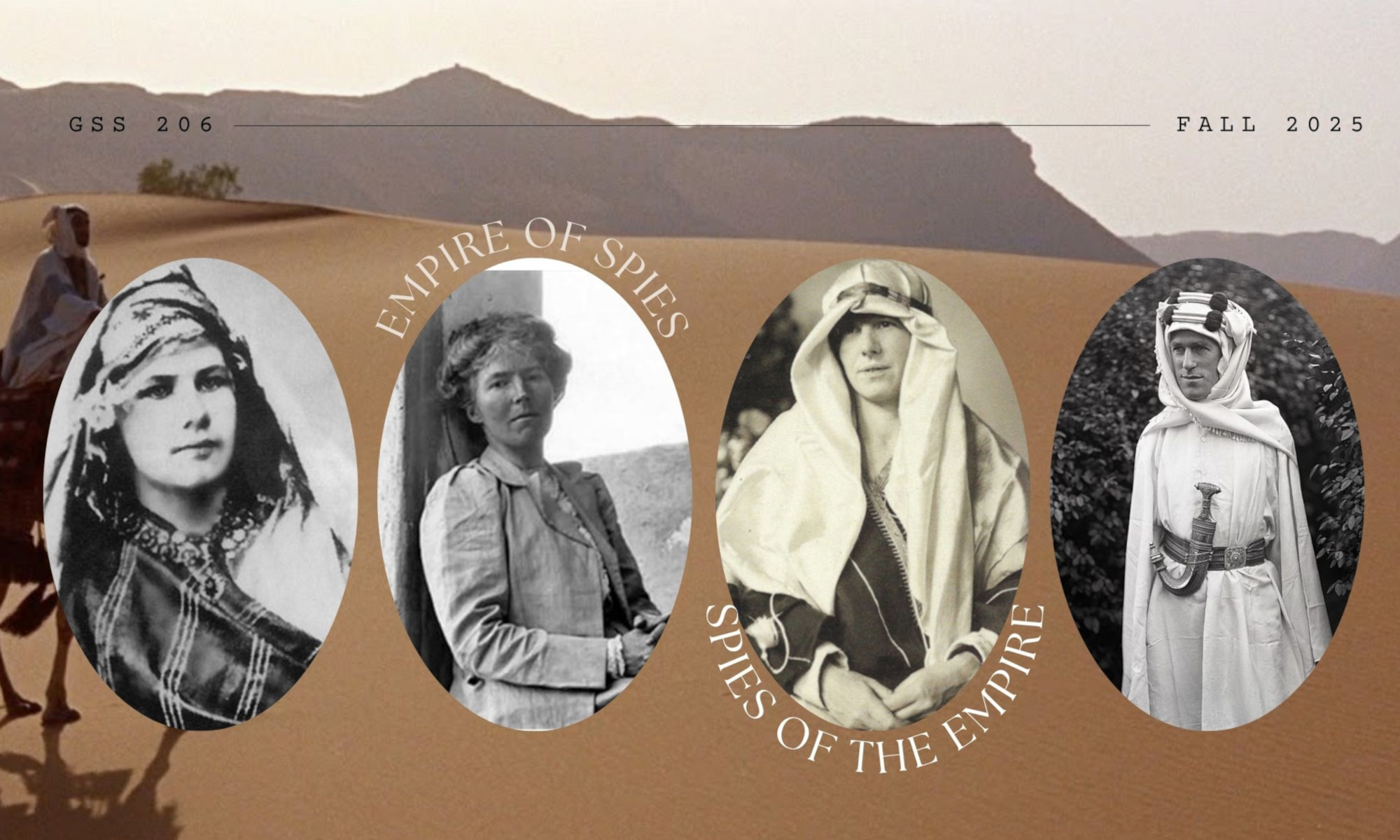
Freya Stark has been the (if not one of) most intellectually stimulating, accomplished, and devoted spies that we have encountered thus far in our seminar. This playlist will be curating some songs that echo this moral and emotional landscape of Freya Stark’s writings and discussions we’ve had over the last 3 weeks, especially towards her ambivalent stance between devotion and exile as well as humility and power. These songs will be reflecting her own cross-cultural sympathies and her layered identity. I think Freya Stark is a really interesting individual, her loyalties will ultimately is always towards Great Britain, but her complexities in how she sees the Arab World and her seeing faith as beauty in everyday life rather than a dogma makes me view her with a more ethical and reliable lens (although we do have our critiques). Her ability to craft her own story through her own choosing and focusing on her travels makes her a great person to analyze.
“Aaj Jane Ki Zid Na Karo” – Farida Khanum (1960s, poet was Fayyaz Hashmi)
This ghazal’s entreaty “Don’t insist on leaving today” encapsulates the sorrow of transience that permeates Letters from Syria and Perseus in the Wind. In our class discussions, we explored how Stark’s existence fluctuates between belonging and departure, between service and solitude. Khanum’s voice embodies that same duality: restraint, longing, and quiet dignity. Similar to Stark’s prose, it avoids sentimentality while brimming with emotion. The song’s languorous rhythm reflects Stark’s evenings in Damascus or Baghdad, moments caught between closeness and distance, faith and exile. It transforms into an anthem for her moral restlessness: desiring to remain, yet aware that she must perpetually move forward.
“El Helwa Di” – Sayed Darwish
The class emphasized Stark’s admiration for “ordinary service”, her belief that empire fails when it strips people of dignity or agency. Darwish’s song about Cairo’s morning workers gives life to that idea. “Empire redeemed through care.” In Baghdad Sketches, Stark likewise finds holiness in ordinary acts: women baking bread, men sweeping courtyards at dawn. The song reflects her conviction that service ennobles the human spirit and that true civilization is measured not by empire, but by small kindnesses. The song’s gentle strings embodies the grace present within empire as seen through Stark’s eyes, strength for the Arab world lies in its humanity and hospitality not its politics the way the British does. However, Stark still uses moral language to critique empire from within. In Passionate Nomad, Geniesse captures this tension: Stark defends Britain’s Arab policy while privately empathizing with Arabs betrayed by the post-WWI settlement.
“Desert Rose” – Sting ft. Cheb Mami
Cheb and Sting’s English and Arab duet creates the same cultural duality as seen through Letters from Syria. This song represent the constant back and forth with the East and the West, reasoning and reverence. Stark is noted to be “morally exiled”, too Western to belong to the East and too “Eastern”/changed in her perspectives to return and be content at home. This song is the exile to everything she is, perfectly framing Stark as sensual, distant, yearning, yet still patriotic. Stark once wrote, “The desert does not separate; it teaches us the beauty of distance.” Stark’s fascination with Arab “service” and her writings that accustomed affectionate realism rather than Orientalist distance, however she still had her 1930s British views as seeing British’s roles as a moral tutor of the Arabs.
“Riverside” – Agnes Obel
Reflective, quiet, sorrowful, mirroring the tone of Perseus in the Wind where Stark is contemplating beauty, life, aging, and faith. Solitude of travel, the river representing her travels and what she’s saying. Obel sings how she “sees how everything is torn in the river deep. And I don’t know why I go the way down by the riverside..” analogous to Stark and her travel writings and her “feminine ethics of observation”. “The world’s beauty,” Stark wrote, “is the highest service a soul can render.” “Riverside” sounds like the stillness of that service. Stark’s gender and her perspective is very much seeing feminine virtues redeeming imperial contact and this process of her continuing to embody empathy and service through her stops and in conjunction with this song, the analogy of her travels to being along the river.
“Arrival of the Birds” – London Metropolitan Orchestra
While this song is purely instrumental, it is fitting for it to be regarded as Freya Stark’s ultimate life theme song. Stark’s numerous writings can be regarded as the lyrics as her writings have been grand, full of rich text to be deciphered, ultimately mimicking the feeling of returning home changed. The tone of the song is very grand, dignified, tapered right as it would approach arrogance. The song invokes discovery, wonder, and the quiet till of achievement. In Perseus in the Wind, she wrote that “the human spirit grows only when challenged,” and this song embodies that belief. It’s not victory by domination, but victory through understanding. This piece encapsulates her quiet ventures from her childhood struggles to her early travels to her dignified later years as Dame Freya Stark.

I love that you see the beauty in Stark’s writings—but the undertow of Empire is never far! I would have liked to see a bit more of the tension between these poles represented in the choice of songs/music—see Givarra’s post for a very different approach!I think both of you have something important to say–incorporating very different perspectives.
I think that in Riverside eg you could mention the River Oxus (which Stark mentions in the doc film shot on location in Nepal)–a reference that links back to that undertow of the ugliness of Empire hidden beneath the beauty–and music–of her language.