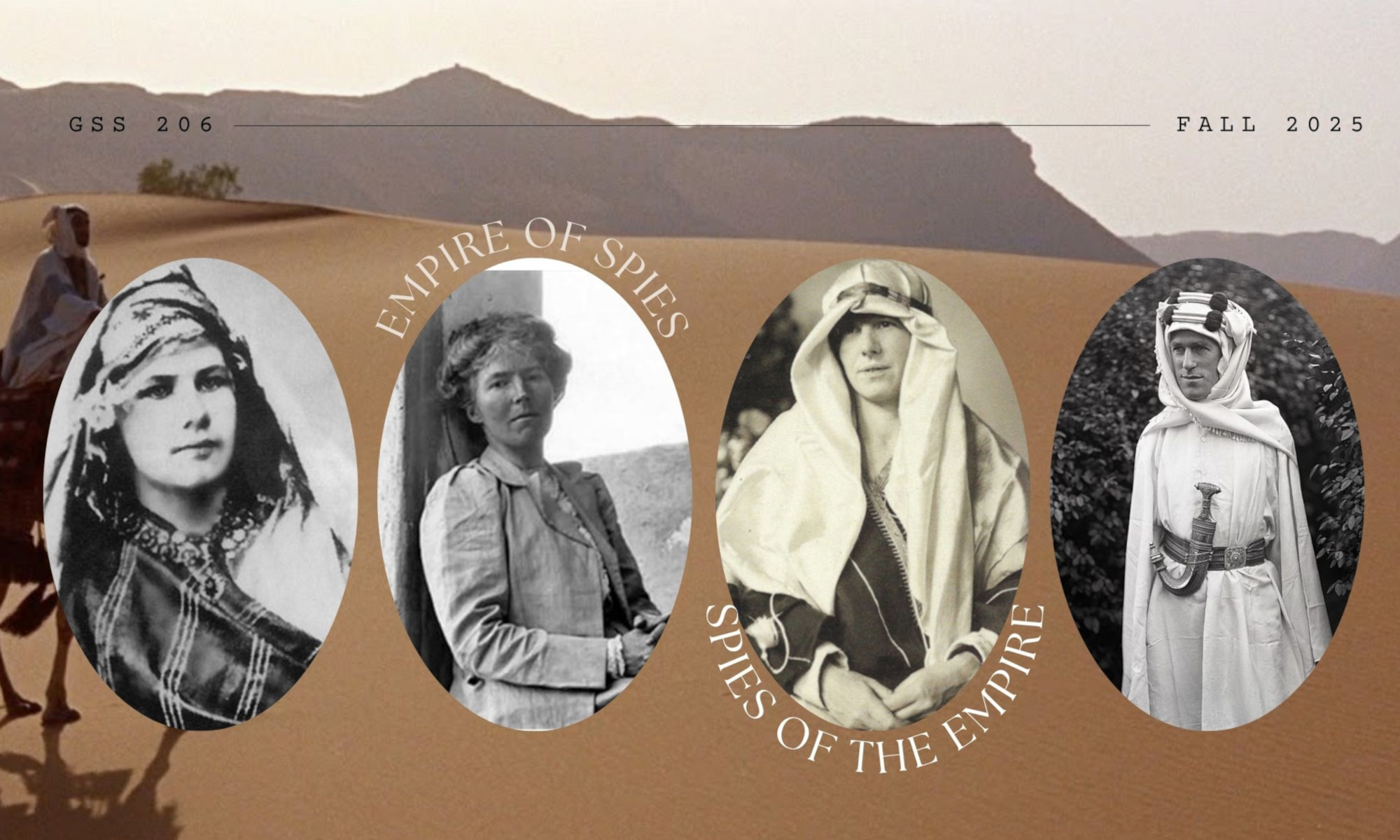
Honestly, the more I read Freya Stark and watched the films about her, the more uneasy I felt. She’s clearly brilliant and bold (there’s no denying that) but something about her voice never sits right with me. She notices everything, but it’s like she never actually feels what she’s seeing. There’s a constant distance, as if she wants to understand the world, but only on her own terms, only while she’s still the one holding the map.
So I made this playlist to respond to what she couldn’t say, what she couldn’t feel.
1) Marcel Khalife – “Ummi (My Mother)”
(Linked to: Letters from Syria and Beyond Euphrates)
In Letters from Syria and Beyond Euphrates, Stark walks through Damascus and Baghdad describing every detail: the graveyards, the veils, the “three separate quarters.” She’s observant to the point of precision, but she never really steps inside what she’s seeing. When I listen to Khalife’s “Ummi (My Mother),” that distance completely disappears. His voice feels like warmth, like home. When he sings, “I long for my mother’s bread, my mother’s coffee,” it’s belonging. Khalife makes what Stark calls “the Orient” feel human again. He sings from within what she only describes. Reading her after hearing him, I realized how often she confuses curiosity for connection.
2) Ahmad Kaabour – “Ounadikum (I Call to You)”
(Linked to: Passionate Nomad, Chapter 19)
There’s one line from Passionate Nomad that stuck with me: “It hardly made sense to make the Palestinians pay with their homes and lands for injuries done to Jews by European Christians.” She’s right, but she says it like an observer writing a report, not someone grieving a people’s loss. Ahmad Kaabour’s “Ounadikum” is the exact opposite of that. When he sings, “I call to you, my people,” it’s urgent, not detached. His voice makes her writing feel distant, like moral language without emotion. Stark’s “they” never becomes “we,” and that’s the difference.
3) Fairuz – “Zahrat al-Madā’in (The Flower of the Cities)”
(Linked to: Passionate Nomad and her 1944 press comments)
When Stark writes about Jerusalem, she does it with a kind of calm that’s almost cold. She calls it “friction between Jews and Arabs,” as if she’s describing weather. Fairuz’s “Zahrat al-Madā’in” destroys that calm completely. When she sings, “Jerusalem, flower of cities,” it’s both a prayer and a cry. You can feel the heartbreak in every word. She aches, grieves, and feels (unlike Stark who seems to only be analyzing).
4) Tracy Chapman – “Talkin’ ’Bout a Revolution”
(Linked to: Freya Stark’s 1944 press tour comments)
During her 1944 press tour, Stark calls the Arabs “the rightful owners of Palestine,” which sounds bold until you realize she’s still speaking as part of the British machine that made the whole crisis possible. She names the problem but never challenges the power behind it. Tracy Chapman’s “Talkin’ ’Bout a Revolution” is like that silence finally breaking open. Chapman doesn’t stop at moral awareness; she pushes toward change. Her song says what I wish Stark had the courage to: not just this is wrong, but this must end.
5) Le Trio Joubran – “Masār”
(Linked to: Towards the Unknown Land – Nepal)
In Stark’s final film, she’s carried through the mountains of Nepal by a team of porters. She looks fragile but composed, smiling faintly as she says, “If it fails, it fails.” The moment is framed as graceful acceptance: an aging traveler facing limits with humility. However, to me, it felt like comfort disguised as wisdom. Even at the end of her life, she’s still being carried (literally) by others whose presence is unnamed. Le Trio Joubran’s “Masār” sounds like that scene. It’s beautiful, but it refuses peace. It feels like remembering something you can’t fix. When I listen to it, I imagine it filling the silence in Stark’s film: not judging her, but not forgiving her either. Just holding her quietness up to the light and asking what’s underneath it. It made me think about how reflection isn’t the same as reckoning. Stark reflects endlessly (on landscapes, people, herself) but her reflections never really cost her anything. Masār feels like what real reckoning would sound like: the moment when beauty stops protecting you, and you finally have to sit with what you’ve done.

To sit with what you have wrought….wallahi, that’s a killer.
The question then becomes also one about the uses of the aesthetic, here, the beauty of her prose, for which she is praised, her ability to convey the smallest details of the places and peoples she meets on her travels. There is great beauty in the music you have shared–but its of a kind that might also be described as fulfilling the mandate of the anti-aesthetic–a move that prioritizes communication of feeling, not shying away from harsh realities to evoke a strong emotional response in your reader/listener etc. Such a move is associated with postmodernism; Stark, however, was a modernist, tied to Empire in all of its forms–including living up to ideals of emotional detachment associated with Aestheticism (that actually preceded modernist era)–wherein beauty is more important than morality–you can see Immanuel Kant on this concept of disninterestedness as an intrinsic quality defining aesthetic pleasure. So yeah—spot on!