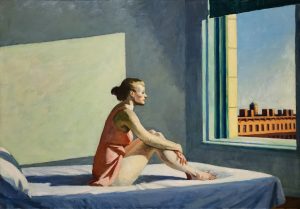
Edward Hopper was a painter who explored American solitude and loneliness more broadly. While Hopper depicts scenes that are rather simple, they still evoke so much emotion. They force the viewer to face emptiness head-on. In Morning Sun, a woman sits on her bed, stares out the window to the sky. But somehow, it feels lonely. Is it the emptiness of the room? Bare walls, a solo figure, a cloudless sky, a simple bloc of buildings, the look on the subject’s face? While studying Freya Stark, it seemed to me that loneliness also permeated her narrative. Stark, perhaps more than the other spies we’ve studied, makes travel seem exceedingly beautiful. Her travel writing stands on its own and would successfully cover her trail (but not dissolve ALL suspicions of her) if we did not know she was a spy. It’s both relaxing and meaningful, adventurous and eye-opening. This makes her spywork particularly captivating and sinister. Quotes like “And if our Empire melts away I think it will not be because we have lost the love of serving but because we have been denying that love to other people, so depriving them of a chance to practise virtues that could make them happy as much as they do us” (Perseus in the Wind, 15) and “It was the fashionable thing to be anti-British in Baghdad at that time” (Baghdad sketches 42) take on a new light. No longer is Stark a judgemental and hoity-toity British traveler, she is an invested patron and benefactor of empire itself. Psychoanalytically, I think much of this is rooted in her low-class (and therefore racialized) upbringing. Her life was deeply nontraditional: a confused family unit, unloving proto-feminist mother, romantically deviant father figure. All of this contributed to her desire to not only be accepted, but to belong to something, to Britain and its empirical values. She took on the identity of a foreigner, despite being British. “She spoke English with a slight foreign accent, [which] made her an immediate object of suspicion to the British authorities,” even though as she writes, “It makes me feel a kind of pariah from my own kind, and awfully disgusted… I am not even pro-native certainly as much of an imperialist as any of the people here” (Ruthven 152, 153). Imagining Hopper’s figure as Stark, in this way, feels significant to me. If the figure is read as Stark, she looks out to the horizon in a trap of loneliness, empty space behind and before her. She works towards empire because of her desire for belonging, but to what end? The room is empty, but so is the view outside the window. All that shows is one bloc of buildings, not even the ground it stands on. This takes on the significance of the consequence of empire: a building with no (or at least an uncertain) foundation. While the sun shines on the subject, the room itself is not warm-toned. It’s cool blue and cold, like a solitary hospital room, evocative of Stark’s nursing experience and her time being ill. The subject’s eyes are dark, perhaps contemplative, her mouth straight and serious. Is she lonely, sad, regretful? What does it mean to her to look away from the presumed comfort of the bed she sits on? She has no cushioning behind her back, despite there being a pillow within reach. Instead, her only comfort seems to be a self-soothing hold. Furthermore, we only see one side of the figure’s face, much like how Stark presents herself (literally and metaphorically): a seemingly innocuous figure with the incredible ability to hide what is underneath the surface. The figure is an incongruity, the only vibrant pink of the piece, yet shadow covers parts of her. Her color is diminished and she almost blends in with the wall behind her. Hopper captures, if read in the context of Freya Stark, the loneliness of empire, its shaky foundation, and the consequence to (not only its victims, but also) its perpetrators. Empire is inherently empty: a sun with no warmth, a bed with no comfort, a room where one is forced to always look ahead, but never successfully move forward.

I really love how you connect Morning Sun to Freya Stark’s loneliness. It’s a great visual metaphor for empire’s emotional cost. I also like how you tie her isolation to her background and desire for belonging since it reframes her travels as a search for emotional citizenship within empire. Do you think Stark herself ever recognized this kind of emptiness in her later writing?
I loved this analysis of Freya as the woman in ‘Morning Sun’ as I have always found this to be quite a captivating painting for its ambiguity. My original impression of this work was one of empathy and embodiment; I could feel the warm rays on my skin, the tranquil solitude of waking up alone, the peaceful moment of reflection. But reading your careful inspection, (especially the detail of the pillow being unused but within reach), my mind turned to a different observation. Where is her blanket? What kind of psychopath sleeps completely uncovered at night? Is the lack of protection in a dark time the consequence of scarcity or of personal punishment and preference? In the same way as you, I applied these questions to Freya Stark, and came to the conclusion that the sun is the Middle East, the room is her identity and constraints as a British woman in her time, but her positioning is a choice of her own.
Absolutely fascinating responses from both Cat and Amber–to a lyrically analytic piece, quite in keeping with the style of Stark herself! Hopper’s use of chiaroscuro is of a piece with the moody fluctuations we witness between emotional resonance vs cool intellect contrasted in Stark’s writing and view of the world and her place in it. BTW—there is an Edward Hopper House m Museum in the ton of Nyack approx an hour and half from Princeton!And my former colleague from MSU, a well regarded poet named Carole Stone, has a poetry collection named Hurt, The Shadow: The Josephine Hopper poems—exploring the painter’s life and work from the perspective of his wife, Jo Hopper. Might yield some interesting material!!!