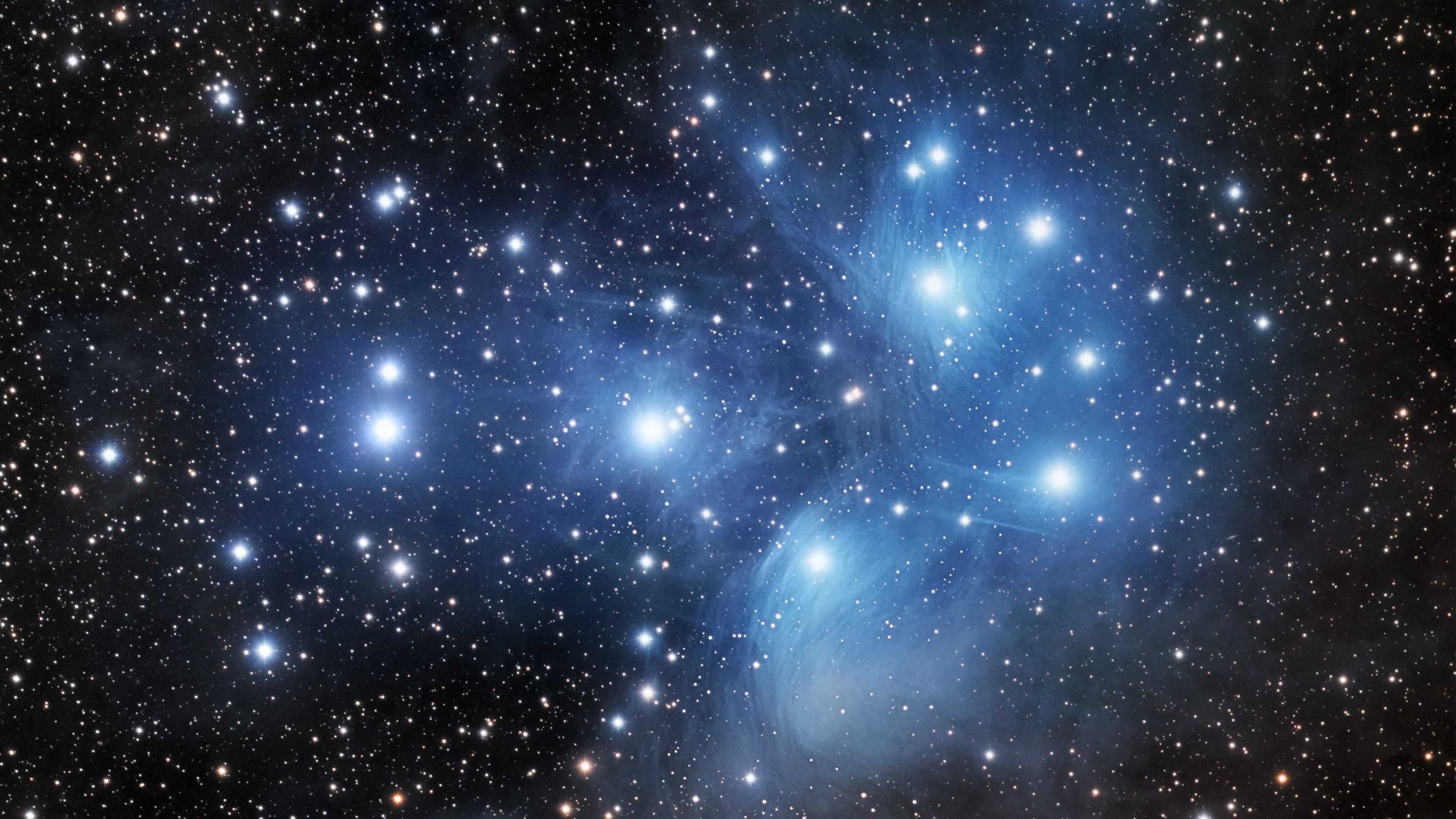
Around ninety-seven years ago, Cornhill Magazine would publish an article about the French imperium in Syria. The author of this work went by the name of Tharaya. We now know that this was only a pseudonym for the legendary Freya Stark. The name Tharaya is actually the Arabic name for the open star cluster commonly referred to as the Pleiades. This cluster contains seven stars and can be found to the right of the Orion constellation. The above image— or rather the stories and meaning that humanity has ascribed to the stars whose majesty this picture tries to replicate— manages to capture a fair amount of Ms. Stark’s essence.
The fact that Freya Stark even chose the name Tharaya is itself insightful. As previously mentioned, Tharaya was and is still more commonly known as The Pleiades. Most of Stark’s western audience would likely not even know that the two names referred to the same stars. However, as someone who prided themselves in truly assimilating with Middle Eastern culture, it is unsurprising that she would adopt an Arabian moniker despite the culture dissonance it may have caused. Moreover, Tharaya’s literal English translation is “She Who Illuminates the World.” This is quite a heavy title to impose on oneself. While some may see this as arrogance on the part of Stark, it may be more accurate to interpret this as her having an understanding of the gravity of her work. In an age before the internet, most people’s perception of the world came from the experiences and writings of adventures like Freya Stark. As a result, Stark likely felt a duty to shine a light on and shape the narrative of the Arab world she came to love.
Further connections between Freya Stark and these stars can be seen when considering their significance to the Greeks. In Greek mythology, the Pleiades were seven sisters who, due to their immense beauty, were chased by Orion the Hunter. This chase continued until Zeus turned the sisters into stars in order to escape. However, Orion would eventually also be turned into a constellation, and continue to chase the sisters through space. It would not be unreasonable to assume that Stark wished to be desired and pursued in a similar way to the Pleiades. When referring to her adventurous life, Passionate Nomad asserts, “In the beginning she did not have a specific goal, other than wanting to be a writer—and, above all, to be loved. Yet in the end love was the one thing at which she failed…” While Freya Stark had attachments to various men, she always felt as though the injury she sustained diminished her looks so severely that she would truly never be desired.
Some may have noticed that the Passionate Nomad refers to Tharaya as “the dazzling star at the center of the constellation Pleiades.” So, why did I discuss the Pleiades as a whole? Upon doing my own research, it seems that when people mention Tharaya they are almost universally referring to all seven stars. Within the same sentence, Passionate Nomad also refers to the Pleides as a constellation instead of a star cluster, so they may just need a general astronomy lesson. With that being said, even if we take Tharaya to be the central star of the Pleiades, we still see a desire for love. The central star of the Pleiades is called Alcyone. In Greek mythology, outside of being part of the Pleiades, Alcyone is best known for her love stories with Poseidon and Ceyx, The particulars of these stories are of lesser importance. What is noteworthy is that, as a mythological figure, Alcyone is deeply associated with a lover. This association is one that, for previously mentioned reasons, Freya did not have yet desired greatly.
For my anime fans, Alcyone is what Neo Genesis Evangelion (Eva) was originally going to be titled. Without going into too much detail, Eva, at its core, is a story about self-acceptance and the importance of loving yourself even without external validation (whether that be from lovers, parents, etc.). Seeing as Eva released in 1995, Freya Stark obviously had no idea this story would be created, let alone almost be named Alcyone. Regardless, she struggled with many of the problems that Eva tackled, and I believe could have really benefitted from experiencing the show. To be honest, I just thought it was a cool connection.

The concept of Freya Stark influencing an Eva knock-off anime…if we had given Masaki Kajishima a couple more years this could have been reality!!! Thank you for this deep dive — it has made me much more interested in the celestial landscape these texts reference, on the whole.
It IS a cool connection to ponder as you did here Femi–I agree with Ayanna: thanks for this deep dive—hadnt thought of the well thought out adoption of this moniker by Stark. As a budding astrophysicist, its pretty cool you would think on this…..