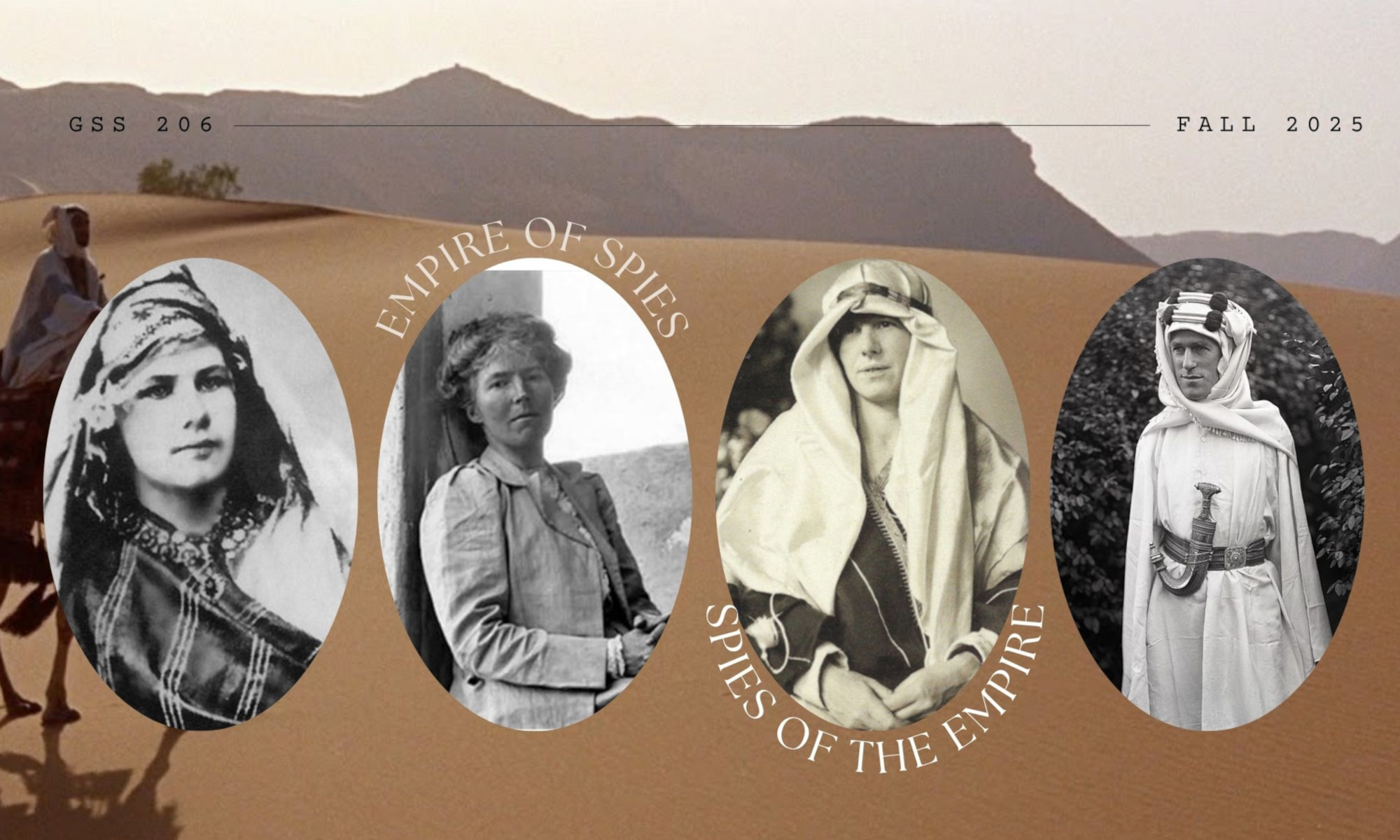
In Passionate Nomad, Jane Geniesse ranges from implying to outright diagnosing Freya’s adult choices and tendencies as a result of her tumultuous childhood. Her desire to please? A consequence of being devoted to a narcissistic mother. Her love for the outdoors? Her father’s influence in making her walk through the woods alone. Her love for extravagances? A need to offset the poverty she grew up in. Her desire for freedom and exploration? The result of her helplessness while sequestered in Italy. The list goes on and on, and wrapped within the layers of her psyche appears to be an interlocking relationship between the Freudian idea of domesticity and childhood with the gendered fantasy of the East.
Alice in Wonderland, or originally, Through the Looking-Glass, and What Alice Found There by Lewis Carroll is largely regarded as a metaphor for a young girls’ psychosexual self-discovery. Written in 1871 and an instant literary classic, it feels a bit divinely coincidental when Freya writes in Perseus and the Wind, “Whatever the ultimate origins, the book of Genesis gives a summary of the repeated story: delight in external things, and then human hunger for truth beyond. Eve, Psyche, Pandora, they would look, not, like the Lady of Shalot, away home the mirror, but through it, to see what is hidden behind the moving show: until the face of things becomes an impedi- ment to them and a torment, a barrier to the simplicity of truth.” Here, Stark equates herself with mythical figures of creation and exploration, but the critical lens we’ve applied to her in class makes her out rather to be the young Alice: bumbling through Wonderland, running away from the confines of mundane life, chased by some fear and ghost of her childhood. This analogy sets up how, in the minds of female colonial explorers such as Stark, the East functioned as a psychosexual space of “self-discovery.” In a world where every action was policed, freedom only existed and fantasy, and the East was a living embodiment. On some level this mentality persists even today, with common tropes of mid-life crisis prompting a trip to India

This is a great post! However, I would like to note that not only does the escapist mentality you mentioned still persist today, but it has actually gotten worse. While this mentality can take the form of a mid-life trip to India, I think it is most deeply rooted in one of the biggest forms of modern entertainment: video games. To escape the confines of our mundane everyday lives we are no longer limited to this reality. Now, we can “go” to space, “play” in the NBA, “fight” a dragon, etc. By no mean do I think that playing Fortnite is the exact same psychosexual experience as Stark’s travels to Arabia, I just found it interesting how escapism has changed over the decades.
Interesting take by Femi.
I do think the psychosexual fantasy of the East is/was a great enabler of these voyages of discovery–of that repressed european self, displaced onto its Other and in that form, made more manageable. There is quite a bit of work on postcolonial readings of Freud –Ashis Nandy might interest you esp his book, The Savage Freud