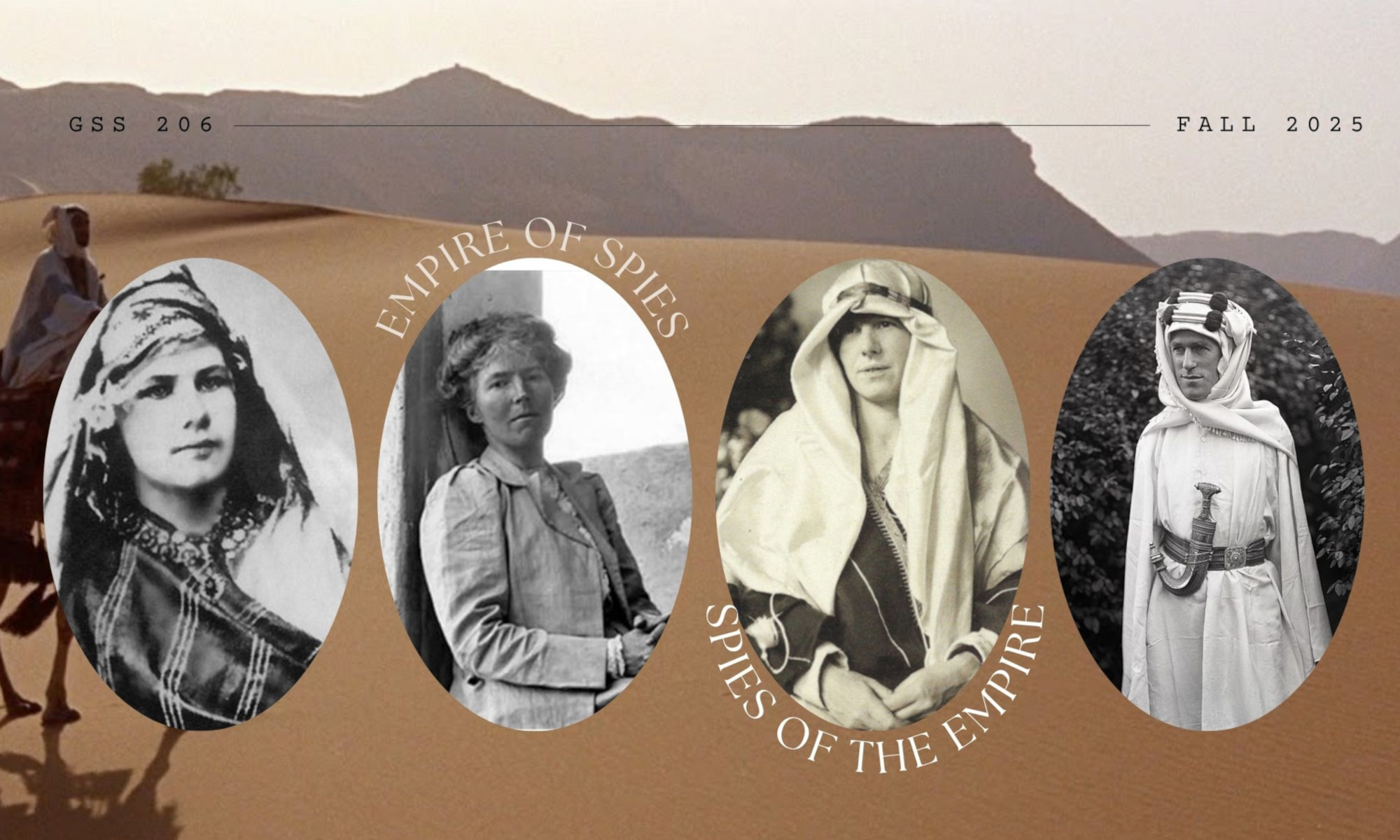
When I decided to write about Isabelle Eberhardt as a “nomad” at the beginning of the semester, I was still preoccupied by questions about goodness (and maybe colonial self-definition). What I wondered was along the lines of: how can Eberhardt escape her colonial positionality through desire? Is her identification with Arab Islamic culture genuine or just another form of appropriation? I spent the entire post wrestling with whether the nomad and the spy could coexist, and genuinely puzzling over whether her attachments were proof of complicity or evidence of something more complex at work underneath the waves. Looking back now, I realize I was trapped in the same framework as Eberhardt herself when she wrestled over her identity in Algeria: implicitly positing via my argumentation that individual intention could transcend the material reality of empire.
Yet, a shift happened somewhere between Bell and Stark specifically, I believe, with our discussion of Herzog. Discussing a figure who fell so firmly into an imperial stereotype yet also commanded the respect of those around her, Arab and non-Arab alike, I think I started realizing that “goodness” or intentionality couldn’t truly capture what was at play in her imperial exploits. With Bell, I began not just to see how narrative forms operate as colonial technologies, but to also treat them with the urgency required in a world order saturated with them. For example, I realized Herzog’s Queen of the Desert succeeded at what colonial craft is designed to do: orient the viewer, create messianic figures, and turn the traditions of colonized peoples into narrative fodder. In such an analysis, drawn from FNT’s criticisms of “craft,” I was not inquiring as to whether individual colonizers were good or bad. Instead, I was asking how the structures they belonged within function: how they produce certain subjects, certain narratives, and certain ways of seeing that make empire inevitable.
By the time I wrote about Stark and Lawrence, I think I’d fully moved into analyzing the material mechanisms of colonial narrative production. With Stark, I experimented with a counter-perspective not to redeem her but to expose what her original narrative structurally excludes such as reciprocity, the possibility of being equally known by colonial subjects, and the colonial asymmetry of travel writing. With Lawrence, I traced how imperial narrativization operates as an obliterative force, the flattening of his fragmentation all served the empire’s material needs. The question I asked this time around wasn’t whether Lawrence was complicit (yes, duh) or whether he felt bad about it (probably) because ultimately, those questions are not helpful in understanding what Lawrence did to Arabia. The question I asked this time around was about how the empire required him to be mythologized differently than Bell, Stark, or Eberhardt because he carried different symbolic weight. This had nothing to do with anyone’s individual goodness and everything to do with how imperial narrative machines function.
What I understand now, looking across these four posts, is that my initial focus upon individual morality was a distraction from actually understanding Empire. The spy figures we studied this semester were all caught in structures that exceeded them, formal mechanisms that shaped what they could write and how they would be remembered. My thinking moved from asking “were they good people?” to asking “how do these structures work, and what would it take to actually betray them?” That shift from individual judgment to structural analysis feels most pertinent in tracing not only my intellectual development this semester, but also in doing the sort of analysis that is useful to the decolonial project as a whole.
P.S. I’m sorry but I hope this can apply for extra credit too…sorry…thank you for the lovely classes!!!!!

Also this is entirely unrelated so discount this maybe even as part of my reflection but I’d just like to say. THE GENDER DYNAMICS WERE KILLING ME THE ENTIRE TIME —> @__@ I was getting Bamboozled by the Lawrence letters like they were actually killing me and then I was like would Bell actually(?) peg her husband then I was getting beaten over the head by Eberhardt transmasculine subtext and Stark being Stark and I really wish I had explored the gender of it all so much more…It was so fascinating my poor colonial meow-meows who discovered that the nation-state sexing apparatus will ultimately betray even those who serve it…also Bell and Stark both being in the anti-suffrage league was peakkkkkk. Thank you to my favorite comedic genius: reality.
You crack me up Ayanna, but honestly reality is truly the grounding factor in this class because it be the reality of empire and the structures around the figures we looked at and ourselves that essentially drive who we are, what we do, how we do what we do.