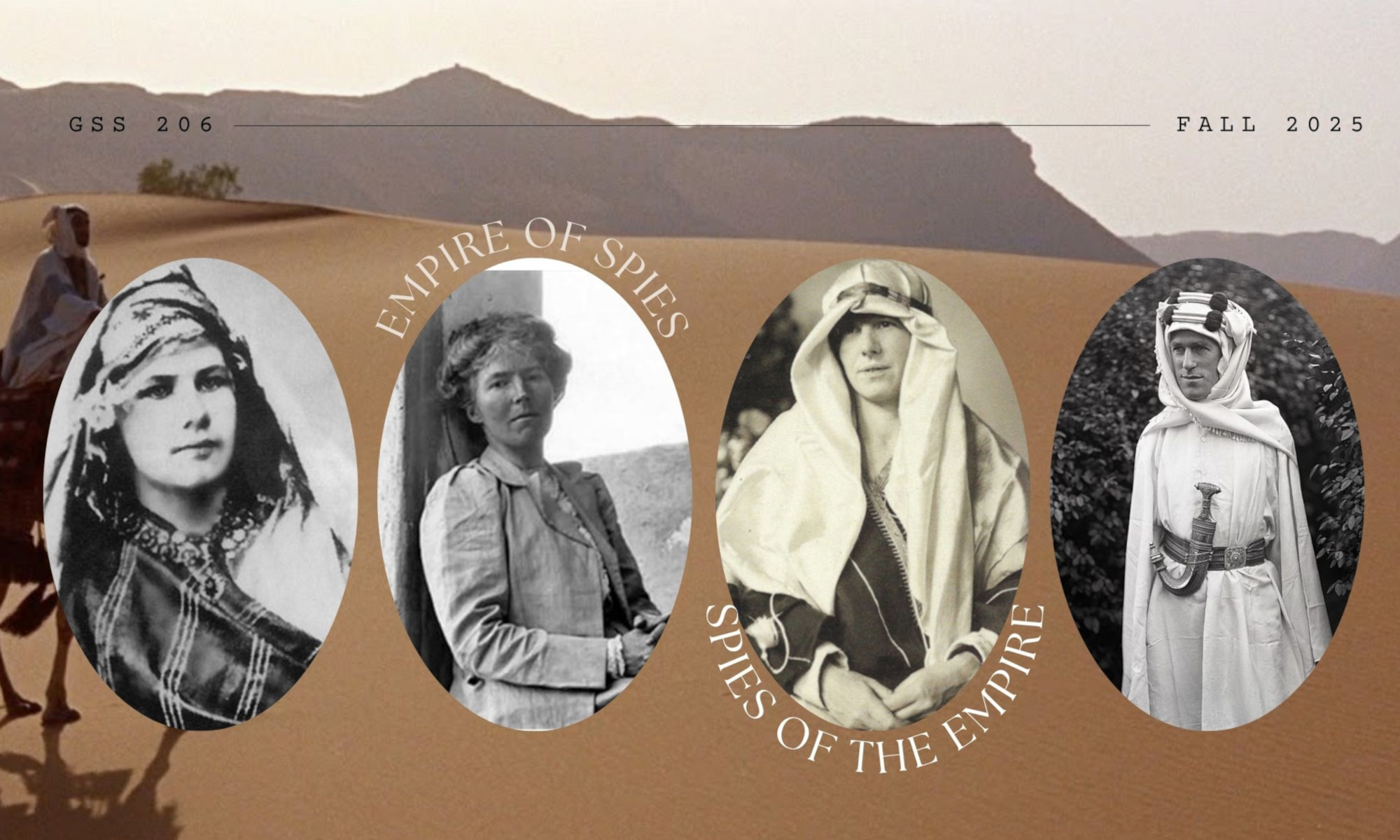
I’m very glad I enrolled in this course. The description stood out as unique, in that it wasn’t a conventional history class, and that it focused on four individuals. I think this was the most entertaining and fun course I’ve had so far because of the exciting topics we covered each week and the spirited discussions we developed together. Initially, my understanding of the course was that we would learn about each spy’s life and activities, and very quickly this deepened into an awareness that the course would address lots of interconnecting, layered aspects that are often not conventionally addressed when looking at historic figures and events – questions of internal motivation, struggle, psychoanalysis, tensions in the spies home environments that pushed them abroad, overarching imperialism that existed before and after their lifespans, and developed their worldviews, and the chief question of morality in espionage: can a spy ever be moral, or morally self-aware?
Why did Eberhardt, Bell, Stark, and Lawrence all deeply love the people they met and lived alongside, while also actively working against their best interests? I question too, how difficult it is to extricate oneself from a dominant empire that one is raised in, and how deep the dedication goes to convincing oneself (and others, and perhaps too in perpetuity through one’s writing) that you are on the right side of history, and that all of your surveillance, information brokering, and political intrigue has been really to help the empire help the local people – to bring some dream of stability and order and “civilization” to a perceived uncivilized place. Operating in this mental frame, which all four of them certainly grew up in, and the tension against their personal difficulties fitting into conventional society (three being confident, independent women in a man’s world, and one being a homosexual man in a heteronormative world), deepened the axes of conflict between individual and empire – they had to serve societies that oppressed them too, and they reclaimed some sense of power by participating in a grand machine (empire) that oppressed foreign peoples, because it validated their need to fit in, to contribute, to go on an “adventure”, to really write their names in the history books and be praised and remembered by their home society which very well might have otherwise discarded them and labelled them as outcasts, had they not turned their passions and obsessions with languages, cultures, writing, and travel to the art of espionage.
Before taking this course, I didn’t really understand what Postcolonial Studies were, or why it was a relevant academic shift to turn to postcolonial analysis. I feel that I’ve gained a significant understanding of what it is and the many ways it is highly useful and important to integrate into how we understand history, politics, culture, and other fields, both in the past and in the present. As we moved through the semester, I began to consider strongly the perspectives and voices (though suppressed in the Western corpus) of the “other side”, that is, the people facing imperialism, and how it changes our interpretation of history when we seek to understand their history and context, rather than only the angle dominated by the colonizing force. I enjoyed how as a class we began linking the figures together, and thinking about similar motives and patterns that connected them, as well as critiquing them and the (often detrimental) long-lasting effects they had upon foreign peoples. I thought as well about contemporary imperialism and overreach, and how while imperialism today is not identical to the imperialism of the late 19th and early 20th centuries, it is very much still present, as is Orientalism (the fantasy of exoticising the foreign, and commodifying it). A lot of our topics intersected with film and TV tropes I had seen, with these fantasies of an imagined Arabia, Persia, Mesopotamia, which all collapse the moment you examine any real history.
Something too that stuck out to me was the concept that empire survives only when an “other” is invented from a real group of people, an “other” which must be civilized and converted, educated, changed, in order to fix them, and to perpetuate the economy, military, and cultural engines of the colonizing imperial state. The empire feels superior when it makes the “other” exist, and the empire remains superior when the “other” is forced to serve its ends. But our four spies interacted so heavily with the “other” that their empires named, and they seemed genuinely to be fascinated and drawn to them, learning their languages, reading their histories and classical literature, traveling everywhere, observing and partaking in traditions, trying to preserve artefacts, making maps, and documenting and photographing places no other Westerners bothered spending time with.
So then, I’m left with this… A whirlwind of a semester, and a lot of unanswered questions – but to me, this doesn’t feel like a conclusion. It feels like I’ve been equipped with a lot of frameworks, tools, and ideas with which to approach everything else. And for that I’m very, very grateful.

I just loved–and was very moved–reading this detailed self-reflexive analysis of the course and its development through the course of this term.
I am so delighted you joined the course Sophie–you brought valuable interventions in our discussions and I sincerely hope that some of the analytic frameworks we explored will be of some use in the rest of your career here at PT as well as later on in life.
Indeed, life and we as individuals in it are a complex interplay of often contradictory motivations and experiences. These spies were no different—but their effects in the world definitely marked them out as worth understanding and learning from–so as perhaps, to carve out other paths that do not serve imperial ends.
Wishing you the very best as you move forward, and please, do stay in touch!