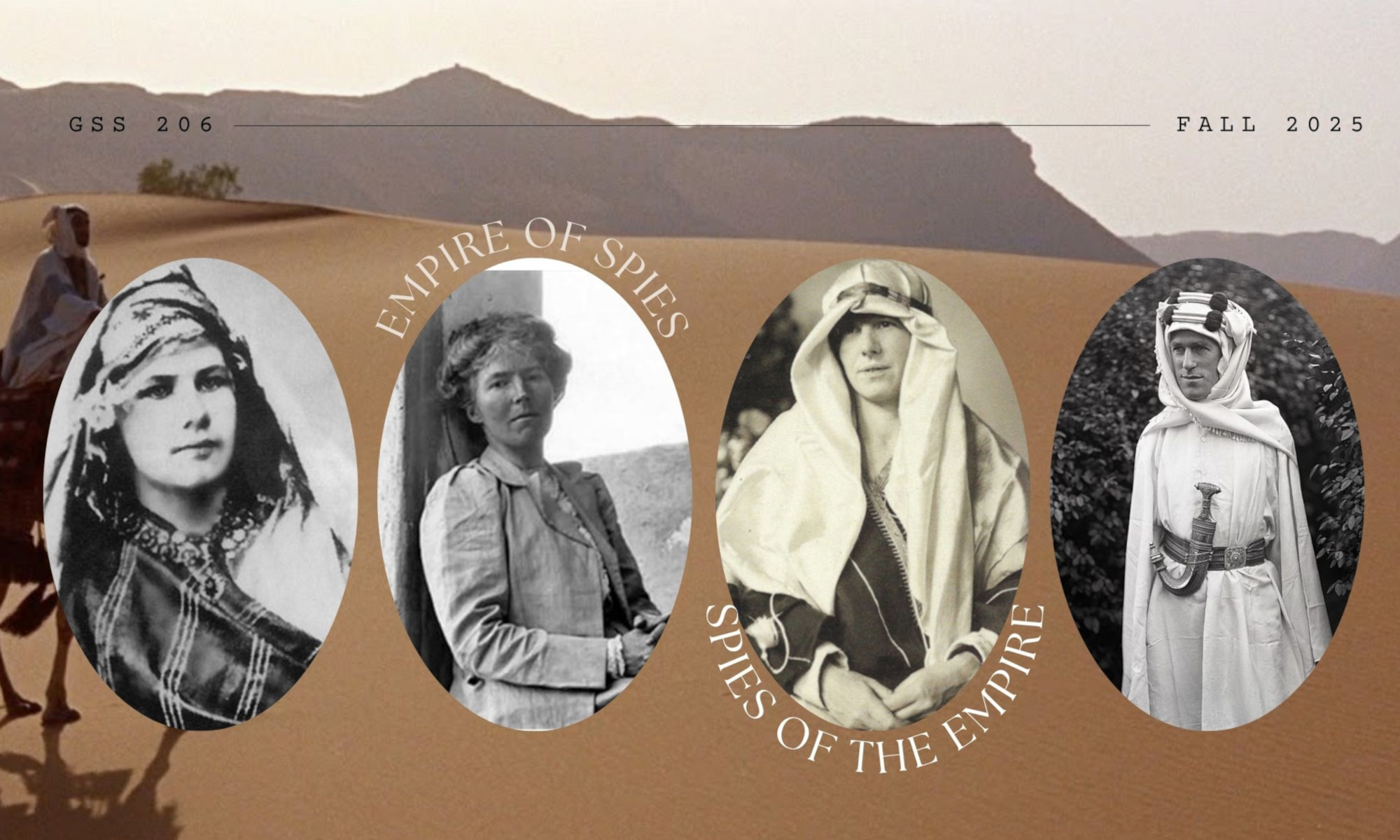
My Adventure with Isabelle

While it is no secret that I often ridicule, slander, and even mock Ms. Eberhardt, there is no one else I would rather vacation with than her. Unlike her status as a spy, Isabelle Eberhardt’s ability to have a good time should not be up for debate. Through the readings, it became clear that Isabelle possessed a quality that far too many people lack nowadays: a sense of adventure. One moment she’ll be worshiping in a mosque and in the next she’ll be indulging at a brothel. It takes a special kind of existence to live a life as full as hers within the constraints of twenty-eight years. I admire the spontaneity that characterized her way of life. Admittedly, I have not gone full vagabond and thrown away all my responsibilities and alliances; however, I too live a life littered with exploits and antics. When referring to her time in Northern Africa, Rana Kabbani claimed, “It provided a way of attaining experiences more varied than those she could have expected in suburban Geneva. ” Growing up in suburban Kentucky, I can relate to the alluring call of the distant and unknown.

The destination for our vacation could not be any where else except for Algeria. While I was very tempted to choose Nigeria, the familiarity the Isabelle has with the people and culture of Northern Africa cemented the choice (I am assuming  that this vacation is during her era and that I can speak Arabic). I think our vacation would go almost perfectly. I can see us riding horses through the desert, discussing her unique practice of Islam, etc. Additionally, I think our personalities would mesh really well with each other. The only type of people I struggle to vibe with are those who are extremely type A. Fortunately, Eberhardt is the exact opposite. She was the definition of “go with the flow.” It has even been said that “She did not make decisions.; she was impelled to take action.” My only worries are that her narcotic and sexual desires would impede our fun. Nothing sounds worse than having to derail our entire vacation so that Isabelle could beg for kief or pine over a man (or God forbid she does both).

Kin and Stranger in Persia

“Ride through [the bazaar] on a summer morning, when its vaulted coolness will offer you a grateful shelter from the sun, and before its activity has been hushed by the heat of mid-day.” Gertrude Bell’s Persian Pictures bursts open with images like this: shafts of light cutting through domes, merchants sitting cross-legged among their wares, mule bells ringing through the crowded arches. I felt transported, and yet, I also felt the distance in her gaze. Reading Bell reminded me of my own road trip from Tangier to Mauritania – where I looked Moroccan, until my Arabic yielded me not a local. I was kin and stranger, welcomed and held apart. Bell writes Persia with that same tension: sympathetic, but detached.

That detachment is double-edged. It sharpens her sketches – the bazaar alive in dust and color, the hidden gardens that bloom like secret paradises, the mourners of Hussein caught between devotion and performance. But it also limits them. Persia, in her hands, becomes spectacle and history, a land she can describe but never fully inhabit. Her authority rests not on intimacy, but on the power to interpret – to render the unfamiliar legible for those at home.

Still, Bell’s Persia endures because it mirrors the paradox of travel itself. To move through another place is to be both transported and estranged, drawn close yet never fully at home. Reading her, I am reminded that distance is not failure but condition – that what lingers is not only the image of Persia she saw, but the uneasy truth that to observe is always to stand slightly apart.

In Response to “Is there an idea or image or line from our readings that has stuck with you for more than the week or unit when it was discussed? What are you continuing to think about it? Why do you think it has had this effect?”

In the records of Isabelle Eberhardt’s life I find neither the vagabond nor the nomad she so fondly self-references. Instead, I find a woman at odds with her colonist’s background, yet who finds herself wedded to it again and again — no matter the landscape. This turn of events may have always caught Eberhardt by surprise, but its cause is really quite simple. A “nomad” must not only shed all attachment to the material forces around them (oppositional and otherwise), and, consequently, shed all loyalties. The spy, however, is a figure of multiple loyalties: their attachments not disavowed, but instead participated in with even more vigor than the common person. As such, a spy cannot be a vagabond, nor a vagabond a spy — no matter how much Ian Fleming’s romantic storytelling attempts to conflate the two. 

Still, why does the role Isabelle occupies (spy) seem to correspond so frequently to the role she wishes to occupy (nomad)? The answer lies on page 213 of Julia Kristeva’s Powers of Horror

“On close inspection, all literature is probably a version of the apoc-

alypse that seems to me rooted, no matter what its socio-historical

conditions might be, on the fragile border (borderline cases) where

identities (subject/object, etc.) do not exist or only barely so—

double, fuzzy, heterogeneous, animal, metamorphosed, altered, abject.”

It is important to understand that border enforcement, in the context of the nation-state, are largely a modern innovation. It draws on the colonial demand for dominion over the Earth, segmenting it into individual pieces that individuals or communities claim to “possess.” For many colonial subjects, the imposition of border regimes stoked more terror than direct violence from colonizers, as the false imposition of ill-defined borders led not only to violence from those meant to enforce them but also from the oft-disparate cultures and societies now forced to occupy the same “nation.” It is only in this world, where the horror of borders and their fragility is stark naked, that we can understand the blurring between Isabelle’s lived and desired roles. 

Spies and nomads share one commonality: the ability to permeate borders. Nomads because they have unattached themselves from nation-states and all that they entail, and spies because they are attached to multiple of these colonial projects intending to redesign the world. Eberhardt, over and over again, confuses her ability to occupy the contradictory worlds of colonial Algeria as proof of her “nomadic” lack of attachment to the way of things. However, Isabelle’s ability and desire to occupy these worlds is a direct result of her many attachments — her eroticized fascination with Arab Islamic culture sublimated in her operative work for the French Empire. Unable to let go of either attachment, she finds a way to manipulate them in her favor: allowing her access to a “foreign frontier” all while refusing to renounce her colonial background.

The nomadic life she details living, then, is revealed to us: a tower of dust.


Desert Ballad: A Playlist for Yasmina

I often do readings while listening to sad playlists full of tragic love songs. While reading Yasmina, I found myself sympathizing with her even more because the music added an extra melancholic element. Her story moves like music, beginning with quiet innocence, swelling with passion, and ending in heartbreak and collapse. These five songs, for me, capture Yasmina’s journey.

  1. “Young and Beautiful” – Lana Del Rey

This song reflects the way Yasmina begins: innocent, dreamy, and living her life as a shepherdess among the ruins. She doesn’t fully understand what’s coming, and when Jacques enters her world, she’s swept along almost without a choice. The line “Will you still love me when I’m no longer young and beautiful?” mirrors Yasmina’s fate. Jacques is captivated by her youth and beauty, but those qualities fade in his memory once he returns to France, leaving her devotion behind.

2. “Love Will Tear Us Apart” – Joy Division

Yasmina and Jacque’s love is doomed before it even begins. She even tells him it’s impossible for a Muslim girl and a French officer to be together. But instead of stopping, they give in, which makes their passion both beautiful and devastating. The song has the same feeling: you know the ending will be tragic, but you can’t look away. For me, the refrain “love will tear us apart” is exactly what happens when Jacques is reassigned. Reality itself rips their love apart.

3. “Boulevard of Broken Dreams” – Green Day

When Jacques leaves for his new post, Yasmina is left in total loneliness. The image that stays with me is her lying facedown in the gorge, immobilized by grief. She doesn’t rage or resist. She just repeats mektoub. That resignation matches the emptiness in Green Day’s song, where the singer walks a lonely road with no one by his side. Yasmina’s “boulevard” is the dusty plain of Timgad, but the isolation and drained hope are the same.

4. “Somebody That I Used to Know” – Gotye ft. Kimbra

This song reflects the cruelty of Jacque’s return. Yasmina still sees him as her Mabrouk, the man she loved and waited for, and she calls to him with joy. But Jacques, now married to a Parisian woman, treats her as nothing but a shameful past. Her outburst: “Why did you use all of your ruses… to seduce me, carry me away, and take my virginity? Why did you lie and promise to return?” This fits perfectly with the song’s bitterness about being turned into a stranger by someone who once defined your whole world. For Yasmina, love was life itself. For Jacques, it became disposable.

5. “Back to Black” – Amy Winehouse

The end of Yasmina’s story is the hardest to read, and Back to Black is the only song that fits. Yasmina spirals into illness, poverty, and prostitution, but even then she still clings to the memory of Jacques. Winehouse’s line “we only said goodbye with words, I died a hundred times” captures the endless mourning Yasmina embodies. The story’s final words, “Yasmina the Bedouin was no more,” echo the song’s raw finality. Both tell of women consumed by love that society never let them keep.

Isabelle Eberheardt + “Slouching Towards Bethelehem”

I found myself regarding Isabelle Eberheardt in a very critical light, one that reminded me of how Joan Didion regards the young hippies of Haight-Ashbury in the 1970s. To me, the most refreshing text on Eberheardt was the introduction to Passionate Nomad, which highlights Eberheardt’s carelessness and essential uselessness in Algeria, to herself, and to those around her. This take on Eberheardt was similar to Didion’s disdainful, unimpressed portrait of hippies in the titular essay of her collection Slouching Towards Bethelehem

The Passionate Nomad introduction paints Eberheardt as beyond her time in that she was more akin to a 1960s hippie orientalist than a real colonialist. It refers to her as a symbol of the moral decay of Western Europe going into the twentieth century, especially of moral decay in European colonies, just as Didion paints the hippies as symbolic of wider moral decay within the American empire in the 60s and 70s before the rigid, fascistic Reaganism of the 80s. Her exploits in Algeria remind me of the Beatles in India, the hippies doing ayahuasca, or people going to “find themselves” backpacking in Southeast Asia—orientalists who like the aesthetics of transgression and the freedom they can claim as “vagabonds” and “outcasts” without any of the responsibilities of real revolutionary action. 

They were young teenagers who ran away from the constrictions of the nuclear family to find Haight-Ashbury a gateway to sex, drugs, and intertia, just as a young Eberheardt fled the constrictions of Geneva society to find Algeria a gateway to similar forces of decay. Neither group showed real interest in political action, despite a fascination with and empathy for local causes (for Eberheardt, Algerians, and for the hippies, often indigenous Americans, or Vietnam). They simply sought their own pleasure, often through exploitative means, and kept going until they ran out of funds. 

To me, these similarities point to broader parallels between the European political mood of Eberheardt’s era and the American political mood of the 1960s-early 70s. What might such parallels tell us about patterns of imperial growth and responding backlash? What about the nature of an imperial culture might, at its moment of internal decay, lead young people to attempt to abandon their privilege—yet fail to fully reject the culture that made and privileged them?

Prompts for Blogposts

Prompts for Blogposts: Empire of Spies


(Adapted from Anna Kornbluh, Northwestern U)


CONNECTIONS to pursue in your Blogposts:

one -two pages of casual writing (min 300, max 600 words) responding to one of the following prompts (a different one of your choice for each unit)


The goal of the reflections is to have ideas; the writing need not be fully polished


  • Describe something you learned from class discussions in this unit that you didn’t know just from doing the assigned readings.


  • Connect something you learned in class through readings/discussions in the unit you are writing about, to something you are learning in another of your classes this semester.


  • Compare assigned readings from two different texts by same author we read/discussed in a unit, or between two authors from two different units; make connections between the two.  Do they share themes?  Forms?  Tone?  Historical context?  Do you find them equally interesting?


  • Look back at the very first paragraph of a text we read by one of the writers under discussion, and discuss how the opening lays the groundwork for the rest of the work/other writings by same author.  Quote specific lines, phrases, or images to back up your claims.


  • What are some sentences you found interesting in this unit’s readings?  What made you notice these?  What do you notice in the passages/sections from to which these sentences belong?


  • Using quotes from this unit’s texts, persuade someone (friend or foe, your grandma or your senator) to change their mind about something important.


  • Compose a five song playlist to accompany an assigned reading from this unit, and write a few sentences for each song, explaining your choices and their connection to the reading/s.


  • Describe an idea you had in response to the readings/discussions for our class – any idea, about literature, the writer/s under discussion, or the world, or yourself.  How might you pursue this idea, in your studies or elsewhere?  Could this idea be a new direction in life? How might it become the basis for a new public policy or public mindset?


  • Choose a passage (no more than 10 lines) from one of the readings this unit and rewrite it, changing at least one of the literary aspects such as: person (change from first to third-person or vice versa), tense (change from past to present etc), focalizing character (i.e. write it from a different character’s perspective), style (adjectives, diction, description, tone). Then write a paragraph or two about the effect of your changes (on you, possibly on other readers).


  • Compose a yelp review to strangers, or a letter to a specific person, or a tiktok style video, recommending a text (film/video/short story/travelogue from this unit’s reading.


  • Find an image – a painting, a photograph, a graphic drawing – something that already exists because a human made it – that would make a good illustration for this unit’s readings.  Explain why you think that.


  • If you could assign this unit’s reading to anyone – your professor of another class, your lover, your boss, aliens from another planet, the president of another country – who would it be and how would they benefit from it? (you don’t have to discuss all of the assignments—pick and choose!)


  • You go on vacation with one character from a text on our syllabus (could be one of our “spies”! Or someone they write about or film representation of them).  Who is the character, what do you two have in common (or how do you differ), where do you travel, is it enjoyable?  Refer to the text (s) you choose for evidence in explaining your trip.


  • Is there an idea or image or line from our readings that has stuck with you for more than the week or unit when it was discussed?  What are you continuing to think about it?  Why do you think it has had this effect?


  • Final Connection Blog Entry: (extra credit)


Read over your entire portfolio of blogposts and describe the progress you have made in thinking and writing about the material assigned in the class.  If you opted to co-write 2 or more reflections, be sure to consider that process too.  What are some of your favorite ideas you’ve had in this class?  What would you like to know more about?