T.E. Lawrence’s Problem with Fame

In class, we often discussed to what extent Lawrence truly despised his fame. It seemed that our class’s  general consensuses was that Lawrence likely enjoyed the notoriety that he received from his exploits. As time passed, though, he came to have a great distain for said fame. This resentment likely coming from a place of shame over his inability to secure Arab independence. However, I disagree with the general consensuses. I believe that Lawrence likely always had, at least, some aversion to any sort of stardom. My opinion is largely based in the writing of Lowell Thomas. This may come off as surprising, because Lowell is know for saying that Lawrence “had a genius for backing into the limelight.” At first, this quote might seem to imply that Lawrence always unintentionally found himself in the spotlight. Describing this tendency as a genius, however, implies that to some degree it was intentional. I find this assertion to directly contradict statements Lowell made in the Foreword and Chapter 1 of this book With Lawrence of Arabia. In the Foreword Lowell states:

“During the time that Mr. Chase and I were in Arabia, I found it impossible to extract much information from Lawrence himself regarding his own achievements. He insisted on giving the entire credit to Emir Feisal and other Arab leaders, and to his fellow-adventurers, Colonel Wilson, of the Sudan, Newcombe, Joyce, Dawney, Bassett, Vickery, Cornwallis, Hogarth, Stirling, etc., all of whom did magnificent work in Arabia.”

Additionally in Chapter 1, Lowell comments:

“Even concerning his connection with the Arabian army he would say nothing, except to give the credit for everything that happened in the desert campaign to the Arab leaders, or to Newcombe, Joyce, Cornwallis, Dawney, Marshall, Stirling, Hornby, and his other British associates.”

From these quotes it is evident that, even while in Arabia, Lawrence did not desire to receive any credit. At this time, Lawrence still likely believed that he could secure Arab self-determination. In fact, he was likely aware that his level of influence was directly correlated to his notoriety. Yet, he still kept fame at an arms distance.

Despite these dismals, Lowell would still go on to make the aforementioned comment on Lawrence’s genius for backing into the spotlight.  Why would he do this? I think Lowell’s words likely stemmed from circumstance. Lawrence criticized Lowell for apparently exploiting his image in the latter’s films. So, in order to abstain himself,  Lowell likely played into the idea of Lawrence covertly finding the limelight.

Lawrence and Ordering

I was struck, especially in our more recent classes, about how much of Lawrence’s life has been dedicated to ordering and “making right” various events, actions, memories, etc., and failing to do so. He tried to reorder his sexuality to align with the British male heterosexual ideal and failed; there’s evidence that he pursued relationships with boys like Dahoum, along with those first lines from Seven Pillars. He tried to do right by the Arabs into whose political life he had inserted himself unsolicited but refused to abandon British imperial interests, and so failed, since he could not do right by every standard, all of the time. He tried to order and control thoroughly his own body by testing its limits, and failed, and his testing devolved into the erotic, masochistic flagellations he inflicted on himself. 


If I had to guess, I would locate the origin of this impulse in his childhood and the strictness of his upbringing, interrupted by bursts of chaos or violence, like when he discovered his parents’ scandal and when his mother beat him. Perhaps he inherited the impulse to make things right from his mother, who some of the scholars we’ve read postulate brought her children up so strictly and religiously to compensate for the nonconformity of her marriage.


To me, Lawrence’s impulse toward ordering also makes Mousa’s clarifications about the holes in his accounts of his time in the Middle East more interesting. What purpose did it serve for him to invent, at least in some respect, these incidences of violence and nonconformity, such as the events of Deraa, or to take credit for more work in the Revolt than he actually deserved? He could have, as some scholars wrote, been inventing these episodes as a means of self-punishment and self-revelation—i.e., he knew there was something nonconformist about him, or he recognized internally some homosexual impulse, and so felt the need to invent Deraa so that he could order himself in the world. He felt the need to punish his own nonconformity by exaggerating/falsifying it and projecting it to the world, so that people would understand where he lay in the order of the world.


He might have taken more credit than he deserved for the Arab and British efforts in the Middle East because of his guilt over his failure to safeguard the rights he had promised the Arabs. By making it appear as though he had done more than he had, Lawrence could right his place in history; his misdeeds could be outweighed by revolutionary action.


If I had more time/space, I would have tried to understand Lawrence’s upbringing through a psychoanalytic framework, which I believe would help in understanding some of his choices, especially those that seem contradictory. Altogether, I believe that Lawrence, despite appearances, was unsure of who he was, what he wanted to be, or even what he was doing as he did it. He was passionate, but frequently irresponsible, not dissimilarly from Isabelle Eberhardt. His impulse to order the world to his vision is more Bell-like, and the fluidness of his identity was in some ways like Freya Stark’s. I’m glad we saved Lawrence for last—I’ve liked being able to compare him to our previous spies.

Final Blog Post (Extra Credit)

Looking back over my portfolio, I can see a clear progression in the way I think and write about travel literature, empire, and the figures we studied. My earliest post, the Yasmina playlist, was driven by empathy and atmosphere. My initial approach was to look for feeling and emotional resonance. As the semester continued, I began to shift my writing to focus more on examining power, especially with Gertrude Bell and Freya Stark. At the end, with Lawrence, I was more intrigued about the psychology of the spies we were studying.

One of my favorite ideas I developed this semester was presented in my “Bystander” blog post. Reframing Lawrence’s torture writing helped me confront something that his narrative often avoids: the uncomfortable representation of performance, trauma, and discipline that is embedded in his demeanor. I explored how the heroic silence was simply a form of survival strategy that could be linked to his internalized need for punishment and also just trauma from the past. I liked this idea because it helped me do a more complicated and human reading of Lawrence.

An important thing I was able to do through these blog posts and the midterm was experiment between analytic and creative writing. Creative writing, like Bystander, the Yasmina Playlist, and the play I wrote, allowed me to look at the spies’s travel writing as performative. They were constantly staging themselves after all, whether as experts, wanderers, diplomats, or heroes. I was able to question why these authors chose to present themselves in the way they did, which I have never done before in a class. Through analytic reading and writing, I was able to learn to read these texts with a specific lens in mind. Looking at the writing with all of these factors, like political structure and alliances, helped reframe it.

Going forward, I would love to know more about how people actually affected by these spies remembered these figures. A lot of what we read came from the Western world. But I would like to know how, say the local people of the past saw Gertrude Bell. I am also a sucker for psychoanalytic analysis, so I would love to see what psychologists think about some of these spies. Something else that would be interesting is to think about what these narratives would look like if they written today. How would Lawrence write about himself today? 

Punishment

An idea or concept that has stuck with me since it was mentioned was the way T. E. Lawrence describes his own self-punishment and self-erasure in Seven Pillars of Wisdom. The idea that Lawrence took it upon himself to punish himself for his account of assault in Dera. I keep thinking about it because it makes me think about our other spies and how despite how difficult times got, they pushed themselves to be this figure, to become someone that sheds their past life similar to how a snake sheds its skin. Other spies embrace the danger and adventure as a second skin. Lawrence’s, in specific, self-discipline and self-destruction as more than just responses to trauma but attempts to overwrite who he is with a part of himself that he can’t (or won’t) reconcile with. He frames his suffering not just as something done to him, but as something he must continually enact on himself to maintain the persona he has constructed. I also think about his somberness and how that one scene in Lawrence in Arabia where King Feisal was holding his hands and the tension that was occurring, but it for a split second looked like he was going to draw back perhaps as a form of self infliction? This further sparks my interests of how espionage narratives often revolve around not just an external conflict but an internal fracture of self, no longer self preservation but searching for familiarity. The spies or intelligence official’s work becomes a punishment once you get attached to where you are, perhaps even a opportunity to discipline or reinvent the self. I think it’s really compelling to think about how much of identity is based off building what they are trying to escape. When I also think about narratives I think about how Lawrence constantly positions himself as an outsider also as a way of punishment. In Seven Pillars of Wisdom, he is suspended between identities, British but doubts the British, fights with the Arabs but cannot truly be one of them. He becomes a legendary figure, but internally he feels deeply fractured. Pain as punishment both to rectify his wrongs and to be purified. An interesting concept to think about that I have been pondering. The myth Lawrence creates of self-inflicted punishment demands sacrifice, and the pain he embraces becomes the proof of that myth. In trying to control his story and elevate himself into a heroic figure, he also destroys parts of himself to maintain that image. When I pivot to modern day as we see the duality between present-day current events, especially in university. I actually see this same kind of duality in a lot of college students. We’re constantly juggling who we really are with who we think we’re supposed to be, academically, socially, professionally. It reminds me of Lawrence because so many students end up shaping themselves around an image or expectation, sometimes to the point of burning out or feeling disconnected from their own interests. While it’s not self-punishment, it can feel suffocating to be in a pressure cooker that ultimately can get over burdened with all the different aspects of college life there is.

Freya Stark and the Seven Sisters

The Pleiades is an open star cluster in the constellation Taurus. (Image credit: Manfred_Konrad via Getty Images)

Around ninety-seven years ago, Cornhill Magazine would publish an article about the French imperium in Syria. The author of this work went by the name of Tharaya. We now know that this was only a pseudonym for the legendary Freya Stark. The name Tharaya is actually the Arabic name for the open star cluster commonly referred to as the Pleiades. This cluster contains seven stars and can be found to the right of the Orion constellation.  The above image— or rather the stories and meaning that humanity has ascribed to the stars whose majesty this picture tries to replicate— manages to capture a fair amount of Ms. Stark’s essence.

The fact that Freya Stark even chose the name Tharaya is itself insightful. As previously mentioned, Tharaya was and is still more commonly known as The Pleiades. Most of Stark’s western audience would likely not even know that the two names referred to the same stars. However, as someone who prided themselves in truly assimilating with Middle Eastern culture, it is unsurprising that she would adopt an Arabian moniker despite the culture dissonance it may have caused. Moreover, Tharaya’s literal English translation is “She Who Illuminates the World.” This is quite a heavy title to impose on oneself. While some may see this as arrogance on the part of Stark, it may be more accurate to interpret this as her having an understanding of the gravity of her work. In an age before the internet, most people’s perception of the world came from the experiences and writings of adventures like Freya Stark. As a result, Stark likely felt a duty to shine a light on and shape the narrative of the Arab world she came to love.

Further connections between Freya Stark and these stars can be seen when considering their significance to the Greeks. In Greek mythology, the Pleiades were seven sisters who, due to their immense beauty, were chased by Orion the Hunter. This chase continued until Zeus turned the sisters into stars in order to escape. However, Orion would eventually also be turned into a constellation, and continue to chase the sisters through space. It would not be unreasonable to assume that Stark wished to be desired and pursued in a similar way to the Pleiades. When referring to her adventurous life, Passionate Nomad asserts, “In the beginning she did not have a specific goal, other than wanting to be a writer—and, above all, to be loved. Yet in the end love was the one thing at which she failed…” While Freya Stark had attachments to various men, she always felt as though the injury she sustained diminished her looks so severely that she would truly never be desired.

Some may have noticed that the Passionate Nomad refers to Tharaya as “the dazzling star at the center of the constellation Pleiades.” So, why did I discuss the Pleiades as a whole? Upon doing my own research, it seems that when people mention Tharaya they are almost universally referring to all seven stars. Within the same sentence, Passionate Nomad also refers to the Pleides as a constellation instead of a star cluster, so they may just need a general astronomy lesson. With that being said, even if we take Tharaya to be the central star of the Pleiades, we still see a desire for love. The central star of the Pleiades is called Alcyone. In Greek mythology, outside of being part of the Pleiades, Alcyone is best known for her love stories with Poseidon and Ceyx, The particulars of these stories are of lesser importance. What is noteworthy is that, as a mythological figure, Alcyone is deeply associated with a lover. This association is one that, for previously mentioned reasons, Freya did not have yet desired greatly.

For my anime fans, Alcyone is what Neo Genesis Evangelion (Eva) was originally going to be titled. Without going into too much detail, Eva, at its core, is a story about self-acceptance and the importance of loving yourself even without external validation (whether that be from lovers, parents, etc.). Seeing as Eva released in 1995, Freya Stark obviously had no idea this story would be created, let alone almost be named Alcyone. Regardless, she struggled with many of the problems that Eva tackled, and I believe could have really benefitted from experiencing the show. To be honest, I just thought it was a cool connection.

Rewriting Stark

My Passage: The woman in the baths possessed the inimitable quality of a ghost: blurred against the sun, swallowed by the horde of us congregating. A veil clung to her neck. Her bareness still seemed wanting. Outside the realm of novelty, there was not much explanation for what drew her to us but if one were to exist, it would be not how she looked as much as her looking.  I understood her gaze was not a gaze as much as it was a way to see nothing. She was not French, at least not entirely. The woman in front of us was instead a stranger, at once cowed by her shadow and utterly at ease, leaning away from her guide to pronounce, with feeling, her answer to our nonverbal query — she was a Brit, a friend. This was as interesting to me as it was uninteresting. What had interested me most in this exchange was the unsaid: which end she sought fixed to the Damascan mean. Or maybe the unsaid remained something else entirely. After she took her formal photograph, she leapt the threshold. Her body swayed back but returned no looking. I did not know if she had ever been a girl. I did not yet know if she knew it was possible to love something so dearly and wrongly, that your body bent helplessly toward your beloved’s opposite end, with no will toward one’s own loving.”

Original Passage:  They had all come up so close to me and I thought them a villainous-looking crowd. Someone murmured to the old man: “French?” “English,’ said I hastily: “we are your people’s friends.” This had an extraordinarily soothing effect on the atmosphere. I asked if they would mind moving away from me for the picture, which they did in silence. When I had taken it I thanked the man who seemed master of the bath and turned to my old man to have the door unfastened: this also was done in complete silence, but just as I was stepping out two or three of them asked me to turn back and look over the baths. This you may imagine I did not do. I was very glad to have that door open, though I suppose it was all really quite all right. I wish now I had taken the picture with more care, for I don’t imagine any European has been in that particular place before.” (Letters from Syria, 76)

Analysis:

What I consider most essential in my transformation of Stark’s writing is the reorientation of perspective: centering the “villainous-looking crowd” rather than Stark herself. In doing so, the scene becomes a counter-expression of the original encounter, told through the eyes of a native who possesses equal power to observe and judge Stark, just as she admires and pities the Levant. This narrative choice preserves the single-person perspective of Stark’s writing while reconfiguring it to welcome the polyphonic voice of the colonial subjects she sought to describe. The counter-grammar of my palimpsest renders autonomous and singular the people who, in Stark’s words, exist only as a monolithic crowd.

Even more significantly, the unnamed colonial subject finds the ability to occupy Stark’s positionality — even to sympathize with her as he dissects her “dear and wrong love.” This reciprocity exposes what Stark’s narrative omits: the colonial asymmetry at the heart of travel writing, in which the Western traveler seeks to know “the people” but cannot imagine being equally known by them. The observer fever dreams the Orient while refusing to see it as a mirror reflecting the hypocrisy of her gaze. Yet the palimpsest is careful not to condemn her; the narrator pays attention to Stark’s hybrid identity — French or not, knowing or unknowing—and emphasizes the fluidity of selfhood in the colonist-colonized relation, along with the vulnerability inherent in human connection. Both are elements Stark’s original text leaves unaddressed (by design, of course) and thus my intervention fleshes out a response to these omissions.

Gertrude Bell’s “Religion”

There is a line from chapter five of Janet Wallach’s Desert Queen that has stuck with me for weeks. It states, “She, an atheist, had faith only in her family and the British Empire. Her doctrine lay in the righteous destiny of England, her conviction in the belief that the British were chosen to lead the world.” This line is filled with so much contradiction and complexity that it could not be described as anything other than human.

For starters, as stated, Gertrude Bell was a staunch atheist. Despite this, the line is overtly religious in tone, littered with words like faith and belief. While this wording is not used to describe a relationship with any sort of god, I find it strange to apply this language to a person who subscribes to a worldview built on the absence of faith. Moreover, I have kept wondering where this belief that the British were chosen came from. If you do not believe in a god, who exactly chose you? It would not make much sense to assign nature as the chooser. Biologically and even phenotypically, there is no real difference between the French, Germans, British, etc. Yet, Bell was certain the rulers of the world had to be British.

As I continued to think over this line and its seemingly uncharacteristically religious nature, I began to think about how Bell could reject the choice to observe a personal religion but could not escape the religious world she inhabited. The time period that Bell was more religious by far. In Western Europe, specifically, Christianity was so ingrained in society that many of what were considered social norms were directly from the religion. Considering her already high standards, I wonder, if Bell were born today, would she even have any desire to marry.

 Gertrude Bell’s Letters: Paradox and Imperial Entanglement

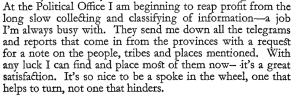
Gertrude Bell demonstrated self-awareness in her role as an agent and as an instrument of empire. She wanted to play a useful role and, in her letters, mentions several times that when she feels she is busy and productive, she is happier, but when there is a lack of work to be done or her duties are minimized, she falls into frustration and sadness. She seems to find purpose in being part of a grand scheme, in her words, “It’s so nice to be a spoke in the wheel, one that helps to turn, not one that hinders.” What does it mean to romanticize one’s own work, especially when that work is being an intelligence officer for the British Empire? This ties too to Bell’s tendency to romanticize the local people and their culture, and the archaeology and history of the region.

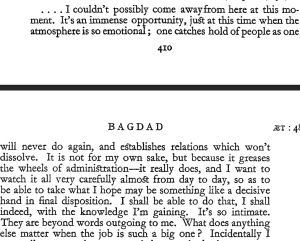
Bell emphasizes interpersonal networks, human intelligence, and building relationships, all of which are concrete ways to create and maintain imperial control, but she projects a sense of romantic adventure onto them. She frames herself not as an imperial oppressor, but as one who studies and interacts with local cultures to build relationships and foster positive developments for them. Was this how she justified her work internally? Does this affect the ethics of how her work played out, and how she was perceived by both sides (the local people and the British Empire)? Her relationship with the local people in some ways was ethical, and in other ways served imperial designs – the duality of Bell’s work is important to understanding her, because she did display a genuine appreciate and care for local people and heritage, but it does not negate the influence and the consequences of her role as an agent of the British Empire.

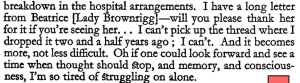
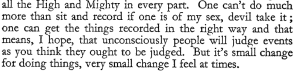
Bell’s work was also beset by a frustration over gendered constraints, and her own personal restlessness. She felt simultaneously thrilled by her work and trapped by limits imposed on her. She did not want to “sit and record”, she yearned to explore and be active – demonstrating the tension between her ambitions and the patriarchal, restrictive environment she grew up in and worked for. Through her letters, frequent references to minutia like the temperature, clothing, and accommodations all reveal her mounting agitation and a sense of containment, which she sought to escape. Her work also takes a toll on her personal life. She mentions loneliness and the difficulty in reconnecting with an old friend. Bell seeks to remain stoic, especially externally, and blames herself whenever this image falters. She sets high standards on herself, even to her own detriment. Her service of empire comes too at a high personal cost.

In closing, we might consider Bell’s fascination with the Near East. She was drawn to its ancient history and to its extant cultural traditions – yet paradoxically, in The Desert and the Sown, describes “the Oriental” (the Arab) as like an “overgrown child”. Does Bell fully buy into the imperialist British mindset of bringing civilization to the local people? She is fascinated with ancient Mesopotamia, while her daily work constructs a new, modern nation-state, designed to serve the British Empire’s regional interests. Her affection towards this land is inextricable from her own participation in destroying its capacity for independence. Her work as an archaeologist and in setting up a museum to maintain artifacts, as well as her insistence that the majority of them remain in Iraq rather than be sent abroad, show that she did genuinely value the cultural heritage of local people, and wanted them to maintain a degree of agency over their own relics. Today, in archaeology and in museology, provenance and cultural heritage are crucial factors. It is important to integrate respect both for the ancient aspects of a region and the modern people that this cultural heritage belongs to.

The following two quotes show the paradox of Gertrude Bell – on the one hand, as someone who appreciated the human connection she found with the local people, and on the other hand, as someone who proudly served the British Empire, and sought to further its dominion over the land and people of Iraq.

“But it’s a wonderful thing to feel this affection and confidence of a whole people around you.”

“…whatever our future policy is to be we cannot now leave the country in the state of chaos which we have created, no one can master it if we can’t.”

Letter excerpts from The Letters of Gertrude Bell Vol. 1 and Vol. 2.


Fanon + A More Feminine Form of Power

After reading Prof. Fawzia’s article about R.F. Kuang’s novel Babel, I started reading The Wretched of the Earth, Franz Fanon’s key decolonial text. I haven’t made it through the entire book yet, but one key idea from Jean-Paul Sartre’s preface is that men are made when they “[thrust] out the settler through force of arms” and decolonize themselves (Fanon 18).  The decolonized, realized man forms himself by throwing back at the colonizer who “no longer clearly remembers that he was once a man; he takes himself for a horsewhip or a gun” his own violence (Fanon 14). “The rebel’s weapon is the proof of his humanity,” and his violence is a direct response to colonial violence imposed on him (Fanon 19). 

Colonization, then, makes non-humans out of both the aggressor and the colonized. I found myself curious about how Fanon’s theory fit into Bell’s experience and action, especially because her work was mostly nonviolent—at least, not overtly so, and especially not from Wallach’s perspective, who provided most of our biographical information on Bell. It may be because England was more insidious in its influence in Iraq in comparison to its unfettered brutality in India, for example; or it might be a function of Bell’s gender, since she was permitted less access to decisions that involved combat than contemporaries like Lawrence or Wilson.

Mostly, though, I was interested in the first part of what Fanon wrote (as it was recounted by Sartre); that colonialism unmakes both the colonizer and the colonized. This theory provides a possible explanation for Bell and even Eberhardt’s ability to “unsex” themselves in the East and take on more male social roles, as with Bell’s negotiations among sheikhs and independent travel, and Eberhardt’s independence and sexual exploits. Fanon’s “unmaking” of colonizing men could be reframed as a movement so far to the masculine end of an imagined masculine-feminine spectrum, such that men become more like pure instruments of violence. Could it be possible that women colonizers are “unmade” differently from the male, in that they are pushed into traditional masculinity instead of total brutality? I was reminded in this train of thought of someone’s comment from class about how colonizers conquered land in an eerily similar way to how men “conquer” female bodies, as well as the references in Wallach’s biography to Bell’s desire to “penetrate” Arabia. 

Bell’s colonialist activities in Iraq could then be conceptualized as a more feminine, but still violent, mode of conquering, something based more in exploitative social, cultural, and economic relations than in direct violence. This might contextualize the quote from A Woman in Arabia, too: “If the American and British invaders of 2003, after ousting Saddam Hussein, had read and taken to heart what Gertrude had to say on establishing peace in Iraq, there might have been far fewer of the bombings and burnings that have continued to this day” (A Woman of Arabia 17). The author would likely advocate for a more neocolonialist, soft-power approach to relations with the East—in the context of Bell, a more ‘feminine’ form of power, enabled by a combination of Orientalism, racism, and the sense of freedom colonialists derived from cultural and spatial distance from the colonial motherland. This strain would be perpetuated not by men “unmade” into pure weaponry, but by women made into effective agents of imperial power.

To Craft or Un-Craft: A Response to Western Depictions of the Eastern World

Image of Fargo Nssim Tbakhi, The Book of Dust

After our exhaustive discussion of Herzog’s Queen of the Desert, I found myself floundering to imagine the narrative landscape of its antidote. A film rife with sentimental orientalisms of the Berlin variety is of course a dime a dozen, but when attempting to deconstruct and reform it, we still found ourselves stymied when contemplating interformal revisions in any order. For example, the choice to use Arabic when historically accurate, then provoked the question of a “revised” Queen of the Desert would require subtitles. From that, the question of who and what subtitles are comes into play, dominating and redominating our psyches with the realization that Craft — particularly one that is as ubiquitously Western as filmmaking — delineates an array of theoretical “choices” who, outside their nominative delineation, differ not at all. The choice to subtitle presents just as much possibility as the choice not to subtitle for a colonial dominion over the narrative form — it is this impossibility which guided me to (what I believe is) the conceit of our in-class discussions: whether or not Craft is an impossibility as a revolutionary mechanism. 

Fargo Nssim Tbakhi’s 2023 “Notes on Craft: Writing in the Hour of Genocide” defines Craft as “the network of sanitizing influences exerted on writing in the English language: the influences of neoliberalism, of complicit institutions, and of the linguistic priorities of the state and of empire.” To Tbakhi, Craft exists to deny a nuanced reckoning with colonial mechanisms writ large. As an example, he points to Solmaz Sharif’s comments on a poem in which she erased a liberal protestor’s abetting of a staunch Republican’s anti-immigrant rhetoric in favor of highlighting only the absurdity of the former’s demands. This too is a Craft decision: the lucidity of a “good” poem implicitly requires a simplicity of forms and understanding. In this process, similarly complicit forces — such as establishment liberalism — are often ignored in favor of highlighting artistic spectacle as a function of craft. Thus, to exist in a necessary, constant state of revolt, like Palestinians have for the past 75 or so years, requires “that we poison and betray Craft at all turns.” While the conceit of Tbakhi’s argument is situated within the Intifada (for good reason), such required betrayals of Craft can be found all throughout the postcolonial world, from Kashmiri paper-maiche to Guyanaese music, in service of creating an anticolonial world order. 

Two paragraphs into this blog post, you may be asking: “But Ayanna, how does this relate to the image you have chosen, and how does that image illustrate our unit’s readings?” In response, I’d like to first contextualize the image, which is from Fargo Nssim Tbakhi’s performance of The Book of Dust. While Queen of the Desert is a film, and The Book of Dust is a theatrical production, both are interformally entangled. In both, considerations of staging, casting, translation, and overall construction must be made — and that making must be undertaken in the context of colonialism. Queen of Desert, via both its subscription to Aristotelian narrative structures and orientalized aesthetic framing of the Near East, becomes a colonial tool. Rather than serving to rupture caricatures of the Middle East, instead it deepens them. And while it can be argued that many traditions within the film do exist, these arguments ignore what the film does with these traditions. Rather than theater, where spontaneous reality is often confronted by physical or imaginary constraint, film is a medium of curation. Thus, it matters not that these races do exist, but how Herzog crafts them. Here, the camel races create a background of an Othered world as Bell familiarly converses with the future kings, physically distancing the viewer from what is unfamiliar and consequently imbuing Bell — who seems completely at ease — with a messianic quality. We must understand that these camel races are not included for cultural posterity. Instead, they exist in the tradition of the traditions of the colonized world being made canon fodder for the narratives of colonizers. 

The image I have chosen of Tbakhi stands in complete opposition to this. It subscribes to nothing of sort, instead navigating the theatrical realm with a dogmatic rejection of Craft. For instance, objects are normally fetishized in reproductions of the Oriental East (eg. the veil) are subverted in the physical theatrical space. In, The Book of Dust, rather than a barrier separating an “Oriental object” from the audience, the veil becomes a physical barrier between act and audience themselves. Consequently, the Craft practices of costuming are denied dominion over “othering” cultural garb. In a similar rejection of visual and narrative Craft, the image’s visual narrative ascends upward rather than moving from a decided end-to-beginning. Within this image, Tbakhi does not cede ground to Craft, and consequently avoids the pitfalls our revisions to Herzog’s Queen of the Desert found inevitable. In short, I find that the question born out of Tuesday’s discussion readings/viewings/discussions was: “How do you revise presentations of the Middle East after they have so long been steeped in coloniality?” This image, then, illustrates the answer.