Lawrence’s Self-Made Authority

As I read Seven Pillars, a few sentences stood out because they exposed the contradictions and self-shaping that Lawrence leans on throughout the book. One of the clearest examples is his early admission that this is a “self-focused narrative…unfair” to the soldiers and even to his British colleagues. On the surface it sounds humble, almost like he’s trying to be transparent, but I think it was more like a pre-emptive shield. By naming his bias up front, he gives himself permission to center his own experience anyway. And honestly, that annoyed me. It’s like he wants to claim subjectivity when it suits him, but still make his perspective the emotional and intellectual anchor of the entire revolt. He gets to frame the story while acting like he’s too self-aware to be blamed for it.

In Chapter I, when he says the campaign stripped fighters of “ordinary morality, pity, and a sense of individual responsibility,” I noticed how quickly the revolt became a stage for his inner psychological drama. The way he talks about moral decay and alienation overshadows everything else. He’s choosing which emotions to foreground, and they almost always circle back to him. Instead of exploring the broader ethical or political meaning of what’s happening, he turns the whole desert into a metaphor for his own unraveling. The chapter ends up feeling less like a collective wartime experience and more like Lawrence working through an existential crisis. How much of this “suffering” is something everyone felt? How much is part of the persona he’s building: half heroic, half damaged philosopher-soldier?

Then in Chapter II, when he defines “the Arabs” mostly through language and shared social structures. He’s drawing a giant map, dividing people into neat categories, and presenting all of it like it’s objective fact. His descriptions sound academic, but they flatten real differences and turn whole populations into abstractions. This reminded me how quickly ethnographic writing, especially by someone who already sees himself as a cultural interpreter can slip into essentialism without ever admitting that’s what’s happening.

Basically, all of this made me way more aware of how Lawrence sets himself up as the voice we’re supposed to trust. He admits things, sure, but then he turns around and uses that to frame everything on his terms.

Freya Stark Playlist: What She Missed

Honestly, the more I read Freya Stark and watched the films about her, the more uneasy I felt. She’s clearly brilliant and bold (there’s no denying that) but something about her voice never sits right with me. She notices everything, but it’s like she never actually feels what she’s seeing. There’s a constant distance, as if she wants to understand the world, but only on her own terms, only while she’s still the one holding the map.

So I made this playlist to respond to what she couldn’t say, what she couldn’t feel.

1) Marcel Khalife – “Ummi (My Mother)”

(Linked to: Letters from Syria and Beyond Euphrates)

In Letters from Syria and Beyond Euphrates, Stark walks through Damascus and Baghdad describing every detail: the graveyards, the veils, the “three separate quarters.” She’s observant to the point of precision, but she never really steps inside what she’s seeing. When I listen to Khalife’s “Ummi (My Mother),” that distance completely disappears. His voice feels like warmth, like home. When he sings, “I long for my mother’s bread, my mother’s coffee,” it’s belonging. Khalife makes what Stark calls “the Orient” feel human again. He sings from within what she only describes. Reading her after hearing him, I realized how often she confuses curiosity for connection.

2) Ahmad Kaabour – “Ounadikum (I Call to You)”

(Linked to: Passionate Nomad, Chapter 19)

There’s one line from Passionate Nomad that stuck with me: “It hardly made sense to make the Palestinians pay with their homes and lands for injuries done to Jews by European Christians.” She’s right, but she says it like an observer writing a report, not someone grieving a people’s loss. Ahmad Kaabour’s “Ounadikum” is the exact opposite of that. When he sings, “I call to you, my people,” it’s urgent, not detached. His voice makes her writing feel distant, like moral language without emotion. Stark’s “they” never becomes “we,” and that’s the difference.

3) Fairuz – “Zahrat al-Madā’in (The Flower of the Cities)”

(Linked to: Passionate Nomad and her 1944 press comments)

When Stark writes about Jerusalem, she does it with a kind of calm that’s almost cold. She calls it “friction between Jews and Arabs,” as if she’s describing weather. Fairuz’s “Zahrat al-Madā’in” destroys that calm completely. When she sings, “Jerusalem, flower of cities,” it’s both a prayer and a cry. You can feel the heartbreak in every word. She aches, grieves, and feels (unlike Stark who seems to only be analyzing).

4) Tracy Chapman – “Talkin’ ’Bout a Revolution”

(Linked to: Freya Stark’s 1944 press tour comments)

During her 1944 press tour, Stark calls the Arabs “the rightful owners of Palestine,” which sounds bold until you realize she’s still speaking as part of the British machine that made the whole crisis possible. She names the problem but never challenges the power behind it. Tracy Chapman’s “Talkin’ ’Bout a Revolution” is like that silence finally breaking open. Chapman doesn’t stop at moral awareness; she pushes toward change. Her song says what I wish Stark had the courage to: not just this is wrong, but this must end.

5) Le Trio Joubran – “Masār” 

(Linked to: Towards the Unknown Land – Nepal)

In Stark’s final film, she’s carried through the mountains of Nepal by a team of porters. She looks fragile but composed, smiling faintly as she says, “If it fails, it fails.” The moment is framed as graceful acceptance: an aging traveler facing limits with humility. However, to me, it felt like comfort disguised as wisdom. Even at the end of her life, she’s still being carried (literally) by others whose presence is unnamed. Le Trio Joubran’s “Masār” sounds like that scene. It’s beautiful, but it refuses peace. It feels like remembering something you can’t fix. When I listen to it, I imagine it filling the silence in Stark’s film: not judging her, but not forgiving her either. Just holding her quietness up to the light and asking what’s underneath it. It made me think about how reflection isn’t the same as reckoning. Stark reflects endlessly (on landscapes, people, herself) but her reflections never really cost her anything. Masār feels like what real reckoning would sound like: the moment when beauty stops protecting you, and you finally have to sit with what you’ve done.


Freya Stark– Writings Reflected in Beautiful Music

Freya Stark has been the (if not one of) most intellectually stimulating, accomplished, and devoted spies that we have encountered thus far in our seminar. This playlist will be curating some songs that echo this moral and emotional landscape of Freya Stark’s writings and discussions we’ve had over the last 3 weeks, especially towards her ambivalent stance between devotion and exile as well as humility and power. These songs will be reflecting her own cross-cultural sympathies and her layered identity. I think Freya Stark is a really interesting individual, her loyalties will ultimately is always towards Great Britain, but her complexities in how she sees the Arab World and her seeing faith as beauty in everyday life rather than a dogma makes me view her with a more ethical and reliable lens (although we do have our critiques). Her ability to craft her own story through her own choosing and focusing on her travels makes her a great person to analyze.

“Aaj Jane Ki Zid Na Karo” – Farida Khanum (1960s, poet was Fayyaz Hashmi)

This ghazal’s entreaty “Don’t insist on leaving today” encapsulates the sorrow of transience that permeates Letters from Syria and Perseus in the Wind. In our class discussions, we explored how Stark’s existence fluctuates between belonging and departure, between service and solitude. Khanum’s voice embodies that same duality: restraint, longing, and quiet dignity. Similar to Stark’s prose, it avoids sentimentality while brimming with emotion. The song’s languorous rhythm reflects Stark’s evenings in Damascus or Baghdad, moments caught between closeness and distance, faith and exile. It transforms into an anthem for her moral restlessness: desiring to remain, yet aware that she must perpetually move forward.

“El Helwa Di” – Sayed Darwish

The class emphasized Stark’s admiration for “ordinary service”, her belief that empire fails when it strips people of dignity or agency. Darwish’s song about Cairo’s morning workers gives life to that idea. “Empire redeemed through care.” In Baghdad Sketches, Stark likewise finds holiness in ordinary acts: women baking bread, men sweeping courtyards at dawn. The song reflects her conviction that service ennobles the human spirit and that true civilization is measured not by empire, but by small kindnesses. The song’s gentle strings embodies the grace present within empire as seen through Stark’s eyes, strength for the Arab world lies in its humanity and hospitality not its politics the way the British does. However, Stark still uses moral language to critique empire from within. In Passionate Nomad, Geniesse captures this tension: Stark defends Britain’s Arab policy while privately empathizing with Arabs betrayed by the post-WWI settlement.

“Desert Rose” – Sting ft. Cheb Mami

Cheb and Sting’s English and Arab duet creates the same cultural duality as seen through Letters from Syria. This song represent the constant back and forth with the East and the West, reasoning and reverence. Stark is noted to be “morally exiled”, too Western to belong to the East and too “Eastern”/changed in her perspectives to return and be content at home. This song is the exile to everything she is, perfectly framing Stark as sensual, distant, yearning, yet still patriotic. Stark once wrote, “The desert does not separate; it teaches us the beauty of distance.” Stark’s fascination with Arab “service” and her writings that accustomed affectionate realism rather than Orientalist distance, however she still had her 1930s British views as seeing British’s roles as a moral tutor of the Arabs.

“Riverside” – Agnes Obel

Reflective, quiet, sorrowful, mirroring the tone of Perseus in the Wind where Stark is contemplating beauty, life, aging, and faith. Solitude of travel, the river representing her travels and what she’s saying. Obel sings how she “sees how everything is torn in the river deep. And I don’t know why I go the way down by the riverside..” analogous to Stark and her travel writings and her “feminine ethics of observation”. “The world’s beauty,” Stark wrote, “is the highest service a soul can render.” “Riverside” sounds like the stillness of that service. Stark’s gender and her perspective is very much seeing feminine virtues redeeming imperial contact and this process of her continuing to embody empathy and service through her stops and in conjunction with this song, the analogy of her travels to being along the river.

“Arrival of the Birds” – London Metropolitan Orchestra

While this song is purely instrumental, it is fitting for it to be regarded as Freya Stark’s ultimate life theme song. Stark’s numerous writings can be regarded as the lyrics as her writings have been grand, full of rich text to be deciphered, ultimately mimicking the feeling of returning home changed. The tone of the song is very grand, dignified, tapered right as it would approach arrogance. The song invokes discovery, wonder, and the quiet till of achievement. In Perseus in the Wind, she wrote that “the human spirit grows only when challenged,” and this song embodies that belief. It’s not victory by domination, but victory through understanding. This piece encapsulates her quiet ventures from her childhood struggles to her early travels to her dignified later years as Dame Freya Stark.


Stark and Benjamin

Freya Stark’s era of power overlapped with the life and work of Walter Benjamin, the Frankfurt School writer and thinker. I was especially reminded of Benjamin when I read about Stark’s deep involvement in the production and distribution of propaganda films. In “The Work of Art in the Age of Its Technical Reproducibility,” Benjamin argues that the film medium, though it carries some latent revolutionary/democratic potential, is especially suited to fascism; it’s part of a broader transition in art away from the cult value of a unique item situated in a particular, hallowed viewing space and toward a mechanically-reproduced image, all meaning and authenticity of which is diluted with reproduction. Film is an especially severe example because politics steps up to replace its cult/religious value. It replicates the real world and adheres to genre convention too precisely, such that all the work of interpretation is already done for the viewer. Stark’s propaganda films did the same and took it even further. They explicitly demonstrated the military might of the British Empire, with the express purpose of telling the subject of the film to think, whether they realized it or not: “these people are powerful, I should ally myself with them.” Her films were pure politics, in the sense that they were a honed tool of imperial power, not in the sense that any real dialogue occurred between the film/propagandist and the subject. 

Benjamin would have hated her films, even as he fled the Nazi Germany the British were helping to defeat. He would have found them artless and fascistic; the colonial mechanism isn’t as different from the fascistic one as it seems imperialists of Freya’s era would like to think. This hypothetical opinion of Benjamin’s reflects how I feel, for the most part, about Stark’s life. She was interesting, but seems to have tried to do the work of interpreting her own life for us already, as Benjamin’s film does to the audience, with her re-wrought books, letters, and autobiographies; still these texts tell us little about the person Stark actually was, so we must turn to biographers, and even they are overly sympathetic at times. She was uncreative in her life’s mission and, while she appreciated the aesthetics of revolution and the East, she never broke from the Empire’s mission. 

She, too, was subject to the controlling influence of the British Empire. Although personal circumstances made her unique, in a core way, she was a person “reproduced” under Benjamin’s model—brought up Britishly, made to memorize poems and love the Empire, repeatedly copied until there could be no original/authentic version of her type, not even Gertrude Bell. All she knew was this method of mechanically reproducing ideology, so it makes perfect sense that she would bring those propaganda films with her to Yemen—she was reproducing the model she knew.

Example of the type of film she might have carried (produced by the Ministry of Information, which she worked for): “WARTIME FACTORY” 1940 WWII BRITISH INDUSTRIAL INCENTIVE PROPAGANDA FILM XD82705

My Day with Gertrude in Petra

*I am going to do a different take on this prompt and imagine my vacation to Petra in Jordan with Gertrude Bell in the modern day. It imagines a portion of our day as we walk through the ruins. Italicized text was taken out of readings we did in class.


It’s a hot and windy day in Jordan. Gertrude and I are on the third day of our week-long vacation through the ruins of Jordan. We are currently in Petra. Gertrude refuses to wear modern-day dress, instead choosing to wear the same muslin gowns that her mother, Florence, had sent her throughout her time in Baghdad. Crowds of people surround us, tourists with their families. Men and women are dressed in over-the-top Oriental outfits, selling trinkets and camel rides to the tourists. It is safe to say that it was a typical day in Petra (at least in the modern day Petra). I am unfazed by the bustle, but when I look over to Gertrude her face tells a completely different story. 


“This place used to be a fairy tale city, I camped amid a row of ornate tombs, three stories high, what has happened to this place?” she asked me with a disgusted look on her face. I laugh, telling her that this is normal. As we make our way through the crowd, Gertrude walks with her nose in the air, ignoring everyone around her. We are approached by a man dressed in bedouin attire. When he begins to speak to us in English Gertrude looks offended. Scoffing, she exclaims, “This is not the real East, I wish I was in Iraq. I like Iraq. It’s the real East”. The man, confused, walks away. I tell her that she shouldn’t talk to people like this. Her response was to glare and bustle away. 


As I trail behind her, I hear her muttering, “Oh how degraded this place has become. All these people, the children, the women. The Arabs have ruined it with their greed. Their need for money and tourism. If the British were in charge this would never have happened. We would have kept it preserved. Only the best could visit, the bravest, certainly no women or children. Only the true explorers.” Once I catch up to her, she suddenly stops, clearly she did not want me to hear what she was saying. Those thoughts were only for herself. Instead, she comments on the weather “it’s breathlessly, damned hot”. I chuckle, telling her that if she didn’t refuse the modern fashion of shorts or light linen pants and a t-shirt she wouldn’t feel so hot. Brushing my comment off she walks away. 


We make our way up the hike to the Monastery. I don’t blame her, it is hot. As we climb our way up the steps she remarks that when she had been in Petra last she made this hike on camelback, “Why do these people insist on walking? Camels are much more efficient!”. Laughing, I continue on without comment. 


She can be a little bit stuck up. I think she would prefer I wasn’t here at all, that she was all alone in this place. Maybe with her servant Fattuh. She definitely doesn’t want any other tourists here. She would much rather cosplay a lone adventurer than be one of the many. Be the first European women to see these places. She is clearly knowledgeable and interested in our surroundings but would rather explore solitarily. 

“Let’s go back to our hotel, maybe there we will be treated with the respect we deserve” she says, interrupting my thoughts. Knowing that I can’t change her mind, I agree to be done for the day. Hopefully some of the other places we visit will be more authentic for her.

Not a Girl’s Girl: A Possible Explanation for Bell’s Position on Women’s Rights

Intentions and motivations aside, the readings of the past three weeks have demonstrated that Gertrude Bell is nothing short of extraordinary. From the many occupations and areas of expertise she mastered to her role in shaping today’s Middle East and even her influence on TE Lawrence, Bell engraved her own name into history. Of course, we learn from Janet Wallach’s thorough account of her that Bell’s greatness was, to some extent, to be expected. After all, she was brought up in a generationally elite and educated family (Wallach 32) and was accustomed to the presence of the great socialites and academics she would later come to work with (Wallach 30, 39). From a young age, Bell was well versed in language learning, and soon, she became one of the first women to not only attend, but excel at Oxford (). However, what was not expected is her positionality as a woman posing so little hindrance to her climb up the British bureaucracy. While she did face some hurdles, from having to sit backwards in class (Wallach 48) to facing the demeaning comments and dismissals of Leachman and other colleagues on multiple occasions (Wallach 267) and even having to fight for an official position within the British intelligence order (Wallach Ch 17), Bell’s sheer expertise on the Middle East meant that once she broke these initial barriers, her climb to the top was smooth. So much so in fact, that Winston Churchill himself would come to rely on her knowledge ()! 

And for good reason. Bell’s writings, from Persian Pictures to letters in which she extensively describes the peoples and geographies of Syria, Baghdad, and even areas of Europe, are clear evidence of her eye for detail and her unique aptitude for information gathering. In fact, Bell ends up producing detailed maps of what was Mesopotamia, maps which detailed tribal affiliations and public opinion of the British, that would become crucial in her later delineation of modern day Iraq (). 

However, and this, I suppose, is what I have written my post to highlight, Bell’s consistent entitlement, whether earned like her positions and knowledge, or inherited like her wealth, meant that she had little sympathy for the struggle of other women, particularly when it came to political involvement. In other words, there is argument to be made that Bell’s scarcity of struggle in coming to power, and the amount of power she held, were the reason she said things like “”(), and was not a supporter of women’s suffrage or a respecter of more conservative women’s practices ()(). This is such an odd positionality. Unlike Eberheardt, Bell did not want to or pretend to be a man. In fact, she embraced her femininity, dressing in luxurious gowns and sophisticated hats (). Yet…Bell was not accepting of the beliefs and needs of other women, she was satisfied by simply being the woman who broke into a men’s world. 

Despite this,we still see, like in the short videos and documentary clips we watched in class, many women praise Bell as a latent feminist, one who advanced the positionality of women through her actions and the achievements she showed were possible. Achievements which would earn her titles like Desert Queen and Maker of Kings…and, I suppose, that she was.

A Bitter Lens

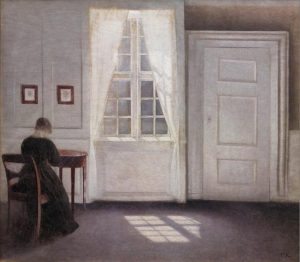
Interior from Strandgade with Sunlight on the Floor
By Vilhelm Hammershoi

Throughout the unit, I noticed a lot how Gertrude Bell had moments of seasonal depression as well as just regular depression. Specifically, in The Letters of Gertrude Bell Volume 1, she exhibited a great amount of seasonal depression while working in Basrah. The transition from being satisfied with her work in December to experiencing physical hardship, illness, strain, and depression in January is reminiscent of this painting and how the woman in it seems sad and reserved. The light in the painting fills the room but it somehow does not warm it which is similar to how the cold feels. Furthermore, when Bell talks about her feeling “limited” by her gender, it feels like how the woman in the painting is alone, cornered, and also “limited” in the way by the artist. I also imagine that the girl in the painting is writing and persevering, similar to how Bell had a sort of quiet endurance despite the inner fatigue she kept feeling when she worked.

Beyond her seasonal depression, Bell deeply mourns the loss of her lover Henry Cadogan. After his death, all her writing is filtered through a lens of grief. If you do a side by side comparison of The Letters of Gertrude Bell with Persian Pictures, you can see that her outlook of the beautiful regions she is visiting is much more grim. Like, in Persian Pictures, she says “Sunshine – sunshine! tedious, changeless, monotonous! Not that discreet English sunshine which varies its charm with clouds… here the sun has long ceased trying to please so venerable a world.” Bell is starting to hate the weather and environment she is in. Although she expresses similar distaste for the weather in the Letters of Gertrude Bell, it is not all encompassing. Just like the woman in the painting, Bell feels colder.

The Life of Gertrude Bell: a playlist with only good songs

Gertrude Bell is a complicated individual, as all these spies are turning out to be. I think what I found so fascinating about Bell is that despite her love for Iraq (however much was genuine, and not exoticized or orientalized), she was consistently loyal; loyal to her family and to Great Britain itself. This made reading her life as a narrative much simpler than Isabelle Eberhardt. I scoured my playlist to find (my best attempt at) the perfect mix of tragedy, beauty, the pull of discovery and power, and the split loyalties/love that define the life and spywork of Gertrude Bell. 

  1. Rebel Prince – Rufus Wainwright 

This song feels like Bell’s love for the British Empire. It is her master, her sordid and salacious lover. While it seems like a far-off, looming entity, the Empire is something dear to Bell. However, she must leave England precisely because of her love. She projects her loyalty into her spywork, leaving the room she knows so well, but always looking back at her far away master. “It was appropriate that the Bells’ family fortune was earned through… Britain’s great strength, after all […] they worked not only to enhance their own communities but to maintain Britain’s place in the sun. They took pride in the British Empire and its role as custodian of the universe” (Wallach; “Of Great and Honored Stock”). 

2. Blacklisted – Neko Case 

I interpret this song as Bell’s growing entanglement and work for the British Empire. Her job of perception is based in deception. She must deceive the Iraqi people she loves to further the aims of the country she answers to, the country she believes has the power to make the trees bend in welcome. Why does the fast train of imperialism rage on, where does it end? Where do the passengers, the colonized, wait, in the meantime? “Authority would remain in the hands of dignified Sir Percy and a group of British advisors. London was convinced that it would control Iraq until that undetermined and presumably distant day when the untutored Iraqis had learned to govern themselves” (Brian; Desert and Sown introduction).

3. Pearl Diver – Mistki 

Bell’s love for Iraq and loyalty to England is paradoxical. She follows the tide to the beautiful that she wanted so badly, with the monster of imperialism over her shoulders. She occupies a middle space, a space of no feeling, and must continue diving deeper, becoming more entangled in life in Iraq and loyalty to Britain. Ironically, her loss of power towards the end of her life also mirrors the death of the song’s treasure hunter. “The work has been so interesting that as far as I am concerned I couldn’t have experienced better or even as good, a destiny” (Bell; Letters II 658-659). “She employs her growing competence of Arabic to describe a backward country in the flux of change” (Brian; Desert and Sown introduction). 

4. Shooting the Moon – OK Go

I see Bell as this song’s Big Hero. With her eventual loss of power, what is there to show? A country divided and kings made by a name no one seems to remember. Her time in Iraq was not exactly true, but it can’t be discounted because she did truly love the people she met (in her own, perhaps infantilizing, belittling way). She can only deliver love to (or perhaps exert power over) Iraq by caring for her museum. Despite all her lies and deception, she would still wish them well in some (British-controlled) way. “Seven years I’ve been at this job of setting up an Arab State. If we fail it’s little consolation to me personally that other generations may succeed, as I believe they must…” (Bell; Letters II 664).

5. Ghir Enta – Souad Massi 

I imagine this as Bell’s love letter to Iraq before she dies. Today, Iraq is with her and the British, but tomorrow, who knows? Iraq has become her home, it’s a place she cannot live with as is, but cannot live away from. It’s tragic and beautiful! Iraq is her true love, perhaps because it’s the place she was able to leave her mark. Souad Massi’s Algerian, but the song is in Arabic, so I think Bell would appreciate the song for its exotic Arab aesthetic. “They never elect any other European. That’s the sort of thing that makes it difficult to leave” (Bell; Letters II 667). “I love seeing [Iraqi visitors] and they are most useful for purposes of information” (Bell; Letters I 407). 

6. Hey Hey Hey – Eilen Jewell

Gertrude Bell did sleep off her regret in a very literal way. Whether her death was a true suicide or not, she was undoubtedly sad and lonely. I see this song as Bell’s tired goodbye to her beloved Iraq, the place she couldn’t quite keep a grasp on. “There are long moments when I feel very lonely… I am aware that I myself have much less control over my emotions than I used to have” (Bell; Letters II 658, 662). “Gertrude Bell took an overdose of sleeping pills. All of Baghdad attended her funeral, along with an honor guard of sheiks from her beloved desert” (Brian; Desert and Sown introduction). 

Reflections on Isabella Eberhardt

I must say, I love a good adventure, Isabella Eberhardt’s adventure however, while wild and exciting, left a confused and hyper romanticized legacy that left a bad taste in my mouth. In looking back at the readings and discussion notes for writing this post, I noticed two major themes along which our study of Isabella Eberhardt fell.  The first theme was intentions and loyalties. Discussion of this theme revolved mostly around Eberhardt’s relationships with different people she came across, particularly, her relationship with the people of Algeria and her relationship with general Lyautey. While there is no definitive evidence which speaks to Eberhardt’s absolute allegiance to anyone but herself and the road, I believe that insight may be gained into her allegiances by analyzing two things. The first is Eberhardt’s own writings about topics surrounding the French and North African populations in both [INSERT TEXT} and [INSERT TEXT]. In [INSERT TEXT] she says “INSERT QUOTE”. Now, while this may have simply been an implication of Eberhardt’s personal admiration for Lyautey rather than her admiration for France’s colonial project, other evidence, such as her saying “INSERT QUOTE” on page [insert pg number] of [INSERT TEXT], suggests that she did, at least somewhat, buy into the French vision of North Africa, even if unintentionally.

The second thing that must be analyzed when attempting to decipher Eberhardt’s loyalties is her biographer’s outlooks on her journey. Now here, opinions do diverge, with some biographers, such as [THAT ONE COUPLE], who in my opinion were more so admirers than experts, claiming that Eberhardt’s allegiances were shifty, and that she was simply trying to survive wherever she went. [AUTHORS’ NAMES] appear to relay that Eberhardt was truly just a writer, a good one, and that if she was looped into French colonial projects, it was unintentional and cause by people taking advantage of her writings. For instance, on [insert pg] of their introduction, they say that Eberhardt “insert quote,” suggesting that Eberhardt was simply an innocent young adventurer trying to live out what she thought to be her purpose. These authors go on to build an what is, in my opinion, an overromanticized or maybe a glorified version of Isabella Eberhardt that focuses more on her allure as an adventurer than about the political motivations and implications of her adventure.

On the other end of the spectrum and just as essential to analyze when studying Eberhardt is [AUTHOR NAME]. [AUTHOR NAME] hints that Eberhardt was indeed mal-intentioned, saying things such as “quote” (cite) and “quote” (cite). These analyses, unlike those that came before, seem to build a more pragmatic version of Eberhardt that adopted the French cause intentionally, regardless of the reason. Since neither side presents definitive evidence, it is difficult to attach labels to Eberhardt, I find it difficult to believe however that someone with that many question marks around them and who has drawn so much attention across time is completely innocent of political involvement. Eberhardt was young, but she was mature and frankly, selfish, her decisions may not have been made in favor of any ideology, but in the pursuit of self-preservation, which for her may have meant walking on the edge between colonist and colonized. 

The second, and in my opinion, equally important theme was Eberhardt’s nonconforming gender practices. Understanding how Eberhardt acted as a man and as a woman, what each gender meant to her and how and where each gender got her is crucial to understanding her person and positionality. One particularly odd thing that stands out about Eberhardt taking on a male persona in Algeria is that she is simply accepted! Even I did not expect that, I was pleasantly surprised but also wondered whether she was accepted because she was a traveller…would a local woman attempting to do the same thing be equally embraced? Both Eberhardt’s own texts and the films which we watched convey her complex understanding of herself as both man and woman. In many texts, including for instance [INSERT TEXT] she refers to herself using male pronouns. Additionally, not only is she addressed by others as Mahmoud, but she also has, as we discussed in class, a male gaze through which she looks upon other women! For example in [INSERT TEXT] she says “quote” (cite), indicating that she views Algerian women in what one might call a typical orientalist light (although to be fair it isn’t quite clear whether she feels this way about European women as well). The conception of herself as a male only in the public space and as female in private and sexual settings is fascinating and is actually a theme in feminist literature. By being male, she is able to access the inner circles of religious orders and society. She is able to freely engage in her hoodlum behaviour with little protest or outright shaming. I wonder however whether she loses a piece of herself in this way…

In the films, Eberhardt is also seen as both man and woman. In the documentary style reflection on her life, people, mostly men, reflect on her as a woman, but also seem to understand and respect the role she held as a man, reflecting the importance of both personas in her legacy. In the recreation of her adventures, she is seen as Mahmoud outside her home and Isabella inside (although the general still refers to her as Mahmoud). Her role as Mahmoud in the film reflects how she was able to form relationships her female existence would have otherwise prevented, specifically her odd relationship with general Lyautey and of course her relationship with many Sufi men.

Tying all of this together is Isabella’s existence as a writer. Through writing, or maybe for writing, she makes sense of herself and the world around her. Her relationships and her positionality, her goals and her past, and much more. We discussed the possibility of her writing being a production of information that categorizes her as a spy…I think that while this may be true, it was not her intention. I believe, because of the passion and colorful language with which she wrote about her travels, that Eberhardt genuinely had a love for the unknown. Whether she got taken advantage of or eventually served the French after losing purpose is a different story. Essentially, I don’t know whether she was a spy or not, and I don’t know that I particularly care…to me she was a woman who defied norms, which in some ways is “cool” but in other ways is genuinely stupid. She was the original Transcendentalist and I am not a huge fan of transcendentalism. She chose to live a difficult but eventful life, a selfish choice, but one that I suppose satisfied her craving for discovery.


The Expatriate Mindset – Eberhardt and the Contemporary Era

The world “expatriate” is defined by Merriam-Webster as:

expatriate (verb):
1. banish, exile
2. to withdraw (oneself) from residence in or allegiance to one’s native country
3. to leave one’s native country to live elsewhere
also: to renounce allegiance to one’s native country

expatriate (adjective): living in a foreign land

expatriate (noun): a person who lives in a foreign country

The idea of expatriates (“expats”) in the contemporary era is one of digital nomads, international businessmen, and passport bros. To be an expatriate is more serious than vacation – to be an expatriate is to choose to be away from home, for a very prolonged, even permanent amount of time, and to refute your home nation for various personal reasons in favor of the foreign.

When studying Isabelle Eberhardt’s life, I considered what I shared with the travelers, writers, archaeologists, and adventurers of the 19th to early 20th century who felt this sense of the expatriate mindset, the Germanic sense of “Fernweh” – a severe desire to wander, travel, and be distanced from their homeland. I found it sad in Eberhardt’s life that she was raised in a difficult, abnormal home, could not reconcile herself with Geneva or Europe in general, and attempted to seek peace in Morocco and Algeria, to the great detriment of her physical health and ultimately her life. In the introduction to Writings from the Sand, Vol. 1, the editors Marie-Odile Delacour and Jean-René Huleu write that she left Geneva “in hopes of never returning” (Eberhardt, 2012).

My parents are both mentally unwell and I also had a difficult, abnormal upbringing. It caused me to associate my geographic constraints with intense negativity. As a child, I fantasized about moving abroad. Later, in the military, I requested an overseas duty station and was out of the United States for four years.

The internet is currently rife with a shared sentiment among many Americans (and those of other nationalities, too), who desire to voluntarily leave their homeland for somewhere else on the grounds of political instability, lack of belonging, safety, better opportunities, and myriad other reasons. My friends echo these desires, with some having successfully relocated abroad, and others unable to do so.

A line that has always stuck with me is from the film, The English Patient: “We are the real countries. Not boundaries drawn on maps with the names of powerful men. I know you’ll come carry me out to the Palace of Winds. That’s what I’ve wanted: to walk in such a place with you. With friends, on an earth without maps.” (Minghella, 1996). Despite collective urges to travel, whether temporarily or permanently, to pursue the foreign, to imagine that it is perhaps better than what is at home (even if this is a falsehood or merely a half-truth – no place is perfect, and exoticizing another nation does not make it a solution to one’s domestic problems) – in the end, nation-states and logistics rule over us. They rule over the expatriate and therefore shape the expatriate mindset itself. Eberhardt contended with such difficulties in her travels, including with finances, physical hardship, and the need to straddle the fine line between appeasing the French occupying force and building friendship with the Arab peoples she so strongly identified with.

The English Patient imagines a hypothetical “earth without maps” with true freedom. However, nation-states cannot exist without borders. What would a border-less world, a dream for a self-described vagabond like Eberhardt look like? How would it function, and would such a mode of existence even be remotely feasible, or does it go against human nature? Would a border-less world serve to answer the anxieties of this generation’s expatriates?

References

Merriam-Webster. (n.d.). Expatriate. In Merriam-Webster.com dictionary. Retrieved September 21, 2025, from https://www.merriam-webster.com/dictionary/expatriate

Minghella, A. (1996). The English Patient: A Screenplay. http://ci.nii.ac.jp/ncid/BA34785462

Eberhardt, I. (2012). Writings from the Sand, Volume 1: Collected Works of Isabelle Eberhardt. U of Nebraska Press.