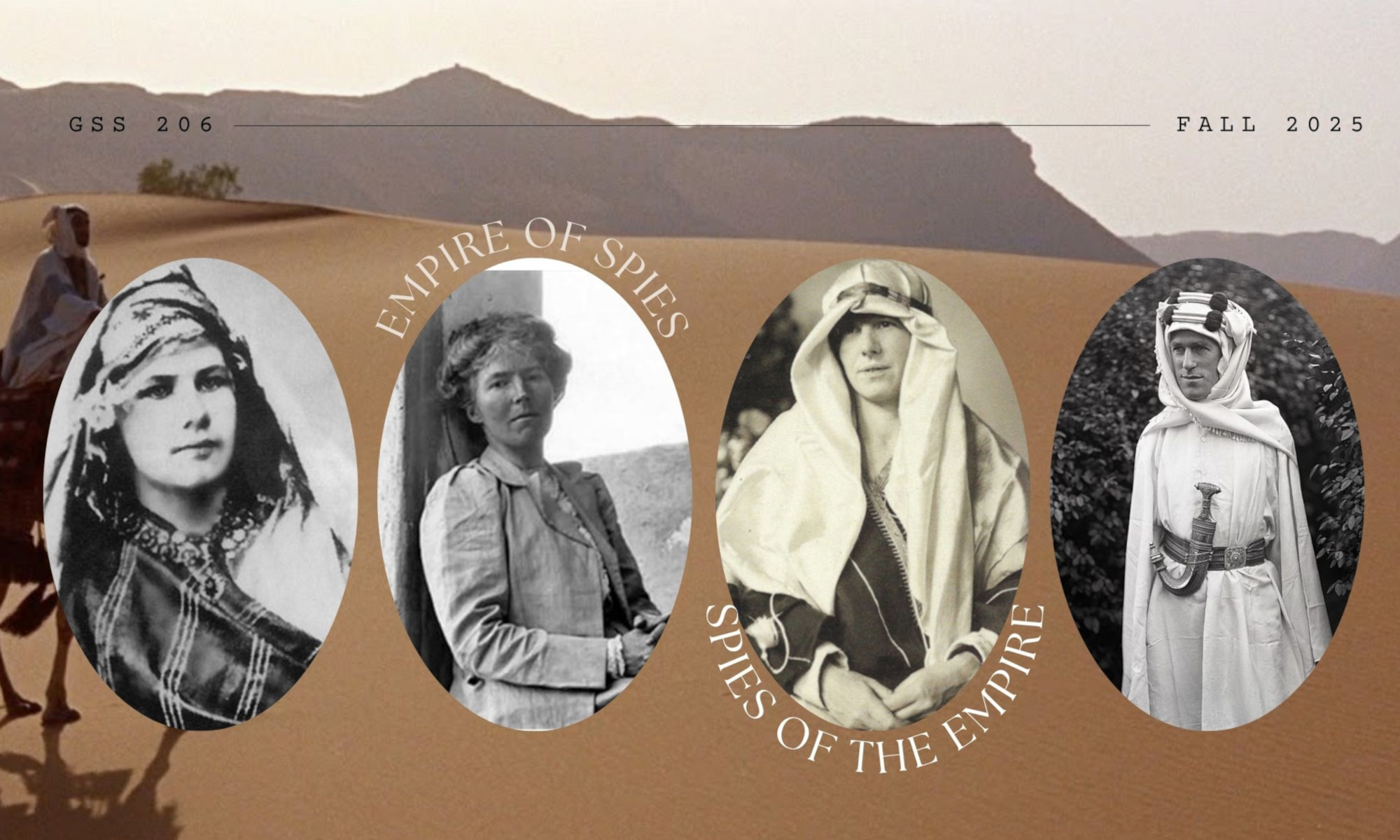
Freya Stark Playlist: What She Missed

Honestly, the more I read Freya Stark and watched the films about her, the more uneasy I felt. She’s clearly brilliant and bold (there’s no denying that) but something about her voice never sits right with me. She notices everything, but it’s like she never actually feels what she’s seeing. There’s a constant distance, as if she wants to understand the world, but only on her own terms, only while she’s still the one holding the map.

So I made this playlist to respond to what she couldn’t say, what she couldn’t feel.

1) Marcel Khalife – “Ummi (My Mother)”

(Linked to: Letters from Syria and Beyond Euphrates)

In Letters from Syria and Beyond Euphrates, Stark walks through Damascus and Baghdad describing every detail: the graveyards, the veils, the “three separate quarters.” She’s observant to the point of precision, but she never really steps inside what she’s seeing. When I listen to Khalife’s “Ummi (My Mother),” that distance completely disappears. His voice feels like warmth, like home. When he sings, “I long for my mother’s bread, my mother’s coffee,” it’s belonging. Khalife makes what Stark calls “the Orient” feel human again. He sings from within what she only describes. Reading her after hearing him, I realized how often she confuses curiosity for connection.

2) Ahmad Kaabour – “Ounadikum (I Call to You)”

(Linked to: Passionate Nomad, Chapter 19)

There’s one line from Passionate Nomad that stuck with me: “It hardly made sense to make the Palestinians pay with their homes and lands for injuries done to Jews by European Christians.” She’s right, but she says it like an observer writing a report, not someone grieving a people’s loss. Ahmad Kaabour’s “Ounadikum” is the exact opposite of that. When he sings, “I call to you, my people,” it’s urgent, not detached. His voice makes her writing feel distant, like moral language without emotion. Stark’s “they” never becomes “we,” and that’s the difference.

3) Fairuz – “Zahrat al-Madā’in (The Flower of the Cities)”

(Linked to: Passionate Nomad and her 1944 press comments)

When Stark writes about Jerusalem, she does it with a kind of calm that’s almost cold. She calls it “friction between Jews and Arabs,” as if she’s describing weather. Fairuz’s “Zahrat al-Madā’in” destroys that calm completely. When she sings, “Jerusalem, flower of cities,” it’s both a prayer and a cry. You can feel the heartbreak in every word. She aches, grieves, and feels (unlike Stark who seems to only be analyzing).

4) Tracy Chapman – “Talkin’ ’Bout a Revolution”

(Linked to: Freya Stark’s 1944 press tour comments)

During her 1944 press tour, Stark calls the Arabs “the rightful owners of Palestine,” which sounds bold until you realize she’s still speaking as part of the British machine that made the whole crisis possible. She names the problem but never challenges the power behind it. Tracy Chapman’s “Talkin’ ’Bout a Revolution” is like that silence finally breaking open. Chapman doesn’t stop at moral awareness; she pushes toward change. Her song says what I wish Stark had the courage to: not just this is wrong, but this must end.

5) Le Trio Joubran – “Masār” 

(Linked to: Towards the Unknown Land – Nepal)

In Stark’s final film, she’s carried through the mountains of Nepal by a team of porters. She looks fragile but composed, smiling faintly as she says, “If it fails, it fails.” The moment is framed as graceful acceptance: an aging traveler facing limits with humility. However, to me, it felt like comfort disguised as wisdom. Even at the end of her life, she’s still being carried (literally) by others whose presence is unnamed. Le Trio Joubran’s “Masār” sounds like that scene. It’s beautiful, but it refuses peace. It feels like remembering something you can’t fix. When I listen to it, I imagine it filling the silence in Stark’s film: not judging her, but not forgiving her either. Just holding her quietness up to the light and asking what’s underneath it. It made me think about how reflection isn’t the same as reckoning. Stark reflects endlessly (on landscapes, people, herself) but her reflections never really cost her anything. Masār feels like what real reckoning would sound like: the moment when beauty stops protecting you, and you finally have to sit with what you’ve done.

 

The Life of Gertrude Bell: a playlist with only good songs

Gertrude Bell is a complicated individual, as all these spies are turning out to be. I think what I found so fascinating about Bell is that despite her love for Iraq (however much was genuine, and not exoticized or orientalized), she was consistently loyal; loyal to her family and to Great Britain itself. This made reading her life as a narrative much simpler than Isabelle Eberhardt. I scoured my playlist to find (my best attempt at) the perfect mix of tragedy, beauty, the pull of discovery and power, and the split loyalties/love that define the life and spywork of Gertrude Bell. 

  1. Rebel Prince – Rufus Wainwright 

This song feels like Bell’s love for the British Empire. It is her master, her sordid and salacious lover. While it seems like a far-off, looming entity, the Empire is something dear to Bell. However, she must leave England precisely because of her love. She projects her loyalty into her spywork, leaving the room she knows so well, but always looking back at her far away master. “It was appropriate that the Bells’ family fortune was earned through… Britain’s great strength, after all […] they worked not only to enhance their own communities but to maintain Britain’s place in the sun. They took pride in the British Empire and its role as custodian of the universe” (Wallach; “Of Great and Honored Stock”). 

2. Blacklisted – Neko Case 

I interpret this song as Bell’s growing entanglement and work for the British Empire. Her job of perception is based in deception. She must deceive the Iraqi people she loves to further the aims of the country she answers to, the country she believes has the power to make the trees bend in welcome. Why does the fast train of imperialism rage on, where does it end? Where do the passengers, the colonized, wait, in the meantime? “Authority would remain in the hands of dignified Sir Percy and a group of British advisors. London was convinced that it would control Iraq until that undetermined and presumably distant day when the untutored Iraqis had learned to govern themselves” (Brian; Desert and Sown introduction).

3. Pearl Diver – Mistki 

Bell’s love for Iraq and loyalty to England is paradoxical. She follows the tide to the beautiful that she wanted so badly, with the monster of imperialism over her shoulders. She occupies a middle space, a space of no feeling, and must continue diving deeper, becoming more entangled in life in Iraq and loyalty to Britain. Ironically, her loss of power towards the end of her life also mirrors the death of the song’s treasure hunter. “The work has been so interesting that as far as I am concerned I couldn’t have experienced better or even as good, a destiny” (Bell; Letters II 658-659). “She employs her growing competence of Arabic to describe a backward country in the flux of change” (Brian; Desert and Sown introduction). 

4. Shooting the Moon – OK Go

I see Bell as this song’s Big Hero. With her eventual loss of power, what is there to show? A country divided and kings made by a name no one seems to remember. Her time in Iraq was not exactly true, but it can’t be discounted because she did truly love the people she met (in her own, perhaps infantilizing, belittling way). She can only deliver love to (or perhaps exert power over) Iraq by caring for her museum. Despite all her lies and deception, she would still wish them well in some (British-controlled) way. “Seven years I’ve been at this job of setting up an Arab State. If we fail it’s little consolation to me personally that other generations may succeed, as I believe they must…” (Bell; Letters II 664).

5. Ghir Enta – Souad Massi 

I imagine this as Bell’s love letter to Iraq before she dies. Today, Iraq is with her and the British, but tomorrow, who knows? Iraq has become her home, it’s a place she cannot live with as is, but cannot live away from. It’s tragic and beautiful! Iraq is her true love, perhaps because it’s the place she was able to leave her mark. Souad Massi’s Algerian, but the song is in Arabic, so I think Bell would appreciate the song for its exotic Arab aesthetic. “They never elect any other European. That’s the sort of thing that makes it difficult to leave” (Bell; Letters II 667). “I love seeing [Iraqi visitors] and they are most useful for purposes of information” (Bell; Letters I 407). 

6. Hey Hey Hey – Eilen Jewell

Gertrude Bell did sleep off her regret in a very literal way. Whether her death was a true suicide or not, she was undoubtedly sad and lonely. I see this song as Bell’s tired goodbye to her beloved Iraq, the place she couldn’t quite keep a grasp on. “There are long moments when I feel very lonely… I am aware that I myself have much less control over my emotions than I used to have” (Bell; Letters II 658, 662). “Gertrude Bell took an overdose of sleeping pills. All of Baghdad attended her funeral, along with an honor guard of sheiks from her beloved desert” (Brian; Desert and Sown introduction). 

Reflections on Isabella Eberhardt

I must say, I love a good adventure, Isabella Eberhardt’s adventure however, while wild and exciting, left a confused and hyper romanticized legacy that left a bad taste in my mouth. In looking back at the readings and discussion notes for writing this post, I noticed two major themes along which our study of Isabella Eberhardt fell.  The first theme was intentions and loyalties. Discussion of this theme revolved mostly around Eberhardt’s relationships with different people she came across, particularly, her relationship with the people of Algeria and her relationship with general Lyautey. While there is no definitive evidence which speaks to Eberhardt’s absolute allegiance to anyone but herself and the road, I believe that insight may be gained into her allegiances by analyzing two things. The first is Eberhardt’s own writings about topics surrounding the French and North African populations in both [INSERT TEXT} and [INSERT TEXT]. In [INSERT TEXT] she says “INSERT QUOTE”. Now, while this may have simply been an implication of Eberhardt’s personal admiration for Lyautey rather than her admiration for France’s colonial project, other evidence, such as her saying “INSERT QUOTE” on page [insert pg number] of [INSERT TEXT], suggests that she did, at least somewhat, buy into the French vision of North Africa, even if unintentionally.

The second thing that must be analyzed when attempting to decipher Eberhardt’s loyalties is her biographer’s outlooks on her journey. Now here, opinions do diverge, with some biographers, such as [THAT ONE COUPLE], who in my opinion were more so admirers than experts, claiming that Eberhardt’s allegiances were shifty, and that she was simply trying to survive wherever she went. [AUTHORS’ NAMES] appear to relay that Eberhardt was truly just a writer, a good one, and that if she was looped into French colonial projects, it was unintentional and cause by people taking advantage of her writings. For instance, on [insert pg] of their introduction, they say that Eberhardt “insert quote,” suggesting that Eberhardt was simply an innocent young adventurer trying to live out what she thought to be her purpose. These authors go on to build an what is, in my opinion, an overromanticized or maybe a glorified version of Isabella Eberhardt that focuses more on her allure as an adventurer than about the political motivations and implications of her adventure.

On the other end of the spectrum and just as essential to analyze when studying Eberhardt is [AUTHOR NAME]. [AUTHOR NAME] hints that Eberhardt was indeed mal-intentioned, saying things such as “quote” (cite) and “quote” (cite). These analyses, unlike those that came before, seem to build a more pragmatic version of Eberhardt that adopted the French cause intentionally, regardless of the reason. Since neither side presents definitive evidence, it is difficult to attach labels to Eberhardt, I find it difficult to believe however that someone with that many question marks around them and who has drawn so much attention across time is completely innocent of political involvement. Eberhardt was young, but she was mature and frankly, selfish, her decisions may not have been made in favor of any ideology, but in the pursuit of self-preservation, which for her may have meant walking on the edge between colonist and colonized. 

The second, and in my opinion, equally important theme was Eberhardt’s nonconforming gender practices. Understanding how Eberhardt acted as a man and as a woman, what each gender meant to her and how and where each gender got her is crucial to understanding her person and positionality. One particularly odd thing that stands out about Eberhardt taking on a male persona in Algeria is that she is simply accepted! Even I did not expect that, I was pleasantly surprised but also wondered whether she was accepted because she was a traveller…would a local woman attempting to do the same thing be equally embraced? Both Eberhardt’s own texts and the films which we watched convey her complex understanding of herself as both man and woman. In many texts, including for instance [INSERT TEXT] she refers to herself using male pronouns. Additionally, not only is she addressed by others as Mahmoud, but she also has, as we discussed in class, a male gaze through which she looks upon other women! For example in [INSERT TEXT] she says “quote” (cite), indicating that she views Algerian women in what one might call a typical orientalist light (although to be fair it isn’t quite clear whether she feels this way about European women as well). The conception of herself as a male only in the public space and as female in private and sexual settings is fascinating and is actually a theme in feminist literature. By being male, she is able to access the inner circles of religious orders and society. She is able to freely engage in her hoodlum behaviour with little protest or outright shaming. I wonder however whether she loses a piece of herself in this way…

In the films, Eberhardt is also seen as both man and woman. In the documentary style reflection on her life, people, mostly men, reflect on her as a woman, but also seem to understand and respect the role she held as a man, reflecting the importance of both personas in her legacy. In the recreation of her adventures, she is seen as Mahmoud outside her home and Isabella inside (although the general still refers to her as Mahmoud). Her role as Mahmoud in the film reflects how she was able to form relationships her female existence would have otherwise prevented, specifically her odd relationship with general Lyautey and of course her relationship with many Sufi men.

Tying all of this together is Isabella’s existence as a writer. Through writing, or maybe for writing, she makes sense of herself and the world around her. Her relationships and her positionality, her goals and her past, and much more. We discussed the possibility of her writing being a production of information that categorizes her as a spy…I think that while this may be true, it was not her intention. I believe, because of the passion and colorful language with which she wrote about her travels, that Eberhardt genuinely had a love for the unknown. Whether she got taken advantage of or eventually served the French after losing purpose is a different story. Essentially, I don’t know whether she was a spy or not, and I don’t know that I particularly care…to me she was a woman who defied norms, which in some ways is “cool” but in other ways is genuinely stupid. She was the original Transcendentalist and I am not a huge fan of transcendentalism. She chose to live a difficult but eventful life, a selfish choice, but one that I suppose satisfied her craving for discovery.


The Expatriate Mindset – Eberhardt and the Contemporary Era

The world “expatriate” is defined by Merriam-Webster as:

expatriate (verb):
1. banish, exile
2. to withdraw (oneself) from residence in or allegiance to one’s native country
3. to leave one’s native country to live elsewhere
also: to renounce allegiance to one’s native country

expatriate (adjective): living in a foreign land

expatriate (noun): a person who lives in a foreign country

The idea of expatriates (“expats”) in the contemporary era is one of digital nomads, international businessmen, and passport bros. To be an expatriate is more serious than vacation – to be an expatriate is to choose to be away from home, for a very prolonged, even permanent amount of time, and to refute your home nation for various personal reasons in favor of the foreign.

When studying Isabelle Eberhardt’s life, I considered what I shared with the travelers, writers, archaeologists, and adventurers of the 19th to early 20th century who felt this sense of the expatriate mindset, the Germanic sense of “Fernweh” – a severe desire to wander, travel, and be distanced from their homeland. I found it sad in Eberhardt’s life that she was raised in a difficult, abnormal home, could not reconcile herself with Geneva or Europe in general, and attempted to seek peace in Morocco and Algeria, to the great detriment of her physical health and ultimately her life. In the introduction to Writings from the Sand, Vol. 1, the editors Marie-Odile Delacour and Jean-René Huleu write that she left Geneva “in hopes of never returning” (Eberhardt, 2012).

My parents are both mentally unwell and I also had a difficult, abnormal upbringing. It caused me to associate my geographic constraints with intense negativity. As a child, I fantasized about moving abroad. Later, in the military, I requested an overseas duty station and was out of the United States for four years.

The internet is currently rife with a shared sentiment among many Americans (and those of other nationalities, too), who desire to voluntarily leave their homeland for somewhere else on the grounds of political instability, lack of belonging, safety, better opportunities, and myriad other reasons. My friends echo these desires, with some having successfully relocated abroad, and others unable to do so.

A line that has always stuck with me is from the film, The English Patient: “We are the real countries. Not boundaries drawn on maps with the names of powerful men. I know you’ll come carry me out to the Palace of Winds. That’s what I’ve wanted: to walk in such a place with you. With friends, on an earth without maps.” (Minghella, 1996). Despite collective urges to travel, whether temporarily or permanently, to pursue the foreign, to imagine that it is perhaps better than what is at home (even if this is a falsehood or merely a half-truth – no place is perfect, and exoticizing another nation does not make it a solution to one’s domestic problems) – in the end, nation-states and logistics rule over us. They rule over the expatriate and therefore shape the expatriate mindset itself. Eberhardt contended with such difficulties in her travels, including with finances, physical hardship, and the need to straddle the fine line between appeasing the French occupying force and building friendship with the Arab peoples she so strongly identified with.

The English Patient imagines a hypothetical “earth without maps” with true freedom. However, nation-states cannot exist without borders. What would a border-less world, a dream for a self-described vagabond like Eberhardt look like? How would it function, and would such a mode of existence even be remotely feasible, or does it go against human nature? Would a border-less world serve to answer the anxieties of this generation’s expatriates?

References

Merriam-Webster. (n.d.). Expatriate. In Merriam-Webster.com dictionary. Retrieved September 21, 2025, from https://www.merriam-webster.com/dictionary/expatriate

Minghella, A. (1996). The English Patient: A Screenplay. http://ci.nii.ac.jp/ncid/BA34785462

Eberhardt, I. (2012). Writings from the Sand, Volume 1: Collected Works of Isabelle Eberhardt. U of Nebraska Press.


Isabelle Eberhardt vs. Dendrology

In my First-Year Seminar ‘The Memory of Trees: Analyzing Climate History Through Dendrology’ we often discuss authors’ motivations when writing their work. For the past couple weeks, motivation for both Isabelle Eberhardt and those writing about her has also been a topic of discussion. Even though the content of the two classes differs, one about trees and the other about a woman in the early 1900s, motivation drives the readings that we use in both. Why authors wrote what they wrote, what their internal motivations were, and what they hoped to portray to their audience are questions asked in both classes. 

For a lot of the texts we read in my First-Year seminar, the motivation is very obvious, the author wants to share their findings for their study and explain why they are important for society as a whole. They are consistently trying to convince their audiences that they are bringing new important knowledge to scientific conversations. When looking at the introductions written in both The Passionate Nomad by Rana Kabbani and Writings in the Sand, Vol. 1 by Marie-Odile Delacour and Jean-René Huleu their portrayals of Eberhardt differ quite dramatically. In Writings in the Sand, the authors characterize her as this tragically romantic figure who was the “first” person to give a true depiction of the “East” (when in reality people had been writing about the region for a long time). They use repetitive exaggerated language to describe her life’s journey, calling her upbringing ‘turbulent’, ‘tragic’, and ‘tormented’. They clearly paint her as a victim and therefore excuse many of her choices she makes once she reaches Northern Africa. It is clear that both authors are in awe of Isabelle Eberhardt and want their readers to be in awe as well. Rana Kabbani takes a different approach in her introduction to The Passionate Nomad. She portrays Eberhardt in a much more realistic light without the hyperbolic language. Kabbani is very clearly not in awe of Eberhardt, writing that she was “painfully thin, flat-chested, with decayed teeth, an abundance of bodily hair, and no periods”. She also doesn’t excuse Eberhardt’s actions, saying that she had “lost all sense of reality and self respect”. Kabbani is not trying to depict Eberhardt as a tragic, romantic figure. She doesn’t even try to put her in a positive light. She realistically portrays Eberhardt as the drunken, high, vagabond she was. 

Eberhardt’s motivations behind her writings, journey, and relationships are much more unclear. What were her intentions when she was passing information to Lyautey? Was she trying to protect the Algerian Arabs or did she want to feel like she belonged to the French? The struggle with Eberhardt is that deep down, she wanted to belong somewhere. She grew up in a household with a father who didn’t claim her as his daughter and an exiled mother. She moved to North Africa to find solace in the Sufi male society. Yet, she claimed to want to be completely alone and did not settle roots down with any specific group. She hated the French but she married her husband to become a French citizen (though those motivations were more centered around wanting to get back to Algeria). She wanted to be a nomad while purposely trying to destroy the nomad populations in Algeria by relaying information to the French. Part of what makes Isabelle Eberhardt the mysterious figure that draws many to obsession is the fact that no one truly knows what drove her to make the decisions she did. The ambiguity in her motivations fascinates her audience, it is what draws people to her a century after her death. 

Motivation is important in both scientific and biographical writing. In both of these classes, we need to analyze the reasons why writers write what they write (whether the topic is analyzing tree rings or a woman exploring Algeria in her 20s). It allows the reader to gain a deeper understanding of the author’s intentions and of the texts themselves.

Hello world!

Hello Students of Spies of Empire!

Lets have some fun interrogating the machinery of Empire as it reveals itself through the shenanigans of some of its more famous–or infamous!—writer-spies-archeologists-travelers: spies one and all!

We will think about what “spying” means” and whose interests it serves–and ask when it can be a force for good or evil, control or being controlled.

More to follow….for now, welcome to the course!