Hi everyone!
This was my final project/lecture that Prof. Fawzia asked to be posted on the course blog!
Hope you all have a good look at it 🙂
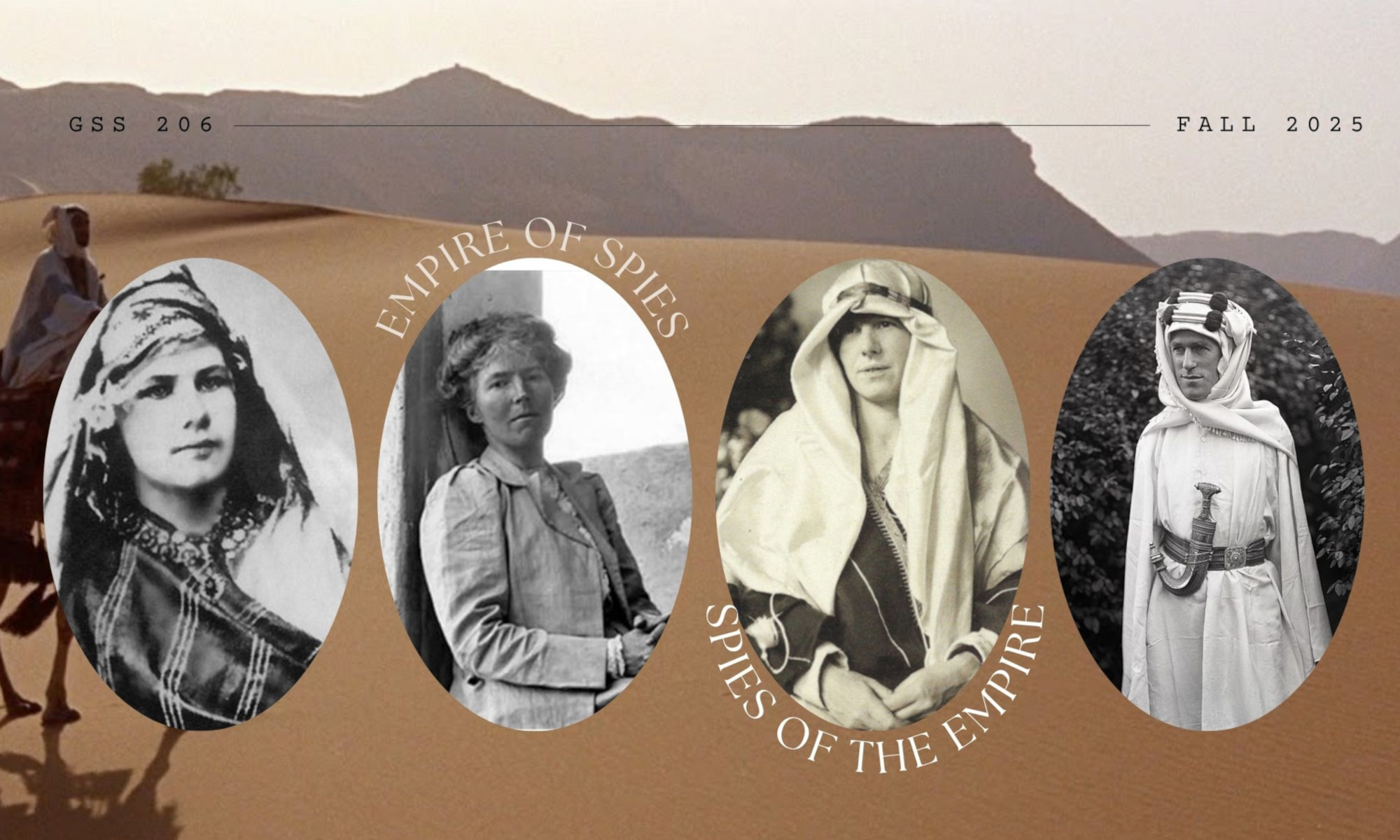
Spies of Empire/Empire of Spies
GSS206-NES204-THR214, Fall 2025
Hi everyone!
This was my final project/lecture that Prof. Fawzia asked to be posted on the course blog!
Hope you all have a good look at it 🙂
If I could assign this unit’s readings to anyone, I would assign them to my girlfriend Nikola. Her curiosity about Lawrence in Lahore sparked an interest in understanding the real T.E. Lawrence, but most portrayals present him as a mythologized hero of the British Empire. Our unit’s readings complicate that heroic image and provide a fuller sense of Lawrence as a complex, at times contradictory, figure.
A central text to begin with would be Seven Pillars of Wisdom, which reveals Lawrence’s contemplative voice and the internal contradictions he carefully constructs and performs. Pairing that with Raili Marling’s “Masculinity in the Margins” would show how Lawrence struggled to fully embody the masculine, heteronormative ideals of his era. Together, these readings would sharpen her understanding of the tension dramatized in Lawrence in Lahore, especially the gap between the public-facing, confident Lawrence and the private Lawrence, whose letters (including The Gay Love Letters of Lawrence of Arabia) describe shame, self-punishment, and discomfort with the heroic narrative imposed on him.
More broadly, reading about Lawrence, an accomplished figure, might make her feel empowered to leave her comfort zone and embark on “adventure”, as Lawrence himself did, and as a queer person, she would appreciate seeing how his time viewed homosexuality – a way of understanding the emotional cost of navigating queer identity within rigid imperial structures. Further, understanding empire from a different perspective (the British Empire, and its interactions with the Middle East), would provide insight on why this region remains unstable today, and a perspective outside of the typical Eurocentric narrative.
By studying Lawrence’s writings alongside biographies and media which re-interpret him, it becomes clear how imperial icons are constructed, edited, and continually developed for new audiences. Nikola often asks me how people “can be so stupid” as to fall for political cults of personality, and the Lawrence myth offers a concrete example of this process. His myth was manufactured and commodified during his lifetime by figures like Lowell Thomas, then posthumously spun by later biographers and filmmakers, who each built their own portrait of Lawrence to suit various political and cultural ends. Overall, I think that the Lawrence readings would be a compelling experience for her, and help her investigate questions about contemporary media and politicizing – and especially, how narratives are twisted and changed long after their creators are gone.
As I read Seven Pillars, a few sentences stood out because they exposed the contradictions and self-shaping that Lawrence leans on throughout the book. One of the clearest examples is his early admission that this is a “self-focused narrative…unfair” to the soldiers and even to his British colleagues. On the surface it sounds humble, almost like he’s trying to be transparent, but I think it was more like a pre-emptive shield. By naming his bias up front, he gives himself permission to center his own experience anyway. And honestly, that annoyed me. It’s like he wants to claim subjectivity when it suits him, but still make his perspective the emotional and intellectual anchor of the entire revolt. He gets to frame the story while acting like he’s too self-aware to be blamed for it.
In Chapter I, when he says the campaign stripped fighters of “ordinary morality, pity, and a sense of individual responsibility,” I noticed how quickly the revolt became a stage for his inner psychological drama. The way he talks about moral decay and alienation overshadows everything else. He’s choosing which emotions to foreground, and they almost always circle back to him. Instead of exploring the broader ethical or political meaning of what’s happening, he turns the whole desert into a metaphor for his own unraveling. The chapter ends up feeling less like a collective wartime experience and more like Lawrence working through an existential crisis. How much of this “suffering” is something everyone felt? How much is part of the persona he’s building: half heroic, half damaged philosopher-soldier?
Then in Chapter II, when he defines “the Arabs” mostly through language and shared social structures. He’s drawing a giant map, dividing people into neat categories, and presenting all of it like it’s objective fact. His descriptions sound academic, but they flatten real differences and turn whole populations into abstractions. This reminded me how quickly ethnographic writing, especially by someone who already sees himself as a cultural interpreter can slip into essentialism without ever admitting that’s what’s happening.
Basically, all of this made me way more aware of how Lawrence sets himself up as the voice we’re supposed to trust. He admits things, sure, but then he turns around and uses that to frame everything on his terms.
Writing blogposts for this class has been very different than for Transnational Feminisms in a REALLY fun way. I’ve enjoyed thinking of our spies in a more creative lens and pulling from MY world around me. In Transnational Feminisms sometimes I just wrote about whatever I wanted LOL, but this time, I always found a way to connect the two. It actually worked really well in forcing me to think of my daily life analytically as well as encouraging me to let some creativity into my studies. It became like an English class in that way, which was SUPER fun. I really enjoyed making the playlist for Gertrude Bell, which I spent HOURS poring over. Writing about her through music helped me understand her life and espionage almost literarily, and also begrudgingly made me feel less biased against her. Same with Lawrence! By seeing these spies as, yes, actors, but also human beings, I think my notes became less critique/taking a strong stance (which is sort of what studying English has trained me to do) and more understanding/connecting dots in the lives of the spies as well as to the modern world. It was always shocking because I’d come to a conclusion, craft an idea about each spy, then go back and connect it through the class readings. Maybe it’s just a lack of confidence, but I was always shocked to find evidence that supported my non-academic connections. I was also shocked at just how much using non-academic sources to fine tune my thinking helped my academic perspectives (ESPECIALLY Lawrence as Sookie LOL). In general, I’d like to know more about modern-day spies, or keep building on the research skills I used to write my midterm play. In class and in Lawrence in Lahore, we talked a lot about everything being interconnected, but as I did my own research on more modern politics, I was shocked to find just HOW true it is. Overall, I want to continue to learn creatively and research with an artistic lens because it opens up entire worlds of thinking that my English-influenced instinct to always take an arguable stance prevents me from doing.

True Blood is set in a world where vampires have recently come out of hiding due to the scientific advancement of a synthetic blood, True Blood. Sookie begins the show as a beautiful, innocent town weirdo. Everyone knows she can read minds, and in fact, she hates the trait herself. However, she realizes she cannot read the minds of vampires, and thus begins her many dramatic vampire affairs. The lore eventually grows and it is revealed that Sookie is a mindreader because she is part fairy (the show’s getting really bad…), which makes her blood alluring to vampires. Here is where my parallel really begins.
Lawrence, perhaps more than our other spies, was able to manage a balance of being an insider-outsider. While he donned an Arab drag, he wasn’t pretending to be Arab. He was able to travel between worlds because of his “ability to penetrate the inner self of the Arab individual” (Mousa 5). In relation to Arabs then, Lawrence had to be different. He was not one of the in-group; his relationships with Arabs was rooted in individuality, the recognition of difference. Like he says, “I can understand it enough to look at myself and other foreigners from their direction, and without condemning it. I know I’m a stranger to them, and always will be: but I cannot believe them worse, any more than I could change their ways” (Lawrence quoted in Garnett 156). Strangely, Sookie mirrors this insider-outsisder paradigm in her relationships with vampires. She can easily slip into their world because she is different. She doesn’t want to become a vampire or adopt their lifestyle, but they give her a reference point of normalcy–what she finds alluring about them. Furthermore, Sookie uses her ability to mind read to spy for vampires. She occupies human space (she visually appears human, can daywalk, and her power is invisible), but can also traverse the vampire world because of her fairy powers (which are based in light, and can therefore hurt vampires), her connections to the in-group, and the promise of her allure. She is both sympathetic and aggravating. She uses others, but gets used, and treats herself as the center of the universe. Her favorite line is: “If our relationship ever meant anything to you, you’d do this for me.”
Lawrence is somewhat the same. Mousa’s An Arab View and Theeb portrayed Lawrence as much less powerful than other iterations of his tale. He was simply a man in the right place at the right time with the right connections. Whatever role he did play in the Arab Revolt, it was exaggerated. He made promises he could not keep and we’ll never know if he actually thought he could make them happen. He used the Arabs for his own psychosexual, sado-masochistic exploration of the self through the east. He was a vampire! In the same way Sookie is, at least. Sookie spies for vampires but because she cannot read their intentions, often finds herself in situations where she has been cornered, manipulated, and even extorted by the very vampires she is psychosexually, sado-masochistially obsessed with (think: biting and blood, vampires are inherently tied to the concept of pain/consumption, fine line of pleasure/pain). Like Lawrence, she is both spy and insider-outsider, although she’s generally the one who ends up losing. I’d also argue she is sexually exploited in a way Lawrence was able to exploit others because of his rank. His gay love letters are described by Norton as “love letters from a slave to his master.” It brings up the question, how much information can one relationship have before it becomes exploitative? Could Sookie ever have a relationship with a vampire that doesn’t have a ridiculous power imbalance? With a human? Could Lawrence ever do the same with Arabs he claimed to love and work for? With his beloved Dahoum?
Spying necessitates betraying others, but in that, it must be wondered if that also means betraying oneself. Can one really love a person (or people) they exploit? It might be a reach, but to some extent all spy stories are vampiric.
An idea or concept that has stuck with me since it was mentioned was the way T. E. Lawrence describes his own self-punishment and self-erasure in Seven Pillars of Wisdom. The idea that Lawrence took it upon himself to punish himself for his account of assault in Dera. I keep thinking about it because it makes me think about our other spies and how despite how difficult times got, they pushed themselves to be this figure, to become someone that sheds their past life similar to how a snake sheds its skin. Other spies embrace the danger and adventure as a second skin. Lawrence’s, in specific, self-discipline and self-destruction as more than just responses to trauma but attempts to overwrite who he is with a part of himself that he can’t (or won’t) reconcile with. He frames his suffering not just as something done to him, but as something he must continually enact on himself to maintain the persona he has constructed. I also think about his somberness and how that one scene in Lawrence in Arabia where King Feisal was holding his hands and the tension that was occurring, but it for a split second looked like he was going to draw back perhaps as a form of self infliction? This further sparks my interests of how espionage narratives often revolve around not just an external conflict but an internal fracture of self, no longer self preservation but searching for familiarity. The spies or intelligence official’s work becomes a punishment once you get attached to where you are, perhaps even a opportunity to discipline or reinvent the self. I think it’s really compelling to think about how much of identity is based off building what they are trying to escape. When I also think about narratives I think about how Lawrence constantly positions himself as an outsider also as a way of punishment. In Seven Pillars of Wisdom, he is suspended between identities, British but doubts the British, fights with the Arabs but cannot truly be one of them. He becomes a legendary figure, but internally he feels deeply fractured. Pain as punishment both to rectify his wrongs and to be purified. An interesting concept to think about that I have been pondering. The myth Lawrence creates of self-inflicted punishment demands sacrifice, and the pain he embraces becomes the proof of that myth. In trying to control his story and elevate himself into a heroic figure, he also destroys parts of himself to maintain that image. When I pivot to modern day as we see the duality between present-day current events, especially in university. I actually see this same kind of duality in a lot of college students. We’re constantly juggling who we really are with who we think we’re supposed to be, academically, socially, professionally. It reminds me of Lawrence because so many students end up shaping themselves around an image or expectation, sometimes to the point of burning out or feeling disconnected from their own interests. While it’s not self-punishment, it can feel suffocating to be in a pressure cooker that ultimately can get over burdened with all the different aspects of college life there is.
I will be rewriting the torture part of Seven Pillars of Wisdom from the perspective of a bystander. The graphic scene is included in Chapter LXXX.
I stood near the wall, pretending to check the lantern, though there was nothing wrong with its flame. The others had already thrown the prisoner across the bench. He was frail—British, I presumed—with the grit he kept pressed between his teeth. His body buckled as they forced his wrists and ankles into place. I worked in these prisons, so I had seen beatings before, but they never made me feel this uneasy. Something about the way he clenched his jaw, as if bracing for pain he expected and almost welcomed, did not sit right with me.
Who is this man?
The corporal came back up the stairs with that Circassian whip he polished like a favorite blade. For a moment I thanked God that I was not on the opposing side. He snapped the lash by the prisoner’s ear. A clear taunt in regards to the impending lashing he was about to receive. The prisoner did not answer. He sharply breathed once and held still.
The first strike left clean streaks, bright and deep like fresh tracks on snow. He faintly counted them, as if insulting the corporal with his consciousness. The corporal grew angrier and the lashings got worse. I would turn away if it did not render me in contempt. His back trembled not only from pain, but from anticipation, a hint at the terror held just beneath the surface.
When he finally slid to the floor in a daze, he looked almost peaceful. As if he had drifted somewhere far away from the beating. I could not understand why this was so difficult for me to watch. Maybe it was the stubbornness he had or the way he remained so still.
Whatever it was, I felt ashamed to be standing there and simply being the bystander.
Rewriting this passage from the perspective of a bystander changed the emotional gravity of the scene. I particularly wanted to emphasize Lawrence’s quietness. In the original text, which is from Lawrence’s perspective, he framed silence as heroic endurance. I wanted to shift the perspective to someone watching these events unfold because I wanted to confront something that maybe Lawrence was not willing to see, which was how brutal, complicated, and practiced that response must have been. I do not want to sound Freudian, but this event of him getting whipped most likely did bring back memories of his mother hitting him. To me and other bystanders, the silence in Seven Pillars of Wisdom was giving old survival strategies that were resurfacing for Lawrence. Also, on the comment of the bystander assuming that Lawrence was British. I got that idea from the Gertrude Bell clip we watched, where she said “exploration is a British thing” or something along those lines. I decided to put my own spin on that.
My Passage: “The woman in the baths possessed the inimitable quality of a ghost: blurred against the sun, swallowed by the horde of us congregating. A veil clung to her neck. Her bareness still seemed wanting. Outside the realm of novelty, there was not much explanation for what drew her to us but if one were to exist, it would be not how she looked as much as her looking. I understood her gaze was not a gaze as much as it was a way to see nothing. She was not French, at least not entirely. The woman in front of us was instead a stranger, at once cowed by her shadow and utterly at ease, leaning away from her guide to pronounce, with feeling, her answer to our nonverbal query — she was a Brit, a friend. This was as interesting to me as it was uninteresting. What had interested me most in this exchange was the unsaid: which end she sought fixed to the Damascan mean. Or maybe the unsaid remained something else entirely. After she took her formal photograph, she leapt the threshold. Her body swayed back but returned no looking. I did not know if she had ever been a girl. I did not yet know if she knew it was possible to love something so dearly and wrongly, that your body bent helplessly toward your beloved’s opposite end, with no will toward one’s own loving.”
Original Passage: “They had all come up so close to me and I thought them a villainous-looking crowd. Someone murmured to the old man: “French?” “English,’ said I hastily: “we are your people’s friends.” This had an extraordinarily soothing effect on the atmosphere. I asked if they would mind moving away from me for the picture, which they did in silence. When I had taken it I thanked the man who seemed master of the bath and turned to my old man to have the door unfastened: this also was done in complete silence, but just as I was stepping out two or three of them asked me to turn back and look over the baths. This you may imagine I did not do. I was very glad to have that door open, though I suppose it was all really quite all right. I wish now I had taken the picture with more care, for I don’t imagine any European has been in that particular place before.” (Letters from Syria, 76)
Analysis:
What I consider most essential in my transformation of Stark’s writing is the reorientation of perspective: centering the “villainous-looking crowd” rather than Stark herself. In doing so, the scene becomes a counter-expression of the original encounter, told through the eyes of a native who possesses equal power to observe and judge Stark, just as she admires and pities the Levant. This narrative choice preserves the single-person perspective of Stark’s writing while reconfiguring it to welcome the polyphonic voice of the colonial subjects she sought to describe. The counter-grammar of my palimpsest renders autonomous and singular the people who, in Stark’s words, exist only as a monolithic crowd.
Even more significantly, the unnamed colonial subject finds the ability to occupy Stark’s positionality — even to sympathize with her as he dissects her “dear and wrong love.” This reciprocity exposes what Stark’s narrative omits: the colonial asymmetry at the heart of travel writing, in which the Western traveler seeks to know “the people” but cannot imagine being equally known by them. The observer fever dreams the Orient while refusing to see it as a mirror reflecting the hypocrisy of her gaze. Yet the palimpsest is careful not to condemn her; the narrator pays attention to Stark’s hybrid identity — French or not, knowing or unknowing—and emphasizes the fluidity of selfhood in the colonist-colonized relation, along with the vulnerability inherent in human connection. Both are elements Stark’s original text leaves unaddressed (by design, of course) and thus my intervention fleshes out a response to these omissions.
Honestly, the more I read Freya Stark and watched the films about her, the more uneasy I felt. She’s clearly brilliant and bold (there’s no denying that) but something about her voice never sits right with me. She notices everything, but it’s like she never actually feels what she’s seeing. There’s a constant distance, as if she wants to understand the world, but only on her own terms, only while she’s still the one holding the map.
So I made this playlist to respond to what she couldn’t say, what she couldn’t feel.
1) Marcel Khalife – “Ummi (My Mother)”
(Linked to: Letters from Syria and Beyond Euphrates)
In Letters from Syria and Beyond Euphrates, Stark walks through Damascus and Baghdad describing every detail: the graveyards, the veils, the “three separate quarters.” She’s observant to the point of precision, but she never really steps inside what she’s seeing. When I listen to Khalife’s “Ummi (My Mother),” that distance completely disappears. His voice feels like warmth, like home. When he sings, “I long for my mother’s bread, my mother’s coffee,” it’s belonging. Khalife makes what Stark calls “the Orient” feel human again. He sings from within what she only describes. Reading her after hearing him, I realized how often she confuses curiosity for connection.
2) Ahmad Kaabour – “Ounadikum (I Call to You)”
(Linked to: Passionate Nomad, Chapter 19)
There’s one line from Passionate Nomad that stuck with me: “It hardly made sense to make the Palestinians pay with their homes and lands for injuries done to Jews by European Christians.” She’s right, but she says it like an observer writing a report, not someone grieving a people’s loss. Ahmad Kaabour’s “Ounadikum” is the exact opposite of that. When he sings, “I call to you, my people,” it’s urgent, not detached. His voice makes her writing feel distant, like moral language without emotion. Stark’s “they” never becomes “we,” and that’s the difference.
3) Fairuz – “Zahrat al-Madā’in (The Flower of the Cities)”
(Linked to: Passionate Nomad and her 1944 press comments)
When Stark writes about Jerusalem, she does it with a kind of calm that’s almost cold. She calls it “friction between Jews and Arabs,” as if she’s describing weather. Fairuz’s “Zahrat al-Madā’in” destroys that calm completely. When she sings, “Jerusalem, flower of cities,” it’s both a prayer and a cry. You can feel the heartbreak in every word. She aches, grieves, and feels (unlike Stark who seems to only be analyzing).
4) Tracy Chapman – “Talkin’ ’Bout a Revolution”
(Linked to: Freya Stark’s 1944 press tour comments)
During her 1944 press tour, Stark calls the Arabs “the rightful owners of Palestine,” which sounds bold until you realize she’s still speaking as part of the British machine that made the whole crisis possible. She names the problem but never challenges the power behind it. Tracy Chapman’s “Talkin’ ’Bout a Revolution” is like that silence finally breaking open. Chapman doesn’t stop at moral awareness; she pushes toward change. Her song says what I wish Stark had the courage to: not just this is wrong, but this must end.
5) Le Trio Joubran – “Masār”
(Linked to: Towards the Unknown Land – Nepal)
In Stark’s final film, she’s carried through the mountains of Nepal by a team of porters. She looks fragile but composed, smiling faintly as she says, “If it fails, it fails.” The moment is framed as graceful acceptance: an aging traveler facing limits with humility. However, to me, it felt like comfort disguised as wisdom. Even at the end of her life, she’s still being carried (literally) by others whose presence is unnamed. Le Trio Joubran’s “Masār” sounds like that scene. It’s beautiful, but it refuses peace. It feels like remembering something you can’t fix. When I listen to it, I imagine it filling the silence in Stark’s film: not judging her, but not forgiving her either. Just holding her quietness up to the light and asking what’s underneath it. It made me think about how reflection isn’t the same as reckoning. Stark reflects endlessly (on landscapes, people, herself) but her reflections never really cost her anything. Masār feels like what real reckoning would sound like: the moment when beauty stops protecting you, and you finally have to sit with what you’ve done.
Freya Stark has been the (if not one of) most intellectually stimulating, accomplished, and devoted spies that we have encountered thus far in our seminar. This playlist will be curating some songs that echo this moral and emotional landscape of Freya Stark’s writings and discussions we’ve had over the last 3 weeks, especially towards her ambivalent stance between devotion and exile as well as humility and power. These songs will be reflecting her own cross-cultural sympathies and her layered identity. I think Freya Stark is a really interesting individual, her loyalties will ultimately is always towards Great Britain, but her complexities in how she sees the Arab World and her seeing faith as beauty in everyday life rather than a dogma makes me view her with a more ethical and reliable lens (although we do have our critiques). Her ability to craft her own story through her own choosing and focusing on her travels makes her a great person to analyze.
“Aaj Jane Ki Zid Na Karo” – Farida Khanum (1960s, poet was Fayyaz Hashmi)
This ghazal’s entreaty “Don’t insist on leaving today” encapsulates the sorrow of transience that permeates Letters from Syria and Perseus in the Wind. In our class discussions, we explored how Stark’s existence fluctuates between belonging and departure, between service and solitude. Khanum’s voice embodies that same duality: restraint, longing, and quiet dignity. Similar to Stark’s prose, it avoids sentimentality while brimming with emotion. The song’s languorous rhythm reflects Stark’s evenings in Damascus or Baghdad, moments caught between closeness and distance, faith and exile. It transforms into an anthem for her moral restlessness: desiring to remain, yet aware that she must perpetually move forward.
“El Helwa Di” – Sayed Darwish
The class emphasized Stark’s admiration for “ordinary service”, her belief that empire fails when it strips people of dignity or agency. Darwish’s song about Cairo’s morning workers gives life to that idea. “Empire redeemed through care.” In Baghdad Sketches, Stark likewise finds holiness in ordinary acts: women baking bread, men sweeping courtyards at dawn. The song reflects her conviction that service ennobles the human spirit and that true civilization is measured not by empire, but by small kindnesses. The song’s gentle strings embodies the grace present within empire as seen through Stark’s eyes, strength for the Arab world lies in its humanity and hospitality not its politics the way the British does. However, Stark still uses moral language to critique empire from within. In Passionate Nomad, Geniesse captures this tension: Stark defends Britain’s Arab policy while privately empathizing with Arabs betrayed by the post-WWI settlement.
“Desert Rose” – Sting ft. Cheb Mami
Cheb and Sting’s English and Arab duet creates the same cultural duality as seen through Letters from Syria. This song represent the constant back and forth with the East and the West, reasoning and reverence. Stark is noted to be “morally exiled”, too Western to belong to the East and too “Eastern”/changed in her perspectives to return and be content at home. This song is the exile to everything she is, perfectly framing Stark as sensual, distant, yearning, yet still patriotic. Stark once wrote, “The desert does not separate; it teaches us the beauty of distance.” Stark’s fascination with Arab “service” and her writings that accustomed affectionate realism rather than Orientalist distance, however she still had her 1930s British views as seeing British’s roles as a moral tutor of the Arabs.
“Riverside” – Agnes Obel
Reflective, quiet, sorrowful, mirroring the tone of Perseus in the Wind where Stark is contemplating beauty, life, aging, and faith. Solitude of travel, the river representing her travels and what she’s saying. Obel sings how she “sees how everything is torn in the river deep. And I don’t know why I go the way down by the riverside..” analogous to Stark and her travel writings and her “feminine ethics of observation”. “The world’s beauty,” Stark wrote, “is the highest service a soul can render.” “Riverside” sounds like the stillness of that service. Stark’s gender and her perspective is very much seeing feminine virtues redeeming imperial contact and this process of her continuing to embody empathy and service through her stops and in conjunction with this song, the analogy of her travels to being along the river.
“Arrival of the Birds” – London Metropolitan Orchestra
While this song is purely instrumental, it is fitting for it to be regarded as Freya Stark’s ultimate life theme song. Stark’s numerous writings can be regarded as the lyrics as her writings have been grand, full of rich text to be deciphered, ultimately mimicking the feeling of returning home changed. The tone of the song is very grand, dignified, tapered right as it would approach arrogance. The song invokes discovery, wonder, and the quiet till of achievement. In Perseus in the Wind, she wrote that “the human spirit grows only when challenged,” and this song embodies that belief. It’s not victory by domination, but victory through understanding. This piece encapsulates her quiet ventures from her childhood struggles to her early travels to her dignified later years as Dame Freya Stark.
The McGraw Center for Teaching and Learning
328 Frist Campus Center, Princeton University, Princeton, NJ 08544
PH: 609-258-2575 | FX: 609-258-1433
mcgrawdll@princeton.edu
A unit of the Office of the Dean of the College
© Copyright 2026 The Trustees of Princeton University