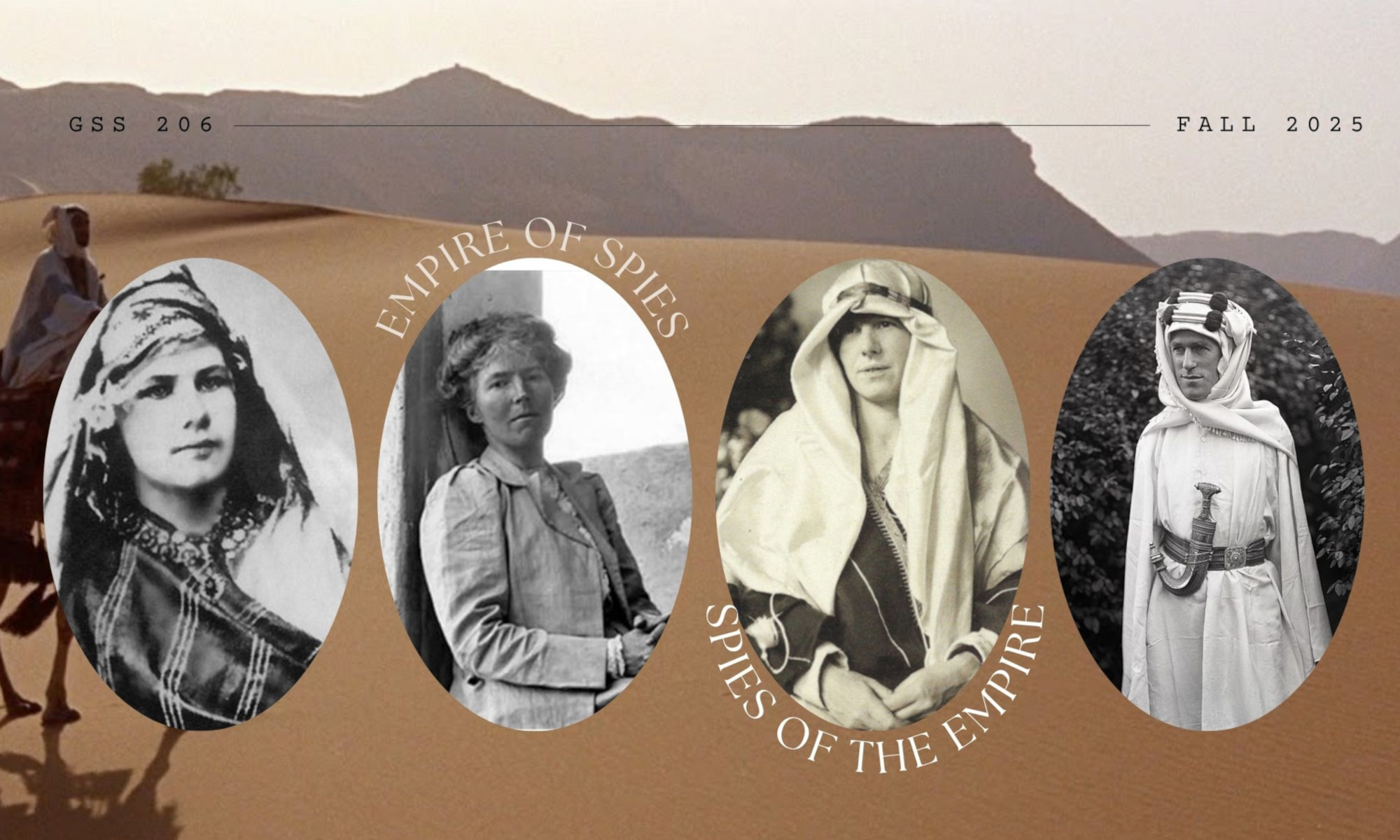
Lawrence’s Self-Made Authority

As I read Seven Pillars, a few sentences stood out because they exposed the contradictions and self-shaping that Lawrence leans on throughout the book. One of the clearest examples is his early admission that this is a “self-focused narrative…unfair” to the soldiers and even to his British colleagues. On the surface it sounds humble, almost like he’s trying to be transparent, but I think it was more like a pre-emptive shield. By naming his bias up front, he gives himself permission to center his own experience anyway. And honestly, that annoyed me. It’s like he wants to claim subjectivity when it suits him, but still make his perspective the emotional and intellectual anchor of the entire revolt. He gets to frame the story while acting like he’s too self-aware to be blamed for it.

In Chapter I, when he says the campaign stripped fighters of “ordinary morality, pity, and a sense of individual responsibility,” I noticed how quickly the revolt became a stage for his inner psychological drama. The way he talks about moral decay and alienation overshadows everything else. He’s choosing which emotions to foreground, and they almost always circle back to him. Instead of exploring the broader ethical or political meaning of what’s happening, he turns the whole desert into a metaphor for his own unraveling. The chapter ends up feeling less like a collective wartime experience and more like Lawrence working through an existential crisis. How much of this “suffering” is something everyone felt? How much is part of the persona he’s building: half heroic, half damaged philosopher-soldier?

Then in Chapter II, when he defines “the Arabs” mostly through language and shared social structures. He’s drawing a giant map, dividing people into neat categories, and presenting all of it like it’s objective fact. His descriptions sound academic, but they flatten real differences and turn whole populations into abstractions. This reminded me how quickly ethnographic writing, especially by someone who already sees himself as a cultural interpreter can slip into essentialism without ever admitting that’s what’s happening.

Basically, all of this made me way more aware of how Lawrence sets himself up as the voice we’re supposed to trust. He admits things, sure, but then he turns around and uses that to frame everything on his terms.


TE Lawrence & True Blood’s Sookie Stackhouse: Love Bites!

True Blood is set in a world where vampires have recently come out of hiding due to the scientific advancement of a synthetic blood, True Blood. Sookie begins the show as a beautiful, innocent town weirdo. Everyone knows she can read minds, and in fact, she hates the trait herself. However, she realizes she cannot read the minds of vampires, and thus begins her many dramatic vampire affairs. The lore eventually grows and it is revealed that Sookie is a mindreader because she is part fairy (the show’s getting really bad…), which makes her blood alluring to vampires. Here is where my parallel really begins. 

Lawrence, perhaps more than our other spies, was able to manage a balance of being an insider-outsider. While he donned an Arab drag, he wasn’t pretending to be Arab. He was able to travel between worlds because of his “ability to penetrate the inner self of the Arab individual” (Mousa 5). In relation to Arabs then, Lawrence had to be different. He was not one of the in-group; his relationships with Arabs was rooted in individuality, the recognition of difference. Like he says, “I can understand it enough to look at myself and other foreigners from their direction, and without condemning it. I know I’m a stranger to them, and always will be: but I cannot believe them worse, any more than I could change their ways” (Lawrence quoted in Garnett 156). Strangely, Sookie mirrors this insider-outsisder paradigm in her relationships with vampires. She can easily slip into their world because she is different. She doesn’t want to become a vampire or adopt their lifestyle, but they give her a reference point of normalcy–what she finds alluring about them. Furthermore, Sookie uses her ability to mind read to spy for vampires. She occupies human space (she visually appears human, can daywalk, and her power is invisible), but can also traverse the vampire world because of her fairy powers (which are based in light, and can therefore hurt vampires), her connections to the in-group, and the promise of her allure. She is both sympathetic and aggravating. She uses others, but gets used, and treats herself as the center of the universe. Her favorite line is: “If our relationship ever meant anything to you, you’d do this for me.”

Lawrence is somewhat the same. Mousa’s An Arab View and Theeb portrayed Lawrence as much less powerful than other iterations of his tale. He was simply a man in the right place at the right time with the right connections. Whatever role he did play in the Arab Revolt, it was exaggerated. He made promises he could not keep and we’ll never know if he actually thought he could make them happen. He used the Arabs for his own psychosexual, sado-masochistic exploration of the self through the east. He was a vampire! In the same way Sookie is, at least. Sookie spies for vampires but because she cannot read their intentions, often finds herself in situations where she has been cornered, manipulated, and even extorted by the very vampires she is psychosexually, sado-masochistially obsessed with (think: biting and blood, vampires are inherently tied to the concept of pain/consumption, fine line of pleasure/pain). Like Lawrence, she is both spy and insider-outsider, although she’s generally the one who ends up losing. I’d also argue she is sexually exploited in a way Lawrence was able to exploit others because of his rank. His gay love letters are described by Norton as “love letters from a slave to his master.” It brings up the question, how much information can one relationship have before it becomes exploitative? Could Sookie ever have a relationship with a vampire that doesn’t have a ridiculous power imbalance? With a human? Could Lawrence ever do the same with Arabs he claimed to love and work for? With his beloved Dahoum?

Spying necessitates betraying others, but in that, it must be wondered if that also means betraying oneself. Can one really love a person (or people) they exploit? It might be a reach, but to some extent all spy stories are vampiric.

The Violence of Grammar: A Tool of Power

One idea that’s been stuck with me since our discussion on the “a” vs. “the” in the Balfour Declaration is how language can decide the fate of an entire people. When Gertrude Bell argued for the use of “a national home” rather than “the national home” for the Jewish people, it might have sounded like a technical adjustment, but to me, it felt like a warning. That “a” became a way to avoid responsibility, to promise without actually promising, to escape accountability. 

As a Palestinian, I have seen this same strategy used before. For example, in the Oslo Accords, the language used to describe Palestinian lands referred to them as “a territory” rather than “the territory which was a choice that allowed Israel to expand settlements and claim land that was never clearly defined as ours in the first place. The ambiguity wasn’t accidental; it was strategic. This showed me that grammar can be violent. A simple “a” can erase and dispossess just as much as bullets or bulldozers.

the use of “a” as a tool of strategic vagueness can be looked at in the broader sense such as in the U.S. Constitution. The way amendments are worded, especially those supposedly guaranteeing “equal protection” or “freedom”, have been deliberately open-ended and therefore leaves space for those in power to interpret justice however they want. Vagueness here is used as a kind of shield: it allows the state to claim moral authority while maintaining the ability to exclude and discriminate. 

I’ve always known that language is never neutral. The smallest choices in phrasing can determine whose lives are protected and whose aren’t. We (the oppressed) tend to celebrate treaties, declarations, and laws as “wins” the moment they’re signed, and it makes sense. These moments usually come after long periods of pain, loss, and struggle, so we cling to any sign of recognition or progress. I would never blame anyone for holding onto hope. But history shows that the real danger lies in the fine print like the indefinite articles, the open-ended clauses, and the carefully chosen ambiguity that gives room to manipulate. We need to look closely at what exactly we’re being offered, and what is being withheld in the wording itself. Because sometimes what looks like a step forward quietly includes the loopholes that will be used against us later.

Fantasy of Fantasy: A Comparison of Language in Queen of the Desert and Dune

In class, I briefly made a point about the use of language in Queen of the Desert (in which most of the dialogue is in English, with only certain buzzwords, names, and greetings in Arabic or relevant Middle Eastern languages) and the use of Arabic in made-up languages in fantastical films based off the Middle East, such as Dune. Where does one draw the line between accessibility, exoticization, and authenticity? When Herzog’s Iran is as much a fantasy as Director Villeneuve’s Arrakis, what lends one white-made artistic vision credibility and the other condemnation?

After a bit of sleuthing, I found a New Yorker article, ‘“Dune” and the Delicate Art of Making Fictional Languages’ (https://www.newyorker.com/culture/cultural-comment/dune-and-the-delicate-art-of-making-fictional-languages?_sp=7e36c459-8134-41bc-9eee-8d6d99565401.1760207334616), which ruminates adjacently on this topic. In Dune, Arabic is the “language of greatest influence…[where the fantasy language] uses at least eighty terms with clear Arabic origins, many of them tied to Islam.” Amongst these words are, most notably, istislah (“natural law”), ijaz (“prophecy”), and names, such as shai-hulud (“thing of eternity”) and mu’addib (teacher). Strikingly, the word jihad, while present in the books, is excluded purposefully in the films, as not to perpetuate modern negative associations. The reasoning for these inclusions is unique; of course, the filmmakers thought it apt to pay tribute to the Middle East, but they also reason that Dune takes place so far in the future the language must have evolved beyond recognition, just as how English has evolved dramatically since Beowolf. There are some other stand-out lines from the article; particularly, when addressing the white-washing of certain characters, scholar Khaldoun Kheli states that “Arabs can’t be heroes…we must be erased.”

These two films hold an interesting dichotomy; Queen of the Desert is a fantasy of a Middle Eastern past, while Dune is essentially a fantasy of a Middle Eastern future. With a shared inspiration, the similarities and differences are fascinating. Both films deal with the colonization of the Middle East (perhaps subconsciously suggesting, though this may be a bit of a long shot, that a place only becomes accessible and relevant after a white man has stepped into it). Herzog’s film seems obviously fetishistic, while Villeneuve executes with more taste and tact. Both films suffer from White Hero Syndrome: Timothee Chalamet plays the world’s legendary prophet Lisan al-Gaib, and Gertrude Bell is bestowed the title of Umm al-Mu’minin (wife of the prophet) by King Faisal (how interesting that these are both Islamic epithets of the highest honor, which the narrative and history has bestowed upon white characters). 

This projects onto a greater point of Orientalism, which characterizes the East as essentially a colonial fantasy. There is quite a depressing argument to be made here, which is that in the past, present, and future, the Middle East is imprisoned within the exaggerated imaginations of white creators. However, that may be too reductionist of a generalization to make in such short a post, as camel races did exist, Gertrude Bell was in fact named Umm al-Mu’minin, and the argument about Beowulf does make quite a lot of sense. Rather, the key definer seems to be about framing, rather than content. However, I am  unfortunately running out of space — hopefully a commentator can take it from here.

The Mirror Trick

The Mirror Trick

In Marie-Odele Delacour and Jean-René Hulue’s “Introduction: The Game of ‘I’”, they draw special attention to the rhetorical and thematic use of perspective in Eberhardt’s writing. In “The Mirror,” a short prelude to the rest of her short story collection, the first-person narrator is Mahmoud Saadi. He is a male wanderer who becomes the vessel for Isabel’s writing, though in the text he is not named, and without further inspection his role is mostly passive. The more active subject is Mohammed, who is described to be of “perfect masculine beauty.”. Mahmoud observes Mohammed looking at himself in a little penny mirror and speculates at his interiority — at the end Mohammed closes the mirror and smiles, and the reader is left unsure as to whether Mohammed was using the mirror to spy upon the spying on Mahmoud.

While reading this passage, I remembered a quote that’s been pinging itself around in my head recently. Margaret Atwood says: “Male fantasies, male fantasies, is everything run by male fantasies? Up on a pedestal or down on your knees, it’s all a male fantasy: that you’re strong enough to take what they dish out, or else too weak to do anything about it. Even pretending you aren’t catering to male fantasies is a male fantasy: pretending you’re unseen, pretending you have a life of your own, that you can wash your feet and comb your hair unconscious of the ever-present watcher peering through the keyhole, peering through the keyhole in your own head, if nowhere else. You are a woman with a man inside watching a woman. You are your own voyeur.” While this refers more to heterosexual objectification, it nevertheless provides an interesting perspective on Eberhart’s superfluous and intersectional identity as a woman who often disparages women, a woman who travels as a man, and a white person who claims a middle-Eastern identity and inheritance. 

In their reading of “The Mirror,” Delacour and Hulue claim Eberhardt as an incredibly active participant; through their description, it’s easy to mistake her as a character in the narration itself. With this supportive interpretation, the question that the Atwood reference then invokes is whether or not there is such a thing as an internal, uncorrupted female gaze. The fact that Eberhardt is the female puppeteer behind these two male figures is a significant reverse-power play considering the context of her time, but that logic is marred when taking into account the privilege of her whiteness in shaping ethnic stories. The infinite “spying” aspect of the mirror trick also relates to Atwood’s quote as it is unclear if Mohammed is reflecting internally within himself, if it is only Mahmoud is spying on Mohammed, if it is Mohammed is spying on Mahmoud spying on Mohammed, or, to get really rhetorical, if Mohammed is piercing the veil of Mahmoud to lay his eyes on Eberhardt; Atwood’s quote is less about separate male and female gazes, but and more that they are inevitably melded within a woman. Is Eberhardt, this double agent of politics and identity, just living an amped up version of this psychosis?


Isabelle Eberhardt: Radically un-Transgressive

As a Kabyle-American, I found all of Eberhardt’s journeys quite fascinating. In a lot of the ways I’ve experienced and understood Algeria, she is transgressive if understood as a woman. While I use the pronouns “she” and “her” for Eberhardt, this is done only for linguistic clarity. I think her gender was far more complicated than just being a woman traveler in drag. Is it fair to even consider her a woman when her gender/religious/cultural expressions were entirely male? If Eberhardt is understood as a man, then really, all she did was not very transgressive. I think I’m inclined to read her this way because the very few times she refers to herself in her daily journals, masculine pronouns are used. So, she is then a masculine European figure, trying to (quasi-)disguise herself as an Arab. Once again, this is very surface level transgressive, and instead further reinforces what Mohamed Boudhan calls “France’s Arabizing function.” 

Let me explain! “These Berber assemblies are tumultuous. Passions have free rein; violent, they often end in blood. However, the Berbers always remain protective of their collective rights. They defend themselves against autocracy by suppressing those who dare aspire to it. In Kenadsa the Arab theocratic spirit has triumphed over the republican confederative Berber spirit” (Eberhardt 307; Oranese South II). Essentially, Eberhardt establishes an ethnic hierarchy of her experiences in Algeria. The (often French-associated) Arabs act as enlightened Muslims, much better and more civilized than their primitive, Indigenous counterparts. While her fascination with Arab identity may be read as transgressive from a western lens, when Eberhardt is understood as someone in the lived reality of North Africa, she instead implicates herself with a fellow ruling, dominating class. She, as a native European, is understood as a qualified speaker on civilization, and she knows the Arabs have it where the Berbers don’t. It completely reinforces the French colonial tactic of dividing and conquering. Arabs and Berbers are SO different, and if you can’t be European, it’s much better to be a civilized Arab! 

Despite the interesting and somewhat controversial history of Amazigh marabouts, Eberhardt associates this caste of people with Arabo-Islamic civilization. “The marabouts’ influence on Kenadsa has been so profound that Berbers and Kharantine have forgotten their languages, no longer using anything but Arabic. Their behavior has softened and become civilized” (Eberhardt 308; Oranese South II). Eberhardt then believes in a cultural/linguistic homogeneity, a precursor to the aftereffects of French colonialism on North Africa. While Eberhardt claims to be a neutral passerby on her journey to self-discovery in the exotic east, she claims to have “never played any kind of political role” (Bowles 87; Eberhardt’s letter to the editors of La petite Gironde). Yet, just a few sentences later, she admits, “whenever possible, I make a point of trying to explain to my native friends exact and reasonable ideas, explaining to them that French domination is far preferable to having the Turks here again, or for that matter, any other foreigners. It is completely unjust to accuse me of anti-French activities” (Bowles 87; Eberhardt’s letter to the editors of La petite Gironde).

Overall, Eberhardt is an incredibly interesting character, but perhaps for the exact opposite reasons western media lauds her as a transgressive, anti-racial, proto-feminist. To me, she is the perfect example of Europe’s ability to separate, class, and racialize their colonial subjects, as well as setting the stage for the postcolonial Arabization of North Africa. Eberhardt’s views were perhaps more progressive than the average European of the era, however, it wasn’t anything particularly revolutionary, despite how impressive her story was. Like Kabani says, “[Eberhardt] became a mouthpiece for patriarchy, voicing traditional male views on sex, culture, religion and politics” (Kabani ix). It’s like the kids say: fork was found in kitchen! 

Hello world!

Hello Students of Spies of Empire!

Lets have some fun interrogating the machinery of Empire as it reveals itself through the shenanigans of some of its more famous–or infamous!—writer-spies-archeologists-travelers: spies one and all!

We will think about what “spying” means” and whose interests it serves–and ask when it can be a force for good or evil, control or being controlled.

More to follow….for now, welcome to the course!