Hi everyone!
This was my final project/lecture that Prof. Fawzia asked to be posted on the course blog!
Hope you all have a good look at it 🙂
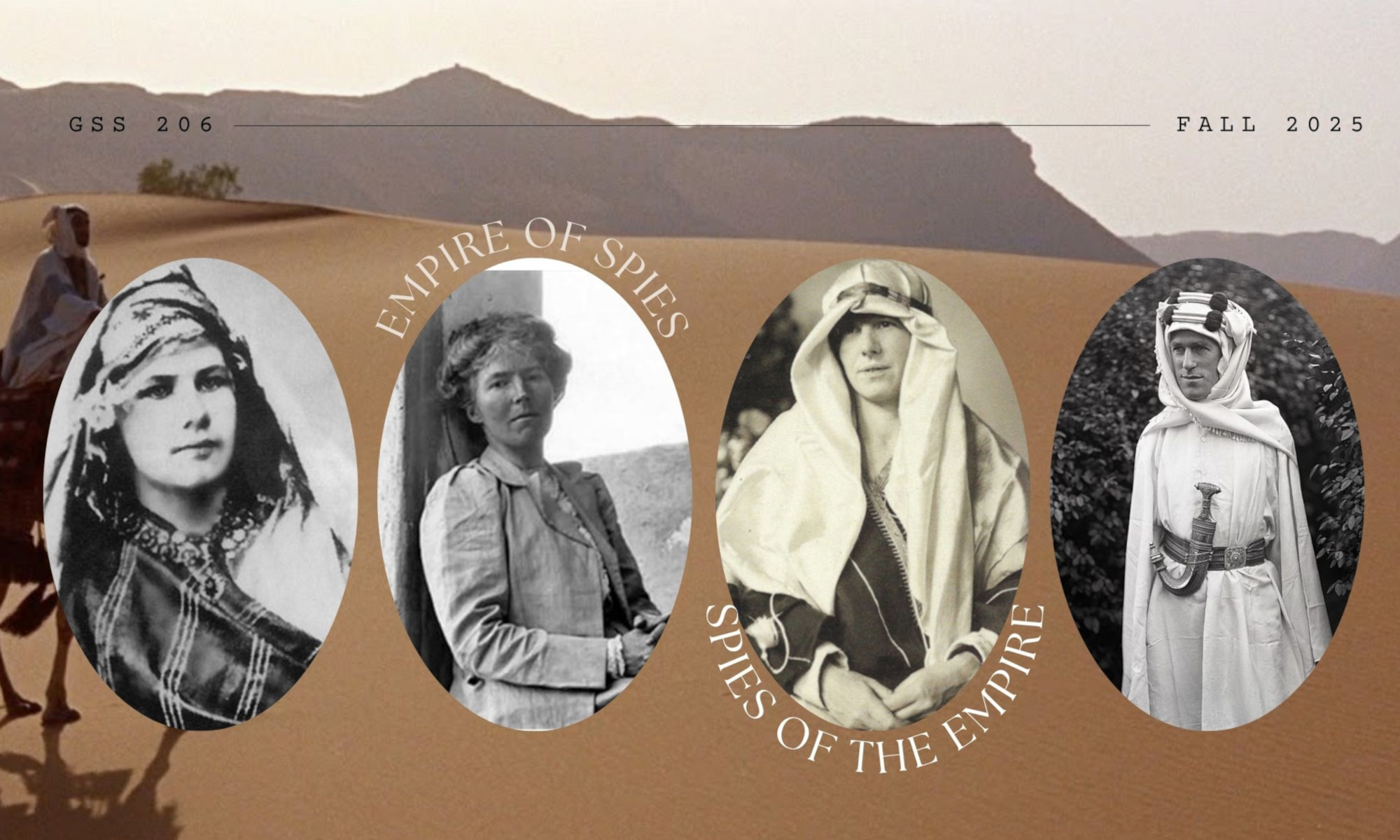
Spies of Empire/Empire of Spies
GSS206-NES204-THR214, Fall 2025
Hi everyone!
This was my final project/lecture that Prof. Fawzia asked to be posted on the course blog!
Hope you all have a good look at it 🙂
If I could assign this unit’s readings to anyone, I would assign them to my girlfriend Nikola. Her curiosity about Lawrence in Lahore sparked an interest in understanding the real T.E. Lawrence, but most portrayals present him as a mythologized hero of the British Empire. Our unit’s readings complicate that heroic image and provide a fuller sense of Lawrence as a complex, at times contradictory, figure.
A central text to begin with would be Seven Pillars of Wisdom, which reveals Lawrence’s contemplative voice and the internal contradictions he carefully constructs and performs. Pairing that with Raili Marling’s “Masculinity in the Margins” would show how Lawrence struggled to fully embody the masculine, heteronormative ideals of his era. Together, these readings would sharpen her understanding of the tension dramatized in Lawrence in Lahore, especially the gap between the public-facing, confident Lawrence and the private Lawrence, whose letters (including The Gay Love Letters of Lawrence of Arabia) describe shame, self-punishment, and discomfort with the heroic narrative imposed on him.
More broadly, reading about Lawrence, an accomplished figure, might make her feel empowered to leave her comfort zone and embark on “adventure”, as Lawrence himself did, and as a queer person, she would appreciate seeing how his time viewed homosexuality – a way of understanding the emotional cost of navigating queer identity within rigid imperial structures. Further, understanding empire from a different perspective (the British Empire, and its interactions with the Middle East), would provide insight on why this region remains unstable today, and a perspective outside of the typical Eurocentric narrative.
By studying Lawrence’s writings alongside biographies and media which re-interpret him, it becomes clear how imperial icons are constructed, edited, and continually developed for new audiences. Nikola often asks me how people “can be so stupid” as to fall for political cults of personality, and the Lawrence myth offers a concrete example of this process. His myth was manufactured and commodified during his lifetime by figures like Lowell Thomas, then posthumously spun by later biographers and filmmakers, who each built their own portrait of Lawrence to suit various political and cultural ends. Overall, I think that the Lawrence readings would be a compelling experience for her, and help her investigate questions about contemporary media and politicizing – and especially, how narratives are twisted and changed long after their creators are gone.
Excerpt from The Valleys of the Assassins by Freya Stark, p. 47:
I bought the jar, collected the skull — which broke into pieces in my hand and required careful packing — and came away none too pleased with the morning’s result, for I had hoped for a grave of the Bronze Age, and it was now quite useless to expect the tribe to dig again. Their misgivings as to the permissibility of carrying away people’s bones had been allayed by the fact that the skeleton had obviously not been laid in the direction of Mecca; but they were still nervous about the Persian law of antiquities, which has brought punishment for illicit dealing in bronzes on to several of the tribes. The government occasionally send spies and then get the chiefs to pay fines, and are really making praiseworthy efforts to save what is left of the graves in Luristan. I knew that what I was doing went directly against this law: but there were some extenuating circumstances.
My rewrite, changing from first to third-person:
Stark purchased the jar and collected the ancient skull, which came to pieces in her hands. She packed the fragments carefully away and regarded the morning with an air of disappointment. She had hoped to find a proper Bronze Age grave. Furthermore, she was fully in the belief that the tribe would not excavate again, despite the richness of archaeological potential here. They were displeased with the idea of walking off with human remains, though they were placated somewhat with the finding that the ancient skeleton had not been faced towards Mecca. Yet the tribesmen remained nervous about the Persian antiquities law, which had already punished several tribes for the blackmarket trading of bronzes. Now, the government did, on occasion, dispatch spies and force the tribal chiefs to pay fines – a noble effort to save the remnants of the Luristan graves. Stark was rather aware that her own actions were in violation of the antiquities law, but she had her reasons. The circumstances justified it.
The effect of the changes:
By removing the passage from Stark’s own POV and voice and shifting it into novel-style third-person narration, the rewrite distances the reader from Stark’s personally-motivated justifications and broadens the scope of issues addressed: placing more weight on the antiquities law, local tribes, and the ethics of archaeology, rather than on Stark’s desire to make archaeological discoveries from the perspective of an outsider. The narration preserves Stark’s private thoughts and attitude towards the activities and the tribes, but leaves to the reader to judge whether she is correct. The final line, “The circumstances justified it.”, is a more terse rewrite of “but there were some extenuating circumstances” (and from later in the paragraph, “I felt that one was justified in trying to discover as much as possible while one was on the spot.”). By stating this in a factual tone, the narration appears to agree with Stark, but the overall tone is critical.
When reading texts in the first-person, it is hard to divest oneself from the internal narrative of the author. Inherently, such texts are more personal, more emotional, and we identify with the human fears and desires of the writer. By removing a text from the first-person, the same emotions and internal dialogue can be captured, but the reader is empowered in a heightened sense to question each character encountered. While Stark remains the main character of the passage, the reader wonders about her affect on the others present, and if this rewrite had a broader scope, the reader would also be able to criticize or root for other characters beyond Stark, and gain perspective into their motivations and feelings about situations Stark engages with.
As I read Seven Pillars, a few sentences stood out because they exposed the contradictions and self-shaping that Lawrence leans on throughout the book. One of the clearest examples is his early admission that this is a “self-focused narrative…unfair” to the soldiers and even to his British colleagues. On the surface it sounds humble, almost like he’s trying to be transparent, but I think it was more like a pre-emptive shield. By naming his bias up front, he gives himself permission to center his own experience anyway. And honestly, that annoyed me. It’s like he wants to claim subjectivity when it suits him, but still make his perspective the emotional and intellectual anchor of the entire revolt. He gets to frame the story while acting like he’s too self-aware to be blamed for it.
In Chapter I, when he says the campaign stripped fighters of “ordinary morality, pity, and a sense of individual responsibility,” I noticed how quickly the revolt became a stage for his inner psychological drama. The way he talks about moral decay and alienation overshadows everything else. He’s choosing which emotions to foreground, and they almost always circle back to him. Instead of exploring the broader ethical or political meaning of what’s happening, he turns the whole desert into a metaphor for his own unraveling. The chapter ends up feeling less like a collective wartime experience and more like Lawrence working through an existential crisis. How much of this “suffering” is something everyone felt? How much is part of the persona he’s building: half heroic, half damaged philosopher-soldier?
Then in Chapter II, when he defines “the Arabs” mostly through language and shared social structures. He’s drawing a giant map, dividing people into neat categories, and presenting all of it like it’s objective fact. His descriptions sound academic, but they flatten real differences and turn whole populations into abstractions. This reminded me how quickly ethnographic writing, especially by someone who already sees himself as a cultural interpreter can slip into essentialism without ever admitting that’s what’s happening.
Basically, all of this made me way more aware of how Lawrence sets himself up as the voice we’re supposed to trust. He admits things, sure, but then he turns around and uses that to frame everything on his terms.
Honestly, the more I read Freya Stark and watched the films about her, the more uneasy I felt. She’s clearly brilliant and bold (there’s no denying that) but something about her voice never sits right with me. She notices everything, but it’s like she never actually feels what she’s seeing. There’s a constant distance, as if she wants to understand the world, but only on her own terms, only while she’s still the one holding the map.
So I made this playlist to respond to what she couldn’t say, what she couldn’t feel.
1) Marcel Khalife – “Ummi (My Mother)”
(Linked to: Letters from Syria and Beyond Euphrates)
In Letters from Syria and Beyond Euphrates, Stark walks through Damascus and Baghdad describing every detail: the graveyards, the veils, the “three separate quarters.” She’s observant to the point of precision, but she never really steps inside what she’s seeing. When I listen to Khalife’s “Ummi (My Mother),” that distance completely disappears. His voice feels like warmth, like home. When he sings, “I long for my mother’s bread, my mother’s coffee,” it’s belonging. Khalife makes what Stark calls “the Orient” feel human again. He sings from within what she only describes. Reading her after hearing him, I realized how often she confuses curiosity for connection.
2) Ahmad Kaabour – “Ounadikum (I Call to You)”
(Linked to: Passionate Nomad, Chapter 19)
There’s one line from Passionate Nomad that stuck with me: “It hardly made sense to make the Palestinians pay with their homes and lands for injuries done to Jews by European Christians.” She’s right, but she says it like an observer writing a report, not someone grieving a people’s loss. Ahmad Kaabour’s “Ounadikum” is the exact opposite of that. When he sings, “I call to you, my people,” it’s urgent, not detached. His voice makes her writing feel distant, like moral language without emotion. Stark’s “they” never becomes “we,” and that’s the difference.
3) Fairuz – “Zahrat al-Madā’in (The Flower of the Cities)”
(Linked to: Passionate Nomad and her 1944 press comments)
When Stark writes about Jerusalem, she does it with a kind of calm that’s almost cold. She calls it “friction between Jews and Arabs,” as if she’s describing weather. Fairuz’s “Zahrat al-Madā’in” destroys that calm completely. When she sings, “Jerusalem, flower of cities,” it’s both a prayer and a cry. You can feel the heartbreak in every word. She aches, grieves, and feels (unlike Stark who seems to only be analyzing).
4) Tracy Chapman – “Talkin’ ’Bout a Revolution”
(Linked to: Freya Stark’s 1944 press tour comments)
During her 1944 press tour, Stark calls the Arabs “the rightful owners of Palestine,” which sounds bold until you realize she’s still speaking as part of the British machine that made the whole crisis possible. She names the problem but never challenges the power behind it. Tracy Chapman’s “Talkin’ ’Bout a Revolution” is like that silence finally breaking open. Chapman doesn’t stop at moral awareness; she pushes toward change. Her song says what I wish Stark had the courage to: not just this is wrong, but this must end.
5) Le Trio Joubran – “Masār”
(Linked to: Towards the Unknown Land – Nepal)
In Stark’s final film, she’s carried through the mountains of Nepal by a team of porters. She looks fragile but composed, smiling faintly as she says, “If it fails, it fails.” The moment is framed as graceful acceptance: an aging traveler facing limits with humility. However, to me, it felt like comfort disguised as wisdom. Even at the end of her life, she’s still being carried (literally) by others whose presence is unnamed. Le Trio Joubran’s “Masār” sounds like that scene. It’s beautiful, but it refuses peace. It feels like remembering something you can’t fix. When I listen to it, I imagine it filling the silence in Stark’s film: not judging her, but not forgiving her either. Just holding her quietness up to the light and asking what’s underneath it. It made me think about how reflection isn’t the same as reckoning. Stark reflects endlessly (on landscapes, people, herself) but her reflections never really cost her anything. Masār feels like what real reckoning would sound like: the moment when beauty stops protecting you, and you finally have to sit with what you’ve done.
Freya Stark is the only one of the spies that we’ve studied that has had the ability to truly tell her own story. This is mainly because of the fact she didn’t die a tragic, untimely death like Bell, Eberhardt, and Lawrence. For both Eberhardt and Bell, their collections of letters were compiled by loved ones or family members (Florence Bell for Bell, and Victor Barrucand for Eberhardt). Since both of the women were dead, they did not have control over the choice or parts of letters that were selected for their books. Therefore, they were unable to control their own narratives. The same can not be said for Stark. In Beyond Euphrates, a story told through selected diary entries and letters, Stark picks and chooses what she wants to be read and seen by her audience. Furthermore, she comments on each of these excerpts, leading her audience towards a certain thought or belief. She is allowed to write her own story, to control her own narrative (though I’m sure others have many critiques of her (I know we have…)).
This follows the concept of “history is written by the victors”. While Stark is not necessarily a victor, she conquered not dying too young like her peers. It gave her the power to shape her public persona. Stark isn’t the only person or group of people to do it. After the Civil War, the Daughter of the Confederacy rewrote the textbooks to favor the Southern perspective (or rid them of any wrongdoing) that are still used today. Even though the women were unable to vote or had any “power”, they shaped the education systems in the south for hundreds of years. They changed the perception of the decisions made about slavery and other controversies during the Civil War by those in power in the South to be more favorable.
This power to shape your history or perception continues to influence the political scene today. As the government bans books, censors topics in higher ed, and defunds important research it is attempting to rewrite our history. We are allowing those in power to change our perception of reality and their view on history is becoming the accepted view. Trump forcing the Smithsonian to remove any exhibit or piece that would put the United States in a bad light is a prime example of reshaping the perception of the US. In allowing this, we are actively seeing our history be changed.
Freya Stark may have been one woman, but her continued legacy is a result of her ability to maintain control over how others perceive her. This idea is applicable to a wide range of situations, from the Civil War to current politics and we need to be aware of its power.
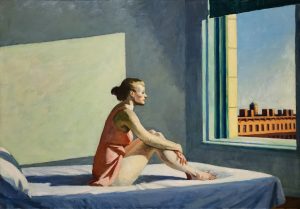
Edward Hopper was a painter who explored American solitude and loneliness more broadly. While Hopper depicts scenes that are rather simple, they still evoke so much emotion. They force the viewer to face emptiness head-on. In Morning Sun, a woman sits on her bed, stares out the window to the sky. But somehow, it feels lonely. Is it the emptiness of the room? Bare walls, a solo figure, a cloudless sky, a simple bloc of buildings, the look on the subject’s face? While studying Freya Stark, it seemed to me that loneliness also permeated her narrative. Stark, perhaps more than the other spies we’ve studied, makes travel seem exceedingly beautiful. Her travel writing stands on its own and would successfully cover her trail (but not dissolve ALL suspicions of her) if we did not know she was a spy. It’s both relaxing and meaningful, adventurous and eye-opening. This makes her spywork particularly captivating and sinister. Quotes like “And if our Empire melts away I think it will not be because we have lost the love of serving but because we have been denying that love to other people, so depriving them of a chance to practise virtues that could make them happy as much as they do us” (Perseus in the Wind, 15) and “It was the fashionable thing to be anti-British in Baghdad at that time” (Baghdad sketches 42) take on a new light. No longer is Stark a judgemental and hoity-toity British traveler, she is an invested patron and benefactor of empire itself. Psychoanalytically, I think much of this is rooted in her low-class (and therefore racialized) upbringing. Her life was deeply nontraditional: a confused family unit, unloving proto-feminist mother, romantically deviant father figure. All of this contributed to her desire to not only be accepted, but to belong to something, to Britain and its empirical values. She took on the identity of a foreigner, despite being British. “She spoke English with a slight foreign accent, [which] made her an immediate object of suspicion to the British authorities,” even though as she writes, “It makes me feel a kind of pariah from my own kind, and awfully disgusted… I am not even pro-native certainly as much of an imperialist as any of the people here” (Ruthven 152, 153). Imagining Hopper’s figure as Stark, in this way, feels significant to me. If the figure is read as Stark, she looks out to the horizon in a trap of loneliness, empty space behind and before her. She works towards empire because of her desire for belonging, but to what end? The room is empty, but so is the view outside the window. All that shows is one bloc of buildings, not even the ground it stands on. This takes on the significance of the consequence of empire: a building with no (or at least an uncertain) foundation. While the sun shines on the subject, the room itself is not warm-toned. It’s cool blue and cold, like a solitary hospital room, evocative of Stark’s nursing experience and her time being ill. The subject’s eyes are dark, perhaps contemplative, her mouth straight and serious. Is she lonely, sad, regretful? What does it mean to her to look away from the presumed comfort of the bed she sits on? She has no cushioning behind her back, despite there being a pillow within reach. Instead, her only comfort seems to be a self-soothing hold. Furthermore, we only see one side of the figure’s face, much like how Stark presents herself (literally and metaphorically): a seemingly innocuous figure with the incredible ability to hide what is underneath the surface. The figure is an incongruity, the only vibrant pink of the piece, yet shadow covers parts of her. Her color is diminished and she almost blends in with the wall behind her. Hopper captures, if read in the context of Freya Stark, the loneliness of empire, its shaky foundation, and the consequence to (not only its victims, but also) its perpetrators. Empire is inherently empty: a sun with no warmth, a bed with no comfort, a room where one is forced to always look ahead, but never successfully move forward.
Freya Stark’s era of power overlapped with the life and work of Walter Benjamin, the Frankfurt School writer and thinker. I was especially reminded of Benjamin when I read about Stark’s deep involvement in the production and distribution of propaganda films. In “The Work of Art in the Age of Its Technical Reproducibility,” Benjamin argues that the film medium, though it carries some latent revolutionary/democratic potential, is especially suited to fascism; it’s part of a broader transition in art away from the cult value of a unique item situated in a particular, hallowed viewing space and toward a mechanically-reproduced image, all meaning and authenticity of which is diluted with reproduction. Film is an especially severe example because politics steps up to replace its cult/religious value. It replicates the real world and adheres to genre convention too precisely, such that all the work of interpretation is already done for the viewer. Stark’s propaganda films did the same and took it even further. They explicitly demonstrated the military might of the British Empire, with the express purpose of telling the subject of the film to think, whether they realized it or not: “these people are powerful, I should ally myself with them.” Her films were pure politics, in the sense that they were a honed tool of imperial power, not in the sense that any real dialogue occurred between the film/propagandist and the subject.
Benjamin would have hated her films, even as he fled the Nazi Germany the British were helping to defeat. He would have found them artless and fascistic; the colonial mechanism isn’t as different from the fascistic one as it seems imperialists of Freya’s era would like to think. This hypothetical opinion of Benjamin’s reflects how I feel, for the most part, about Stark’s life. She was interesting, but seems to have tried to do the work of interpreting her own life for us already, as Benjamin’s film does to the audience, with her re-wrought books, letters, and autobiographies; still these texts tell us little about the person Stark actually was, so we must turn to biographers, and even they are overly sympathetic at times. She was uncreative in her life’s mission and, while she appreciated the aesthetics of revolution and the East, she never broke from the Empire’s mission.
She, too, was subject to the controlling influence of the British Empire. Although personal circumstances made her unique, in a core way, she was a person “reproduced” under Benjamin’s model—brought up Britishly, made to memorize poems and love the Empire, repeatedly copied until there could be no original/authentic version of her type, not even Gertrude Bell. All she knew was this method of mechanically reproducing ideology, so it makes perfect sense that she would bring those propaganda films with her to Yemen—she was reproducing the model she knew.
Example of the type of film she might have carried (produced by the Ministry of Information, which she worked for): “WARTIME FACTORY” 1940 WWII BRITISH INDUSTRIAL INCENTIVE PROPAGANDA FILM XD82705
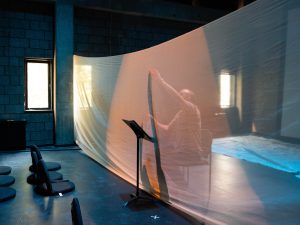
Image of Fargo Nssim Tbakhi, The Book of Dust
After our exhaustive discussion of Herzog’s Queen of the Desert, I found myself floundering to imagine the narrative landscape of its antidote. A film rife with sentimental orientalisms of the Berlin variety is of course a dime a dozen, but when attempting to deconstruct and reform it, we still found ourselves stymied when contemplating interformal revisions in any order. For example, the choice to use Arabic when historically accurate, then provoked the question of a “revised” Queen of the Desert would require subtitles. From that, the question of who and what subtitles are comes into play, dominating and redominating our psyches with the realization that Craft — particularly one that is as ubiquitously Western as filmmaking — delineates an array of theoretical “choices” who, outside their nominative delineation, differ not at all. The choice to subtitle presents just as much possibility as the choice not to subtitle for a colonial dominion over the narrative form — it is this impossibility which guided me to (what I believe is) the conceit of our in-class discussions: whether or not Craft is an impossibility as a revolutionary mechanism.
Fargo Nssim Tbakhi’s 2023 “Notes on Craft: Writing in the Hour of Genocide” defines Craft as “the network of sanitizing influences exerted on writing in the English language: the influences of neoliberalism, of complicit institutions, and of the linguistic priorities of the state and of empire.” To Tbakhi, Craft exists to deny a nuanced reckoning with colonial mechanisms writ large. As an example, he points to Solmaz Sharif’s comments on a poem in which she erased a liberal protestor’s abetting of a staunch Republican’s anti-immigrant rhetoric in favor of highlighting only the absurdity of the former’s demands. This too is a Craft decision: the lucidity of a “good” poem implicitly requires a simplicity of forms and understanding. In this process, similarly complicit forces — such as establishment liberalism — are often ignored in favor of highlighting artistic spectacle as a function of craft. Thus, to exist in a necessary, constant state of revolt, like Palestinians have for the past 75 or so years, requires “that we poison and betray Craft at all turns.” While the conceit of Tbakhi’s argument is situated within the Intifada (for good reason), such required betrayals of Craft can be found all throughout the postcolonial world, from Kashmiri paper-maiche to Guyanaese music, in service of creating an anticolonial world order.
Two paragraphs into this blog post, you may be asking: “But Ayanna, how does this relate to the image you have chosen, and how does that image illustrate our unit’s readings?” In response, I’d like to first contextualize the image, which is from Fargo Nssim Tbakhi’s performance of The Book of Dust. While Queen of the Desert is a film, and The Book of Dust is a theatrical production, both are interformally entangled. In both, considerations of staging, casting, translation, and overall construction must be made — and that making must be undertaken in the context of colonialism. Queen of Desert, via both its subscription to Aristotelian narrative structures and orientalized aesthetic framing of the Near East, becomes a colonial tool. Rather than serving to rupture caricatures of the Middle East, instead it deepens them. And while it can be argued that many traditions within the film do exist, these arguments ignore what the film does with these traditions. Rather than theater, where spontaneous reality is often confronted by physical or imaginary constraint, film is a medium of curation. Thus, it matters not that these races do exist, but how Herzog crafts them. Here, the camel races create a background of an Othered world as Bell familiarly converses with the future kings, physically distancing the viewer from what is unfamiliar and consequently imbuing Bell — who seems completely at ease — with a messianic quality. We must understand that these camel races are not included for cultural posterity. Instead, they exist in the tradition of the traditions of the colonized world being made canon fodder for the narratives of colonizers.
The image I have chosen of Tbakhi stands in complete opposition to this. It subscribes to nothing of sort, instead navigating the theatrical realm with a dogmatic rejection of Craft. For instance, objects are normally fetishized in reproductions of the Oriental East (eg. the veil) are subverted in the physical theatrical space. In, The Book of Dust, rather than a barrier separating an “Oriental object” from the audience, the veil becomes a physical barrier between act and audience themselves. Consequently, the Craft practices of costuming are denied dominion over “othering” cultural garb. In a similar rejection of visual and narrative Craft, the image’s visual narrative ascends upward rather than moving from a decided end-to-beginning. Within this image, Tbakhi does not cede ground to Craft, and consequently avoids the pitfalls our revisions to Herzog’s Queen of the Desert found inevitable. In short, I find that the question born out of Tuesday’s discussion readings/viewings/discussions was: “How do you revise presentations of the Middle East after they have so long been steeped in coloniality?” This image, then, illustrates the answer.
One idea that’s been stuck with me since our discussion on the “a” vs. “the” in the Balfour Declaration is how language can decide the fate of an entire people. When Gertrude Bell argued for the use of “a national home” rather than “the national home” for the Jewish people, it might have sounded like a technical adjustment, but to me, it felt like a warning. That “a” became a way to avoid responsibility, to promise without actually promising, to escape accountability.
As a Palestinian, I have seen this same strategy used before. For example, in the Oslo Accords, the language used to describe Palestinian lands referred to them as “a territory” rather than “the territory” which was a choice that allowed Israel to expand settlements and claim land that was never clearly defined as ours in the first place. The ambiguity wasn’t accidental; it was strategic. This showed me that grammar can be violent. A simple “a” can erase and dispossess just as much as bullets or bulldozers.
the use of “a” as a tool of strategic vagueness can be looked at in the broader sense such as in the U.S. Constitution. The way amendments are worded, especially those supposedly guaranteeing “equal protection” or “freedom”, have been deliberately open-ended and therefore leaves space for those in power to interpret justice however they want. Vagueness here is used as a kind of shield: it allows the state to claim moral authority while maintaining the ability to exclude and discriminate.
I’ve always known that language is never neutral. The smallest choices in phrasing can determine whose lives are protected and whose aren’t. We (the oppressed) tend to celebrate treaties, declarations, and laws as “wins” the moment they’re signed, and it makes sense. These moments usually come after long periods of pain, loss, and struggle, so we cling to any sign of recognition or progress. I would never blame anyone for holding onto hope. But history shows that the real danger lies in the fine print like the indefinite articles, the open-ended clauses, and the carefully chosen ambiguity that gives room to manipulate. We need to look closely at what exactly we’re being offered, and what is being withheld in the wording itself. Because sometimes what looks like a step forward quietly includes the loopholes that will be used against us later.
The McGraw Center for Teaching and Learning
328 Frist Campus Center, Princeton University, Princeton, NJ 08544
PH: 609-258-2575 | FX: 609-258-1433
mcgrawdll@princeton.edu
A unit of the Office of the Dean of the College
© Copyright 2026 The Trustees of Princeton University